
What you’ll learn in this article…
- Colorado offers NSA CAE designated cybersecurity programs at multiple institutions, signaling rigorous curriculum standards.
- Colorado Springs alone employs roughly 3,000 information security professionals, forming a major western U.S. cyber hub.
- Stackable credentials let students start at the associate's level and advance through a master's without losing credits.
- Top ranked programs embed industry certifications like CompTIA Security Plus and hands on lab training into coursework.
Colorado is home to five major military installations and one of the fastest-growing tech corridors between the coasts, which translates into persistent employer demand for cybersecurity talent at every skill level. For career changers weighing an online degree, the practical tension is real: tuition across the state's cybersecurity programs ranges from roughly $4,500 to over $42,000, and not every program carries the same credential weight with employers or aligns with NSA CAE standards.
The 2026 rankings on onlinecybersecurity.org feature 8 schools offering 15 program listings, from associate's through master's level, each scored on a quality composite rather than any single metric. Whether you are exploring the full landscape of best online cybersecurity programs or zeroing in on Colorado specifically, the sections below break down tuition, earnings outcomes, CAE designations, and the hands-on training details that matter most. With three of those schools located in Colorado Springs, proximity to defense-sector hiring pipelines is baked into several options by default.
2026 Rankings: Best Online Cybersecurity Programs in Colorado
Our 2026 rankings of the best online cybersecurity programs in Colorado reflect each school's eligibility to deliver coursework online combined with a composite quality score. That composite weighs graduation rates, net price after aid, and graduate earnings outcomes to surface the programs that balance affordability, academic rigor, and real-world return. No single metric determines placement; instead, the list rewards schools that perform well across multiple dimensions that matter to career changers and first-time cybersecurity students alike.
- Institutional graduation rate
- Net price after financial aid
- Graduate earnings outcomes
- Online delivery eligibility
- Program depth and breadth
- Independent program research
- Internal program database
- NCES-IPEDS federal institutional data — nces.ed.gov
- College Scorecard graduate earnings — collegescorecard.ed.gov
- #1
University of Colorado Colorado Springs
Colorado Springs, CO · $10,000 – $24,000/yr
Best for: Career changers pursuing cybersecurity leadership
The University of Colorado Colorado Springs pairs an MBA with a dedicated Cybersecurity Management track, giving students a graduate credential that blends business strategy with hands-on security knowledge. The 36-credit program runs on an 8-week course model and is available fully online, making it practical for working professionals. With a 15:1 student-to-faculty ratio and a net price around $15,788, UCCS offers a relatively accessible entry into cybersecurity leadership.
View program
- 36-credit fully online master's program
- 8-week accelerated course format
- Covers cybersecurity technologies and governance
- Designed for business and non-business graduates
- No previous cybersecurity experience required
- Completable in approximately 2.5 years
- Foundation courses can be waived with prior coursework
- #2
Colorado State University Global
Denver, CO · ~$17,000/yr (est.)
Best for: Working adults needing maximum schedule flexibility
Colorado State University Global is built from the ground up for online learners, offering a 120-credit Bachelor of Science in Cybersecurity at a flat $375 per credit with no out-of-state surcharge. The fully asynchronous program features 12 start dates per year and accepts up to 90 transfer credits, including military and professional experience. Coursework prepares students for CISSP, CCSP, and SSCP certifications, covering ethical hacking, digital forensics, and network security.
View program
- 120 credits at $375 per credit, no extra fees
- Fully asynchronous with 8-week course sessions
- 12 start dates annually for rolling enrollment
- Transfer up to 90 credits from prior learning
- Prepares for CISSP, CCSP, and SSCP certifications
- Covers ethical hacking and digital forensics
- No prior technology experience required
- Military and career experience credits accepted
- #3
Colorado State University-Fort Collins
Fort Collins, CO · ~$21,000/yr (est.)
Best for: Graduate students seeking NSA-validated credentials
Colorado State University in Fort Collins delivers a 33-credit, STEM-designated Master of Computer Information Systems with a cybersecurity concentration and is recognized as an NSA Center of Academic Excellence in Cyber Defense. The AACSB-accredited program can be completed in as few as 18 months online and includes an embedded graduate certificate in cybersecurity. A separate 12-credit online graduate certificate is also available for those who want a shorter credential first.
View 2 programs
- 33-credit STEM-designated master's degree
- Completable in 18 months full-time online
- NSA Center of Academic Excellence in Cyber Defense
- AACSB-accredited College of Business
- Embedded graduate certificate in cybersecurity
- Blends technical skills with business management
- Start dates in fall and spring semesters
- LinkedIn Learning access included
- 12-credit fully online program
- Teaches IT risk identification and information security
- Stackable into the full master's degree
- Offered through the College of Business
- Flexible distance learning format
- Ideal entry point for non-technical backgrounds
- #4
Pikes Peak State College
Colorado Springs, CO · $5,000 – $10,000/yr
Pikes Peak State College offers one of the most affordable cybersecurity pathways in the state through its Bachelor of Applied Science in Cybersecurity, with a net price near $6,007 for aided students. The program partners with the National Cybersecurity Center to provide real-world simulations and access to current security tools. Located in Colorado Springs, a major hub for defense and cybersecurity employers, the college connects graduates directly to regional workforce demand.
View program
- Lowest net price among ranked Colorado programs
- Partnership with the National Cybersecurity Center
- Covers network security, ethical hacking, digital forensics
- Real-world simulation exercises built into curriculum
- Supports Colorado Springs cybersecurity workforce
- Prepares students for advanced cyber defense roles
- #5
Regis University
Denver, CO · ~$18,000/yr (est.)
Regis University, a private Jesuit institution in Denver, offers both a 36-credit Master of Science in Information and Cyber Security and a 12-credit Graduate Certificate in Cybersecurity Essentials. The master's program features two specialization tracks and can be completed in 12 to 36 months online, with no application fee and potential scholarships up to $9,000. Regis holds NSA and DHS recognition, and the certificate credits transfer directly into the full master's degree.
View 2 programs
- 36-credit program with two specialization options
- Completable in 12 to 36 months online
- NSA and DHS recognized program
- No application fee required
- Dean's Scholarship opportunities up to $9,000
- 8-week term structure with multiple start dates
- No recommendation letters needed
- Covers network forensics and offensive security
- 12-credit online program, 6 to 12 months
- Credits transfer fully into the master's degree
- Financial aid eligible
- Cybersecurity generalist focus
- 3.0 GPA required for completion
- Four core courses covering security fundamentals
- #6
University of Denver
Denver, CO · $36,000/yr
The University of Denver provides multiple graduate cybersecurity pathways, including an MS in Information and Communications Technology with concentrations in Cybersecurity Management and Information Systems Security, plus two related graduate certificates. The 18-month master's programs are available online or through on-campus evening sessions, and the security concentration aligns with CISSP certification domains. DU's 9:1 student-to-faculty ratio supports a high-touch learning experience, though the net price of roughly $36,131 reflects its status as a private research university.
View 4 programs
- 18-month program, online or evening on campus
- Focus on governance, compliance, and regulatory issues
- Develops corporate cybersecurity plan strategy
- Prepares graduates for cybersecurity leadership roles
- Small class sizes with 9:1 student-to-faculty ratio
- Master's degree from a private R1 university
- 18-month program, online or evening on campus
- Hands-on technical skills for analyzing security needs
- Curriculum aligned with CISSP certification domains
- Focuses on providing effective security solutions
- Available alongside Cybersecurity Management track
- Graduate-level technical concentration
- 6 to 9 month completion timeline
- Online or evening on-campus delivery
- Aligned with CISSP certification framework
- Focuses on real-world cybersecurity challenges
- Stackable toward the full master's degree
- Technical skills emphasis
- 6 to 9 month fully online program
- Focus on developing organizational security policies
- Complements the technical certificate option
- Graduate-level credential
- Designed for working professionals
- Covers information protection strategies
- #7
Metropolitan State University of Denver
Denver, CO · $15,000/yr (net price)
Metropolitan State University of Denver offers a 36-credit Master of Science in Cybersecurity that blends technical skills with criminal justice and policy perspectives, a unique interdisciplinary approach among Colorado programs. Courses are delivered through hybrid, hyflex, and online formats with evening scheduling for working students. In-state tuition runs $550 per credit, and the program admits a fall cohort with a sequential course structure spread across four semesters.
View program
- 36-credit interdisciplinary graduate program
- Hybrid, hyflex, and online delivery options
- $550 per credit for Colorado residents
- Evening class scheduling for working professionals
- Combines cybersecurity with criminal justice perspectives
- Capstone project required for graduation
- Optional internship component available
- Accepts up to 6 transfer credits
- #8
Colorado Technical University-Colorado Springs
Colorado Springs, CO · ~$17,000/yr (est.)
Colorado Technical University in Colorado Springs offers a Bachelor of Science in Computer Science with a Cybersecurity Engineering concentration, featuring 5-week accelerated course blocks and a Fast Track option that can shorten completion time by up to 30 percent. The program holds ABET accreditation and is recognized as an NSA/DHS Center of Academic Excellence in Cyber Defense. Coursework emphasizes hands-on programming, ethical hacking, and team-based capstone projects that simulate real-world threats.
View program
- ABET-accredited program with 183 credit hours
- NSA/DHS Center of Academic Excellence designation
- 5-week accelerated course format
- Fast Track option for up to 30% faster completion
- Available online and at Colorado Springs campus
- Hands-on capstone simulating real-world challenges
- Military tuition benefits and corporate grants accepted
- Covers ethical hacking, cloud security, software assurance
Tuition and Cost Comparison Across Colorado Cybersecurity Programs
The table below provides a side-by-side look at tuition rates and average net price for each Colorado cybersecurity program featured in our 2026 rankings. Net price figures represent institution-wide averages after financial aid and are not guaranteed quotes for any individual student. Keep in mind that tuition listed for master's and doctorate programs reflects graduate-level rates, while bachelor's and associate's rows show undergraduate tuition. Public universities typically offer lower sticker prices for Colorado residents, but private institutions sometimes close the gap through institutional aid. Where available, median graduate debt is included to give you a fuller picture of the true cost of attendance.
| School | Degree Level | Type | In-State Tuition | Out-of-State Tuition | Avg. Net Price (After Aid) | Median Graduate Debt |
|---|---|---|---|---|---|---|
| Pikes Peak State College | Bachelor's | Public | $4,510 | $17,110 | $6,007 | $9,000 |
| Colorado State University Global | Bachelor's | Public | $9,000 | $9,000 | $16,510 | $25,000 |
| Metropolitan State University of Denver | Master's | Public | $11,017 | $13,033 | $15,327 | $21,500 |
| Colorado Technical University (Colorado Springs) | Bachelor's | Private | $12,750 | $12,750 | $16,745 | $29,832 |
| Colorado State University, Fort Collins | Master's | Public | $14,125 | $30,813 | $21,279 | $20,000 |
| University of Colorado Colorado Springs | Master's | Public | $15,704 | $27,218 | $15,788 | $20,000 |
| Regis University | Master's | Private | $24,300 | $24,300 | $18,397 | $25,000 |
| University of Denver | Master's | Private | $42,173 | $42,173 | $36,131 | $21,844 |
Questions to Ask Yourself
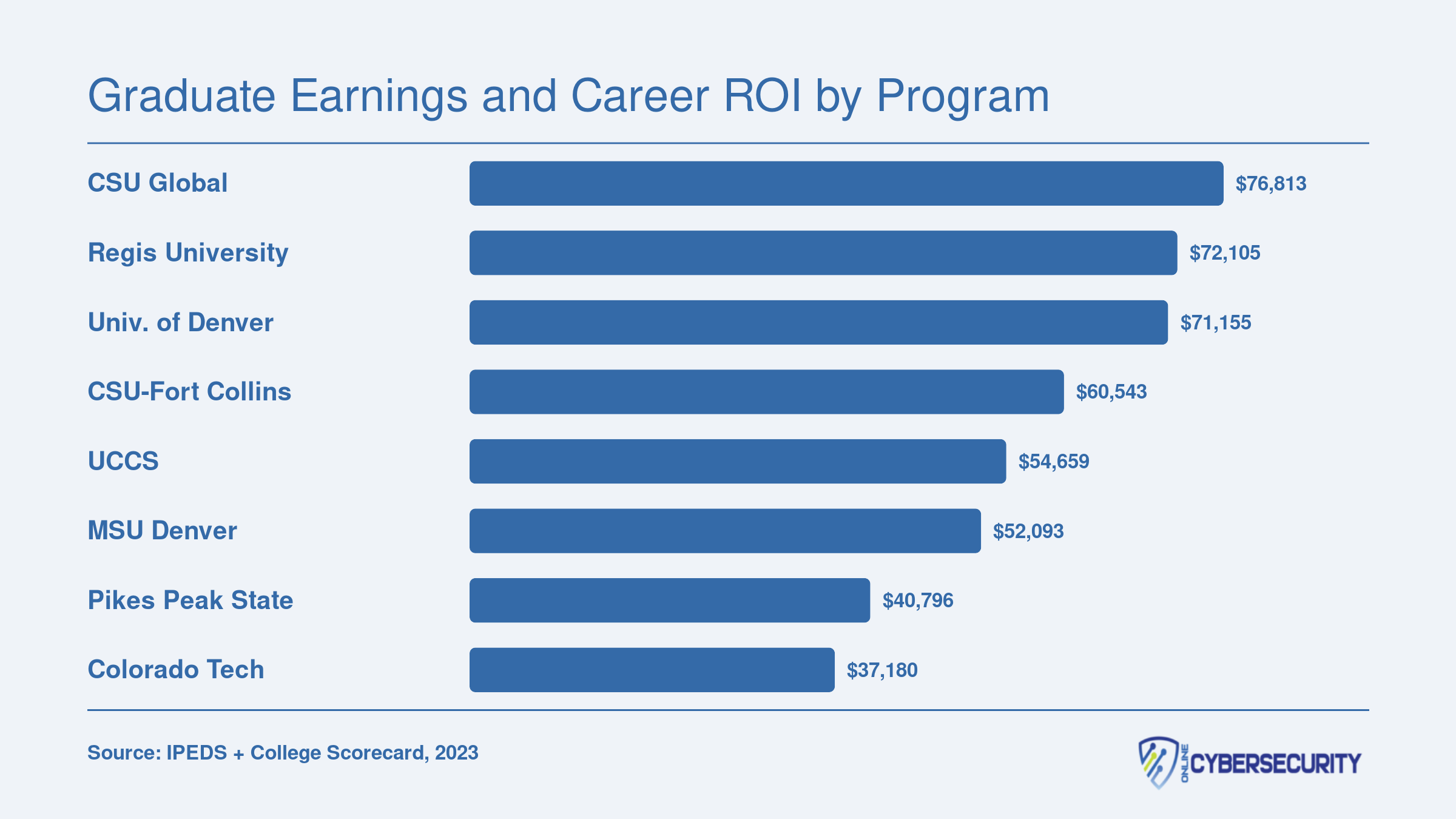
Graduate Earnings and Career ROI by Program
Program-level earnings at the one-year and two-year marks are not yet reported for these Colorado cybersecurity programs. However, institution-wide median earnings ten years after enrollment offer a useful longer-horizon view of career ROI. Keep in mind that earnings vary significantly by degree level: master's programs typically command higher starting salaries than bachelor's or associate's options, so use these figures as a general benchmark rather than a direct program-to-program comparison.
NSA CAE-Designated Cybersecurity Programs in Colorado
If you are evaluating cybersecurity programs in Colorado, the NSA Centers of Academic Excellence (CAE) designation is one of the most reliable quality signals you can look for. Schools that earn this designation have met rigorous curriculum standards validated by the Centers of Academic Excellence program run by the National Security Agency. Colorado is home to seven CAE-designated institutions as of the 2025-2026 academic year, making the state one of the stronger hubs for federally recognized cybersecurity education.1
What CAE Designation Actually Means
CAE status comes in several flavors, each reflecting a different focus:
- CAE-CD (Cyber Defense): The most common designation, signaling that a school's curriculum covers a comprehensive set of cyber defense knowledge units defined by the NSA.
- CAE-R (Cyber Research): Awarded to institutions with strong, active cybersecurity research programs, typically at the doctoral or advanced graduate level.
- CAE-CO (Cyber Operations): A more specialized and selective designation focused on offensive and deeply technical cyber operations.
For students, these designations translate into three practical advantages. First, CAE curricula must be regularly reviewed and revalidated, so coursework stays current with evolving threats. Second, graduates of CAE-designated programs may receive preferential consideration for certain federal cybersecurity positions. Third, attending a CAE school makes you eligible for prestigious funding opportunities, including the CyberCorps Scholarship for Service (SFS) program, which covers tuition and provides a stipend in exchange for government service after graduation.
Colorado's CAE-Designated Schools
Here is how the designation breaks down across the state's seven recognized institutions:
- Colorado State University (Fort Collins): Holds both CAE-CD (2022-2031) and CAE-R (2024-2031) designations. Also confirmed as eligible for CyberCorps Scholarship for Service funding.2
- University of Colorado Colorado Springs: Carries both CAE-CD and CAE-R designations, placing it among a small number of Colorado schools recognized for advanced research.1
- Colorado School of Mines: Designated CAE-CD since 2016 and eligible for NCAE-C grants that support student scholarships and lab development.3
- Colorado State University Pueblo: Holds CAE-CD designation.1
- Colorado Technical University: Holds CAE-CD designation (originally designated 2014-2021; check current revalidation status).4
- University of Denver: Holds CAE-CD designation (originally designated 2014-2021; verify current status for enrollment planning).4
- United States Air Force Academy: Carries CAE-CD designation, though this is a federal service academy with a distinct admissions process.1
Several of these schools also appear in our ranked list of best online cybersecurity programs in Colorado. Colorado State University (Fort Collins), the University of Colorado Colorado Springs, the University of Denver, and Colorado Technical University all feature in the rankings, giving you options that combine strong national recognition with accessible online or hybrid formats. If you are comparing programs across degree levels, our guide to best online bachelor's degrees in cybersecurity can help you evaluate curricula side by side.
How to Verify a School's CAE Status
Before enrolling, it is worth confirming that a school's CAE designation is current and covers the specific degree level you plan to pursue. The NSA maintains a public, searchable CAE Institution Map on its website, where you can look up any school by name or state and see its designation type, active dates, and validated programs of study.1 Designations do expire and must be renewed, so always check the listed dates rather than relying solely on a school's marketing materials. If a designation period ended several years ago and no renewal is shown, contact the school's cybersecurity department directly to ask about revalidation status.
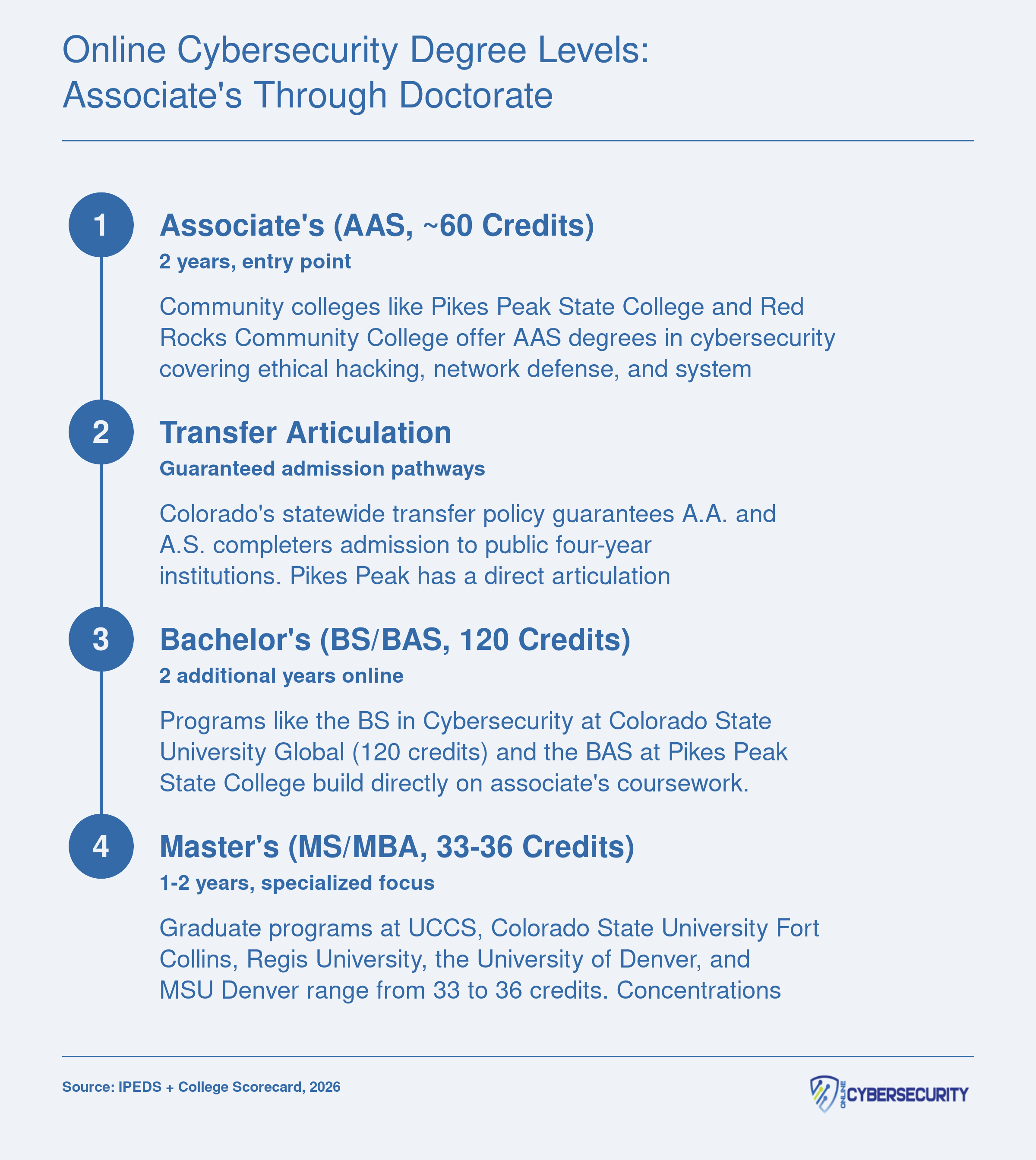
Online Cybersecurity Degree Levels: Associate's Through Doctorate
Colorado's cybersecurity programs form a clear stackable credential pathway, letting you enter at the associate's level and advance all the way through a master's degree without losing credits along the way. Transfer articulation agreements across the Colorado Community College System and individual university partnerships make each step efficient and intentional.
Certifications and Hands-On Training Built Into Colorado Programs
One of the smartest moves you can make when choosing an online cybersecurity program in Colorado is finding one that weaves industry certifications and practical lab work directly into the curriculum. A degree alone opens doors, but pairing it with recognized credentials like CompTIA Security+, CISSP, or CEH can accelerate your timeline to employment and boost your starting salary.
How to Identify Programs With Embedded Certification Prep
Start by visiting the official websites of schools you are considering, such as the University of Colorado, Colorado State University, or Regis University. Look for pages labeled "curriculum," "certification prep," or "program outcomes" that spell out which industry certifications are aligned with specific courses. Some programs bundle exam vouchers into tuition, which saves you hundreds of dollars per attempt.
For example, the Community College of Aurora offers an online Security+ Certification program that includes a CompTIA Security+ exam voucher as part of enrollment.1 This is a non-credit certificate, making it a fast, focused option if you want to stack a credential before or alongside a cybersecurity degree program. It is also worth knowing that some Colorado schools white-label third-party training platforms like Cyberkraft for their online Security+ coursework, so the underlying curriculum may be more standardized than it first appears.2
Another resource worth noting: ISC2 currently offers its Certified in Cybersecurity (CC) credential with free online training and a free exam, making it an accessible entry point for career changers who want to validate foundational knowledge at zero cost.3
Reaching Out for Details That Are Not Always Online
Program websites do not always tell the full story. Contact the admissions office or an academic advisor directly and ask specific questions:
- Embedded certifications: Which certification exams does the program prepare students for, and are vouchers included?
- Virtual cyber ranges: Does the program provide access to online labs or simulated environments where you can practice incident response, penetration testing, or network defense?
- Pass-rate data: Does the school publish certification exam pass rates? If so, where can you find them, such as in an institutional fact book or annual report from the research office?
Advisors are often the best source for details that have not made it onto the website yet, especially for newer or recently updated programs.
Checking Alignment Through Professional Associations
You can also verify curriculum quality by visiting the websites of organizations like CompTIA, ISC2, and EC-Council. Each maintains lists of academic partners or programs whose coursework aligns with their certification objectives. If a Colorado school appears on one of these lists, it is a strong signal that coursework maps closely to what you will see on the actual exam. Keep in mind that pass rates are generally not published by these organizations on a per-school basis, so you will need to ask the institution directly for that data.
Why Hands-On Training Matters for Online Students
Cybersecurity is a field where employers want to see that you can do the work, not just describe it on paper. Virtual cyber ranges and lab environments let online students practice real-world scenarios, from analyzing malware to configuring firewalls, without needing to be on campus. If you are earlier in your education journey, an online cybersecurity associate's degree can also build foundational lab skills before you move into a bachelor's program. When evaluating programs, prioritize those that clearly describe their lab infrastructure and how remote students access it.
For broader career outlook data, the Bureau of Labor Statistics at BLS.gov remains the most authoritative source for cybersecurity job growth projections and salary benchmarks. But for program-specific details like lab access, certification pass rates, and hands-on training tools, go straight to the school and ask.
Colorado Cybersecurity Job Market and Salary Outlook
Colorado consistently ranks among the top states for cybersecurity professionals, and the numbers reflect that strength. Whether you are pivoting from another IT role or launching your first career in the field, understanding the local job market will help you set realistic expectations and target the right opportunities.
Salary Snapshot Across Colorado
According to Bureau of Labor Statistics data, the median annual wage for information security analysts in Colorado was approximately $130,570 as of 2024, which sits well above the national median of roughly $124,910.1 Wages do vary by region:
- Denver-Aurora-Lakewood metro: Median salaries generally fall in the $130,000 to $135,000 range, reflecting the concentration of large employers and federal contractors in the area.
- Colorado Springs metro: Analysts here typically earn between $120,000 and $130,000, buoyed by a heavy military and defense presence.
- Fort Collins metro: Salaries tend to land in the $115,000 to $125,000 range, with opportunities tied to growing tech firms and the university ecosystem.2
These figures represent experienced analysts. Entry-level positions will start lower, but the upward trajectory in this field is steep for those who build the right credentials. If you are curious about what that early career path looks like, our guide on how to become a security analyst breaks down the steps.
What Is Driving Demand
Colorado's cybersecurity ecosystem benefits from a unique mix of federal, military, and private-sector employers. NORAD and the U.S. Space Command, both headquartered at Peterson Space Force Base in Colorado Springs, generate sustained demand for cleared cybersecurity professionals. The National Cybersecurity Center, also based in Colorado Springs, serves as a hub for workforce development, training, and public-private collaboration.
In the Denver metro area, defense giants like Lockheed Martin and Raytheon maintain significant operations that require large cybersecurity teams. Technology companies such as Palantir add to the demand, alongside a growing roster of startups and mid-size firms in sectors like fintech and health tech. Roles such as cloud security specialist and security engineer career path positions are especially common among these employers.
National Growth, Local Advantage
Nationally, the Bureau of Labor Statistics projects a 29 percent growth rate for information security analyst positions over the 2024 to 2034 period, with an estimated 16,000 openings per year. That pace is roughly five times faster than the average for all occupations. Colorado's dense concentration of defense installations and tech employers positions the state to capture more than its proportional share of that growth.
Workforce Initiatives Worth Knowing
Colorado has taken active steps to grow its cybersecurity talent pipeline. The National Cybersecurity Center works with educational institutions and employers on training and apprenticeship programs. The state has also participated in broader workforce development efforts through grants and public-private partnerships aimed at closing the cyber skills gap, though specific funding programs can shift with legislative cycles. Students considering an online cybersecurity degree in Colorado should check with their chosen school and the state's workforce development office for any current tuition assistance, scholarship, or apprenticeship opportunities tied to cybersecurity roles.
The bottom line: Colorado's job market for cybersecurity professionals is robust, well-compensated, and supported by a deep bench of employers across government and the private sector. Earning a degree from a Colorado-based program can position you to tap into this market quickly, especially if your program incorporates hands-on labs and industry certifications valued by local employers.
Colorado Springs alone employs roughly 3,000 information security professionals, making it one of the densest cybersecurity workforce hubs in the western United States. The city's concentration of military installations, defense contractors, and organizations like the National Cybersecurity Center fuels steady demand for skilled cyber talent across the region.
How to Choose the Right Online Cybersecurity Program in Colorado
Picking the right online cybersecurity program is one of the most consequential decisions you will make as a career changer or new student. Colorado offers a range of options across price points, degree levels, and delivery styles, so it helps to work through a few key decision factors before you apply.
Start With Accreditation and Admissions
Regional accreditation is non-negotiable. Every school on our ranked list holds institutional accreditation recognized by the U.S. Department of Education, which matters for financial aid eligibility, credit transferability, and employer credibility. Beyond accreditation, take a look at how selective a program actually is. Several Colorado cybersecurity schools admit the vast majority of applicants, which can be good news if you are pivoting from another career and worried about a competitive admissions process. Schools that accept a higher share of applicants often provide more support services for non-traditional students as well.
Financial accessibility is another factor worth weighing. Programs where a large percentage of undergraduates receive Pell Grants tend to serve students who are funding their own education, often while working. That usually translates into institutional cultures, advising models, and scheduling options that are friendlier to adult learners. If cost is your primary concern, our guide to affordable cybersecurity programs can help you benchmark Colorado options against national averages.
Evaluate Flexibility and Employer Reimbursement Compatibility
Not all "online" programs are built the same way. Asynchronous programs, like the B.S. in Cybersecurity at Colorado State University Global with its eight-week courses and twelve annual start dates, let you complete coursework on your own schedule. Synchronous or hybrid programs, such as those at Metropolitan State University of Denver, may require you to log in at set times or attend occasional in-person sessions. If you are balancing a full-time job, asynchronous delivery with part-time enrollment options will likely work best.
If your employer offers tuition reimbursement, confirm that the program's billing cycle and credit structure align with your company's reimbursement caps. Some schools, including Colorado Technical University, explicitly support employer reimbursement workflows and accept credits from industry certifications and military experience, which can shorten your time to degree.1
Understand Transfer Credit Policies
Colorado's GT Pathways system guarantees that approved general education courses transfer from any community college to all public four-year institutions in the state, as long as you earn a C or higher.2 This covers core areas like communication, mathematics, natural and physical sciences, arts and humanities, and social and behavioral sciences.3 However, GT Pathways applies only to general education coursework. Cybersecurity major courses do not automatically transfer statewide, so you will need to verify program-specific articulation agreements directly with the four-year school.2
If you are building a stackable pathway (for example, starting with an associate degree at a community college like Arapahoe Community College or Pikes Peak State College and then moving to a bachelor's program), ask the receiving institution exactly which technical credits they will accept. Students considering the fastest cybersecurity degree with transfer credits route should pay special attention here. Colorado Technical University, for instance, allows up to 75 percent of a degree to come from transfer, experiential learning portfolios, ACE-recognized certifications, or military training.1 That is one of the most generous transfer policies in the state.
Build Your Personal ROI Comparison
Finally, use the tuition comparison table and earnings data from earlier in this article to build a side-by-side picture of each program's value. Look at tuition differences between in-state and out-of-state rates (at public schools these gaps can be significant), then compare those costs against graduate earnings and median debt levels. A program that costs less upfront but leads to lower mid-career earnings may not actually be the better deal, and vice versa. Cross-referencing cost with outcome data gives you a much clearer sense of which program delivers the strongest return on your investment in both time and money.
The right program is the one that fits your schedule, respects your existing credentials, and positions you for the salary trajectory you are targeting. Take the time to map out your priorities before you start filling out applications.
Frequently Asked Questions About Online Cybersecurity Programs in Colorado
Below are answers to the most common questions prospective students ask about pursuing an online cybersecurity degree in Colorado. Where possible, each answer points back to relevant sections of this guide for deeper detail.