
What you’ll learn in this article…
- Montana lacks ranked in-state online cybersecurity degrees, so most students enroll in nationally available programs.
- Bootcamps and certificate programs offer career-ready cybersecurity skills in under a year for Montana career changers.
- Remote work now connects Montana graduates to high-paying cybersecurity roles across the country.
- Average net tuition for out-of-state online programs drops significantly after federal and institutional aid is applied.
The Bureau of Labor Statistics projects information security analyst roles will grow 33% through 2033, roughly six times the national average for all occupations. Montana students are well positioned to capture that demand: the state's expanding remote-work infrastructure means a degree earned online can translate directly into a position with an employer anywhere in the country, no relocation required.
The challenge is that Montana's in-state colleges do not currently offer fully online cybersecurity degree programs. That gap sends most Montana learners to national online programs, where out-of-state tuition can range from roughly $10,000 to over $38,000 per year depending on the institution and degree level. Flat-rate online tuition policies at several schools help close that gap, but comparing net price after aid is essential. For those weighing a cybersecurity career path or first degree, the real question is not whether quality programs exist, but which format, cost structure, and credential level will deliver the strongest return.
2026 Best Online Cybersecurity Schools for Montana Students
The programs below are nationally available online cybersecurity offerings ranked by a mixed quality composite that weighs institutional outcomes, program depth, and online delivery eligibility. Montana does not yet have a large in-state pipeline of online cybersecurity degrees, so most students in the state enroll in programs hosted by universities elsewhere. Every school on this list accepts students from Montana, and coursework can be completed remotely from Billings, Missoula, Great Falls, or anywhere else in the state. Tuition figures reflect published rates; net price after financial aid is often significantly lower. Program-level earnings data are not yet available for most of these cybersecurity offerings, so we report institution-wide median earnings where applicable.
- Institutional graduation and retention rates
- Net price and financial aid availability
- Program depth and online delivery
- Graduate earnings outcomes
- Cybersecurity curriculum relevance
- NCES-IPEDS federal institutional data — nces.ed.gov
- Internal program database
- College Scorecard graduate earnings — collegescorecard.ed.gov
- Independent program research
- #1
Florida International University
Miami, FL · ~$9,000/yr (est.)
Best for: Career changers seeking stackable cyber credentials
Florida International University fields one of the broadest cybersecurity program suites on this list, spanning a fully online B.S. in Cybersecurity with multiple concentrations and a STEM-designated MBA in Cybersecurity Risk Management. FIU holds an NSA/DHS Center of Academic Excellence designation and leverages Miami's cross-border business environment to infuse international data-privacy and governance topics into its cyber curriculum. The institution posts a 74.4% graduation rate, a 92% retention rate, and a net price of roughly $9,288 after aid, making it one of the most affordable options for out-of-state online learners.
View 2 programs
- Fully online bachelor's with specializations in network security and threat analysis
- Covers risk management, digital forensics, and cybersecurity principles
- Multiple concentrations let students customize their career path
- No standardized test scores explicitly required for admission
- Part of FIU's Cybersecurity@FIU initiative with industry partnerships
- Financial aid available; in-state tuition $11,334, out-of-state $24,439
- 16-month hybrid program with Monday and Wednesday virtual sessions
- STEM-designated MBA with 24 hours of cybersecurity specialization
- Cohorts capped at 20 students for personalized instruction
- Qualifies for ISACA certification waivers upon completion
- Two optional in-person residencies in Miami
- Covers governance frameworks, business analytics, and regulatory issues
- #2
San Jose State University
San Jose, CA · $14,000/yr
Best for: Tech professionals adding graduate-level cyber skills
San Jose State University offers a focused 9-unit Graduate Certificate in Cybersecurity: Core Technologies through its Computer Science Department. Situated at the heart of Silicon Valley, the program aligns with NSA CAE knowledge units and the NICE Cybersecurity Workforce Framework, giving remote students access to employer networks in the tech capital. SJSU's institution-wide median earnings reach $78,988 ten years after enrollment, and the net price sits at $13,760 after aid.
View program
- 9-unit online certificate through the Computer Science Department
- Curriculum covers cryptography, computer security, and information security
- Aligned with national cybersecurity knowledge standards
- Designed for computer and software engineers seeking specialization
- Evening and asynchronous options support working professionals
- In-state tuition $9,934; out-of-state $20,014; net price $13,760 after aid
- #3
Florida State University
Tallahassee, FL · $11,000/yr
Best for: Aspiring intelligence and policy analysts
Florida State University's online Cyber Intelligence Graduate Certificate is a 12-credit credential with optional concentrations in Cybersecurity Technology and Intelligence Analytics. The program is housed in FSU's iSchool and connects students to state and federal intelligence and law-enforcement agencies. FSU boasts the highest graduation rate on this list at 85.6% and a 96% retention rate, reflecting strong institutional support for remote learners.
View program
- 12-credit online certificate covering cybersecurity, defense, privacy, and ethics
- Two optional concentrations: Cybersecurity Technology or Intelligence Analytics
- Can be integrated into master's or specialist degree programs at FSU
- Admission requires a bachelor's degree with a minimum 3.0 GPA
- Coursework includes organizational information security and data mining electives
- In-state tuition $10,553; out-of-state $26,707; net price $11,297 after aid
- #4
New Jersey Institute of Technology
Newark, NJ · $20,000 – $38,000/yr
New Jersey Institute of Technology's 12-credit Graduate Certificate in Foundations of Cybersecurity provides a technical grounding in security, privacy, and cryptography for computer systems and web applications. Credits transfer directly into NJIT's MS in Cyber Security and Privacy for students who maintain at least a 3.0 GPA, creating a clear stackable pathway. The institution's median earnings ten years out reach $84,276, the highest among schools on this list.
View program
- 12-credit hybrid program with core courses in cryptography and security
- Credits articulate into the MS in Cyber Security and Privacy
- Requires a bachelor's in computing or STEM with professional experience
- Evening and hybrid scheduling suits NYC-metro working professionals
- Ties to financial services and critical infrastructure employers in the region
- In-state tuition $27,156; out-of-state $38,436; net price $16,504 after aid
- #5
Appalachian State University
Boone, NC · $8,000 – $25,000/yr
Appalachian State University offers a 120-credit B.S. in Cybersecurity that covers networking, ethical hacking, cyber forensics, and database management. The hybrid program is expanding its online course offerings for 2025 and 2026, giving remote students more flexibility in upper-division coursework. With in-state tuition of just $7,579, App State is among the most affordable four-year options, and the curriculum emphasizes community-oriented cyber projects relevant to smaller markets.
View program
- 120-credit hybrid bachelor's with growing online course availability
- Covers ethical hacking, cyber forensics, networking, and IT audit
- Includes internship opportunities and community security projects
- 34 major credit hours plus 44 general education credits
- In-state tuition $7,579; out-of-state $25,212; net price $16,836 after aid
- Student-to-faculty ratio of 16:1 supports personalized advising
- Institution-wide graduation rate of 74.5%
- #6
Michigan Technological University
Houghton, MI · $10,000 – $15,000/yr
Michigan Technological University's 9-credit Graduate Certificate in Foundations of Cybersecurity can be completed in as little as one semester, making it one of the fastest credentials on this list. Michigan Tech is a National Center of Academic Excellence in Cyber Defense, and the certificate feeds directly into its master's programs in Cybersecurity or Computer Science. Notably, the university charges a single tuition rate regardless of residency for this online offering.
View program
- 9-credit hybrid certificate completable in one to three semesters
- No GMAT or GRE required for admission
- Flat tuition rate of $25,916 regardless of state residency
- Credits apply toward MS in Cybersecurity or Computer Science
- CAE-CD designation underscores research-oriented cyber focus
- Requires a bachelor's in computer science, computer engineering, or software engineering
- Net price $14,182 after aid; median graduate debt $24,990
- #7
Eastern Florida State College
Melbourne, FL · $5,000 – $10,000/yr
Eastern Florida State College delivers a Bachelor of Applied Science in Computer Information Systems Technology with a Cybersecurity Specialization. Students choose among database security, network security, and forensics tracks, all offered in a hybrid format. With in-state tuition of just $2,791 and no standardized test requirement, EFSC removes many common enrollment barriers and prepares graduates for entry-level security analyst roles through its Space Coast employer connections.
View program
- 120-credit hybrid bachelor's with three specialization tracks
- Tracks include database security, network security, and forensics
- Designed as a 2+2 pathway for students with an A.S. or A.A. degree
- No SAT, ACT, or additional testing required for admission
- In-state tuition $2,791; out-of-state $10,976; net price $6,440 after aid
- Internship option and ties to Space Coast aerospace and defense employers
- Institution-wide graduation rate of 52.1% (note: institution-wide, not program-specific)
- #8
University at Albany
Albany, NY · $17,000/yr
The University at Albany (SUNY) offers a 36-credit M.S. in Digital Forensics and Cybersecurity with five concentrations, including Cyber Security, Cyber Operations, and Digital Forensics. The interdisciplinary program is a collaboration between the School of Business and the College of Emergency Preparedness, Homeland Security and Cybersecurity, and it includes an internship or thesis capstone. No entrance exam is required, and the hybrid format allows remote participation for most coursework.
View program
- 36-credit hybrid master's with five concentration options
- Concentrations include Cyber Security, Cyber Operations, and Digital Forensics
- Internship or thesis capstone provides hands-on experience
- No GRE or GMAT required for admission
- Collaborative program spanning business and homeland security colleges
- In-state tuition $13,808; out-of-state $27,468; net price $17,167 after aid
- Institution-wide median earnings of $67,979 ten years post-enrollment
- #9
Oklahoma State University
Stillwater, OK · ~$17,000/yr (est.)
Oklahoma State University's 12-credit Graduate Certificate in Information Assurance is delivered fully online and covers advanced data communications, information assurance management, and legal and ethical issues in cybersecurity. Credits can stack toward an MS in Management Information Systems with a cybersecurity emphasis, and no GMAT or GRE is needed. The Spears School of Business hosts the program and provides dedicated academic advisor support.
View program
- 12-credit fully online certificate focused on cybersecurity and information assurance
- Required courses in advanced data communications and assurance management
- Electives cover applied systems security and legal/ethical issues
- No GMAT or GRE required; bachelor's degree and resume needed
- Credits stack toward MS in Management Information Systems
- In-state tuition $9,092; out-of-state $24,595; net price $17,447 after aid
- Application deadlines: July 1 for fall, December 1 for spring
- #10
Louisiana State University and Agricultural & Mechanical College
Baton Rouge, LA · $15,000 – $20,000/yr
Louisiana State University's Graduate Certificate in Cybersecurity Risk Management is a 12-credit, fully online credential offered through the E.J. Ourso College of Business at a flat rate of $867 per credit hour ($10,404 total). The curriculum covers cybersecurity frameworks, risk assessments, and IT auditing, and credits apply toward an MBA. Student success coaching and flexible scheduling make it approachable for working professionals balancing jobs and family.
View program
- 12-credit fully online certificate at $867 per credit hour ($10,404 total)
- Covers cybersecurity frameworks, risk assessment, and IT auditing
- Credits apply toward an LSU MBA
- Requires a bachelor's degree with a minimum 3.0 GPA
- No GRE or GMAT required for admission
- Enrollment and student success coaches provided throughout the program
- Prepares graduates for roles such as Information Security Manager and Cybersecurity Analyst
Why Montana Students Often Choose National Online Programs
Montana has a handful of cybersecurity-related offerings at its public colleges, but the in-state landscape has notable gaps that push many students toward nationally available online programs. Understanding what is (and is not) available close to home will help you make a more informed decision.
What Montana Schools Currently Offer
Several Montana institutions have stepped into cybersecurity education, though most offerings are at the certificate or associate level:
- Gallatin College MSU: Offers a Certificate of Technical Studies (CTS) in Cybersecurity, a 16-credit program that prepares students for CompTIA Network+, CompTIA Security+, CompTIA CySA+, and CEH certifications.1 Through the CyberMontana initiative, Gallatin College also runs a Jump-start Cyber Rapid Training program geared toward high school students, delivered online over roughly 10 to 15 weeks.2
- MSU Billings: Provides a Cybersecurity/Network Technology Associate of Science degree at 61 credits, giving students a solid two-year foundation.3
- Great Falls College MSU: Has offered cybersecurity-related certificates, though these tend to be narrow in scope and may involve hybrid delivery.
- University of Montana partnerships: UMT has participated in collaborative arrangements (such as a partnership with Excelsior University) to extend cybersecurity pathways, but these are partnership models rather than standalone UM degrees.
These programs are valuable entry points, especially if you are exploring the field or need a quick credential. However, none of them amount to a fully online bachelor's or master's degree in cybersecurity from a Montana institution. As of 2026, no Montana university offers that on its own.
Why That Gap Matters
If your goal is a four-year degree or a graduate credential in cybersecurity, you will need to look beyond state lines. That is not a disadvantage. National online programs frequently offer benefits that Montana-based options simply cannot match right now:
- NSA CAE designation: Many nationally available online programs hold designation as National Security Agency Centers of Academic Excellence in Cyber Defense or Cyber Operations, a credential no Montana school currently carries for a fully online degree.
- Specialization depth: National programs let you focus on areas like digital forensics, cloud security, penetration testing, or security architecture, specializations that smaller in-state programs rarely support at the bachelor's or master's level.
- Asynchronous scheduling: Montana's geography means many students live hours from the nearest campus. Fully asynchronous coursework eliminates that barrier entirely, letting you study from Kalispell, Miles City, or anywhere with an internet connection.
Tuition Is Rarely a Penalty
One common worry is that attending an out-of-state school online will trigger higher tuition. In practice, most reputable online programs now charge a single flat tuition rate for all online students regardless of where they live. Montana residents typically pay the same per-credit cost as students in any other state. Some schools even participate in regional tuition-exchange agreements that keep costs competitive. If budget is a primary concern, our guide to affordable cybersecurity programs breaks down what to look for.
Before enrolling, confirm the school's tuition policy for fully online learners. Look for language like "uniform online rate" or "no out-of-state differential for distance students" on the program's tuition page.
The Bottom Line for Montana Students
Montana's in-state cybersecurity programs are a strong starting point for certificates and associate degrees, and initiatives like CyberMontana are expanding access at the entry level.4 But for a complete bachelor's or master's degree, national online programs remain the practical and often more affordable path. The schools ranked on this site are evaluated with exactly this kind of student in mind: someone who needs a quality, fully online program that works regardless of zip code.
Questions to Ask Yourself
Online Cybersecurity Degrees by Level: Associate to Doctorate
Montana has no in-state cybersecurity degree programs in our ranked set, but dozens of nationally available online programs welcome Montana students and charge a flat online tuition or out-of-state rate. The table below groups the ranked programs by degree level so you can compare typical costs and see which credential fits your career stage. Program-level earnings data is not yet available for most of these programs, so the institutional median earnings at 10 years after enrollment are shown where reported to give a general benchmark. Several bachelor's level programs from schools such as Champlain College, Dakota State University, Norwich University, and the University of Arizona hold NSA Center of Academic Excellence (CAE) designations, while master's and graduate certificate programs are more widely represented in the ranked set.
| Degree Level | Programs in Ranked Set | Typical Out-of-State or Online Tuition Range | NSA CAE Designated Options | Best Fit For |
|---|---|---|---|---|
| Associate / BAS Completion | 2 (Eastern Florida State College, George Mason University) | $10,976 to $38,688 | Limited at this level; check individual schools | Career changers with some college credit seeking entry-level roles such as help desk analyst or junior security technician |
| Bachelor's (B.S.) | 6 (Appalachian State, Charter Oak State College, Kennesaw State, American Public University System, University of Cincinnati, Eastern Florida State College BAS) | $8,400 to $28,697 | Kennesaw State (CAE-CD), plus nationally available CAE programs from Champlain College, Dakota State University, Norwich University, and University of Arizona (CAE-CO) | Students building a foundation for security analyst, SOC analyst, or network security roles |
| Master's (M.S. / MBA) | 11 (Florida International University, University at Albany, West Virginia University, Kennesaw State, Penn State, Northern Arizona, University of Arizona, Rowan, James Madison, UMass Lowell, and others) | $15,800 to $45,574 | Penn State (CAE designated), James Madison (NSA Cyber Defense certificate track), University of Arizona (CAE-CO) | Working professionals targeting security management, architecture, or CISO-track positions |
| Graduate Certificate | 10 (San Jose State, Florida State, NJIT, Michigan Tech, Oklahoma State, LSU, Indiana University-Indianapolis, Virginia Commonwealth, Sam Houston State, Missouri S&T) | $10,404 to $38,436 | Michigan Tech (National Center of Academic Excellence) | Professionals adding a credential quickly, often in 9 to 15 credits; many certificates stack toward a full master's degree |
| Doctorate / Ph.D. | Not represented in this ranked set | Varies widely | Available at select research universities nationally | Researchers, policy advisors, or faculty candidates pursuing original cybersecurity scholarship |
Related Articles
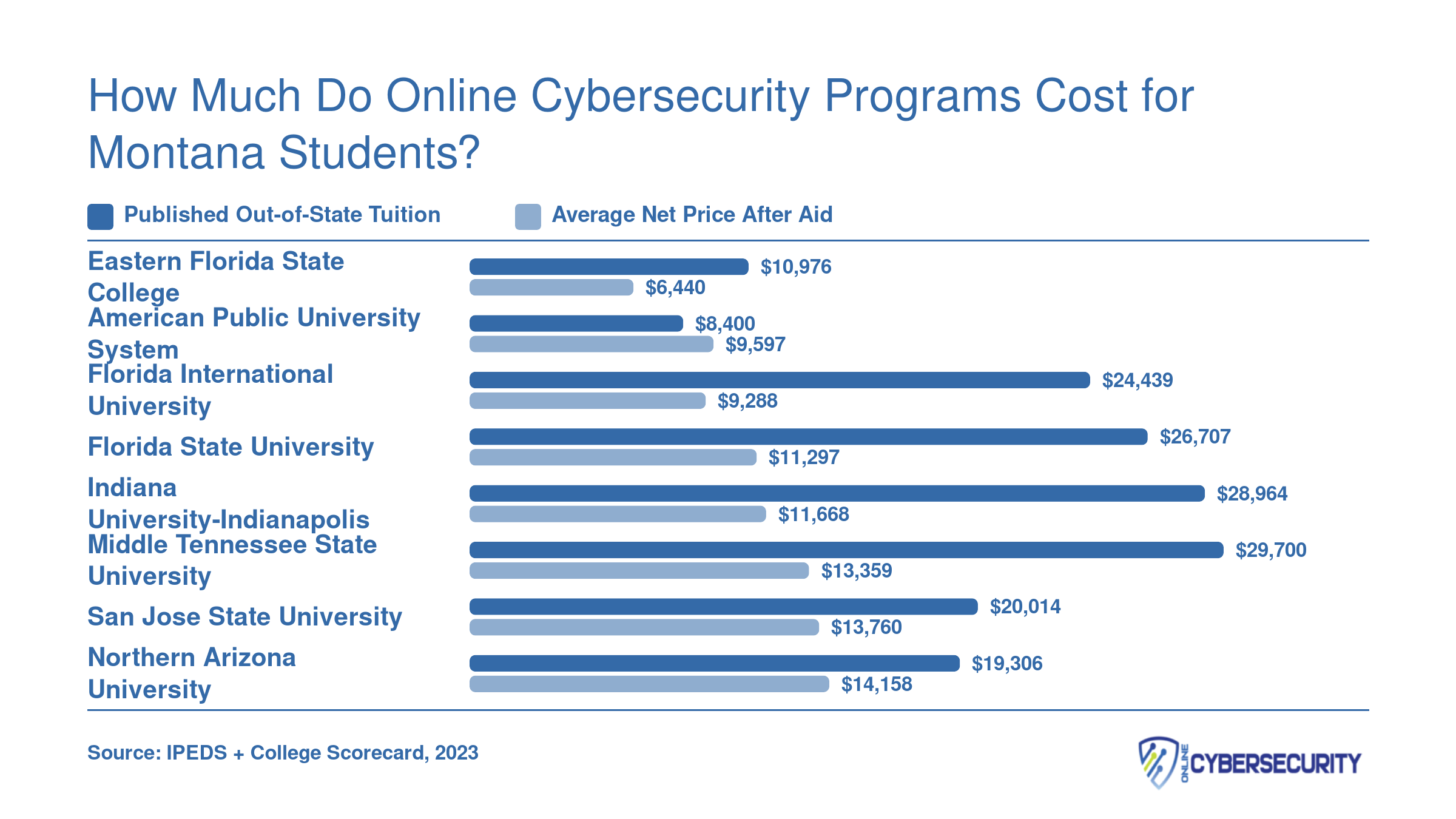
How Much Do Online Cybersecurity Programs Cost for Montana Students?
Because most Montana students enroll in out-of-state online programs, the published tuition rate you see is rarely the final price you pay. After federal, state, and institutional aid are factored in, the institution-wide average net price can be significantly lower. Keep in mind that net price figures reflect the whole school, not a specific cybersecurity program, so always contact admissions for a program-level aid estimate.
Cybersecurity Bootcamps and Certificate Alternatives for Montana Students
Not every cybersecurity career path requires a four-year degree. Bootcamps and certificate programs offer a faster on-ramp, especially if you are switching careers or want to add a security specialty to an existing IT skill set. Montana students can access several strong online cybersecurity bootcamp options without relocating.
Notable Bootcamps Open to Montana Students
Here are a few programs worth researching. Pricing and structure can shift between enrollment windows, so confirm details directly with each provider before committing.
- TripleTen Cybersecurity Bootcamp: Roughly $5,000 to $8,000, with a self-paced format and mentor support that can stretch from about 3 to 7 months depending on your schedule. It includes a CompTIA Security+ exam voucher and a job guarantee, making it a solid pick for beginners.1
- Cleveland State University Cybersecurity Bootcamp: Around $8,995 for a live online cohort that runs 3 to 5 months. It also bundles a CompTIA Security+ exam voucher and follows a synchronous class schedule.2
- Evolve Security Academy: Priced between roughly $12,000 and $15,000 for a 5-month live online program that emphasizes hands-on labs. Graduates earn the Evolve Security Certified Professional credential.3
- CyberMontana and Cybrary Partnership: This one is unique to the state. Montana public employees and affiliated organizations can access Cybrary's self-paced training library at no cost, covering topics from foundational security concepts to advanced threat analysis.4
Bootcamp vs. Certificate vs. Degree
Choosing the right format depends on where you are today and where you want to be in five years.
- Time commitment: Bootcamps typically wrap up in 3 to 7 months. Stand-alone certificate programs often take 6 to 12 months. An associate degree runs about two years, and a bachelor's takes four.
- Cost: Bootcamps range from free (through CyberMontana) to roughly $15,000. Online certificate programs at accredited colleges may fall in a similar range or lower. A full degree represents a bigger investment, often $20,000 or more for a bachelor's.
- Credential value: Bootcamps shine when they prepare you for industry certifications like CompTIA Security+ or CEH, which hiring managers recognize quickly. A degree, on the other hand, carries weight for promotions, government roles with education requirements, and long-term salary growth.
- Employer perception: Many employers now accept bootcamp graduates for entry-level and mid-level analyst positions, especially when paired with a recognized certification. Senior roles in security architecture, management, or policy still tend to favor candidates with a bachelor's or master's degree.
Who Should Choose What
If you are a career changer looking to land your first security analyst or SOC role within the year, a bootcamp paired with Security+ prep is often the most efficient path. If you already work in IT and simply need to upskill, the CyberMontana partnership or a focused cyber security certificates online program can fill specific gaps without a large financial commitment.
For anyone aiming at leadership positions, compliance management, or roles in defense contracting, a full degree offers the strongest long-term return on investment. Many students combine approaches: start with a bootcamp or certificate to get hired, then pursue a degree part-time while working. Online programs make that sequence entirely practical from anywhere in Montana.
Career Outcomes and Earning Potential After Graduation
Cybersecurity is one of the fastest-growing and highest-paying fields in technology, and Montana students who earn an online degree in this space position themselves for strong long-term returns. Here is what the data tells us about earnings, job market conditions, and the financial payoff of completing a program.
National Earnings for Information Security Analysts
According to the most recent federal wage data (2024), the national median annual salary for information security analysts sits at approximately $124,910.1 Entry-level professionals at the 10th percentile earn around $69,660, while those at the 90th percentile bring in roughly $186,420. These figures reflect a broad range of experience levels and specializations, but even the lower end of the pay scale compares favorably to median wages in many other professional fields. For a deeper look at available roles and how to break in, our cybersecurity career guide is a good starting point.
How Montana Compares
Montana's employment base for cybersecurity roles is smaller than in major metro areas, and state-level wage figures for information security analysts are not always published in detail due to the relatively modest number of local positions. That said, Montana residents who complete an online cybersecurity degree are not limited to local employers. Many graduates work remotely for companies headquartered in higher-paying markets such as the Washington, D.C., corridor, the San Francisco Bay Area, or New York. This remote work dynamic means Montana-based professionals can often earn salaries closer to, or even above, the national median while enjoying a lower cost of living.
Program-Level Earnings and ROI
Program-specific earnings data (such as median salaries one year and four years after completion) are not yet available for many of the top-ranked online cybersecurity programs open to Montana students. Federal reporting lags behind graduation timelines, and several of the programs featured in our rankings are relatively new or have small cohort sizes that delay publication. As a result, it is best to use occupation-level wage benchmarks as a proxy when estimating your earning potential.
From a return-on-investment perspective, many of the programs in our rankings carry modest price tags. Tuition for fully online options ranges from under $9,000 to roughly $39,000 depending on degree level and institution. Graduate certificates can often be completed for less than $15,000 to $27,000, while bachelor's and master's programs generally fall between $14,000 and $39,000 in total tuition. When you compare those costs against a national median salary north of $124,000, the math works in your favor. You can explore the full list of best online cybersecurity programs to compare tuition side by side. Even if you take on some student debt, a typical cybersecurity graduate can expect to recoup their educational investment within a year or two of full-time employment.
Key Takeaways for Montana Students
- National median salary: Approximately $124,910 per year for information security analysts.1
- Earning range: From roughly $69,660 at the entry level to over $186,000 for seasoned professionals.
- Remote work advantage: Montana graduates frequently land remote positions paying metro-level salaries while benefiting from a lower cost of living.
- Fast payback: With many programs costing well under $40,000, graduates often recover their investment quickly relative to starting salaries in the field.
If you are weighing the financial side of an online cybersecurity degree, the numbers strongly favor this career path. The combination of accessible tuition at nationally ranked online programs and a labor market hungry for qualified professionals makes cybersecurity one of the more reliable bets for Montana career changers and new graduates alike.
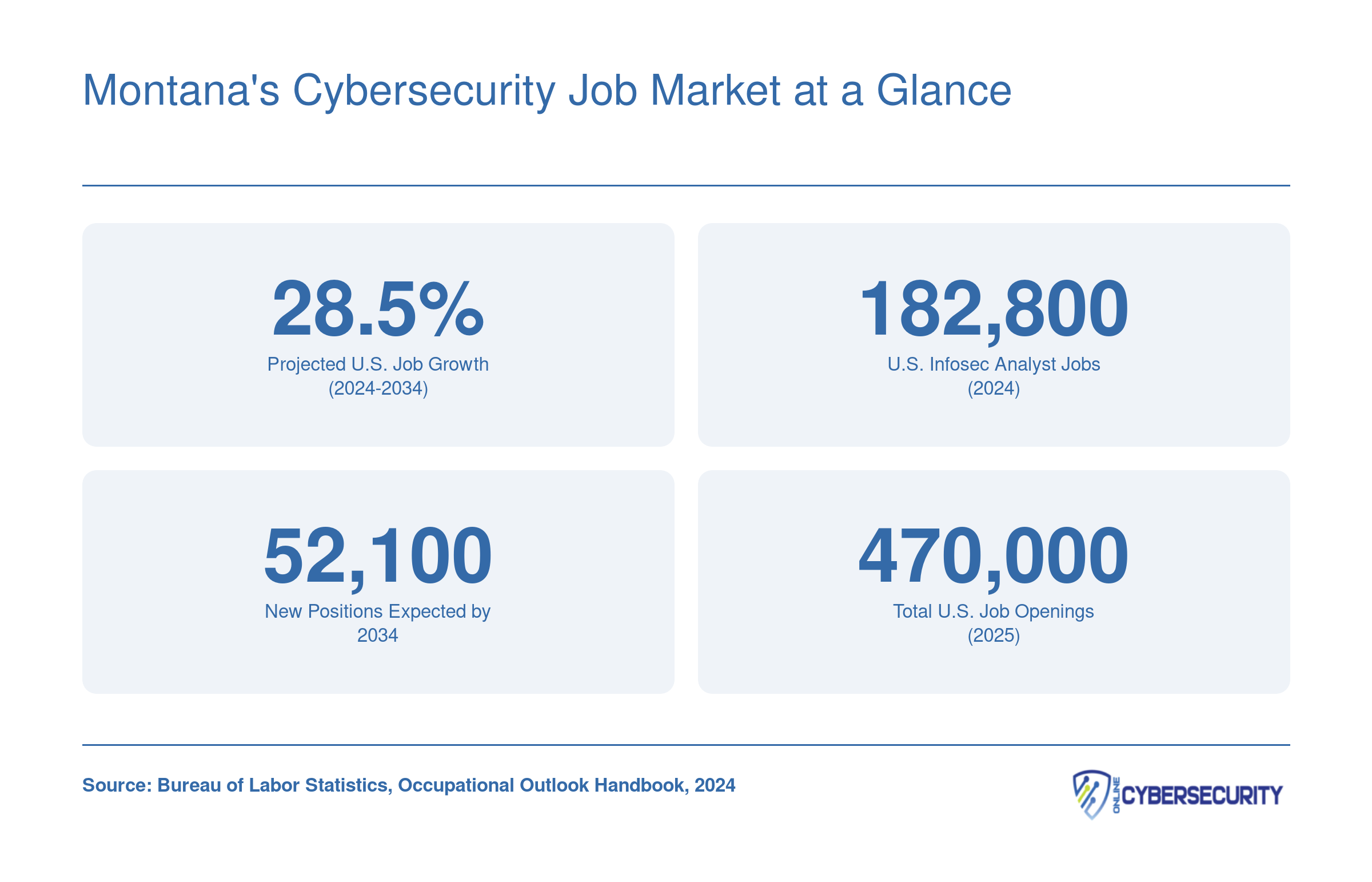
Montana's Cybersecurity Job Market at a Glance
Montana's cybersecurity workforce is part of a national field growing faster than nearly any other tech sector. While the state's in-person employer base is smaller, remote work has dramatically expanded the effective job market for Montana residents, connecting graduates to opportunities with companies headquartered anywhere in the country.
How to Choose the Right Online Cybersecurity Program
Picking the right online cybersecurity program takes more than a quick search. Montana students, whether you are working full time, living in a rural community, or transferring credits from a local college, should evaluate programs against a handful of practical criteria before committing.
Start With Accreditation
Regional accreditation is the non-negotiable baseline. Without it, your credits may not transfer, employers may question the degree, and you could be locked out of federal financial aid. Beyond that, look for the NSA Center of Academic Excellence (CAE) designation, which signals that the cybersecurity curriculum meets rigorous federal standards. A CAE-designated program is one of the strongest quality indicators in this field and can also open doors to scholarships funded through the Department of Defense. For a deeper look at what accredited curricula actually cover, explore our guide to cybersecurity program accreditation.
Understand How the Classes Are Delivered
Online programs fall into two broad categories: fully asynchronous (you complete lessons on your own schedule) and synchronous (live sessions at set times). For students in rural Montana or those juggling shift work, asynchronous delivery removes time-zone headaches and scheduling conflicts. If you prefer real-time interaction with instructors and classmates, a synchronous or hybrid model may be a better fit. Confirm the format before you apply, because some programs advertise as "online" but require you to log in at specific hours that may not align with Mountain Time.
Check Certification Alignment
The strongest programs map coursework directly to widely recognized industry certifications. Look for curricula aligned with CompTIA Security+, CySA+, or ISC2 CISSP exam objectives. Graduates of these programs can sit for certification exams with much of the study already behind them, giving you a real head start in a field where credentials carry serious weight alongside a degree.
Confirm Transfer Credit Policies
If you are transferring from a Montana community college such as Flathead Valley Community College or Miles Community College, verify articulation agreements before you enroll. Most online bachelor's programs require 120 total credits and accept between 60 and 90 transfer credits from regionally accredited institutions, with a minimum grade of C.1 Students entering with an online cybersecurity associate's degree (roughly 60 credits) can often finish in about two years. Keep in mind that technical coursework older than seven to ten years may not transfer, so check expiration policies for any older credits.2 Some programs also award credit for industry certifications like CompTIA A+, Network+, Security+, CCNA, or CISSP, typically ranging from 9 to 15 credits.2
Evaluate the Hands-On and Support Elements
Cybersecurity is a skills-driven profession, so the program should include virtual labs where you practice in realistic environments, not just read about attacks in a textbook. Ask whether the curriculum features a capstone project or practicum, both of which give you portfolio-ready experience. Finally, confirm that career services are fully available to online students, including resume reviews, interview coaching, and job placement support. Some schools limit these resources to on-campus learners, so it is worth checking before you commit.
- Accreditation: Regional accreditation is essential; NSA CAE designation adds a strong quality signal.
- Modality: Asynchronous programs offer the most flexibility for rural and working students.
- Certification prep: Curricula aligned with Security+, CySA+, or CISSP save time and money.
- Transfer credits: Confirm articulation agreements and credit expiration windows early.
- Practical components: Virtual labs, capstone projects, and online-accessible career services matter.
Montana may not offer a fully online cybersecurity degree through its in-state institutions, but that does not have to slow you down. Nationally ranked online programs provide strong career outcomes, flexible scheduling, and competitive tuition. Many charge a flat online rate regardless of where you live, so out-of-state pricing is not a barrier. Focus on accreditation, program fit, and cost transparency to find the right match.
Frequently Asked Questions About Online Cybersecurity Programs for Montana Students
Choosing an online cybersecurity program raises plenty of practical questions, especially when you are balancing Montana's unique geography, cost of living, and job market. Below are answers to the questions Montana students ask most often, drawn from current program data and industry benchmarks.
More Online Cybersecurity Programs Available to Montana Students
Beyond the top 10, here are additional online cybersecurity programs that welcome Montana students. Explore these options to find a program that fits your goals and budget.
- Business Cybersecurity Management M.S.
- Master of Science in Business Cybersecurity Management
- Graduate Certificate in Business Cybersecurity Management
- Business Cybersecurity Foundations Graduate Certificate
- Master of Science in Cybersecurity
- Master of Business Administration (Information Security and Assurance)
- Bachelor of Science with a major in Cybersecurity
- Master of Science in Cybersecurity Analytics and Operations
- Master of Professional Studies in Cybersecurity Analytics and Operations
- Master of Science in Cybersecurity
- Bachelor of Science in Cybersecurity
- Bachelor of Science in Cybersecurity Engineering (Cyber-attack and defense)
- Bachelor of Science in Cybersecurity Engineering (Network and data security)
- Bachelor of Science Degree Cyber Security
- Master of Science in Security Studies (Cybersecurity)
- Master of Science in Computer Science (Cybersecurity)
- Graduate Certificate Program in Cybersecurity
- Applied Science, Cybersecurity Concentration (BAS)
- M.S. in Cybersecurity
- M.S. in Cybersecurity (Advanced Cybersecurity Principles and Applications)
- M.S. in Cybersecurity (Cybersecurity Risk Analysis in Homeland Security)
- Master of Science in Computer Science, concentration in Cybersecurity
- MBA (Information Security)
- Cyber Intelligence Graduate Certificate
- Master of Science in Cybersecurity Management
- Bachelor of Science in Cybersecurity Management
- Cybersecurity Management Graduate Certificate
- Bachelor of Science in Cybersecurity
- Bachelor of Science in Cybersecurity (Critical Infrastructure)
- Bachelor of Science in Cybersecurity (Digital Forensics)
- Master of Science in Cybersecurity (Information Systems)
- Master of Science in Cybersecurity (Physical Systems)
- Cybersecurity, Certificate in