

What you’ll learn in this article…
- CompTIA Security+ is the recommended first certification, and over-certifying before landing a role can waste time and money.
- The BLS projects 29 percent job growth for information security analysts between 2024 and 2034, with roughly 16,000 annual openings.
- Roughly 20 to 30 percent of working cybersecurity professionals entered the field without a traditional four-year degree.
- National median pay for information security analysts sits near six figures, with top-paying states offering significantly more.
The Bureau of Labor Statistics projects 29 percent job growth for information security analysts between 2024 and 2034, a pace that dwarfs most occupations. Median pay sat at $120,360 as of 2024, with top earners clearing $168,000 in high-demand states. Those numbers attract attention, but the real question for most people is how to actually break in.
The path is not one-size-fits-all. Some analysts enter through a bachelor's degree in cybersecurity or computer science. Others pivot from IT support, skip the degree entirely, or stack certifications alongside hands-on lab work. What matters most in 2026 is the combination of foundational knowledge, at least one recognized certification, and demonstrable technical skills. Employers hiring for SOC analyst and junior security analyst roles increasingly screen for portfolios and practical ability over pedigree alone. Whether you are just starting out or exploring a cybersecurity career path from another field, this guide walks you through every step.
What Does a Security Analyst Do Day to Day?
If you are considering this career, one of the smartest things you can do is build a realistic picture of the work before you commit. The day-to-day reality of a security analyst varies quite a bit depending on the type of role, the size of the organization, and whether you are working in a Security Operations Center (SOC), a governance team, or a cloud security group. Here is a practical look at the workflow, along with tips on how to research it further yourself.
A Typical SOC Analyst Shift
Most entry-level security analysts start in a SOC, and the rhythm tends to be structured around monitoring, triaging, and responding to alerts. A typical day might include:
- Alert triage: Reviewing security alerts generated by a SIEM platform (tools like Splunk, Microsoft Sentinel, or similar) and determining which events are genuine threats versus false positives.
- Endpoint investigation: Using endpoint detection and response (EDR) solutions such as CrowdStrike to dig into suspicious activity on individual machines.
- Incident documentation: Writing up findings in a ticketing system so the next shift or escalation team can pick up where you left off.
- Shift handoffs: Many enterprise SOCs operate 24/7, so analysts often work rotating shifts, including nights and weekends, especially early in their careers.
The pace can swing from quiet monitoring to intense incident response in minutes, so comfort with ambiguity and the ability to stay focused during both lulls and surges matters more than most job descriptions let on.
How GRC Analysts Differ
If you lean more toward policy and compliance, a Governance, Risk, and Compliance (GRC) analyst's day looks quite different. Instead of watching dashboards, you might spend your time reviewing vendor risk questionnaires, mapping controls to frameworks like NIST or ISO 27001, and preparing audit evidence. The work is more document-driven and follows a standard business-hours schedule, which appeals to people who prefer predictability.
How to Research the Role Yourself
Rather than relying on a single source, cast a wide net so you get a well-rounded view of the job:
- Check the Bureau of Labor Statistics (BLS.gov) for the official occupational profile of information security analysts. It covers duties, work environment, and typical schedules in plain language.
- Browse job postings on major boards and read the "responsibilities" sections carefully. Patterns across dozens of listings will tell you more than any single description.
- Look at professional associations like ISACA and (ISC)², which publish career guides and competency frameworks that outline expected skills at each level.
- Search for "day in the life of a security analyst" content on professional blogs and video platforms. Hearing practitioners describe their actual routines, including the tedious parts, gives you context that polished career pages often skip.
- Visit school program pages for cybersecurity degrees and certificates. Curriculum breakdowns can hint at which daily tasks the industry considers foundational versus advanced. Our overview of what to expect from a cybersecurity degree program is a good starting point.
Building this kind of firsthand research habit serves you well beyond the job search. Security analysts are, at their core, investigators, and the curiosity you bring to understanding the role is the same curiosity that will make you effective once you are in it. If you are still mapping out the broader cybersecurity career path, exploring adjacent roles can also sharpen your sense of where a security analyst position fits in the bigger picture.
Types of Security Analysts: SOC, GRC, Cloud, and More
One of the most important things to understand early on is that "security analyst" is not a single job. It is an umbrella term covering several distinct specializations, each with its own daily rhythm, toolset, and career trajectory. Knowing which path resonates with your personality and skills can save you months of unfocused study.
SOC Analyst
Security Operations Center analysts sit at the front lines of incident monitoring and response. You will spend your days triaging alerts in a SIEM platform like Splunk or Microsoft Sentinel, investigating suspicious network traffic, and escalating confirmed threats to senior responders. This role rewards curiosity, pattern recognition, and calm under pressure.
- Primary focus: Real-time threat detection, log analysis, and incident response.
- Key tools: Splunk, Elastic SIEM, Wireshark, endpoint detection and response (EDR) platforms.
- Typical certifications: CompTIA Security+, CySA+, CEH, Splunk Core Certified User.
- Entry-level salary range: Roughly $60,000 to $80,000.2
- Best fit for: People who enjoy investigative problem-solving and thrive in fast-paced, shift-based environments.
GRC Analyst
Governance, Risk, and Compliance analysts operate on the policy and process side of security. Instead of hunting threats, you audit controls, draft security policies, and ensure your organization meets frameworks like NIST, ISO 27001, or HIPAA. Strong writing skills and attention to regulatory detail matter more here than packet captures. If GRC appeals to you, our guide on how to become a compliance analyst explores the role in greater depth.
- Primary focus: Policy development, risk assessments, and compliance audits.
- Key tools: GRC platforms (ServiceNow, Archer), spreadsheet-based risk registers, audit management software.
- Typical certifications: CompTIA Security+, ISC2 Certified in Cybersecurity (CC), ITIL Foundation, CISA, CRISC.
- Entry-level salary range: Roughly $60,000 to $85,000.3
- Best fit for: Organized communicators who prefer structured, document-driven work over live incident response.
Cloud Security Analyst
With most enterprises running workloads in AWS, Azure, or GCP, cloud security analysts focus on securing that infrastructure. Your responsibilities include configuring identity and access management (IAM) policies, monitoring cloud-native logs, and remediating misconfigurations that could expose sensitive data. This specialization commands a premium because cloud fluency is still in high demand. Those drawn to this niche should explore the cloud security specialist roadmap for a deeper look at the required skills.
- Primary focus: Securing cloud infrastructure, IAM governance, and cloud logging.
- Key tools: AWS CloudTrail, Azure Defender, Google Chronicle, Terraform for infrastructure-as-code reviews.
- Typical certifications: AWS Certified Cloud Practitioner, Azure Security Engineer, CCSK, CCSP.
- Entry-level salary range: Roughly $80,000 to $105,000.3
- Best fit for: Learners who enjoy hands-on lab work with cloud consoles and want to combine networking knowledge with DevOps practices.
Penetration Tester / Red Team Analyst
Penetration testers are the "ethical hackers" who simulate real-world attacks against an organization's networks, web applications, and physical controls. Red team analysts take this further by running full adversary simulations. The work is creative and offensive in nature, which sets it apart from the defensive orientation of most analyst roles. For a complete breakdown, see our penetration tester career path guide.
- Primary focus: Web application testing, network penetration tests, and adversary emulation.
- Key tools: Burp Suite, Nmap, Metasploit, Cobalt Strike, custom scripting (Python, Bash).
- Typical certifications: CompTIA Security+, CEH, eJPT, OSCP.
- Entry-level salary range: Roughly $85,000 to $105,000.
- Best fit for: Self-driven learners who love puzzles, enjoy coding or scripting, and are comfortable documenting findings in detailed reports.
Choosing Your Direction
Notice that salary ranges overlap, so compensation alone should not drive your decision. Instead, think about what energizes you. Do you want the adrenaline of live incident response (SOC)? The structure of regulatory frameworks (GRC)? The architectural puzzle of cloud environments? Or the creative challenge of breaking into systems before attackers do? Your honest answer will point you toward the right education path and certifications, both of which we cover in the sections ahead.
Questions to Ask Yourself
Step-By-Step Education Pathways
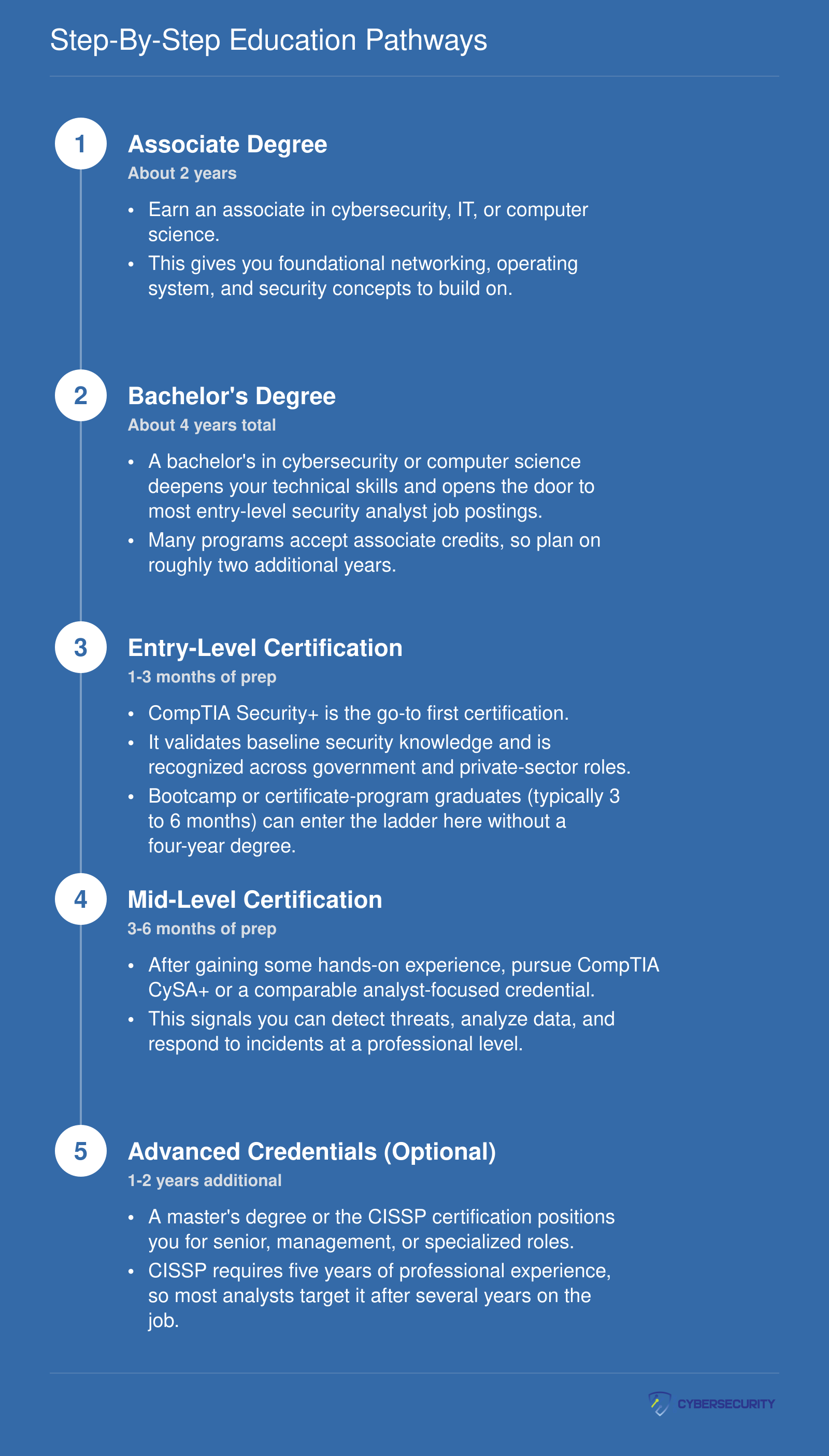
There is no single route into a security analyst role, but most paths converge on the same credentialing ladder. The traditional track starts with a degree, while an alternative on-ramp through bootcamps or certificate programs lets you jump in faster. Use the timeline below to estimate how long each stage takes.
Step-By-Step Education Pathways: Degrees, Bootcamps, and Certificates
There is no single educational recipe for becoming a security analyst, but most paths fall into four broad categories. Understanding the timeline, cost, and strategic value of each option helps you build a plan that fits your life, not someone else's.
Associate Degree (About 2 Years)
A two-year associate degree in cybersecurity, information technology, or computer science gives you foundational knowledge in networking, operating systems, and security concepts. Community colleges and online programs make this route accessible and affordable. Just as importantly, an associate degree is stackable: many programs have articulation agreements that let you transfer credits directly into a four-year bachelor's program. If you need to start earning sooner rather than later, an associate paired with an entry-level certification can get you into a SOC analyst or help-desk role while you continue your education part time.
Bachelor's Degree (About 4 Years)
A bachelor's degree remains the credential most frequently listed in security analyst job postings. Three degree titles show up most often in employer requirements:
- B.S. in Cybersecurity: Focuses specifically on defensive and offensive security topics, incident response, and compliance frameworks.
- B.S. in Computer Science: Offers deeper programming and algorithm foundations, which are valuable for roles that involve scripting, automation, or malware analysis.
- B.S. in Information Technology: Covers broader IT infrastructure, networking, and systems administration, providing a well-rounded base for security work.
All three can lead to the same roles. Your choice should depend on whether you prefer depth in code, breadth in infrastructure, or a security-first curriculum. If you are leaning toward the CS route, explore the computer science cybersecurity degree options to compare programs side by side.
Master's Degree (1 to 2 Years)
A master's in cybersecurity, information assurance, or a related discipline is not required for most analyst positions, but it can accelerate movement into senior or specialized roles such as security architecture, threat intelligence management, or GRC leadership. It is most strategic after you have a few years of hands-on experience and a clearer picture of where you want to specialize.
Bootcamps and Certificate Programs (3 to 12 Months)
Bootcamps and professional certificate programs compress practical, job-ready training into a shorter timeframe. They work especially well as a supplement to a non-technical bachelor's degree: if you already hold a degree in business, communications, or another field, a focused cybersecurity bootcamp online can bridge the skills gap without requiring you to start a second four-year program. Many bootcamps also include hands-on labs and capstone projects that double as portfolio pieces for job applications.
Which Path Opens the Most Doors?
While a bachelor's degree is the most commonly requested credential in job postings, it is not the only way in. Employers increasingly value demonstrable skills, relevant certifications, and practical experience alongside (or sometimes instead of) a traditional degree. If you want a deeper look at coursework and what day-to-day study involves, our guide on what to expect from a cybersecurity degree program is a good next read. The following section explores exactly how people break into security analyst roles without a four-year degree, so keep reading if that path resonates with you.
How to Become a Security Analyst Without a Degree
Here is the encouraging reality: a bachelor's degree is not the only door into this field. While roughly 70 to 80 percent of cybersecurity job postings still list a degree as preferred1, industry surveys consistently show that 20 to 30 percent of listings accept equivalent experience1, and an estimated 30 to 40 percent of working cybersecurity practitioners do not hold a formal computer science or cybersecurity degree.2 Even more telling, about 70 percent of security leaders say they value hands-on experience over formal education when evaluating candidates.2 The path is real, but it demands structure and discipline.
Three Proven Transition Paths
There is no single route, but three patterns show up repeatedly among analysts who broke in without a four-year degree.
- Help desk or IT support to SOC analyst: This is the most common pipeline. A year or two handling tickets, troubleshooting networks, and learning how systems fail gives you operational context that classroom work alone cannot replicate. Many SOC teams actively recruit from their own help desk ranks.
- Military or veteran cyber training to civilian analyst: Programs like the DoD Cyber Workforce Framework, service branch MOS/NEC cyber specialties, and nonprofit veteran transition programs (such as VetsinTech) map directly to SOC and incident response roles. Military candidates often already hold a security clearance, which is a significant hiring advantage with defense contractors.
- Career changer with certifications and a home lab portfolio: If you are coming from an unrelated field, the combination of a recognized certification and a portfolio of documented lab work is your proof of competence. Employers hiring for junior SOC roles want to see that you can analyze logs, write detection rules, and triage alerts, not that you sat through four years of lectures.
The Minimum Viable Credential
For candidates without a degree, CompTIA Security+ is widely recognized as the baseline certification that opens doors. It validates foundational knowledge of threats, architecture, and incident response. Pair it with tangible lab evidence, such as a home SIEM deployment, write-ups from capture-the-flag competitions, or a documented malware analysis project, and you have a credible application package.
It is worth noting that several major employers have formally dropped degree requirements for cybersecurity roles in recent years. Google, IBM, and a number of Department of Defense contractors now evaluate candidates on skills and certifications rather than diplomas. Sectors with especially strong cybersecurity hiring, including IT services, computer systems design, banking, and health insurance, are increasingly following this trend.3 If you do eventually decide to pursue formal education, best online cybersecurity programs can let you earn a credential while continuing to work.
A Realistic Timeline
If you are starting from scratch and can commit 10 to 15 hours per week to self-study and lab work, plan on a 12 to 18 month runway before you are competitive for an entry-level SOC analyst position. A rough breakdown looks like this:
- Months 1 through 4: Study for and pass CompTIA Security+. Use free or low-cost resources such as Professor Messer videos, TryHackMe, or Hack The Box.
- Months 4 through 10: Build a home lab. Stand up a SIEM (Security Onion or Splunk Free), practice log analysis, and participate in at least two or three CTF events. Document everything in a public portfolio or blog.
- Months 10 through 18: Apply broadly, targeting help desk or junior SOC roles. Contribute to open-source detection projects on GitHub. Network in local security meetups or online communities like the Blue Team Village Discord.
For those interested in specializing further down the road, roles like cyber threat intelligence analyst build naturally on the SOC foundation you develop during this phase.
This timeline is not a guarantee, but it reflects the experience of many analysts who have walked this road. The key is consistency: treat your study hours like a part-time job, and the compound effect of daily practice adds up faster than you might expect.
Certifications: What to Earn First and What Can Wait
No matter which specialization you eventually pursue, CompTIA Security+ is the single best starting certification for aspiring security analysts. It validates foundational knowledge that every employer expects, it satisfies the DoD 8570 baseline for government and contractor roles, and it feeds naturally into every branch of the field.1 Once you have Security+ in hand, your next certification should follow the career path you identified earlier: SOC and threat-focused analysts benefit from CySA+ or GSEC, GRC professionals lean toward CISM or CISA, and penetration testers gravitate toward CEH and beyond. For a broader look at credential options across the field, explore our cybersecurity certifications guide.
The table below groups certifications into three tiers so you can plan your spending and study time strategically.
Tier 1: Entry Level
- CompTIA Security+: Exam cost around $425.1 No formal prerequisites, though CompTIA recommends Network+ knowledge and roughly two years of IT experience with a security focus.1 Maps to SOC analyst, junior security analyst, and help-desk-to-security transition roles across every specialization.
- SSCP (Systems Security Certified Practitioner): Exam cost around $249. Requires one year of cumulative paid work experience in one or more of the seven SSCP domains, or a relevant degree can satisfy the requirement. Maps well to SOC analyst and general security administration positions.
Tier 2: Mid-Career
- CompTIA CySA+ (Cybersecurity Analyst): Exam cost around $425. No formal prerequisites; CompTIA recommends Security+ and four years of hands-on experience. Ideal for SOC analysts moving into threat detection, behavioral analytics, and incident response.
- GIAC GSEC (Security Essentials): Exam cost around $979 (or bundled with SANS training). No formal prerequisites. Valued across SOC, cloud security, and GRC roles; SANS courseware is widely regarded as top-tier.
- CEH (Certified Ethical Hacker): Exam cost around $1,199 for the exam voucher alone. Requires two years of information security experience or completion of official EC-Council training. Maps to penetration testing, vulnerability assessment, and red-team adjacent SOC work.
Tier 3: Senior and Management
- CISSP (Certified Information Systems Security Professional): Exam cost around $749. Requires five years of cumulative paid experience across two or more of the eight CISSP domains; a four-year degree or approved credential can waive one year. The gold standard for security architects, senior analysts, and security leadership.
- CISM (Certified Information Security Manager): Exam cost around $760 for non-ISACA members. Requires five years of information security management experience, with some substitutions allowed. Targets GRC managers, security program directors, and CISO-track professionals.
- CISA (Certified Information Systems Auditor): Exam cost around $760 for non-ISACA members. Requires five years of IS auditing, control, or security experience. Best suited for GRC analysts, IT auditors, and compliance-focused roles.
How to Sequence Your Plan
Start with Security+ in your first year of study or career transition. If you are working in a SOC, follow up with CySA+ once you have a year or two of alert triage and incident handling under your belt. If your path is governance or compliance, aim for CISA after you accumulate qualifying experience. Reserve CISSP and CISM for the point in your career when you have the required experience and are targeting leadership or architecture roles. Stacking multiple entry-level certifications is rarely cost-effective: pick one Tier 1 cert, earn it, gain hands-on experience, then invest in a Tier 2 credential that aligns with your day-to-day work.
Budget matters too. Certification exams, study materials, and renewal fees add up quickly. Prioritize the credential your target job postings mention most frequently, and ask your employer about tuition or certification reimbursement programs before paying out of pocket. If cost is a concern, pairing certifications with an affordable cybersecurity program can stretch your education budget further.
Hiring managers consistently value one foundational certification paired with proven hands-on skills over a long list of acronyms. Earn your Security+, build a solid portfolio, and land that first role. Once you are in the door, let your employer fund the next certification on your learning path.
Building Experience: Labs, CTFs, and Your First Portfolio
Certifications tell a hiring manager what you have studied. A portfolio tells them what you can actually do. For entry-level SOC analyst roles in 2026, the shift toward proof-of-skill hiring is unmistakable. Recruiters and SOC leads increasingly want to see documented, hands-on work before they schedule an interview, so the time you invest in labs, capture-the-flag (CTF) competitions, and write-ups can matter just as much as the letters after your name.
Free and Low-Cost Platforms to Start Today
You do not need an expensive lab to build meaningful experience. These four platforms cover a wide range of blue-team and red-team fundamentals:
- TryHackMe: Guided, browser-based rooms that walk you through topics from basic networking to SIEM analysis. The free tier is generous, and the structured learning paths are ideal for beginners.
- Hack The Box: More challenge-oriented, with retired machines you can legally exploit and then write up. A great next step once you are comfortable with TryHackMe basics.
- CyberDefenders: Focused specifically on blue-team skills like log analysis, memory forensics, and malware triage. If your goal is a SOC or incident-response role, this platform deserves regular attention.
- SANS Holiday Hack Challenge: Released annually, this free event blends storytelling with real-world security puzzles. Completing it and publishing your solutions is an easy portfolio win.
What a Security Analyst Portfolio Looks Like
Think of your portfolio as a GitHub repository (or personal site) that shows, rather than tells. Strong portfolios typically include:
- CTF write-ups that walk through your methodology, the tools you used, and the reasoning behind each step.
- Screenshots and dashboards from a home lab SIEM, showing that you can ingest logs, create alerts, and investigate events.
- Documented incident-response walkthroughs where you outline detection, containment, eradication, and lessons learned, even if the "incident" happened in a sandbox.
Consistency matters more than volume. Five detailed, well-organized write-ups outperform dozens of one-paragraph summaries.
Building a Basic Home Lab
A functional home lab does not require expensive hardware. Many candidates pair lab work with coursework from affordable cybersecurity programs to round out their practical training. Here is a practical starting setup:
- Install a free-tier SIEM such as Splunk Free or Elastic Security on a virtual machine. Either tool lets you ingest, search, and visualize log data without paying a licensing fee.
- Spin up intentionally vulnerable virtual machines like Metasploitable or DVWA (Damn Vulnerable Web Application) on your local hypervisor. These give you safe, legal targets to generate realistic attack traffic.
- Create a simple write-up template you reuse for every exercise. A good template includes the objective, environment details, step-by-step actions, evidence (screenshots or log snippets), and a brief analysis section.
This kind of lab mirrors the daily workflow of a junior SOC analyst: collect telemetry, spot anomalies, investigate, and document findings.
Why This Work Gets You Hired
When a hiring manager reviews two candidates with the same certification and similar education, the candidate who can point to a repository of organized, thoughtful analysis stands out. A portfolio demonstrates curiosity, discipline, and the communication skills that SOC teams depend on during real incidents. Start small, publish consistently, and treat every lab session as a chance to build evidence that you belong in the role.
Security Analyst Salary: National Overview
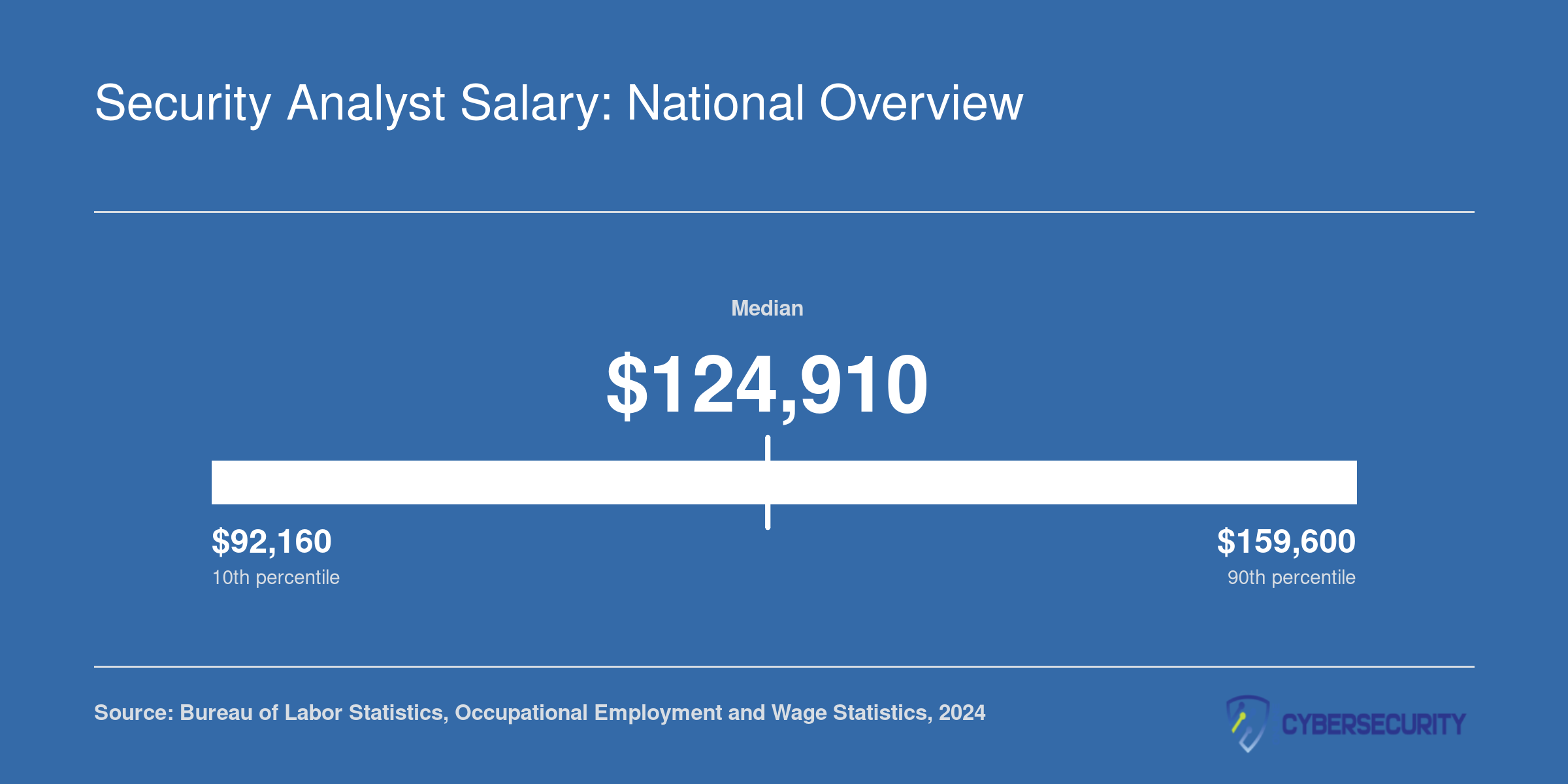
As of 2024, roughly 179,430 information security analysts were employed across the United States, according to the Bureau of Labor Statistics. The salary distribution below shows how pay spans from the lower quartile to the upper quartile, with a healthy median that reflects strong demand for this skill set.
Security Analyst Salary by State
The table below shows the highest-paying states for Information Security Analysts, ranked by median annual salary. These figures are drawn from 2024 Bureau of Labor Statistics data and cover all Information Security Analysts across experience levels, not just entry-level roles. States like Virginia, California, and Texas stand out because they combine top-tier pay with massive employment bases (over 14,000 analysts each), making them especially attractive job markets. By contrast, smaller states like Delaware, New Hampshire, and New Mexico offer competitive salaries but employ far fewer analysts, so job availability may be more limited.
| State | Total Employment | Median Salary | 25th Percentile | 75th Percentile |
|---|---|---|---|---|
| Washington | 6,830 | $142,920 | $117,040 | $169,350 |
| California | 15,800 | $140,660 | $105,150 | $178,090 |
| Maryland | 8,770 | $140,480 | $105,230 | $175,390 |
| New Jersey | 4,730 | $135,390 | $108,320 | $168,240 |
| Delaware | 630 | $134,050 | $105,310 | $154,060 |
| New Mexico | 1,760 | $133,780 | $101,940 | $166,300 |
| Virginia | 18,670 | $132,460 | $101,610 | $166,510 |
| New York | 8,860 | $131,100 | $98,320 | $170,220 |
| Colorado | 5,840 | $130,570 | $102,350 | $164,010 |
| Connecticut | 1,160 | $130,500 | $95,260 | $152,410 |
| New Hampshire | 730 | $129,690 | $98,540 | $158,360 |
| Minnesota | 2,550 | $128,830 | $99,300 | $145,860 |
| District of Columbia | 2,010 | $127,760 | $109,680 | $150,920 |
| Massachusetts | 5,780 | $127,610 | $101,730 | $161,940 |
| Arizona | 4,170 | $125,320 | $88,520 | $161,250 |
| Texas | 14,730 | $124,970 | $96,020 | $149,780 |
Security Analyst Salary by Experience Level
While the previous section covered government-published wage data from the Bureau of Labor Statistics, salary aggregator sites like Payscale and Glassdoor offer a complementary view by breaking compensation down by years of experience. These self-reported figures tend to skew differently from BLS data, so treat them as useful directional benchmarks rather than exact numbers.
Entry Level: 0 to 2 Years
According to Payscale data from 2024 to 2025, cybersecurity analysts at the entry level report total compensation around $70,800, while those with a year or two of experience (early career) report roughly $79,600.1 At this stage you are typically working in a SOC or help-desk-adjacent role, triaging alerts, writing incident tickets, and learning the tooling. The good news: even the floor of this range sits well above the national median household income, which makes cybersecurity an attractive on-ramp for career changers.
Mid Career: 3 to 5 Years
This is where the earnings curve steepens noticeably. Payscale reports a mid-career salary increase of about 19 percent over early-career figures, but that number climbs fast once you layer in title changes and specialization.1 Industry sources generally show that analysts who move from a generalist SOC seat into a focused discipline, such as cloud security engineering or penetration testing, can see total compensation jump 30 to 50 percent within three years of their start date. Those specialized roles tend to carry a 10 to 20 percent premium over general SOC analyst positions at the same experience level, partly because the talent pool is smaller and the required skill set is deeper.
Senior Level: 6 or More Years
At the senior tier, Payscale data indicates compensation roughly 43 percent above entry-level figures.1 Glassdoor listings for information security analysts (a title that often maps to senior individual contributors or team leads) show mean annual wages approaching the mid-$130,000 range, though location, industry, and clearance status all move the needle significantly.2 Professionals who pair deep technical chops with leadership responsibilities, such as a SOC manager or principal security engineer title, can push well beyond those averages.
Why the Jump Matters
The steepest percentage increase in a security analyst's career almost always happens in the first three to five years. Two factors drive it:
- Skill compounding: Real incident-response experience is difficult to simulate, so employers pay a premium once you have it.
- Certification stacking: Earning credentials like CySA+ or a cloud-security specialty cert during your early years signals readiness for mid-level roles and opens doors that pure experience alone may not.
Keep in mind that salary aggregator data is self-reported and can vary by region, job title, and sample size. Use these figures to set realistic expectations and negotiate offers, but always cross-reference with local job postings and the BLS benchmarks discussed in the previous section for a fuller picture.
Career Outlook and Growth Opportunities
The demand for security analysts is not just strong, it is accelerating. The Bureau of Labor Statistics projects a 29 percent growth rate for information security analysts between 2024 and 2034, with roughly 16,000 openings expected each year over that decade.1 To put that in perspective, the average projected growth rate across all occupations is about 4 percent, making cybersecurity one of the fastest-growing career fields in the entire U.S. economy. If you are weighing whether to invest time and money in this path, the numbers leave little room for doubt.
The Career Ladder: Realistic Timelines
One of the most common questions career changers ask is how long it takes to reach senior roles. While every trajectory is different, a typical progression looks something like this:
- Junior SOC Analyst (0 to 2 years): Monitoring alerts, triaging incidents, and learning the tooling. This is where most people start, and it is perfectly normal to spend a couple of years here building pattern recognition.
- Security Analyst (2 to 4 years): Deeper investigation work, writing detection rules, contributing to incident response plans, and mentoring newer team members.
- Senior Analyst or Security Engineer (4 to 7 years): Leading complex investigations or designing and maintaining security infrastructure. This is where the analyst and engineer paths begin to diverge.
- Security Architect or Manager (7 to 10 years): Setting security strategy for an organization, reviewing architecture decisions, or managing a team of analysts and engineers.
- CISO (10 to 15+ years): Overseeing the entire security program, reporting to executive leadership, and aligning security investments with business risk.
These timelines are guidelines, not rules. People with strong soft skills, business acumen, or niche technical depth sometimes move faster.
Analyst vs. Engineer: Understanding the Fork
Around the four-to-seven-year mark, many professionals face a choice. Security analysts focus on monitoring, detection, and response. They are the people who spot threats and coordinate the reaction. Security engineers, on the other hand, build and maintain the infrastructure that makes detection possible: SIEM pipelines, automation playbooks, cloud security controls, and custom tooling. Engineers typically command higher salaries, but the role demands deeper skills in coding, systems architecture, and DevOps practices. Neither path is inherently better; the right choice depends on whether you prefer investigating problems or building solutions. Those drawn to infrastructure design can explore what does a security architect do as a natural next step.
Lateral Moves That Keep Your Options Open
The security analyst role is also a launching pad for lateral pivots that do not require starting over. Professionals regularly move into governance, risk, and compliance (GRC), where strong analytical thinking translates directly. Others shift into cloud security, threat intelligence, or even pre-sales engineering, where technical credibility and communication skills combine to create a high-earning niche. If you are curious about the executive track, learning how to become a CISO can help you map out the long game. The investigative mindset and cross-functional knowledge you develop as an analyst travel well across the broader cybersecurity landscape, so you are never locked into a single track.
Frequently Asked Questions About Becoming a Security Analyst
Below are some of the most common questions career changers and students ask when exploring a security analyst career path. Each answer is kept concise so you can quickly find the facts that matter most.