

What you’ll learn in this article…
- Online cybersecurity law degrees range from graduate certificates under $15,000 to JD programs exceeding $150,000 in total tuition.
- LL.M. programs let licensed attorneys specialize in cyber law in roughly one year, while JD concentrations take three.
- Privacy officers, cybersecurity counsel, and compliance directors can earn median salaries well above $100,000 annually.
- ABA accreditation for JD and LL.M. programs is the single most important factor when choosing a cybersecurity law school.
Regulatory enforcement actions tied to data breaches topped $4 billion globally in 2025, driven by frameworks like GDPR, CISA directives, and a growing patchwork of U.S. state breach-notification statutes. Organizations need legal professionals who can interpret these rules and understand the technical threats behind them, yet the talent pool remains thin.
The challenge for prospective students is that "cybersecurity law degree" is not a single credential. It can mean a JD concentration, an LL.M., a Master of Legal Studies, a policy-focused MS, or a standalone certificate. Each carries different bar-eligibility implications, cost profiles, and career ceilings. Employers increasingly distinguish between candidates who hold a practice-ready law degree and those with a compliance-oriented master's, so choosing the wrong format can cost years and tens of thousands of dollars.
What Is a Cybersecurity Law Degree?
Cybersecurity law sits at the crossroads of information security, data privacy regulation, and legal practice. Unlike general technology law, which might touch on intellectual property or telecommunications policy, cybersecurity law zeroes in on how organizations protect digital assets, respond to breaches, and comply with an ever-expanding web of privacy statutes. It is also distinct from standalone data-privacy programs, which often emphasize compliance frameworks without diving deeply into incident response, national security considerations, or the technical underpinnings of network defense. A cybersecurity law degree weaves all of those threads together, preparing graduates to advise clients or employers on topics ranging from SEC cyber-disclosure rules to cross-border data transfers under frameworks like the EU-U.S. Data Privacy Framework. For a broader look at the discipline itself, our guide on why cybersecurity is important provides useful context.
The Credential Spectrum
No single degree dominates this space. Instead, several credential types map to different career goals:
- JD with a cyber-law concentration: Designed for students who want to practice law. This path leads to bar eligibility and positions such as cybersecurity counsel or litigation associate handling data-breach cases.
- LL.M. in cybersecurity or privacy law: A post-JD specialization ideal for practicing attorneys who want to deepen their expertise, or for foreign-trained lawyers seeking a pathway to U.S. bar admission in states that accept LL.M. credentials.
- MLS or MS in cybersecurity law: A non-JD graduate degree built for compliance officers, policy analysts, and technology professionals who need legal fluency without sitting for the bar.
- Graduate certificate: The fastest upskill option, typically 12 to 18 credits, suited for mid-career professionals who want targeted knowledge in areas like data governance or AI regulation.
Who Each Credential Serves
Career changers moving from IT or information security roles often gravitate toward the MLS or MS track because it adds legal context to existing technical skills. Mid-career attorneys looking to pivot into privacy or cybersecurity practice tend to pursue an LL.M. for its depth and prestige. Technology professionals who need enough legal literacy to partner effectively with in-house counsel may find a best online graduate certificate in cybersecurity sufficient. And students entering law school with a clear interest in the digital economy can build a JD concentration from day one, combining doctrinal coursework with clinics or externships focused on cyber incidents.
Why Demand Is Surging
The need for lawyers fluent in cybersecurity keeps accelerating. Organizations face mandatory breach-notification timelines, evolving SEC reporting obligations for material cyber incidents, and emerging AI governance mandates at both the state and federal level. Meanwhile, cross-border data transfers require counsel who can navigate conflicting regulatory regimes across dozens of jurisdictions. Companies hiring for these roles want advisors who can speak credibly to both the legal team and the security operations center, and our cybersecurity career guide outlines many of the positions that benefit from this dual fluency. That combined legal and technical expertise is exactly what a cybersecurity law degree is designed to build, making it one of the fastest-growing specializations in legal education heading into 2026 and beyond.
Common Cybersecurity Law Specializations and Concentrations
Law schools are embedding cybersecurity concentrations into curricula at an accelerating pace, but their delivery models vary widely. Some institutions offer formal tracks with structured sequences, while others let students self-assemble a cluster of electives around a theme. Understanding the distinction between a named concentration and an ad hoc elective path is essential to planning both your coursework and your post-graduation positioning.
Core Specializations in Cybersecurity Law
Five specializations capture the majority of program offerings in 2026. Data privacy and information privacy courses anchor nearly every curriculum, covering GDPR, CPRA, sector frameworks, and consumer-protection enforcement.1 National security and cyber conflict appeal to students aiming at government roles, exploring topics from attribution and rules of engagement to FISA authorities and classified-information protocols. Financial regulation tracks address security obligations under GLBA, PCI-DSS, and SEC disclosure rules, aligning with compliance and enforcement pathways in banking and fintech. Incident responder career path content informs the incident response and breach litigation specialization, which prepares students to manage real-time crises, notification obligations, and follow-on class actions. Emerging technology policy rounds out the landscape, spanning AI governance, blockchain law, and IoT regulatory gaps.
Loyola Law School's Cybersecurity & Data Privacy Concentration exemplifies a formal track, bundling required courses with capstone simulation. Santa Clara Law offers a Privacy Law Certificate that stacks onto a JD or serves as a standalone credential.3 Albany Law School's Online LL.M. in Cybersecurity and Data Privacy provides a full graduate program dedicated to the field.4 The State Bar of California now certifies a Privacy Law Specialization, the first of its kind in any U.S. jurisdiction, signaling employer appetite for verifiable expertise.5
Aligning Specialization with Career Path
Government and public-sector careers favor candidates with national security, cyber conflict, and global-privacy coursework. BigLaw practices prioritize data privacy, incident response, and financial regulation because transactional and litigation matters often turn on those domains. Tech companies seek graduates fluent in data privacy, emerging technology, and cybersecurity governance, especially for product counsel and policy roles. Compliance and consulting tracks reward sector-specific privacy knowledge and familiarity with NIST, ISO, and industry frameworks.6
LL.M. versus JD Depth
LL.M. students typically pursue deeper specialization than JD students, dedicating 24 to 30 credits to a single discipline rather than sampling broadly.4 JD students taking cyber electives build breadth across related topics but may not achieve the same granular command unless they complete a formal concentration or certificate.7 If you hold a foreign law degree or already practice in a related field, an LL.M. offers the most direct route to specialized credentialing.
2026 Best Online Cybersecurity Law Programs
Finding the right online cybersecurity law program takes more than a quick Google search. The landscape is evolving quickly, with new concentrations, certificate add-ons, and hybrid formats appearing each year. Rather than hand you a static ranking that may be outdated by next semester, this section walks you through exactly how to build your own vetted shortlist of programs that are active, accredited, and aligned with your career goals in 2026.
Start With ABA Accreditation Status
If you are pursuing a JD concentration, an LL.M., or a Master of Legal Studies (MLS) with a cybersecurity or data privacy focus, accreditation from the American Bar Association matters. An ABA-accredited degree is typically required to sit for the bar exam, and even for non-bar-track degrees like the LL.M. or MLS, ABA accreditation signals that the curriculum meets rigorous academic standards.
Visit the ABA's official website and use its directory of approved law schools to confirm each institution's current status. Not every ABA-accredited school offers an online cybersecurity law track, so you will need to cross-reference the directory against each school's program catalog. Look specifically for:
- JD concentrations: Some schools let you specialize in cybersecurity, technology law, or data privacy within a standard JD. Online JD programs with ABA approval remain limited, so verify that the school's distance-education format has received the necessary ABA acquiescence or variance.
- LL.M. programs: An LL.M. in Cybersecurity Law or Data Privacy Law is designed for lawyers who already hold a JD. Several ABA-accredited schools now deliver these entirely online.
- MLS or MS degrees: These are aimed at professionals who want legal literacy without sitting for the bar. Regional accreditation through bodies like the Higher Learning Commission or Middle States Commission is the minimum standard here, though many are housed within ABA-accredited law schools.
Always confirm that the program is actively enrolling for the 2025-2026 academic year. Programs occasionally pause admissions or restructure, and an outdated listing can waste weeks of your time.
Verify Costs and Format on Each School's Website
Aggregator sites and ranking publications are helpful starting points, but tuition figures, per-credit costs, and format details change frequently. Go directly to the program's official page or contact the admissions office to confirm:
- Per-credit tuition and total estimated cost of the degree, including fees
- Whether the program is fully asynchronous, hybrid with required campus visits, or offered in an evening synchronous format
- Curriculum highlights such as courses in incident response law, privacy regulation (GDPR, CCPA, emerging state laws), intellectual property in tech, or national security cyber policy
- Capstone or experiential requirements like a practicum, clinic, or research project
Tuition can vary dramatically. Some public university LL.M. programs charge under $800 per credit, while private law schools may exceed $1,800 per credit. Getting the real, current number from the source prevents sticker shock down the road.
Use Rankings as a Filter, Not a Final Answer
Publications like U.S. News and the National Jurist maintain lists that can help you narrow down online law programs with technology or cybersecurity concentrations. These rankings weigh factors like bar passage rates, employment outcomes, and peer assessments. They are useful as an initial filter, but they are not a substitute for your own due diligence.
After generating a shortlist from one or two ranking sources, circle back to each school's site. Confirm that the specific cybersecurity law track (not just the broader law program) is still offered online, check that the faculty includes practitioners with relevant industry or government experience, and read the fine print on residency requirements.
Cross-Check With Industry and Government Resources
Two additional resources can sharpen your evaluation:
- The Bureau of Labor Statistics (BLS.gov) publishes career outlook data for roles commonly filled by cybersecurity law graduates, including information security analysts, compliance officers, and lawyers specializing in technology. Reviewing projected job growth and median earnings helps you gauge whether a program's curriculum aligns with where the labor market is heading.
- The International Association of Privacy Professionals (IAPP) maintains educational partnerships and occasionally highlights programs that prepare students for certifications like the CIPP or CIPM. If a program is recognized or recommended by IAPP, that is a strong signal of industry relevance.
Combining accreditation checks, direct school verification, ranking filters, and industry cross-references gives you a research process you can trust. If your background is more technical than legal, pairing a cybersecurity law degree with a computer science cybersecurity degree can make you especially competitive. The cybersecurity law field is growing fast, and the programs serving it are still maturing. Taking an extra hour to verify details now can save you years of regret over a program that did not deliver what it promised.
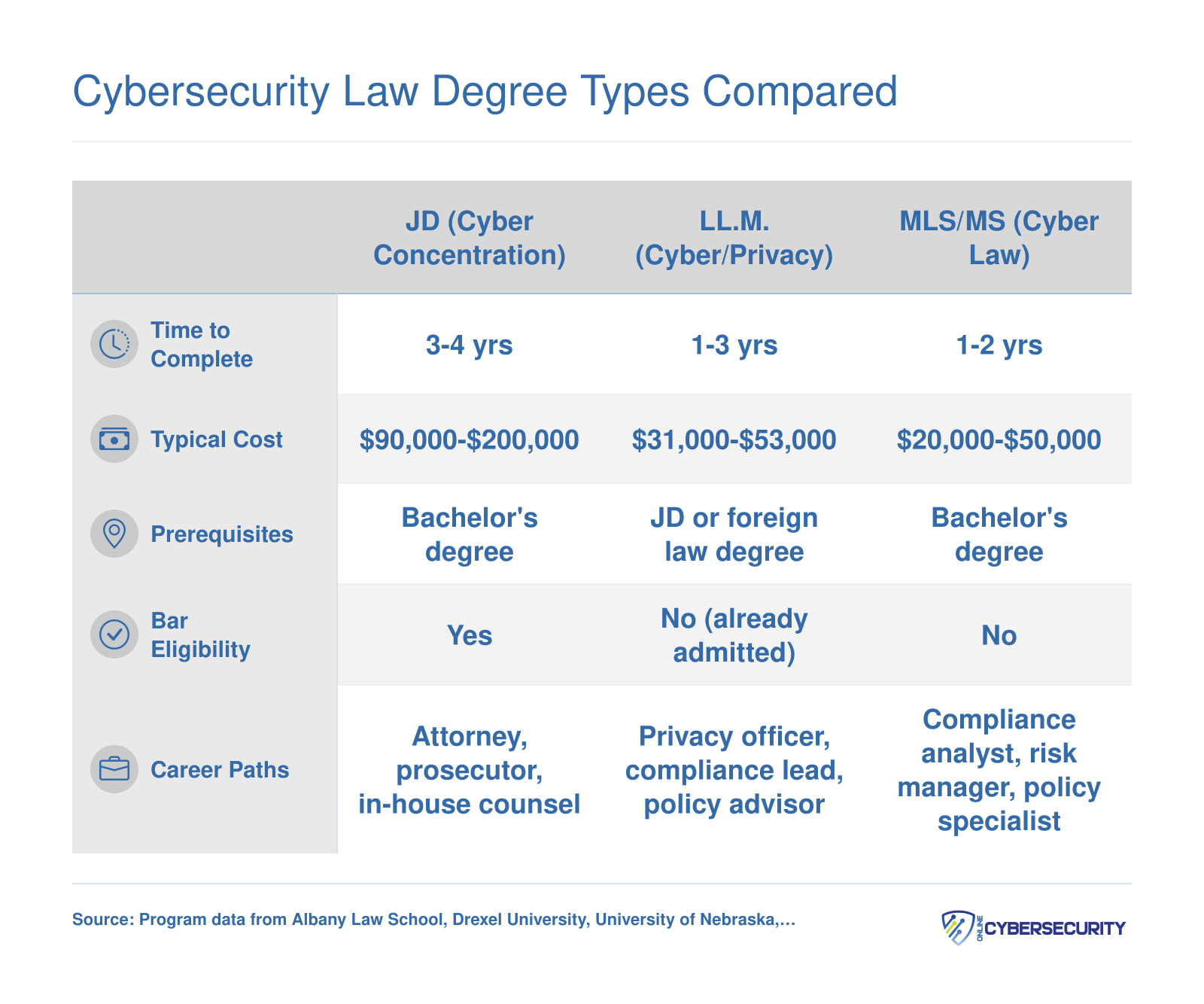
Cybersecurity Law Degree Types Compared
Not every cybersecurity law credential serves the same purpose. The table below compares four common options across key attributes so you can quickly match a credential to your background and career goals. Cost ranges are approximate and vary by school; always confirm current tuition with the program directly.
Accelerated and 1-Year Online Cybersecurity Law Programs
Albany Law School's online LL.M. in Cybersecurity and Data Privacy completes in 12 months across 24 credits, with courses delivered in seven-week asynchronous blocks.1 That pace is representative of the one-year LL.M. model more broadly, and it is worth understanding what that model requires before you commit.
Who One-Year LL.M. Programs Are Built For
One-year LL.M. programs in cybersecurity law are designed for students who already hold a JD or an equivalent foreign law degree.4 They are not an entry point into legal education. Instead, they serve practicing attorneys, foreign-trained lawyers, and recent JD graduates who want focused expertise without a multi-year commitment. Albany Law's fully online, asynchronous format suits working professionals who need schedule flexibility. George Mason University's LL.M. in Cyber, Intelligence and National Security Law2 and the University of Nebraska's Space, Cyber, and National Security Law LL.M.3 also follow the 12-month structure, though Nebraska's program runs on-campus for full-time students and shifts to an online format for part-time enrollment.
Master of Legal Studies as a Faster Alternative
For professionals who do not hold a law degree and are not seeking bar admission, a Master of Legal Studies (MLS) offers a shorter runway into cybersecurity law. Most MLS programs complete in 12 to 24 months, depending on whether you enroll full- or part-time.4 These credentials are well-suited for compliance officers, IT professionals, and policy analysts who need legal fluency without a full legal practice credential. If you want a broader look at accelerated cybersecurity degrees online, that resource covers technical programs that follow a similar compressed timeline.
Combined Degree Pathways
Some universities allow students to pursue a JD alongside a technical or policy master's degree, compressing what would otherwise be five or six years of sequential study into roughly three to four years.4 These joint pathways, typically a JD paired with a master's in cybersecurity, information science, or public policy, make sense for students entering directly from an undergraduate program who want to enter the market with dual credentials.
Trade-Offs Worth Knowing Before You Enroll
Accelerated timelines mean compressed academic calendars. A 12-month LL.M. typically runs through summer with few extended breaks, and self-paced flexibility varies widely by program. Before applying, check whether a program operates on a traditional semester calendar, a rolling enrollment model, or a year-round schedule of shorter course blocks. That structure affects how you manage work, study, and any clinical or experiential requirements. The payoff for pushing through is measurable: faster re-entry into the job market, lower total tuition, and an earlier start building seniority in a field where specialized credentials are still relatively uncommon.
Questions to Ask Yourself
Admissions Requirements by Degree Level
Admissions expectations in cybersecurity law vary significantly depending on the credential you are pursuing. Below is a breakdown of what programs typically require, organized by degree level.
JD with a Cyber-Law Concentration
- Prior degree required: Bachelor's degree in any field.
- Standardized tests: LSAT is standard; a growing number of ABA-accredited schools also accept the GRE.
- Technical background: Not required. Most JD programs welcome applicants from any academic discipline, though a few note that prior coursework in computer science or information technology can be helpful.
- Work experience: Not required, though many applicants bring one to three years of professional experience.
- Bar eligibility: Graduates of an ABA-accredited JD program are eligible to sit for the bar in all U.S. jurisdictions.
LL.M. in Cybersecurity Law (Post-JD, U.S.-Trained)
- Prior degree required: JD from an ABA-accredited law school.
- Standardized tests: None.
- Technical background: Generally not required, although programs may recommend familiarity with IT concepts.
- Work experience: Varies; some programs prefer candidates with legal practice experience, but it is rarely mandatory.
- Bar eligibility: U.S.-trained LL.M. holders who already hold a JD maintain their existing bar admission. The LL.M. itself does not independently confer bar eligibility in any state.
LL.M. in Cybersecurity Law (Foreign-Trained Lawyers)
For attorneys who earned a law degree outside the United States, an LL.M. from an ABA-accredited school can open a path to bar admission, but only in a handful of states.
- Prior degree required: Foreign law degree recognized in the applicant's home country.
- Standardized tests: None.
- Technical background: Not required.
- Work experience: Typically none, with one notable exception: Florida requires two years of practice in another U.S. jurisdiction before an LL.M. holder may sit for its bar exam.1
- Bar eligibility: Several states allow foreign-trained LL.M. graduates to take the bar exam, including New York (minimum 24 credit hours, with required coursework in Professional Responsibility and American Law subjects)2, California (minimum 20 semester units covering four bar subjects and Professional Responsibility)3, the District of Columbia (24 credit hours in U.S. common-law subjects)2, Texas4, and Louisiana (14 credit hours in designated subjects such as Constitutional Law, Contracts, and Criminal Law).5 Rules differ state by state, and not every online LL.M. format automatically satisfies each state's delivery requirements. If bar admission is your goal, confirm directly with the relevant state bar that your chosen program qualifies.
MLS or MS in Cybersecurity Law
- Prior degree required: Bachelor's degree in any field.
- Standardized tests: GRE is sometimes accepted but frequently waived, especially for applicants with professional experience.
- Technical background: Not required. These programs are designed for professionals outside the legal profession, including compliance officers, IT managers, and policy analysts. Some programs recommend introductory coursework in information systems.
- Work experience: Often preferred but not mandatory. Many cohorts include mid-career professionals.
- Bar eligibility: MLS and MS degrees do not qualify graduates to sit for the bar exam in any state.
Graduate Certificate in Cybersecurity Law
- Prior degree required: Bachelor's degree; some certificate programs housed within law schools may require a JD or LL.M.
- Standardized tests: Typically none.
- Technical background: Not required.
- Work experience: Not required, though certificates are popular among working professionals seeking a focused credential.
- Bar eligibility: Certificates do not confer bar eligibility.
Do I Need a Technical Background?
This is one of the most common questions from career changers, and the short answer is no. The vast majority of cybersecurity law programs are built for students with legal, policy, or business backgrounds rather than engineering or computer science training. You will learn enough technical vocabulary and framework knowledge within the curriculum itself. That said, some programs do prefer or recommend prior coursework in computer science, networking, or information technology, particularly at the MS level. If your background is entirely nontechnical, look for programs that include a foundational technology module in the first semester to help bridge the gap. For a broader look at what technical and conceptual topics these programs cover, see our overview of cybersecurity coursework.
Related Articles
Cybersecurity Law Careers and Salary Outcomes
A cybersecurity law credential opens doors across several high-demand sectors, and compensation varies meaningfully depending on your degree type, employer, and years of experience. Understanding where the money is, and where it is heading, can help you target the right program and career track from the start.
Baseline Salary Benchmarks
Two Bureau of Labor Statistics occupational categories capture most cybersecurity law professionals. Lawyers (SOC 23-1011) carry a national median annual wage above $145,000, while Information Security Analysts (SOC 15-1212) report a median near $120,000. When you filter by industry, the numbers shift: lawyers employed in management consulting and computer systems design often earn well above the overall median, whereas government roles (federal agencies such as CISA, DOJ, and the FTC) tend to pay somewhat less but offer strong benefits, loan-repayment programs, and predictable advancement.
Specialization Premiums in Private Practice and In-House Roles
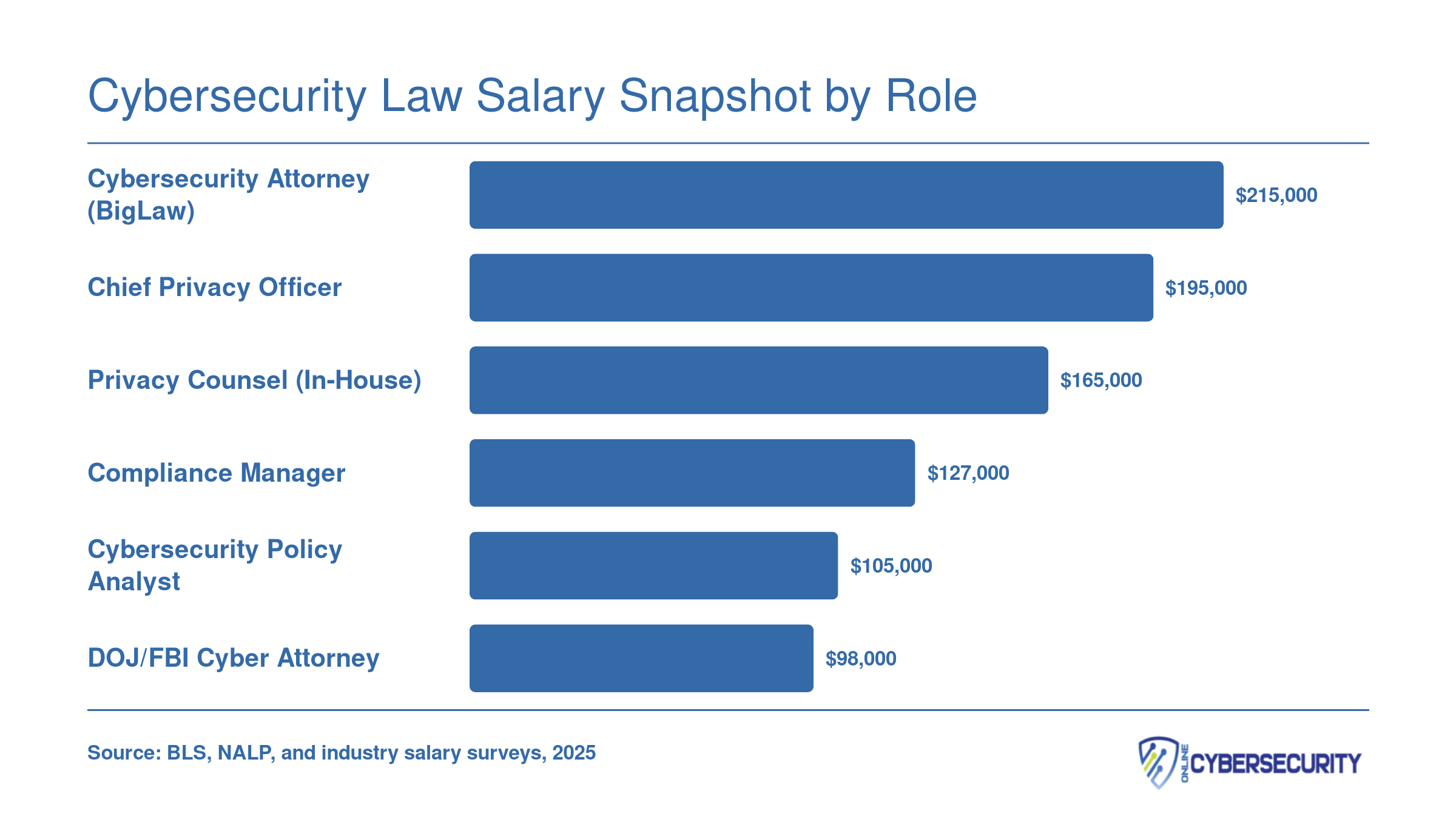
Annual salary surveys from organizations like NALP and staffing firms such as Robert Half Legal consistently highlight privacy and cybersecurity expertise as a premium specialization within the legal profession. In BigLaw, associates with a demonstrated focus on data privacy, incident response, or regulatory compliance can command salaries at the top of the associate pay scale, with first-year base compensation at large firms now commonly exceeding $215,000 in major markets. In-house counsel positions at technology companies often match or exceed those figures when equity compensation is included, and demand for these roles has intensified as data-breach litigation and global privacy regulations expand.
How Degree Type Affects Outcomes
Your credential level shapes both starting salary and the roles available to you.
- JD graduates: Eligible for bar admission and the full spectrum of legal practice, including litigation, regulatory enforcement, and BigLaw cybersecurity groups. Published employment reports from schools like Georgetown and Stanford show strong placement rates for JD holders entering privacy and technology law.
- LL.M. holders: Particularly valuable for foreign-trained lawyers or JD holders seeking a recognized specialization. LL.M. graduates frequently move into compliance leadership, policy advisory, or specialized counsel roles.
- MLS or MS in Cybersecurity Law graduates: These professionals often land in compliance, risk management, or government affairs positions where legal knowledge is essential but bar admission is not required. Salaries typically range from the mid-$80,000s to well over $110,000 depending on sector and experience. If this path appeals to you, learning how to become a compliance analyst can help you map out the day-to-day responsibilities and required skills.
Where to Verify Current Numbers
Salary data shifts year to year, so it pays to check a few sources before making enrollment decisions. The BLS Occupational Outlook Handbook lets you filter wages by industry and geography. Law school career services offices, particularly at programs known for cybersecurity law, publish annual employment reports with salary breakdowns by degree type and sector. Industry salary guides from firms like Robert Half Legal release updated figures each year and often call out cybersecurity and privacy as a distinct specialization category. Reviewing all three gives you a well-rounded picture of what graduates are actually earning rather than relying on a single snapshot.
Cybersecurity Law Salary Snapshot by Role
Compensation in cybersecurity law varies widely depending on whether you practice in a firm, work in-house, or serve in the public sector. The chart below compares median annual salaries across six common roles to help you gauge earning potential at each stage of a cybersecurity law career.
Online Vs. On-Campus Cybersecurity Law Programs: Choosing the Right Format
Deciding between an online and on-campus format is less about academic quality and more about how the program fits your life. Both delivery models can lead to the same credentials and career outcomes, but each comes with trade-offs worth weighing honestly. Hybrid and evening-cohort options offer a practical middle ground, and several top programs now require only a short residency or weekend intensive to blend flexibility with face-to-face interaction.
- Asynchronous schedules let working attorneys and compliance professionals study on their own time without leaving a current role.
- No relocation means you can access top-ranked programs outside your region without uprooting your family or career.
- Total cost is often lower because you avoid campus fees, housing expenses, and commuting costs.
- ABA accreditation applies to JD programs regardless of format, so an accredited online JD concentration carries the same professional weight.
- Hybrid and weekend-intensive models give you networking benefits without requiring a full-time campus commitment.
- Fewer opportunities for in-person networking, moot court, and spontaneous hallway conversations with faculty and peers.
- Self-discipline demands are higher because asynchronous coursework requires you to manage your own schedule consistently.
- Some employers still perceive on-campus programs as more rigorous, though this gap has narrowed significantly in recent years.
- Limited access to on-campus clinics and legal labs that simulate real courtroom or compliance environments.
- Short residency requirements in hybrid programs still involve travel and time away from work, which can be a logistical hurdle.
How Much Does an Online Cybersecurity Law Degree Cost?
Tuition for an online cybersecurity law degree varies widely depending on the credential you pursue, the institution, and whether you qualify for in-state rates. Understanding the full cost picture, along with the financial levers available to you, can help you avoid overpaying and shorten your path to a positive return on investment.
Tuition Ranges by Degree Type
Here is a realistic breakdown of what you can expect to pay in 2026 across the most common credential levels:
- JD programs (with a cybersecurity concentration): $80,000 to $180,000 total. Three-year JD programs carry the highest sticker price, though hybrid and online-friendly options at some state-affiliated law schools sit closer to the lower end of that range.
- LL.M. in Cybersecurity Law: $20,000 to $60,000 total. These one-year programs are designed for attorneys who already hold a JD, and many charge on a per-credit basis between roughly $800 and $1,800 per credit hour.
- MLS or MS degrees: $15,000 to $50,000 total. Master of Legal Studies and similar non-JD graduate programs offer the broadest price spread; public universities with online delivery often land below $25,000.
- Graduate certificates: $5,000 to $15,000 total. Certificates in cybersecurity law or data privacy typically require 12 to 18 credits and represent the most budget-friendly entry point.
Among the programs highlighted in this guide, several public and nonprofit institutions post median debt at graduation and net prices well below the midpoints above. For example, certain state university LL.M. and MLS programs report total costs under $25,000, while a handful of certificate options come in below $8,000, making them accessible even without employer sponsorship.
Thinking About ROI
Cost matters, but so does what you earn afterward. When you compare median debt at graduation against reported earnings four years after completion, many cybersecurity law graduates reach a break-even point within two to four years, particularly at the LL.M. and master's level. JD holders generally carry more debt but also command higher salaries in roles like privacy counsel or compliance director, so the payback timeline tends to stretch only modestly longer. If you are weighing law-specific credentials against broader best online cybersecurity programs, factor in how each degree positions you for the roles you actually want. When post-graduation earnings data is not yet available for a specific program, look at broader outcomes for the institution and degree level as a proxy.
Financial Aid Levers Worth Exploring
You do not have to fund the entire degree out of pocket. Several strategies can meaningfully reduce your net cost:
- Employer tuition reimbursement: Government agencies, Big Four consulting firms, and large technology companies commonly cover $5,250 or more per year in tuition. Some defense and intelligence employers go further for mission-critical credentials.
- Military and veteran benefits: The Post-9/11 GI Bill and Yellow Ribbon partnerships at ABA-accredited law schools can eliminate most or all tuition for eligible service members.
- Merit scholarships at ABA schools: Many law schools reserve scholarship funds specifically for online and hybrid students, especially those with strong undergraduate GPAs or relevant professional experience.
- Employer-sponsored education agreements: Some firms will fund an LL.M. or certificate in exchange for a service commitment, which simultaneously eliminates cost and guarantees a role upon completion.
Pairing a law degree with industry cybersecurity certifications can also strengthen your negotiating position for tuition reimbursement, since employers often view the combination as a high-value investment. Before committing, request a net price estimate directly from each program's financial aid office. The published tuition rate is rarely what you will actually pay, and even a modest scholarship or reimbursement benefit can shift a program from borderline affordable to clearly worthwhile.
How to Choose the Right Cybersecurity Law Program
Choosing the right program means layering your decision criteria in order of importance. Start with accreditation and work your way toward the details that match your specific career goals.
Start with Accreditation and Academic Quality
Accreditation is the non-negotiable first filter. If you are pursuing a JD or LL.M., the school must hold ABA accreditation, or you risk being ineligible to sit for the bar in most states. For MS-level programs, regional accreditation is the baseline, and a CAE (Centers of Academic Excellence) designation from the NSA and CISA is a strong bonus that signals curriculum rigor.
Once accreditation checks out, examine curriculum depth. Some programs offer only a survey-level overview of cyber law topics. Others dig into incident response planning, SEC disclosure obligations, AI governance frameworks, and cross-border data privacy regulations. A program that covers these granular areas will prepare you for the complexity of real-world practice far better than one that treats cybersecurity law as a single elective.
Consider Dual-Degree and Accelerated Pathways
If you want both legal credentials and technical fluency, dual-degree programs can save significant time and money. Indiana University Maurer School of Law offers a joint JD/MS in Cybersecurity Risk Management that requires roughly 103 credits over three to four years, a reduction of about 15 credits compared to earning both degrees separately.1 Roger Williams University School of Law has a JD/MA in Cybersecurity that can be completed in about 42 months, with a 12-credit cross-transfer arrangement between the two degree tracks.2
These pathways are still relatively rare, so if a combined credential appeals to you, they deserve serious attention during your search. Programs like NYU's MS in Cybersecurity Risk and Strategy serve a different purpose: a 12-month, executive-style master's designed for working professionals who already hold a law degree or other graduate credential.3
Evaluate the Alumni Pipeline
Not every program feeds into the same career track. Schools like Georgetown and George Washington University (which offers an MSL in National Security and Cybersecurity Law) have deep ties to federal agencies, the intelligence community, and national security roles. Other programs channel graduates toward BigLaw data privacy practices or in-house counsel positions at technology companies. Ask admissions offices for alumni placement data in your target sector, and look for clinics, externships, or capstone projects that connect you to employers while you are still a student.
Your Pre-Enrollment Checklist
Before committing, run through these practical steps:
- Bar eligibility: Confirm that the program satisfies bar admission requirements in the state where you plan to practice, especially for online or hybrid JD formats.
- Net cost after aid: Request a financial aid estimate and calculate total out-of-pocket expenses, not just sticker-price tuition.
- Schedule flexibility: Verify whether coursework is fully asynchronous if you need to study around a full-time job or other obligations.
- Certification prep integration: Check whether the curriculum aligns with professional certifications such as the CIPP (Certified Information Privacy Professional) or CISSP (Certified Information Systems Security Professional). Programs that weave exam preparation into coursework give you a credential advantage upon graduation.
- Experiential learning: Look for law clinics, externship placements, or applied capstone projects that let you work on real cybersecurity legal problems before you enter the job market.
By working through these layers, from accreditation down to practical logistics, you can narrow the field to a program that genuinely fits your career trajectory rather than settling for the first option you find.
Frequently Asked Questions About Cybersecurity Law Degrees
Cybersecurity law is a fast-evolving niche that blends legal expertise with an understanding of digital threats, data privacy, and regulatory compliance. Below are answers to common questions prospective students ask when exploring this field.
What is a cybersecurity law degree?
What can you do with a cybersecurity law degree?
Do you need a technical background for a cybersecurity law program?
Which cybersecurity law programs can be completed entirely online?
What is the difference between a JD, LL.M., and MLS in cybersecurity law?
Can an LL.M. in cybersecurity law qualify you to take the bar exam?
How much does an online cybersecurity law degree cost?
Explore Programs
- Best Affordable Online Cybersecurity Degrees
- Best Bachelor's in Computer Science Cybersecurity
- Best Fastest Online Cybersecurity Degrees in
- Best Online Associate Degrees in Cybersecurity
- Best Online Bachelor's in Cybersecurity
- Best Online Cybersecurity Bootcamps in
- Best Online Graduate Certificates in Cybersecurity
- Best Online Master's in Cybersecurity
- Best Online Ph.D. in Cybersecurity Programs for