

What you’ll learn in this article…
- Information security analysts earned a median annual wage of $124,910 in 2024, and independent consultants often bill $150 to $300 plus per hour.
- A bachelor's degree in cybersecurity or a related field is the most common starting point, though alternative pathways exist for career changers.
- Certifications like CISSP, CISA, and CompTIA Security Plus carry extra weight in consulting because they build immediate client trust.
- Most consultants need three to five years of hands-on security experience before transitioning into an advisory role.
Global cybersecurity spending is projected to exceed $200 billion in 2026, yet more than half of organizations report they still lack sufficient in-house expertise to manage their risk. That gap is why cybersecurity consulting continues to grow faster than most adjacent roles. Unlike a salaried security engineer embedded in one company's SOC, a cybersecurity consultant moves across clients, industries, and threat profiles, delivering assessments, remediation plans, and compliance strategies on contract.
The path into consulting is structured but flexible: a combination of formal education, hands-on operational experience, targeted certifications, and eventually a specialization that differentiates you in a crowded market. If you are still exploring the broader cybersecurity career path, consulting is one of the most versatile branches you can grow into. Most consultants need three to five years of practitioner experience before clients or firms will trust them in an advisory seat, which makes early career decisions matter more than they might appear to at first glance.
What Does a Cybersecurity Consultant Do?
A cybersecurity consultant is an external or contracted advisor who assesses, designs, and improves an organization's security posture. Think of the role as part detective, part architect, and part translator. Unlike a cybersecurity analyst, who monitors networks and responds to alerts on a day-to-day basis from inside the organization, a consultant parachutes in with fresh eyes, diagnoses weaknesses, recommends fixes, and often helps implement them before moving on to the next client. That blend of deep technical knowledge, client-facing communication, and business acumen is what separates consulting from pure engineering roles.
Four Specialization Lanes
Most cybersecurity consultants gravitate toward one of four lanes, each with its own rhythm and deliverables.
- GRC (Governance, Risk, and Compliance): You spend your day reviewing policies, mapping controls to frameworks like NIST or ISO 27001, and preparing organizations for audits. A typical morning might include a focused 60- to 90-minute block drafting a risk assessment report, followed by stakeholder interviews.1 The work tempo is generally steady with peaks around audit deadlines, and hours often follow a standard nine-to-five schedule.
- Technical (Penetration Testing and Architecture Review): Your job is to think like an attacker. Engagements are sprint-based, typically lasting one to two weeks, during which you probe networks, applications, or cloud environments for exploitable vulnerabilities.2 One day you might be crafting phishing simulations; the next, you are writing a detailed findings report for the client's engineering team.
- vCISO (Virtual Chief Information Security Officer): You serve as a fractional executive, providing strategic security leadership to organizations that cannot justify a full-time CISO. Most vCISOs juggle three to eight clients simultaneously on a calendar-driven cadence, building 12- to 24-month security roadmaps, presenting to boards, and aligning security investments with business objectives.
- Incident Response: Calm stretches punctuated by bursts of urgency define this lane. When a breach hits, you triage the damage, lead forensic investigations, coordinate with legal teams, and guide the client through recovery. Between incidents, you refine playbooks and conduct tabletop exercises.
Typical Engagement Structures
How you work with clients varies almost as much as what you do for them. Most consulting arrangements fall into three models.
- Fixed-scope assessments: A defined project, usually two to four weeks, with a clear deliverable such as a penetration test report or compliance analyst gap analysis.
- Retainer-based advisory: The client pays a monthly fee for ongoing access to your expertise, common in vCISO and GRC work where continuity matters.
- Project-based implementations: Longer engagements focused on deploying or redesigning security controls, such as rolling out a zero-trust architecture or standing up a security operations center.
The Consultant Differentiator
Technical chops alone will not make you successful in this career. Consultants must translate complex findings into language that executives, board members, and non-technical stakeholders can act on. You are selling trust as much as expertise. The ability to scope engagements accurately, manage client expectations, and deliver polished reports on time is what turns a skilled practitioner into a sought-after consultant. If you enjoy variety, thrive on solving new puzzles, and feel comfortable presenting to a room full of decision-makers, consulting may be the right fit for your cybersecurity career path.
Step 1: Build Your Educational Foundation
Your educational background sets the stage for where you enter the cybersecurity consulting pipeline, how quickly you advance, and which doors open first. The good news: there is more than one path, and the field rewards demonstrated skill as much as formal credentials.
Degree Tiers and What They Unlock
Think of degrees as accelerators rather than gatekeepers. Each tier positions you differently in the consulting landscape.
- Associate's (IT, cybersecurity, networking): A two-year degree can land you entry-level SOC analyst or help-desk roles, which are valuable stepping stones. You will build foundational knowledge in networking, operating systems, and threat monitoring that consulting work demands later.
- Bachelor's (cybersecurity, computer science, information systems): This is the most common entry point for consulting positions. A four-year degree signals broad technical literacy and is often a baseline requirement at Big Four firms, large consultancies, and federal contractors.
- Master's or MBA with a security concentration: If your goal is virtual CISO (vCISO) advisory work, GRC consulting, or executive-level strategy engagements, a graduate degree strengthens your candidacy. It also helps career changers reframe prior experience in audit, compliance, or law into a security context.
Do You Actually Need a Degree?
The honest answer is no, a degree is not strictly required, but context matters. Career changers from military, legal, compliance, or audit backgrounds regularly transition into cybersecurity consulting by combining industry certifications with hands-on lab work. Employers at mid-sized firms and startups tend to prioritize what you can do over where you studied.
That said, a degree accelerates hiring at large consulting firms. Big Four recruiters still use degree completion as a screening filter, and some government consulting contracts mandate a bachelor's or equivalent. If you are weighing the investment, think about where you want to consult, not just whether you can consult.
Non-Degree Pathways Worth Exploring
If a traditional degree is not the right fit, several alternatives can build real, portfolio-ready skills.
- Coding bootcamps with security tracks: Programs that blend software development fundamentals with penetration testing or secure coding give you demonstrable project work in weeks rather than years.
- Vendor academies: Cisco, Microsoft, and AWS each offer structured learning paths that culminate in respected certifications. Completing these tracks signals you can operate within specific enterprise ecosystems, which clients value.
- Self-study platforms: TryHackMe and Hack The Box let you practice offensive and defensive security in guided lab environments. Documenting your progress (write-ups, challenge completions, rankings) creates a portfolio that speaks louder than a transcript in many hiring conversations.
Competency-Based Programs Are Gaining Ground
Employers increasingly accept competency-based online programs from institutions like WGU and the SANS Technology Institute. These programs let you move at your own pace, often folding industry certifications directly into the curriculum so you graduate with both a degree and credentials like the CompTIA Security+ or GIAC certifications already in hand. For working professionals and career changers, this model can cut both cost and time significantly. You can explore best online cybersecurity programs to compare options that fit your schedule and budget, or look into affordable cybersecurity programs if cost is a primary concern.
If you are curious about what coursework actually looks like, a helpful overview of what to expect from a cybersecurity degree program can demystify the academic side before you commit.
Regardless of the path you choose, the goal at this stage is the same: build a knowledge base in networking, operating systems, and security principles that gives you the vocabulary and technical intuition consulting clients expect from day one.
Questions to Ask Yourself
Step 2: Gain Hands-On Cybersecurity Experience
No one hires a consultant who has only studied security in the abstract. Clients pay for practitioners who have solved real problems under real pressure. Before you pitch yourself as a cybersecurity consultant, you need a track record of hands-on work, and the role you choose now will shape the consulting niche you grow into later.
Match Your Stepping-Stone Role to a Consulting Track
Think of your first few positions as an apprenticeship for the consulting career ahead. Different roles feed different consulting specialties:
- SOC analyst or security engineer: These positions immerse you in threat detection, incident response, and security architecture. They are the natural launchpad for technical consulting, penetration testing engagements, and red-team advisory work.
- IT auditor or compliance analyst: If you gravitate toward frameworks like NIST, ISO 27001, or HIPAA, these roles prepare you for governance, risk, and compliance (GRC) consulting, one of the fastest-growing consulting niches.
- Security manager or director: Leading a security program end to end builds the strategic perspective needed for virtual CISO (vCISO) engagements, where organizations hire you to serve as their outsourced security executive.
If the SOC analyst or security engineer career path appeals to you, those roles offer the deepest immersion in day-to-day defensive operations. Similarly, the compliance analyst education requirements are well worth exploring if the GRC track sounds like your fit. Pick a path that matches your strengths, but stay curious about the others. Versatility is a consulting superpower.
Set Realistic Timelines
Most cybersecurity consultants land their first consulting engagement after roughly three to five years of hands-on experience. That timeframe gives you enough depth to diagnose problems confidently and enough breadth to adapt across client environments. Senior consultants and vCISOs typically carry eight to fifteen years of progressive experience before stepping into those roles. Rushing the timeline is possible but risky; clients notice thin expertise quickly.
Build a Portfolio Before You Have Clients
You do not need paying clients to demonstrate consulting-caliber skills. Start building evidence of your abilities now:
- Compete in capture-the-flag (CTF) events on platforms like HackTheBox or PicoCTF. Consistent participation shows problem-solving stamina and curiosity.
- Contribute to open-source security projects such as OWASP ZAP or community Sigma detection rules. Commits and pull requests are public proof of technical depth.
- Write mock penetration test reports or risk assessment summaries for fictional (or home-lab) environments. These samples demonstrate your ability to communicate findings to non-technical stakeholders, which is arguably the core skill of any consultant.
Publishing writeups on a personal blog or sharing CTF walkthroughs also helps you practice the clear, structured communication style that separates good consultants from great ones.
Get Inside a Consulting Firm Early
One of the smartest accelerators is joining a consulting firm at the analyst or associate level. Organizations like Deloitte, CrowdStrike, and Optiv hire early-career professionals and rotate them across multiple client engagements within the first year or two. That exposure compresses what might take five years of single-employer experience into a fraction of the time. You learn to context-switch between industries, adapt to different security maturity levels, and deliver under tight project timelines. Even if you eventually go independent, the consulting methodology and client-management habits you pick up at a firm will serve you for the rest of your career.
Step 3: Earn Key Certifications for Consulting
Certifications tell clients and employers that your skills have been independently validated, and in consulting they carry even more weight than in traditional IT roles. The right credentials signal specialization, build trust, and can directly influence the rate you command. Choosing which certifications to pursue depends on where you are in your career and which consulting track you want to follow. For a broader look at credential options, explore our cybersecurity certifications guide.
Technical Track Certifications
If you plan to focus on penetration testing, vulnerability assessment, or security architecture, start with foundational credentials and work up.
- CompTIA Security+: No formal prerequisites; recommended for those with about two years of IT experience. This is widely recognized as the entry point for security roles and is approved for DoD 8570 baseline positions.
- CompTIA CySA+ and PenTest+: Both build on Security+ and target analysts and penetration testers, respectively. Each recommends three to four years of hands-on experience.
- CEH (EC-Council): Requires either two years of information security experience or completion of an EC-Council training program before you can sit for the exam.
- OSCP (Offensive Security): No strict prerequisites, but this is a hands-on, performance-based exam that most candidates tackle after several years in penetration testing. It is considered one of the most respected offensive security credentials in the industry.
Governance, Risk, and Compliance (GRC) Track
Consultants who advise on regulatory frameworks, audit readiness, and risk management lean on a different set of credentials.
- CGRC (formerly CAP), from (ISC)²: Targets professionals working in risk management and authorization roles. Requires two years of cumulative experience in one or more of the exam domains.
- CISA (ISACA): Focused on information systems auditing. Requires five years of relevant professional experience, though certain substitutions for education are allowed.
- CISM (ISACA): Geared toward security management and strategy. Also requires five years of experience, with at least three in information security management.
Senior and vCISO Track
Once you have deep experience and want to serve as a fractional or virtual CISO, these credentials carry the most authority.
- CISSP ((ISC)²): The gold standard for senior security professionals. Requires five years of cumulative, paid work experience across two or more of eight domains. You can pass the exam first and work as an Associate of (ISC)² while accumulating the required experience.
- CCISO (EC-Council): Designed specifically for chief information security officers. Requires five years of experience in at least three of five CCISO domains to qualify for the exam without taking the EC-Council training.
Practical Tips for Choosing and Verifying
Exam costs, renewal cycles, and prerequisites change regularly. Before committing time and money, go directly to the official certification body websites for CompTIA, (ISC)², ISACA, EC-Council, and Offensive Security to confirm current pricing and policies. ISACA and (ISC)² both publish detailed breakdowns of how education and professional experience hours are calculated, which is especially useful if you are transitioning from a related field.
To understand which certifications employers and clients are actually requesting, check job postings on BLS.gov and major hiring platforms. You will notice that Security+ and CySA+ appear most often in entry-level and mid-level listings, while CISSP and CISM dominate senior consultant and advisory roles. Aligning your certification roadmap to real market demand keeps your investment practical and your consulting career on a clear trajectory.
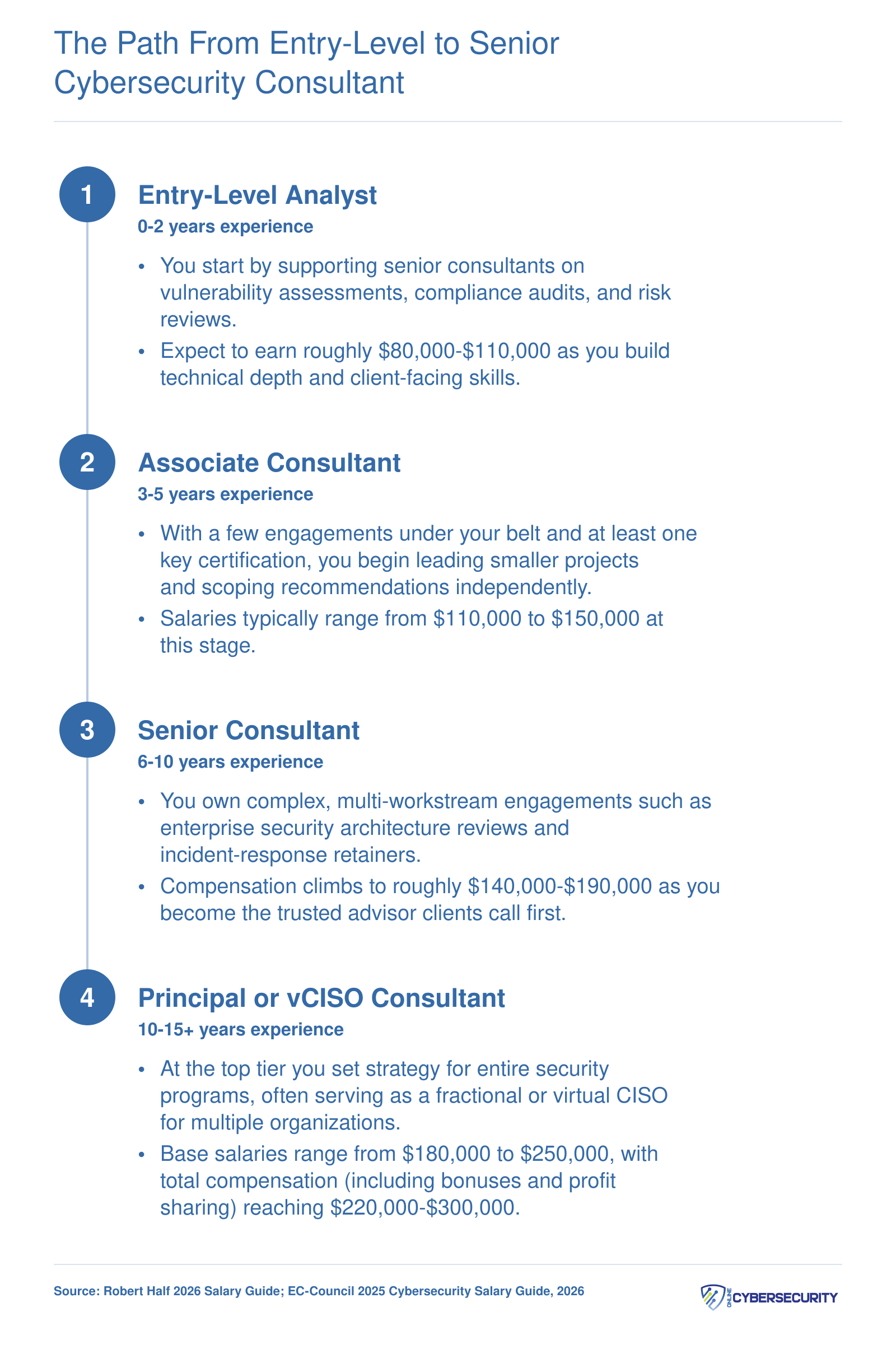
The Path From Entry-Level to Senior Cybersecurity Consultant
Cybersecurity consulting rewards specialization and staying power. Each career stage unlocks higher-impact projects, broader client relationships, and significantly better compensation. Here is what the typical progression looks like in 2026.
Cybersecurity Consultant Salary and Job Outlook
Cybersecurity consulting pays well above the national average, and demand for qualified professionals continues to accelerate. According to the Bureau of Labor Statistics, information security analysts earned a median annual wage of $124,910 in 2024, roughly 2.5 times the $49,500 median for all U.S. occupations. The field is projected to grow 29% from 2024 to 2034, with approximately 16,000 to 17,000 openings expected each year. That growth rate far outpaces most occupations, making cybersecurity consulting one of the strongest career bets for the decade ahead.
| Metric | Information Security Analysts | All Occupations | Computer and IT Occupations |
|---|---|---|---|
| Median Annual Wage (2024) | $124,910 | $49,500 | $105,990 |
| Mean Annual Wage (2024) | $127,730 | N/A | N/A |
| 25th Percentile Wage (2024) | $92,160 | N/A | N/A |
| 75th Percentile Wage (2024) | $159,600 | N/A | N/A |
| Total Employment (2024) | 179,430 | N/A | N/A |
| Projected Job Growth (2024 to 2034) | 29% | N/A | N/A |
| Estimated Annual Openings (2024 to 2034) | 16,000 to 17,000 | N/A | N/A |
Highest-Paying States and Metro Areas for Cybersecurity Consultants
Where you work can significantly affect your earning potential as a cybersecurity consultant. The following table highlights the top-paying metropolitan areas for information security analysts, the occupational category that includes cybersecurity consultants. These figures reflect annual wages reported by the Bureau of Labor Statistics and can help you weigh relocation or remote work decisions as you plan your consulting career path.
| Metro Area | Total Employment | 25th Percentile Salary | Median Salary | Mean Salary | 75th Percentile Salary |
|---|---|---|---|---|---|
| San Jose, Sunnyvale, Santa Clara, CA | 2,500 | $132,810 | $175,520 | $204,340 | $220,100 |
| San Francisco, Oakland, Fremont, CA | 4,010 | $129,350 | $168,160 | $166,090 | $188,060 |
| Seattle, Tacoma, Bellevue, WA | 4,490 | $121,370 | $152,660 | $156,000 | $174,530 |
| New York, Newark, Jersey City, NY/NJ | 10,160 | $106,760 | $138,360 | $146,810 | $172,050 |
| Washington, Arlington, Alexandria, DC/VA/MD/WV | 15,870 | $111,130 | $138,410 | $146,720 | $172,670 |
| Baltimore, Columbia, Towson, MD | 4,370 | $103,780 | $136,050 | $144,460 | $175,420 |
| Denver, Aurora, Centennial, CO | 3,620 | $103,780 | $131,670 | $137,180 | $165,430 |
| San Diego, Chula Vista, Carlsbad, CA | 1,240 | $94,260 | $130,900 | $134,740 | $168,070 |
| Los Angeles, Long Beach, Anaheim, CA | 4,420 | $97,800 | $131,280 | $133,230 | $164,130 |
| Boston, Cambridge, Newton, MA/NH | 4,870 | $101,760 | $132,170 | $132,120 | $164,370 |
| Dallas, Fort Worth, Arlington, TX | 6,570 | $101,550 | $131,280 | $128,470 | $154,150 |
| Phoenix, Mesa, Chandler, AZ | 3,160 | $99,400 | $130,390 | $130,430 | $170,400 |
| Austin, Round Rock, San Marcos, TX | 1,870 | $93,450 | $121,880 | $128,460 | $151,540 |
| Charlotte, Concord, Gastonia, NC/SC | 2,130 | $96,960 | $127,840 | $127,280 | $161,250 |
| Minneapolis, St. Paul, Bloomington, MN/WI | 2,090 | $100,860 | $129,380 | $127,600 | $147,390 |
| Atlanta, Sandy Springs, Roswell, GA | 4,940 | $96,970 | $126,880 | $127,490 | $160,670 |
| Houston, Pasadena, The Woodlands, TX | 2,040 | $94,770 | $120,170 | $127,360 | $150,390 |
| Philadelphia, Camden, Wilmington, PA/NJ/DE/MD | 2,440 | $95,060 | $124,270 | $126,220 | $152,350 |
| Orlando, Kissimmee, Sanford, FL | 2,070 | $97,190 | $124,870 | $124,570 | $151,380 |
| Huntsville, AL | 1,570 | $92,240 | $127,120 | $122,530 | $153,820 |
Independent Vs. Firm-Based Consulting: Which Path Is Right for You?
Most cybersecurity consultants eventually face a defining career question: go solo or join an established firm? Neither path is inherently better. The right choice depends on your risk tolerance, financial situation, and how much you enjoy the business side of consulting alongside the technical work.
- Independent consultants often command higher hourly rates, sometimes 30 to 50 percent more per engagement than salaried peers at firms.
- You choose your own clients, letting you specialize in industries or threat domains you find most rewarding.
- Schedule flexibility allows you to balance project intensity with personal time, a major draw for career changers seeking work-life control.
- Niche specialization freedom means you can pivot quickly into emerging areas like AI security or cloud compliance without corporate approval.
- Firm-based consultants enjoy a steady salary plus benefits such as health insurance, retirement plans, and paid time off.
- Working at a recognized firm gives you built-in deal flow, so you spend less time hunting for projects and more time doing the work.
- Established firms provide mentorship, structured training budgets, and exposure to large-scale engagements that accelerate your skills.
- A well-known firm's brand lends instant credibility with enterprise clients, which can be hard to earn on your own.
- Independent consultants have no steady paycheck; income can swing dramatically between busy quarters and dry spells.
- You fund your own benefits, professional development, and tools, costs that add up to thousands of dollars annually.
- Running a solo practice means handling sales, marketing, invoicing, and admin tasks that take time away from billable work.
- Building a client base from scratch often takes 12 to 18 months, so expect a slower ramp-up period before reaching full earning potential.
- Firm-based consultants typically earn less per engagement because the firm captures a significant share of the client fee.
- You have limited control over which projects land on your desk, and turning down assignments can be politically difficult.
- Heavy travel schedules and back-to-back client engagements at firms can lead to burnout, especially in the first few years.
- Career advancement inside a firm may depend more on internal politics and utilization targets than on pure technical excellence.
How to Start an Independent Cybersecurity Consulting Business
Going independent is one of the most rewarding moves in a cybersecurity consulting career path, but it demands more than technical skill. You need a legitimate business structure, clear contracts, a pricing strategy, and a reliable way to find clients. Here is how to set each piece in place.
Form Your Business Entity
Most independent cybersecurity consultants register as an LLC or elect S-Corp tax status. An LLC separates your personal assets from business liabilities, which matters when you are handling sensitive client data and risk assessments.
Filing fees vary widely by state.1 Montana, Kentucky, and Missouri charge as little as $35 to $50 to file, with minimal or zero annual fees. On the other end, Massachusetts and Nevada can cost $425 to $500 upfront and $300 to $500 per year in recurring fees. California's annual franchise tax adds $800 regardless of revenue. Across all states, the average filing fee sits around $132, so the barrier to entry is low in most places.
Beyond the filing itself, budget for a registered agent ($100 to $300 per year) and, optionally, an attorney review of your formation documents ($1,000 to $1,500). You can use an online formation service for $39 to $79 if you prefer the DIY route.
Protect Yourself with Insurance and Contracts
Professional liability insurance (sometimes called errors and omissions, or E&O) is non-negotiable. If a vulnerability you missed in an assessment leads to a breach, E&O coverage protects you from lawsuits. Typical annual premiums for cybersecurity consultants run $1,000 to $3,000, depending on your coverage limits and client base.
On the contract side, prepare two core documents:
- Master Services Agreement (MSA): Establishes the overall relationship, confidentiality obligations, liability caps, data handling requirements, and dispute resolution terms.
- Statement of Work (SOW): Attached to the MSA for each engagement, detailing scope, deliverables, timeline, and pricing.
Having these templates ready signals professionalism to prospective clients and protects both sides if scope creep or disagreements arise.
Set Your Billing Model
Independent consultants typically use one of three pricing structures, and many blend them depending on the engagement.
- Hourly rates: Mid-career consultants commonly bill $150 to $300 or more per hour. Those operating at the virtual CISO (vCISO) level often command $300 to $500 or higher.
- Project-based fees: A full penetration testing engagement, for example, might range from $15,000 to $50,000 depending on scope and complexity.
- Monthly retainers: Fractional CISO services, where you serve as a part-time security leader for a small or midsize company, typically land between $5,000 and $15,000 per month.
Retainers offer predictable income and deeper client relationships, so many independents aim to build a portfolio of two or three retainer clients as their revenue foundation.
Build Your Client Pipeline
Finding your first clients is usually the hardest part. Here are strategies that consistently work in this space:
- LinkedIn thought leadership: Publish short posts and articles on compliance changes, emerging threats, or lessons from real engagements (anonymized, of course). Decision-makers notice consultants who share practical insight.
- Local chapter involvement: Volunteering with ISACA, ISC2, or ISSA chapter events puts you in rooms with CISOs and IT directors who may need outside help.
- MSP and MSSP partnerships: Managed service providers often encounter clients who need deeper security work than they can deliver in-house. Becoming a trusted referral partner can generate a steady flow of engagements.
- Freelance platforms: Listing on curated marketplaces like Upwork Pro or Toptal can fill early gaps in your pipeline while you build direct relationships.
Transition Wisely
One pattern worth noting: most successful independent consultants do not quit their full-time job on day one. They start by moonlighting on small engagements, perhaps a policy review, a risk assessment for a friend's company, or a short advisory project. The goal is to build two or three solid reference clients before making the leap. Those references become the credibility engine that wins your next engagement and the one after that.
If you are still early in your cybersecurity career path, gaining hands-on experience as a salaried professional first will make the transition to independent consulting far smoother. Starting a cybersecurity consulting business involves real overhead and planning, but the financial upside and professional autonomy make it a compelling option for experienced practitioners ready to bet on themselves.
How to Land Your First Cybersecurity Consulting Role
Breaking into cybersecurity consulting can feel like a catch-22: firms want consultants with client-facing experience, but you need that first role to get it. The good news is that with the right positioning, you can bridge the gap faster than you might expect. Here is a practical playbook for making it happen.
Craft a Results-Driven Resume
Consulting hiring managers care less about what you were responsible for and more about the outcomes you delivered. Rewrite every bullet on your resume to lead with measurable business impact. For example, instead of "Performed vulnerability assessments for clients," try "Reduced client attack surface by 40% across 12 assessments by prioritizing critical findings and delivering remediation roadmaps within SLA." Quantify wherever possible: dollars saved, incidents prevented, compliance gaps closed, time-to-remediation shortened. Even internal IT security work can be reframed in consulting language if you focus on the stakeholder you served and the result you produced.
Build Your LinkedIn Brand
Your LinkedIn profile is often the first impression a recruiter or prospective client gets. Optimize your headline for the specific consulting niche you are targeting. Something like "GRC Consultant | CISM | NIST/ISO 27001" immediately signals domain expertise. Beyond the headline, commit to publishing one or two short posts per week on topics such as evolving compliance frameworks, emerging threat vectors, or lessons from recent breach disclosures. Consistent thought leadership, even in bite-sized form, builds credibility and keeps you visible to the people who make hiring decisions.
Network With Purpose
Relationships open doors that resumes alone cannot. Prioritize events where security practitioners and decision-makers overlap:
- BSides and DEF CON: Great for technical credibility and meeting hiring consultants face-to-face.
- ISSA and ISACA chapter meetings: Local chapters often host smaller gatherings where you can have real conversations with regional consulting leaders.
- Nonprofit security reviews: Offer a free 30-minute security posture review to a local nonprofit. You gain a genuine portfolio piece, a testimonial you can reference in proposals or interviews, and the satisfaction of giving back.
Think of each interaction as a chance to demonstrate how you think, not just what you know. If you are still building foundational knowledge, exploring online cybersecurity programs can help you fill any remaining gaps before you start networking in earnest.
Prepare for Scenario-Based Interviews
Consulting interviews lean heavily on situational questions designed to test both your technical depth and your ability to communicate with non-technical stakeholders. Expect prompts like, "A client just experienced a ransomware incident. Walk us through your first 48 hours." Practice structuring your answers around containment, communication, investigation, and recovery, and be ready to explain trade-offs in plain language.
Another common exercise is presenting a mock risk assessment to a panel that includes business-side interviewers. Rehearse translating technical findings into business risk: frame vulnerabilities in terms of potential financial exposure, regulatory penalties, or reputational damage rather than CVSS scores alone. Record yourself and watch it back. The ability to distill complexity into clear, actionable guidance is the single skill that separates good consultants from great ones.
Combine these four strategies and you will not just land interviews; you will walk in with the confidence and positioning that consulting firms are actively looking for.
Frequently Asked Questions About Cybersecurity Consulting
These are some of the most common questions career changers and students ask about breaking into cybersecurity consulting. Each answer draws on the salary data, certification details, and career path information covered throughout this guide.
What qualifications do you need to be a cybersecurity consultant?
How long does it take to become a cybersecurity consultant?
Do you need a degree to be a cybersecurity consultant?
What is the difference between a cybersecurity analyst and a cybersecurity consultant?
What certifications should a cybersecurity consultant have?
Can you become a cybersecurity consultant with no IT experience?
There is no single path into cybersecurity consulting. Career changers, self-taught practitioners, and degree holders all find viable routes, and the field's projected growth means demand is not slowing down.
Here is a concrete first move: choose a specialization track (GRC, technical penetration testing, or vCISO advisory), commit to earning your first certification within six months, and start building a portfolio of projects today. Even a home lab write-up or a pro bono risk assessment counts. The sooner you start stacking real experience on top of your education, the sooner you will be billing for it. If you are still mapping your broader cybersecurity career path, our degree guides and certification resources can help you chart the next step with confidence.