

What you’ll learn in this article…
- A bachelor's degree in business, finance, or a related field meets most employers' compliance analyst education requirements in 2026.
- Certifications like CCEP and CRCM can accelerate advancement and help career changers break in from non-traditional backgrounds.
- The national median salary for compliance officers is $78,420, with top-paying states exceeding $100,000 annually.
- BLS projects about 5 percent employment growth for compliance officers from 2024 to 2034, keeping demand steady across industries.
Regulatory enforcement actions in the U.S. topped $5.8 billion in financial penalties in 2025 alone, and every one of those cases reinforced the same reality: organizations across finance, healthcare, and tech need skilled compliance analysts more than ever. The Bureau of Labor Statistics pegs the median salary for compliance officers at $78,420, with top earners clearing six figures, yet the talent pipeline remains thin relative to demand.
For career changers, the practical tension is real. Some employers expect a bachelor's degree in business or law, while others hire candidates who pivot from IT, nursing, or military service with the right certifications. Both paths work, but the combination of education, credentials, and industry focus you choose determines how fast you get hired and how quickly your salary grows.
What Does a Compliance Analyst Do?
Think of a compliance analyst as part detective, part educator. At its core, the role revolves around monitoring whether an organization is following the laws, regulations, and internal policies that govern its operations. When something looks off, you investigate. When people need guidance, you teach. It is a position that demands curiosity, attention to detail, and the ability to translate dense regulatory language into action items that real teams can follow.
A Day in the Life of a Compliance Analyst
No two days are identical, but most compliance analysts cycle through a predictable set of responsibilities:
- Reviewing policy documents: You compare existing company policies against current regulations to spot gaps or outdated language.
- Running risk assessments: You identify areas where the organization is most vulnerable to regulatory violations and quantify the potential impact.
- Preparing audit reports: Whether for an internal review or an external regulator, you compile data, document findings, and present clear summaries.
- Training staff: You design or deliver training sessions so employees across departments understand their compliance obligations.
- Flagging issues to senior leadership: When you uncover a potential violation or a trending risk, you escalate it with evidence and recommended next steps.
The weight you give each of these tasks shifts considerably depending on your industry, a topic we explore in more detail later in this guide.
How the Analyst Role Differs From Officer or Manager
Job titles in compliance can look similar from the outside, but the scope is distinct. A compliance analyst is typically the hands-on data and reporting engine of the team. You gather evidence, run queries, analyze trends, and draft the documentation that decision-makers rely on. A compliance officer or compliance manager, by contrast, owns more of the strategic direction: setting policy, negotiating with regulators, and making judgment calls about acceptable risk. As an analyst, your recommendations carry weight, but final decisions usually rest a level or two above you. In cybersecurity-focused organizations, a similar analyst-to-leadership trajectory exists for security analysts who move into engineering or architecture roles over time.
Where Compliance Analysts Sit in an Organization
Most compliance analysts report into a Chief Compliance Officer or work within a broader legal or risk management department. In smaller companies, you might report directly to the general counsel or even the CFO. In large enterprises, especially in heavily regulated sectors like banking or healthcare, the compliance team can be its own sizable division with a clear hierarchy from analyst through manager to officer.
Understanding the reporting structure matters because it shapes the kind of mentorship and career growth you can expect. A dedicated compliance department typically offers a more defined promotion path, while a smaller team might give you broader exposure to different aspects of the business from day one.
Compliance Analyst Education Requirements
The path to becoming a compliance analyst starts with education, but the exact route depends on the industry you want to work in and how quickly you need to get there. Here is what employers expect in 2026 and how to plan accordingly.
The Baseline: A Bachelor's Degree
Most employers require a bachelor's degree as the minimum qualification for a compliance analyst role. The most commonly accepted majors include:
- Business administration: A versatile foundation covering operations, ethics, and organizational management.
- Finance or accounting: Especially valued in banking, insurance, and financial services compliance.
- Criminal justice or political science: Useful for regulatory agencies and government compliance positions.
- Public administration: A strong fit for healthcare, environmental, or municipal compliance work.
- Computer science or information systems: Increasingly sought after for tech-sector compliance, data privacy, and cybersecurity regulatory roles.
The industry you target shapes the ideal major more than most people realize. If you want to work in healthcare compliance, a degree in health administration or health informatics gives you an edge over a general business degree. Banking and financial compliance teams lean heavily toward candidates with accounting or finance backgrounds because they need people who can read a balance sheet as fluently as they read a regulation. And if data privacy or technology compliance interests you, a cybersecurity degree program positions you well for roles governed by frameworks like GDPR, HIPAA, or emerging AI regulations.
Is a Master's Degree Necessary?
For entry-level positions, the answer is almost always no. A bachelor's degree paired with relevant internship experience or an entry-level certification is enough to get your foot in the door. That said, a graduate degree accelerates your climb into senior and leadership roles. An MBA sharpens your business acumen for chief compliance officer tracks. A Juris Doctor (JD) is a natural fit if your compliance work involves heavy legal interpretation. A specialized Master's in regulatory affairs or healthcare compliance can set you apart in niche fields. Think of advanced degrees as a career accelerator, not a prerequisite.
Can You Become a Compliance Analyst Without a Degree?
Yes, though the path is narrower and takes deliberate effort. Employers will consider candidates without a four-year degree if they bring substantial adjacent experience. Professionals who have worked as paralegals, internal auditors, IT security analysts, or in administrative roles at regulated companies often have transferable knowledge that hiring managers value. If your background is in information security, for example, you may already qualify for adjacent roles on the cybersecurity career path before pivoting into compliance. Pairing that experience with one or two respected certifications, such as the Certified Compliance and Ethics Professional (CCEP) or a similar credential, helps bridge the gap. Be prepared to demonstrate not just familiarity with regulations but a track record of applying them in a professional setting.
A Realistic Timeline
If you are starting from scratch, plan for roughly five years before landing your first compliance analyst position:
- Bachelor's degree: About four years of full-time study. Accelerated online programs can shave this down to three years in some cases.
- Entry-level certification: Typically takes anywhere from a few weeks to six months of focused preparation.
- Job search and onboarding: Budget six to twelve months for applications, interviews, and landing the right role, especially if you are building your network from the ground up.
This timeline compresses significantly if you already hold a degree in a related field or have work experience in a regulated industry. Career changers with backgrounds in audit, legal support, or information security may be able to transition in under two years with the right certification and a targeted job search strategy.
Essential Skills for Compliance Analysts
The good news about compliance analyst skills is that nearly all of them are buildable, whether you are starting from scratch or pivoting from a related field. Employers look for a blend of technical know-how and interpersonal strengths, so think of your skill set as two columns you can develop in parallel.
Hard Skills Employers Want to See
Job-posting data from 2024 through 2026 paints a clear picture of the technical competencies hiring managers prioritize most:
- Regulatory research and interpretation: Between 50 and 80 percent of compliance analyst postings call for the ability to read statutes, agency guidance, and internal policies, then translate them into actionable controls.1 You can start building this muscle by following free regulatory feeds from agencies like the SEC, CFPB, or NIST and summarizing updates in your own words.
- Data analysis (SQL, Excel, BI dashboards): SQL proficiency and advanced Excel skills (pivot tables, VLOOKUP, conditional formatting) appear in roughly 50 to 80 percent of listings.2 Business intelligence tools such as Tableau and Power BI show up in 30 to 60 percent.3 Free courses on platforms like Codecademy (SQL) or Microsoft Learn (Power BI) can get you job-ready in weeks, not months.
- Report writing and documentation: Compliance lives and dies by its paper trail. Expect to draft audit findings, risk assessments, and board-level summaries. Practice by writing concise memos that bridge technical detail and plain language.
- GRC platform fluency: Governance, risk, and compliance platforms are referenced in 50 to 80 percent of postings overall, with specific tools like ServiceNow GRC, MetricStream, LogicGate, and Archer named in 20 to 50 percent.1 Many vendors offer free community editions or sandbox environments. ServiceNow, for instance, provides a developer instance you can spin up at no cost to learn workflow configuration.
A smaller but growing slice of postings, roughly 5 to 20 percent, now mention emerging RegTech capabilities such as AI-powered monitoring and automated control testing.4 Keeping an eye on this space gives you an edge even at the entry level.
Soft Skills That Set You Apart
Technical ability gets your resume past the filter. Soft skills get you through the interview and keep you effective on the job.
- Attention to detail: A single overlooked clause in a regulation can trigger fines or audit failures. Build this habit by proofreading your own work against checklists before submitting anything.
- Cross-audience communication: You will explain the same finding differently to a software engineer, a general counsel, and a C-suite executive. Practice reframing technical concepts for non-technical readers; it is one of the fastest ways to stand out. If you are curious how communication skills translate across cybersecurity roles, the guide on how to become a CISO shows how compliance expertise can eventually support executive leadership.
- Ethical judgment: Compliance analysts sometimes surface uncomfortable truths. Employers value professionals who can flag issues objectively and propose solutions without finger-pointing.
- Adaptability: Regulations shift constantly. New frameworks drop, enforcement priorities pivot, and technology evolves. Staying curious and comfortable with ambiguity is not optional in this career.
Building Your Skills on a Budget
You do not need to spend thousands of dollars to become competitive. A practical starting plan might look like this:
- Complete an introductory SQL course (Codecademy or Khan Academy, both free).
- Explore a GRC vendor sandbox such as the ServiceNow developer instance or LogicGate's resource library.
- Subscribe to two or three regulatory newsletters relevant to your target industry (finance, healthcare, tech) and summarize one update per week.
- Volunteer for documentation or audit-prep tasks in your current role to gain real-world report-writing practice.
Small, consistent effort across both hard and soft skills will put you in a strong position when you start applying. Most hiring managers understand that nobody walks in knowing every tool on day one. What they want to see is a foundation you are actively building.
Questions to Ask Yourself
Top Certifications for Compliance Analysts
Earning a professional certification can set you apart in a competitive job market and signal to employers that you have verified, up-to-date expertise. Below are five certifications worth evaluating at different career stages, from early-career analysts to seasoned compliance leaders.
Certified Compliance & Ethics Professional (CCEP)
The CCEP, issued by the Compliance Certification Board through the Society of Corporate Compliance and Ethics, is one of the most widely recognized credentials in corporate compliance.1 It covers broad compliance and ethics program management, making it a strong starting point for analysts building a generalist foundation.
- Prerequisites: At least one year of compliance-related work experience. No specific degree is required.1
- Exam format: 115 questions (100 scored, 15 unscored) completed in roughly two to three hours.3
- Cost: Approximately $200 to $300 for SCCE members, or $350 to $450 for non-members.2
- Maintenance: Recertification every two years, requiring a minimum of 20 continuing education units per cycle.1
Because the eligibility bar is relatively accessible, the CCEP is well suited for entry-level and early-career compliance analysts who want a respected, vendor-neutral credential.
Certified Regulatory Compliance Manager (CRCM)
Administered by the American Bankers Association, the CRCM targets professionals working in banking and financial-services regulation. If your career path points toward a bank or credit union compliance department, this certification carries significant weight with hiring managers who need specialists in consumer-protection and lending regulations.
Certified Anti-Money Laundering Specialist (CAMS)
Offered by ACAMS, the CAMS is the go-to credential for analysts focused on anti-money laundering, sanctions, and financial-crime prevention. It is particularly valuable in banking, fintech, and insurance sectors where AML programs are heavily scrutinized by regulators.
Certification in Control Self-Assessment (CCSA)
The Institute of Internal Auditors issues the CCSA for professionals who evaluate risk and internal controls. This certification pairs well with compliance roles that overlap with audit functions, and it tends to appeal to mid-career analysts moving into governance or risk management.
Cybersecurity-Compliance Certifications (CISA and CRISC)
For analysts drawn to the intersection of compliance and information security, two ISACA credentials deserve attention. The Certified Information Systems Auditor (CISA) validates your ability to assess IT controls and audit information systems. The Certified in Risk and Information Systems Control (CRISC) focuses on enterprise IT risk identification and management. Both are ideal if you plan to work in industries where data-privacy regulations and cybersecurity frameworks drive compliance requirements. You can explore a broader list of cybersecurity certifications to compare options across the security and compliance landscape.
Choosing the Right Certification
Prioritize based on your target industry and career stage. If you are just entering the field, the CCEP offers a broad, affordable credential that does not demand years of prior experience. If you already know you want to specialize in financial services, the CRCM or CAMS will deliver a stronger return on investment. And if your interests lean toward IT governance or data protection, CISA or CRISC can position you for roles that blend compliance with cybersecurity, a combination that is increasingly in demand across virtually every sector. Analysts considering a deeper pivot into security leadership may also want to review how to become chief information security officer, since that career path often builds on compliance expertise.
How to Break Into Compliance From a Non-Traditional Background
If you are reading this and thinking, "I didn't study compliance in college," you are in excellent company. A large share of working compliance analysts arrived through lateral moves, and hiring managers often prize the diverse perspective that comes with cross-functional experience. The key is positioning what you already know so employers can see the fit.
Mapping Your Background to a Compliance Entry Point
Certain roles translate surprisingly well into specific compliance niches. Here are a few common paths:
- IT support or help desk: Your familiarity with access controls, ticketing systems, and security policies maps directly to cybersecurity compliance roles, where organizations need people who understand both technical environments and regulatory frameworks.
- Paralegal or legal assistant: You already know how to parse regulation, track filing deadlines, and maintain documentation, all core regulatory compliance tasks.
- Bank teller or customer-facing finance roles: Day-to-day exposure to identity verification and transaction monitoring gives you a practical foundation for Anti-Money Laundering (AML) and Know Your Customer (KYC) compliance.
- Internal auditor: If you have assessed controls, tested processes, or prepared workpapers, you can pivot into controls testing and SOX compliance with relatively little ramp-up.
The Bridge Strategy
Think of your transition as a three-part bridge:
1. Leverage the adjacent experience you already have. 2. Earn one targeted certification that signals commitment. For a finance-oriented pivot, the Certified Anti-Money Laundering Specialist (CAMS) credential carries weight. For a broader entry, the Certified Compliance and Ethics Professional (CCEP) designation is well recognized across industries. 3. Seek out compliance committee work at your current employer. Many organizations have ethics committees, audit support teams, or policy review groups that welcome volunteers. Even a few months of participation gives you concrete compliance stories for interviews.
Combining these three elements tells a cohesive career narrative: relevant skills, credentialed knowledge, and real-world compliance exposure.
A Realistic Timeline
Most career changers can complete a certification and build supporting experience within six to twelve months of focused effort. During that period, target entry-level or compliance-adjacent hybrid roles, positions such as "compliance coordinator" or "risk and operations associate" that blend your existing strengths with compliance responsibilities. If your background leans toward IT, you might also explore the security engineer career path, which shares many of the same access-control and policy-enforcement fundamentals.
Translating Your Resume
One of the simplest, highest-impact changes you can make is rewriting your bullet points in compliance language. Instead of "followed company procedures," say "ensured policy adherence across departmental workflows." Replace "handled customer complaints" with "investigated and documented potential regulatory concerns." Compliance hiring managers scan for vocabulary that shows you understand the discipline, so mirror the phrasing you see in job descriptions.
The bottom line: you do not need to start over. You need to reframe what you have already done and fill the gap with a targeted credential and some hands-on committee experience. That combination gets interviews.
Related Articles
Compliance Analyst Salary: National Overview
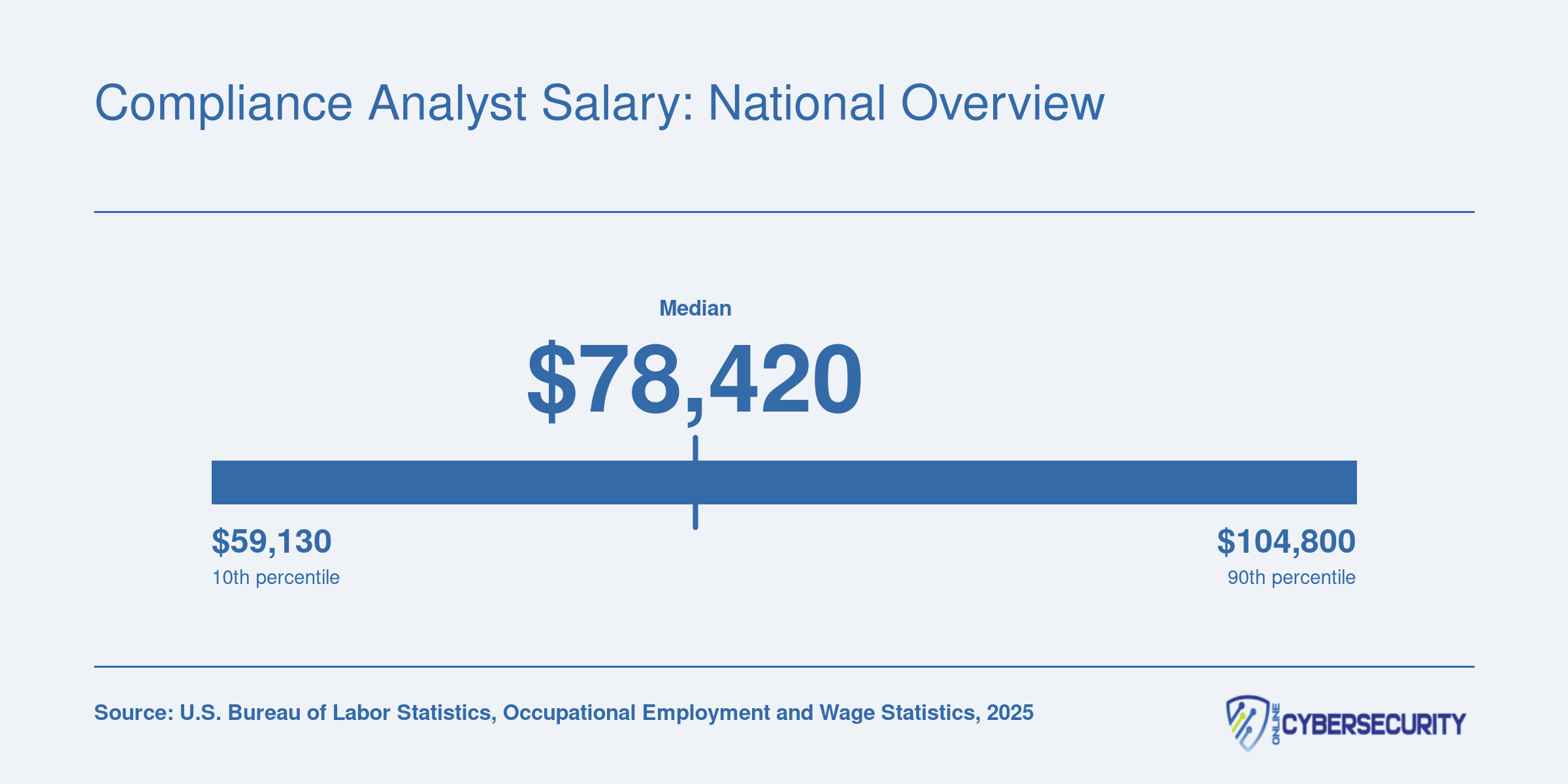
The Bureau of Labor Statistics groups compliance analysts under the broader Compliance Officers category (SOC 13-1041), which covers roughly 397,770 professionals nationwide. The median annual wage sits at $78,420, with the middle half of earners falling between about $59,130 and $104,800. Where you land in that range depends on your experience, industry, and location.
Compliance Analyst Salary by State
Compliance analyst salaries vary significantly depending on where you work. The table below shows salary data for compliance officers across 25 states, ranked by median annual wage. States with major financial hubs and higher costs of living, such as New Jersey, Massachusetts, and California, tend to offer the strongest compensation. Keep in mind that cost of living should factor into any geographic salary comparison.
| State | Total Employment | 25th Percentile | Median Salary | 75th Percentile | Mean Salary |
|---|---|---|---|---|---|
| New Jersey | 12,000 | $70,180 | $93,520 | $119,370 | $96,970 |
| Massachusetts | 11,460 | $72,380 | $92,890 | $117,600 | $96,880 |
| California | 47,420 | $67,380 | $92,350 | $121,690 | $98,970 |
| Alaska | 770 | $69,750 | $88,730 | $110,500 | $91,500 |
| Vermont | 1,920 | $65,250 | $88,550 | $106,270 | $86,330 |
| Delaware | 2,370 | $65,980 | $88,450 | $103,850 | $91,030 |
| Maryland | 8,860 | $66,940 | $87,580 | $117,960 | $94,030 |
| Connecticut | 3,290 | $67,990 | $87,210 | $107,610 | $93,710 |
| Maine | 1,890 | $63,180 | $86,940 | $107,240 | $86,690 |
| New York | 23,690 | $65,180 | $86,880 | $111,990 | $92,310 |
| Washington | 10,820 | $70,080 | $86,200 | $113,590 | $93,560 |
| Minnesota | 6,460 | $68,490 | $85,220 | $107,500 | $91,420 |
| Oregon | 4,960 | $65,590 | $84,210 | $102,790 | $86,590 |
| Rhode Island | 970 | $66,540 | $83,200 | $104,730 | $88,880 |
| New Hampshire | 1,770 | $61,800 | $82,530 | $103,810 | $85,740 |
| Virginia | 15,120 | $61,060 | $80,990 | $109,000 | $85,780 |
| Hawaii | 1,290 | $63,370 | $80,930 | $99,720 | $83,510 |
| Colorado | 7,470 | $65,780 | $80,590 | $104,620 | $89,020 |
| Wyoming | 600 | $61,780 | $80,150 | $105,960 | $84,510 |
| Illinois | 10,190 | $61,480 | $79,350 | $104,650 | $85,040 |
| Nevada | 3,810 | $61,550 | $78,940 | $101,860 | $84,720 |
| North Dakota | 890 | $63,100 | $78,450 | $98,840 | $81,750 |
| South Carolina | 4,650 | $55,260 | $76,200 | $102,920 | $83,350 |
| Wisconsin | 5,200 | $61,550 | $75,780 | $96,100 | $80,180 |
| Michigan | 9,660 | $59,290 | $75,300 | $99,860 | $90,870 |
Compliance Analyst Salary by Experience and Job Outlook
One of the most common questions career changers ask is whether compliance analysis offers a salary trajectory worth the investment. The short answer: yes. Compensation grows meaningfully with experience, the job market is stable, and senior roles carry earnings that rival many other business and legal professions.
Salary Progression by Experience Level
Based on industry salary benchmarking data, here is what compliance analysts can expect at each career stage:
- Entry level (0 to 2 years): Median salaries generally fall in the range of $50,000 to $60,000, depending on location and industry. Financial services and tech employers tend to pay toward the higher end of this band.
- Mid-career (3 to 7 years): With a few years of regulatory experience and perhaps a certification under your belt, median compensation typically climbs to roughly $65,000 to $80,000. At this stage, many analysts begin specializing in areas like anti-money laundering, data privacy, or healthcare compliance, which can push pay higher.
- Senior level (8 or more years): Senior compliance analysts and managers commonly earn $85,000 to $105,000 or more. Those who move into director or chief compliance officer (CCO) roles often exceed $130,000 to $160,000, well above the 75th percentile for the broader occupation.1 In large financial institutions, CCO compensation can reach into the mid-six figures.
The upward trajectory is one of the career's most attractive features. Unlike roles that plateau early, compliance rewards depth of expertise and leadership ability with significant earning potential over time.
Job Outlook and What Is Driving Demand
The Bureau of Labor Statistics projects about 3 percent job growth for compliance officers between 2024 and 2034, which translates to roughly 33,300 annual openings across the economy.2 While that growth rate is close to the average for all occupations, the raw number of openings tells a more encouraging story. With approximately 418,000 compliance officers employed nationwide as of 2024, turnover, retirements, and organizational expansion create a steady pipeline of opportunities.2
Several forces are fueling sustained demand:
- Expanding data privacy legislation, including state-level consumer protection laws and evolving international frameworks, means organizations need professionals who can interpret and implement new rules.
- The growth of fintech, cryptocurrency platforms, and digital banking has created compliance challenges that did not exist a decade ago.
- Heightened regulatory scrutiny in healthcare, environmental policy, and financial services continues to push companies toward larger compliance teams.
Is Compliance Analyst a Good Career?
If you value job security, transferable skills, and a clear path to leadership, compliance analysis checks all three boxes. Regulatory obligations do not disappear during economic downturns; if anything, enforcement often intensifies. That gives compliance professionals a level of resilience that many other business roles lack.
Equally important is the career's portability. The analytical, communication, and regulatory interpretation skills you build transfer across banking, healthcare, technology, government, and energy. Professionals who enjoy the investigative side of the work sometimes pivot into adjacent fields such as cyber threat intelligence analyst roles, where regulatory knowledge pairs well with technical analysis. If you decide to switch industries five years in, your core expertise travels with you.
Combine a strong salary trajectory, consistent demand, and cross-industry flexibility, and compliance analysis stands out as a practical, rewarding career path for both new graduates and professionals pivoting from other fields.
The Bureau of Labor Statistics projects employment for compliance officers to grow about 5 percent from 2024 to 2034, roughly in line with the average growth rate for all occupations. That steady demand means organizations across virtually every industry will continue hiring analysts to keep pace with evolving regulations.
Compliance Analyst Careers by Industry
One of the most appealing aspects of a compliance career is that nearly every industry needs analysts who understand its regulatory landscape. The day-to-day work, the regulations you master, and even your earning potential shift depending on the sector you choose. Here is a closer look at four of the most active areas for compliance hiring.1
Financial Services
Banking, insurance, and investment firms represent the largest and longest-standing employer base for compliance analysts. Professionals in this sector focus on regulations such as the Bank Secrecy Act, anti-money laundering rules, the USA PATRIOT Act, OFAC sanctions, and know-your-customer and customer due diligence requirements. Common titles include AML Analyst, BSA Analyst, KYC Analyst, and Financial Crimes Analyst. Entry-level salaries typically fall between $55,000 and $80,000, and demand remains very high as regulators continue to tighten enforcement around financial crime.1
Healthcare
Healthcare compliance covers patient privacy, billing integrity, and fraud prevention. Analysts in this space work with HIPAA, the HITECH Act, CMS regulations, the Anti-Kickback Statute, the False Claims Act, and Stark Law. You might see titles like HIPAA Compliance Analyst, Revenue Integrity Analyst, or Fraud Waste and Abuse Analyst. Entry-level pay ranges from roughly $60,000 to $80,000. Demand is solid and stable, driven by ongoing audits and the complexity of healthcare reimbursement rules.1
Tech and Data Privacy
This is the fastest-growing compliance niche. With global privacy laws expanding, companies need analysts who understand the GDPR, the CCPA and its successor the CPRA, SOC 2 trust principles, and ISO 27001 standards. Roles go by names such as Privacy Analyst, Data Privacy Analyst, GRC Analyst, and Information Security Compliance Analyst. Entry-level compensation tends to be the highest of the four sectors, ranging from $70,000 to $95,000. Demand is high and rising, which makes this an especially attractive lane for career changers with a technology background.1
Government and Defense
Defense contractors, federal agencies, and aerospace firms need compliance professionals who can navigate export control and procurement regulations. Key frameworks include ITAR, EAR, FAR, DFARS, NIST 800-171, and the newer CMMC requirements. Typical titles are Export Compliance Analyst, Trade Compliance Analyst, Government Contracts Compliance Specialist, and Ethics and Compliance Analyst. Entry-level salaries generally land between $60,000 and $85,000, and demand is steady to strong as cybersecurity requirements for government suppliers continue to expand.1
Choosing Your Path
When deciding which industry to target, consider the regulations that genuinely interest you and where your existing experience gives you an edge. A background in nursing or health administration, for example, translates naturally into healthcare compliance. Someone coming from IT or software development may find the tech and data privacy sector the most intuitive fit. If you are drawn to the intersection of security and compliance, exploring the broader Cybersecurity Jobs Guide can help you see how these roles connect to the wider field. Regardless of the industry, the core analytical and communication skills you develop as a compliance analyst transfer across sectors, so switching later in your career is entirely possible.
Steps to Land Your First Compliance Analyst Job
Landing that first compliance analyst role takes more than submitting a generic resume to every posting you find. A focused strategy across your resume, portfolio, interview prep, and networking will dramatically improve your odds of breaking in.
Build a Targeted Resume
Compliance hiring managers scan for specific signals, so your resume should speak their language. Pull keywords directly from job postings: terms like "regulatory reporting," "internal controls," "risk mitigation," "SOX compliance," or "AML/KYC" tell applicant tracking systems (and human reviewers) that you understand the domain. If you have compliance-adjacent experience, such as auditing, quality assurance, contract review, or even customer dispute resolution, frame those accomplishments in compliance terms. Highlight any analytical tools you have used, including Excel pivot tables, SQL, Tableau, or GRC platforms like ServiceNow or LogicGate. Quantify where you can: "Reviewed 200+ vendor contracts for regulatory alignment" is far more compelling than "assisted with contract review."
Create Portfolio Deliverables That Set You Apart
Most entry-level applicants skip this step entirely, which is exactly why it works. Consider assembling one or two of the following:
- Mock compliance risk assessment: Choose a fictional company or a publicly traded firm's 10-K filing. Identify three to five regulatory risks, rate their likelihood and impact, and propose controls. Format it as a one-page matrix with a brief executive summary.
- Sample policy memo: Draft a short internal memo recommending a new policy or updating an existing one to address a recent regulatory change. Keep it to two pages, with clear sections for background, recommendation, and implementation steps.
- Gap analysis: Map an organization's current practices against a specific framework (GDPR, PCI-DSS, HIPAA) and document where gaps exist. Present findings in a table and include a prioritized remediation timeline.
You can create any of these using publicly available regulations and free templates. Store them in a clean PDF portfolio or a simple personal website, and reference the link on your resume. If you are also interested in building a technical portfolio, the process for an application security engineer portfolio offers a useful template.
Prepare for Scenario-Based Interviews
Compliance interviews lean heavily on situational questions. Expect prompts like "How would you handle discovering a potential violation by a senior leader?" or "Walk me through how you would investigate a suspicious transaction." Interviewers also test your knowledge of relevant regulations and your ability to navigate ethics dilemmas where the right answer is not always the popular one.
Practice using the STAR method (Situation, Task, Action, Result) so your answers stay structured and concise. Even if you have not worked in compliance before, you can draw on examples from school projects, volunteer roles, or adjacent work experience. Research the specific regulations that govern the employer's industry before your interview so you can reference them naturally.
Network With Purpose
Compliance is a relationship-driven field, and the right connection can open doors that job boards cannot.
- Join the Society of Corporate Compliance and Ethics (SCCE) or a local compliance roundtable. Many chapters offer student or career-changer memberships at reduced rates.
- Attend RegTech webinars hosted by vendors and industry groups. These are often free and give you talking points for interviews.
- On LinkedIn, connect with compliance professionals at companies you admire. Send a brief, specific message: mention a post they shared or a regulation you are studying, and ask a focused question rather than a vague "Can I pick your brain?"
Know Where to Look
Generic job boards surface compliance roles, but specialty resources surface them faster and with less noise.
- The SCCE Career Center and the ACAMS Career Center both list compliance-focused positions across industries.
- On Indeed and LinkedIn, search for "entry level compliance analyst" and add industry modifiers like "healthcare," "fintech," or "banking" to narrow results.
- Company career pages at large banks, insurance firms, and healthcare systems frequently post compliance openings that never make it to aggregator sites.
Combining a polished resume, tangible portfolio pieces, sharp interview skills, and an active network puts you well ahead of candidates who rely on volume alone. Treat your job search like your first compliance project: be methodical, document everything, and follow through.
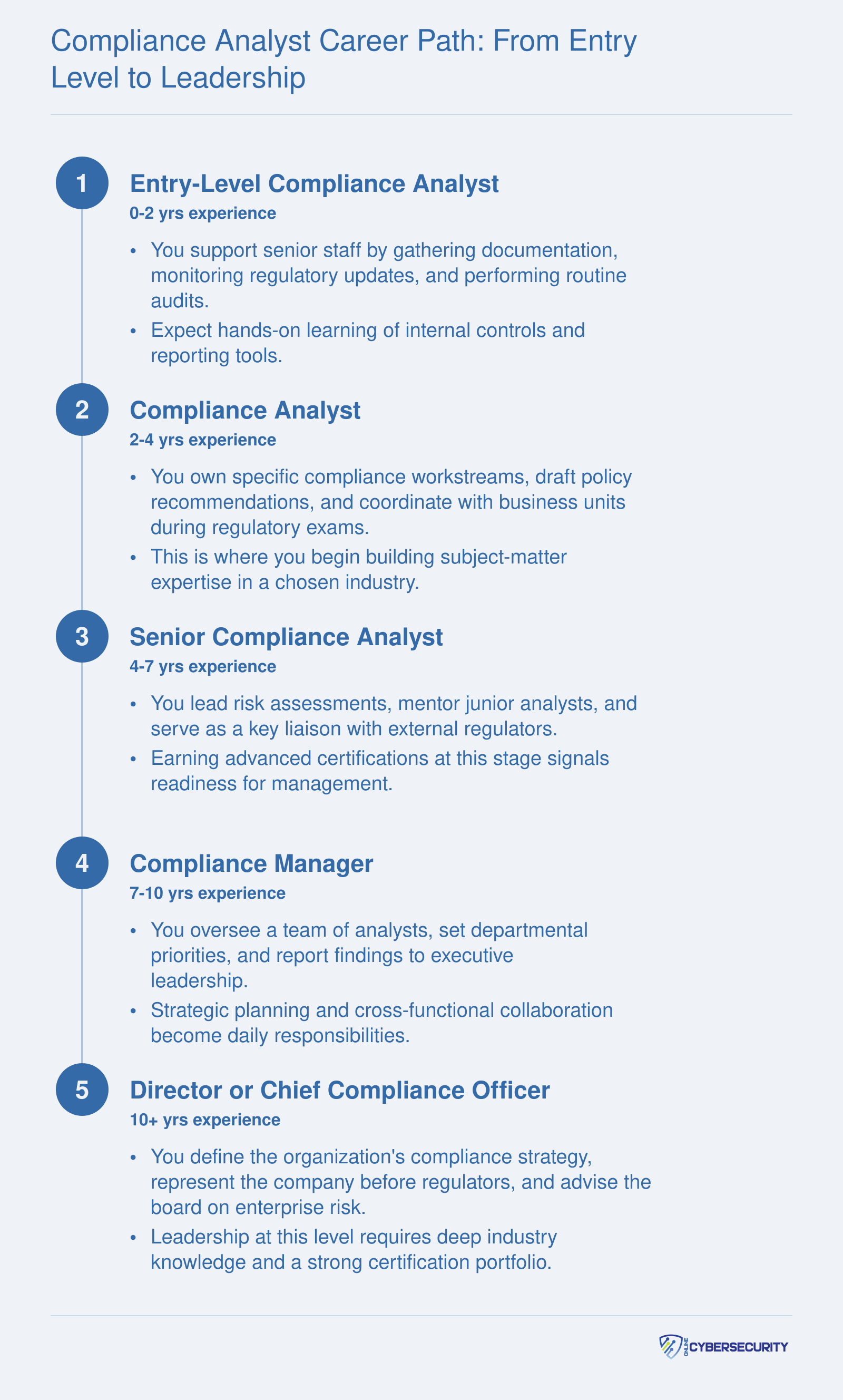
Compliance Analyst Career Path: From Entry Level to Leadership
The road from your first compliance role to the C-suite follows a fairly predictable arc, though industry specialization and targeted certifications (such as CCEP or CRCM) can shave years off each stage. Here is a typical progression and how responsibilities shift at each level.
Frequently Asked Questions About Becoming a Compliance Analyst
Below are answers to the most common questions career changers and students ask about entering the compliance analyst field. Each response draws on the education, certification, salary, and career path guidance covered throughout this guide.