
What you’ll learn in this article…
- Maryland cybersecurity salaries rank among the highest nationwide, driven by federal agencies and defense contractors.
- Online programs range from short certificates to doctoral degrees, fitting both newcomers and experienced professionals.
- Tuition varies widely across Maryland institutions, and multiple financial aid sources can significantly cut costs.
- Rankings at onlinecybersecurity.org weigh graduation rate, net price, earnings, and student support with no paid placements.
Maryland sits at the geographic center of the U.S. cybersecurity apparatus. The NSA, U.S. Cyber Command, and a dense corridor of defense contractors along the I-95 and I-270 corridors generate sustained demand for credentialed professionals, pushing median information security analyst salaries in the state well above the national average.
For career changers and students exploring online cybersecurity programs in Maryland, the practical challenge is sorting through a wide range of options. Fully online programs span associate's through master's levels, and certificate tuition can range from roughly $8,000 to over $64,000 depending on the institution. Schools like Capitol Technology University, Stevenson University, Johns Hopkins, and the University of Maryland system all compete for enrollees, each with different price points, pacing, and specialization tracks.
Proximity to employers matters less when you study online, but program alignment with industry certifications and federal workforce frameworks still separates credentials that open clearance-eligible roles from those that do not.
Best Online Cybersecurity Schools in Maryland: 2026 Rankings
This ranking highlights online cybersecurity programs at Maryland institutions, ordered by a composite that weighs online delivery eligibility alongside institutional quality indicators such as graduation rate, net price, post-graduation earnings, and student support metrics. Whether you are a career changer exploring your first cybersecurity credential or an experienced IT professional ready for a graduate degree, these programs offer flexible pathways rooted in one of the nation's strongest cybersecurity job markets.
- Online delivery eligibility
- Institutional graduation rate
- Net price and affordability
- Post-graduation earnings
- Student support and retention
- College Scorecard graduate earnings — collegescorecard.ed.gov
- Internal program database
- NCES-IPEDS federal institutional data — nces.ed.gov
- Independent program research
- #1
University of Maryland, Baltimore
Baltimore, MD
Best for: Legal-minded professionals entering cyber policy
The University of Maryland, Baltimore delivers an online Master of Science in Cybersecurity Law through its Carey Law School, blending legal analysis with hands-on cyber threat policy. Faculty from the Center for Health and Homeland Security (CHHS) bring practitioner expertise drawn from Maryland state agencies, regional healthcare networks, and federal partners. With a 5:1 student-to-faculty ratio and institution-wide median earnings of roughly $88,200 ten years after enrollment, UMB pairs deep mentorship with strong long-term outcomes.
View program
- Online graduate degree through UMB's Carey Law School
- Covers threat identification, privacy law, cybercrime, and data breaches
- Capstone project applies core competencies to real scenarios
- Taught by CHHS experts and law faculty with practitioner backgrounds
- Designed for non-JD professionals such as CISOs and compliance officers
- Maryland-specific case studies on ransomware and public health systems
- Courses address state-level privacy and federal cyber frameworks
- In-state graduate tuition available for Maryland residents
- #2
Capitol Technology University
Laurel, MD · $22,000/yr
Best for: Federal workforce aspirants near Fort Meade
Capitol Technology University, located in the Baltimore-Washington corridor near Fort Meade, offers an online Certificate in Computer and Cybersecurity that covers network security fundamentals, UNIX security, encryption, firewalls, and intrusion detection. Access to the Center for Cybersecurity Research and Analysis (CCRA) gives online students research and training opportunities aligned with NSA and DOD missions. The school's overall graduation rate is about 42.7%, while institution-wide median earnings reach approximately $85,000 a decade after enrollment. The net price of roughly $22,100 and a stackable certificate-to-degree pathway make it a practical on-ramp for working professionals.
View program
- Online certificate covering network security, UNIX, and encryption
- Hands-on labs in firewalls, intrusion detection, and network management
- Access to CCRA for research briefings and virtual lab sessions
- Stackable into Capitol Tech's online bachelor's or master's programs
- Aligned with NSA/DHS CAE institutional standards
- Tuition is $12,060 regardless of residency
- Designed as a quick pivot for Maryland IT professionals
- Prepares students for further training in specific security platforms
- #3
Stevenson University
Owings Mills, MD · $27,000/yr
Best for: Forensics-focused learners seeking hands-on labs
Stevenson University offers both a fully online Master of Cybersecurity and Digital Forensics and a Bachelor of Science in Cybersecurity and Digital Forensics. The graduate program emphasizes incident response, malware detection, and forensic analysis while building leadership skills for senior roles. The undergraduate track carries an NSA Center of Academic Excellence designation and places interns with the FBI, NSA, and Maryland State Police. The school's overall graduation rate is about 68.5%, with median graduate debt around $26,000 and institution-wide median earnings near $62,100 a decade after enrollment.
View 2 programs
- Fully online master's degree with flexible scheduling
- Covers incident response, malware detection, and forensic analysis
- Real-world projects using cutting-edge tools and remote labs
- Builds leadership and management skills for senior cyber roles
- Expanded remote-lab access for cloud and mobile forensics
- Prepares graduates for roles like Security Architect or Cyber Consultant
- NSA-designated Center of Academic Excellence in Cyber Defense
- Internship placements with FBI, NSA, and Maryland State Police
- Coursework includes intrusion testing and advanced digital forensics
- Articulation pathways from Maryland community colleges like CCBC
- Bachelor's-to-Master's accelerated option available
- Certificates may count for DoD training credit
- Top employers of graduates include Amazon and Microsoft
- #4
Johns Hopkins University
Baltimore, MD · $19,000/yr (net price)
Johns Hopkins University's Whiting School of Engineering offers an online Graduate Certificate in Cybersecurity consisting of four graduate-level courses that can be completed within five years. All credits apply toward the full online MS in Cybersecurity, creating a low-risk entry point for working engineers and software developers. Course content draws on expertise from the Applied Physics Laboratory in Laurel, Maryland, one of the nation's premier cyber R&D facilities. The school's overall graduation rate is about 93.8%, median graduate debt sits near $10,250, and institution-wide median earnings reach roughly $87,600 a decade after enrollment. Published tuition is $64,730, but the average net price drops to approximately $18,800 after aid.
View program
- Four graduate courses: three foundational plus one elective
- All credits ladder into the full online MS in Cybersecurity
- Curriculum informed by APL research in Laurel, Maryland
- Recent additions include zero-trust architecture and secure DevOps
- Virtual project environments for realistic hands-on scenarios
- Part-time friendly for Baltimore-Washington corridor professionals
- Same admission standards as the master's program
- Course waivers available with strong prior academic performance
- #5
University of Maryland Eastern Shore
Princess Anne, MD · $13,000/yr
The University of Maryland Eastern Shore, a historically Black university on the state's Eastern Shore, offers an online Master of Science in Cybersecurity Engineering Technology that can be completed in as little as 18 months. The self-paced, Quality Matters-aligned curriculum covers network intrusion, mobile security, and vulnerability analysis, with a practical emphasis on deploying and maintaining secure systems. In-state tuition of roughly $8,010 and a net price near $13,340 make it one of the most affordable graduate cyber options in Maryland. The school's overall graduation rate is about 35.3%, and institution-wide median earnings are approximately $47,700 a decade after enrollment.
View program
- Online, self-paced master's completable in about 18 months
- Quality Matters-aligned course design with live video sessions
- In-state tuition near $8,010 for Maryland residents
- Covers network intrusion, mobile security, and IoT security
- Admits applicants with work experience or industry certifications
- Tutoring, writing assistance, and library access included for online students
- Designed for hands-on deployment of secure infrastructure
- Virtual career fairs connect students with regional employers
- #6
Hood College
Frederick, MD · ~$21,000/yr (est.)
Hood College in Frederick, Maryland, offers a hybrid Graduate Certificate in Cybersecurity that requires 15 credits across three core courses and two electives. The program is designed for professionals who may not have a computer science background, with optional foundation courses in computing hardware and programming. Hood's proximity to Fort Detrick and the I-270 corridor connects students to federal defense and biomedical employers. The school's overall graduation rate is about 56.9%, median graduate debt is around $25,000, and institution-wide median earnings are roughly $57,100 a decade after enrollment.
View program
- 15-credit hybrid program: three core courses and two electives
- No prior computer science background required
- Foundation courses available in computing hardware and programming
- Electives in ethical hacking, computer forensics, and applied encryption
- Credits stack into Hood's MS in Cybersecurity
- Hybrid format accommodates Frederick-area commuting professionals
- Prepares students for professional credentialing exams
- Aligned with federal and Maryland state compliance requirements
How We Ranked Maryland's Online Cybersecurity Programs
Transparency matters when you are making a decision as significant as choosing a cybersecurity program. Many ranking lists never explain what goes into the scores, leaving readers to guess whether the order reflects genuine quality or paid placements. At onlinecybersecurity.org, we take a different approach: every factor that shapes our 2026 rankings is described below so you can weigh the results with full context.
The Composite Score
Our ranking uses a composite methodology built on measurable quality signals rather than subjective reputation surveys. Each school's score reflects a blend of the following factors:
- Graduation rate: The percentage of students who complete their program within the expected timeframe, signaling institutional support and student success.
- Net price: What students actually pay after grants and scholarships, giving a realistic picture of out-of-pocket cost.
- Post-graduation earnings: Median salaries reported after program completion, helping you gauge return on investment.
- Median debt at graduation: The typical loan burden students carry when they finish, an important counterweight to sticker-price comparisons.
- Online-delivery boost: Programs designed specifically for online learners receive a small score adjustment, recognizing the flexibility and accessibility that career changers and working professionals need.
Where the Data Comes From
Earnings and debt figures are drawn from the U.S. Department of Education's College Scorecard. When program-level data is available for a specific cybersecurity credential, we use it. When it is not yet published at the program level, we fall back to institution-wide figures and note the distinction.
Graduation rates come from IPEDS (the Integrated Postsecondary Education Data System). One important caveat: IPEDS reports graduation rates at the institution level, not for individual programs. That means a university's overall completion rate may differ from the experience of cybersecurity students specifically. We flag this because honesty about data limitations is part of responsible guidance.
Why This Matters for You
Ranking methodologies that stay hidden cannot be challenged or improved. By disclosing exactly what drives our scores, we invite scrutiny and earn trust. If a school ranks highly, you can trace the reasons back to concrete data points rather than vague editorial judgment. That clarity is especially valuable for career changers who may be investing tuition dollars for the first time in years and deserve to know precisely what they are comparing. You can apply the same lens when exploring our best online cybersecurity programs across all states, or when considering a fastest online cyber security degree to accelerate your timeline.
Questions to Ask Yourself
Online Cybersecurity Degrees Available in Maryland
Maryland is home to a strong pipeline of online cybersecurity degree programs that span every level, from two-year associate's degrees through graduate programs. Whether you are just entering the field or looking to move into leadership, there is a program structured around your timeline and career goals.
Associate's Degrees: A Fast On-Ramp
Community colleges across the state offer Associate of Applied Science (A.A.S.) degrees in cybersecurity that can be completed in about two years. Montgomery College, for example, delivers a fully online Cybersecurity A.A.S. requiring 60 to 61 credits1, while Carroll Community College offers a 60-credit A.A.S. with both campus and online options.2 These programs teach foundational skills in network defense, operating system security, and basic scripting, giving you enough grounding to pursue entry-level roles or transfer into a four-year program.
Bachelor's Degrees: The Primary Entry Point
A bachelor's degree remains the most common starting credential employers in the Baltimore-Washington corridor look for when hiring cybersecurity analysts and engineers. UMGC's fully online B.S. in Cybersecurity Technology requires 120 credits (42 in the major, 41 in general education) and is designed to be completed in about four years, though transfer credits can shorten that timeline.3 No prior IT background is required to enroll. If you want a closer look at what a typical cybersecurity degree program covers, it helps to understand the coursework before committing. Bachelor's programs in Maryland frequently embed preparation for industry certifications such as CompTIA Security+ and CySA+, letting you stack credentials while you earn your degree.
Master's Degrees: Specialization and Leadership
For professionals aiming at senior or managerial roles, Maryland's online master's programs typically take one to two years. Stevenson University offers a fully online Master of Cybersecurity and Digital Forensics, and the University of Maryland Eastern Shore provides a self-paced M.S. in Cybersecurity Engineering Technology that can be finished in as few as 18 months. The University of Maryland, Baltimore runs an online M.S. in Cybersecurity Law through its law school, blending policy and technical coursework. Graduate-level programs generally align with advanced certification tracks like CISSP and CISM, which many employers treat as prerequisites for roles such as security architect or chief information security officer.
How Online Delivery Works
Most Maryland cybersecurity programs use asynchronous coursework, meaning you watch lectures, complete labs, and participate in discussion boards on your own schedule. Virtual lab environments let you practice penetration testing, incident response, and forensic analysis from a home computer. Many programs also require a capstone project or practicum that mirrors real-world scenarios. This flexibility is especially valuable for working adults commuting along the I-95 corridor between Baltimore and Washington, D.C., where long work hours and government or contractor schedules make fixed class times impractical.
Maryland Online Cybersecurity Certificates and Bootcamps
If you are not ready to commit to a full degree, or you want to fast-track into the workforce, Maryland institutions offer a solid lineup of for-credit certificates and bootcamp programs you can complete entirely or mostly online. Below is a practical comparison so you can weigh cost, timeline, certification-exam alignment, and whether those credits can roll into a degree later.
For-Credit Certificate Programs
These options earn you academic credit and, in every case listed here, stack toward a related associate's or bachelor's degree at the same institution. If you are exploring best online graduate certificate in cybersecurity options beyond Maryland, several national programs follow the same stackable model.
- Montgomery College, Cybersecurity for IT Professionals Certificate: Roughly $2,520 to $5,400 depending on residency, completable in about 12 months.1 Coursework aligns with CompTIA Security+, CompTIA Network+, CompTIA CySA+, and Cisco CCNA. At the lower end of the price range, this is one of the cheapest online cybersecurity certificates you will find in Maryland, and its CySA+ alignment gives career changers a direct path into an analyst role.
- College of Southern Maryland, Cybersecurity Certificate: Approximately $5,270 to $6,270 over 12 to 18 months.2 Prepares students for CompTIA A+, CompTIA Security+, CompTIA Linux+, and Cisco CCNA. The broader foundational coverage makes it a good fit if you are starting from scratch and need hardware and OS fundamentals alongside security concepts.
- UMGC Graduate Certificate in Cybersecurity Technology: A graduate-level option priced at roughly $6,000 to $7,500, designed to be completed in about six months.3 It maps to CompTIA Security+, CySA+, and CISSP, making it the strongest cert-exam alignment among the for-credit programs at this level. Credits stack into UMGC's master's programs, so it works well if you already hold a bachelor's degree and want a credential that counts toward a future M.S.
- UMD Cybersecurity Engineering Post-Baccalaureate Certificate: The premium option at around $12,000 to $15,000 over 8 to 16 months.4 It targets advanced certifications like CISSP and CASP+, and credits feed into University of Maryland graduate programs. Best suited for professionals who already have IT experience and want deeper engineering-level knowledge.
Bootcamp Option
- UMBC Training Centers Cybersecurity Academy: A noncredit bootcamp running three to six months, with tuition between $7,000 and $15,000 depending on the track you choose.5 What sets it apart is the sheer breadth of certification prep: CompTIA Security+, CySA+, PenTest+, EC-Council CEH, and ISC2 CISSP and CCSP are all covered across its course paths. Because the program is noncredit, those hours will not transfer into a degree, but the intensive format and wide certification coverage make it a strong choice if your goal is rapid upskilling and you want multiple industry credentials on your resume.
Which Option Is Right for You?
If budget is your top concern, the Montgomery College certificate offers the lowest entry point and still aligns with four widely recognized certifications. For the strongest certification-exam alignment at the graduate level, the UMGC graduate certificate covers Security+ through CISSP in just six months. And if you want maximum certification breadth without worrying about academic credit, the UMBC bootcamp covers more exam objectives than any single for-credit program in the state. You can also compare it against best cybersecurity bootcamp options nationally to see how Maryland's offering stacks up.
All of the for-credit certificates listed here are stackable, meaning you can apply those credits toward a larger degree if you decide to continue your education. That flexibility is a real advantage for career changers who want to start earning quickly but keep the door open for a bachelor's or master's down the road.
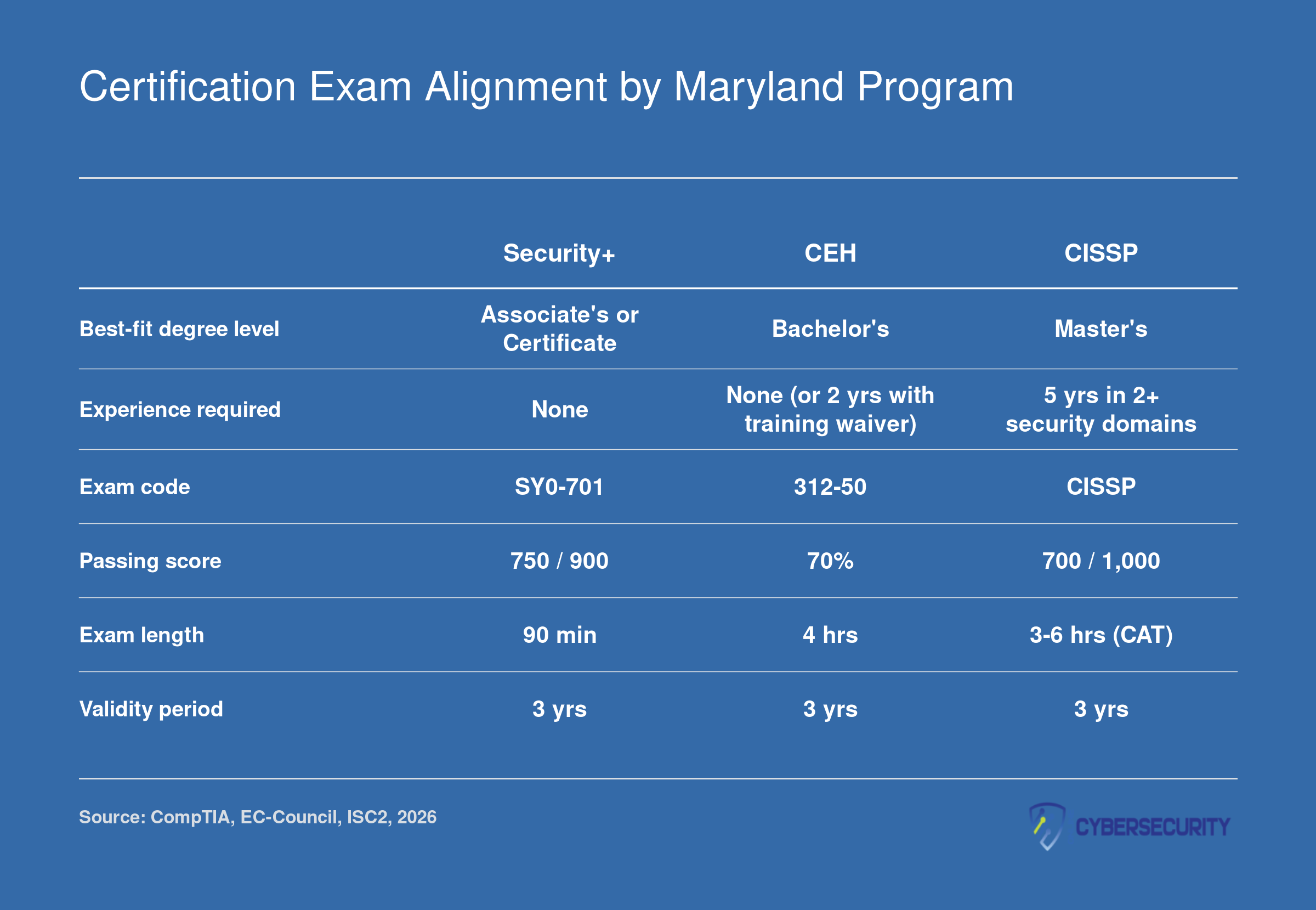
Certification Exam Alignment by Maryland Program
Not every certification fits every stage of your cybersecurity career. The table below maps three widely recognized exams to the degree level whose coursework most naturally prepares you, along with the experience each cert demands before you can sit for the exam.
Cost, Financial Aid, and ROI of Maryland Cybersecurity Programs
One of the biggest questions career changers ask is whether the investment will pay off. The good news: Maryland's online cybersecurity programs span a wide price range, and several funding sources can dramatically reduce your out-of-pocket costs.
Tuition Ranges Across Maryland Programs
Published tuition for the programs in our 2026 rankings varies considerably. At the low end, University of Maryland Eastern Shore lists in-state tuition around $8,010 for its online cybersecurity master's program, while Stevenson University's Master of Cybersecurity and Digital Forensics comes in near $8,460 regardless of residency. Hood College's graduate certificate runs about $9,470, and Capitol Technology University's certificate is roughly $12,060. At the top of the spectrum, Johns Hopkins University's graduate certificate carries a sticker price near $64,730.
Keep in mind that sticker price rarely tells the whole story. Institution-wide average net prices after financial aid range from approximately $13,300 at UMES to around $26,500 at Stevenson. These figures reflect all students at the institution (not just cybersecurity enrollees), but they give you a useful ballpark for what families actually pay.
Maryland-Specific Financial Aid Worth Knowing
Maryland offers several funding opportunities tailored to cybersecurity students:
- Cybersecurity Public Service Scholarship Program: Administered by the Maryland Higher Education Commission, this merit-based award covers tuition, fees, and potentially room and board. A 3.0 GPA is required, and the 2026-2027 application window runs from January 15 through October 15, 2026. In exchange, recipients commit to working in a Maryland public-service cybersecurity role after graduation.12
- Microsoft Cybersecurity Scholarship Program: Designed for community college students in Maryland, this program provides emergency financial assistance, industry certification exam vouchers, and career services. If you are starting at a two-year school, this is worth exploring early.3
- GI Bill and DoD Tuition Assistance: Many of the online programs in our rankings are approved for military education benefits, which is especially relevant given Maryland's proximity to Fort Meade, NSA, and U.S. Cyber Command. Verify each school's VA approval status before enrolling.
Framing the Return on Investment
Program-level earnings and debt data are not yet available for most of these Maryland cybersecurity offerings, which is common for newer or smaller graduate programs. However, institution-wide data offers useful context. Median earnings ten years after enrollment range from roughly $47,700 at UMES to about $87,600 at Johns Hopkins, with Capitol Technology University graduates landing near $85,000. Median institutional debt at graduation sits between roughly $10,250 (Johns Hopkins) and $27,000 (UMES).
When you weigh those debt figures against typical cybersecurity salaries in the Maryland market (covered in the next section), the math tends to work in your favor. Programs with lower net prices, such as UMES and Stevenson, can deliver especially strong returns for students who take advantage of state-level scholarships and employer tuition reimbursement. If you are comparing costs across multiple states, browsing best online cybersecurity programs nationwide can help you benchmark Maryland's value. If affordability is your top priority, start with institutions whose net price falls below the $20,000 mark and layer on every aid option available to you.
Cybersecurity Salaries and Job Outlook in Maryland
Maryland is one of the highest-paying states in the country for cybersecurity professionals, and the numbers tell a compelling story for anyone weighing an online program here. Whether you are just starting out or pivoting from another tech role, understanding the salary landscape helps you plan a realistic return on your education investment.
Statewide and Metro-Area Wages
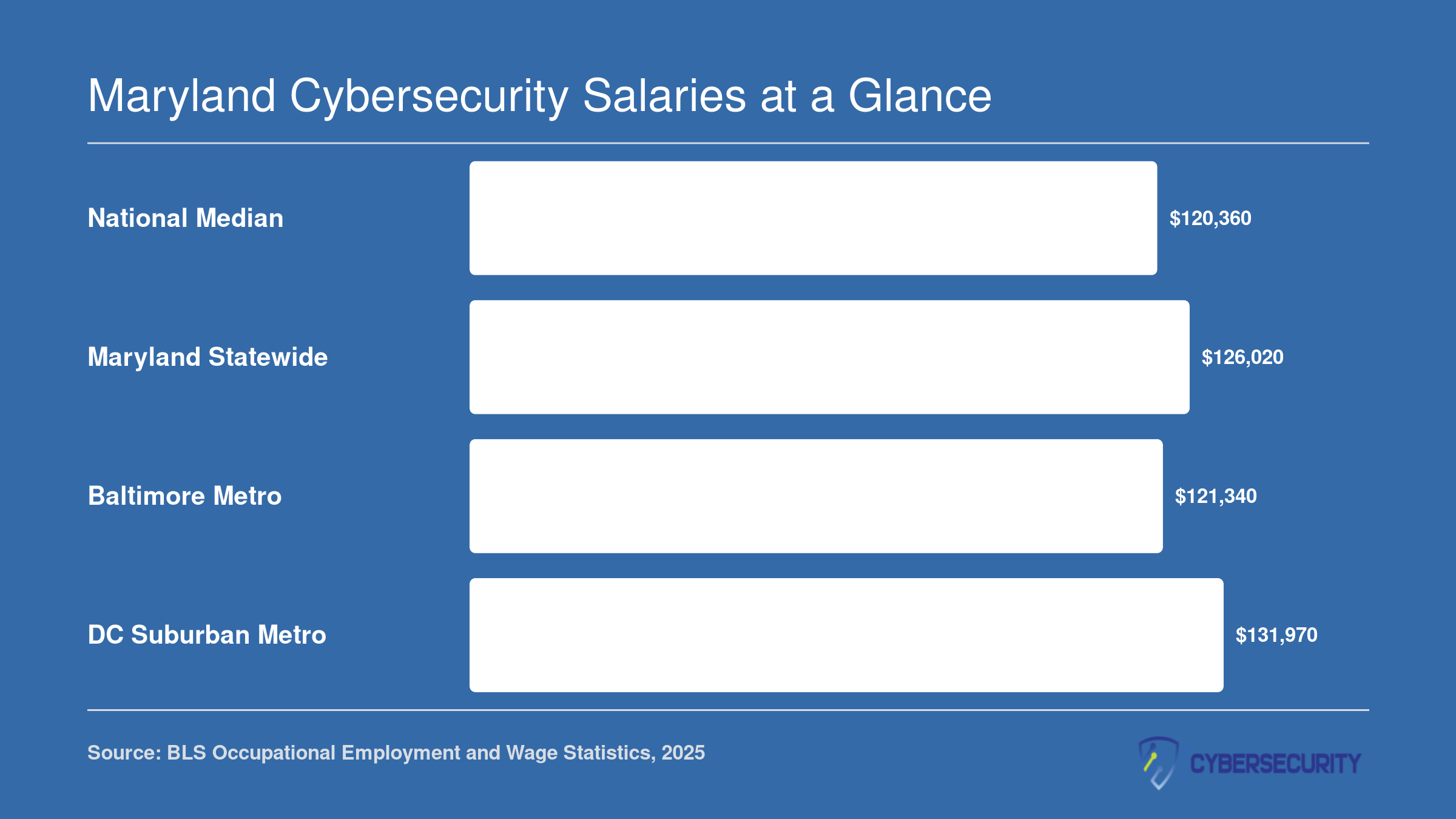
According to the Bureau of Labor Statistics, the statewide median annual wage for information security analysts in Maryland falls in the $125,000 to $128,000 range, with a mean annual wage of roughly $138,180.1 That is well above the national median of $120,360. Two major metro areas drive much of this demand:
- Baltimore-Columbia-Towson: Mean annual wage of approximately $130,580.
- Washington-Arlington-Alexandria (DC metro): Mean annual wage of approximately $129,110.
Because Maryland sits between these two metro hubs, graduates from online programs in the state have access to employers on both sides of the corridor without relocating.
What Graduates Actually Earn Early On
It is worth noting that program-level earnings shortly after graduation are not yet available for most of the online cybersecurity programs ranked in this guide. However, broader institutional data gives useful context. Graduates of schools like the University of Maryland, Baltimore, Johns Hopkins University, and Capitol Technology University report median earnings in the $85,000 to $88,000 range within a decade of enrollment across all programs. Early-career cybersecurity salaries will typically be lower than the statewide median for experienced analysts, but the trajectory is steep, especially in a market as competitive as Maryland's.
Why Maryland's Job Market Stands Apart
Few states can match Maryland's concentration of federal and defense cybersecurity employers. Fort Meade alone houses both the National Security Agency and U.S. Cyber Command, two of the largest cyber-focused organizations in the world. The Defense Information Systems Agency (DISA) also operates nearby. On the private side, contractors such as Northrop Grumman, Booz Allen Hamilton, and Raytheon maintain significant presences in the state, all of which regularly recruit graduates with cybersecurity credentials. For a broader look at the roles these organizations hire for, our cybersecurity career guide breaks down responsibilities across the field.
This federal and defense ecosystem creates a uniquely stable source of demand that insulates Maryland's cyber workforce from the hiring volatility that can affect purely private-sector markets.
Long-Term Growth Outlook
Nationally, the BLS projects a 32 percent growth rate for information security analyst roles between 2022 and 2032, with roughly 17,000 openings expected each year. That pace far outstrips the average for all occupations. Given Maryland's outsized share of federal cyber operations and the ongoing expansion of defense budgets for digital security, the state is positioned to capture a disproportionate slice of that growth.
For career changers and students exploring online cybersecurity programs in Maryland, the takeaway is straightforward: salaries start strong, the ceiling is high, and employer demand shows no signs of slowing down.
Maryland Cybersecurity Salaries at a Glance
Maryland's concentration of federal agencies, defense contractors, and intelligence organizations pushes cybersecurity salaries well above the national average. Here is how median annual pay for information security analysts compares across the state's major employment hubs.
How to Choose the Right Online Cybersecurity Program in Maryland
Picking the right online cybersecurity program in Maryland involves more than comparing tuition stickers. The state sits at the center of the federal cybersecurity ecosystem, so factors like government designations, workforce framework alignment, and scheduling flexibility carry real weight here. Below are the key decision points to walk through before you commit.
Start With Regional Accreditation
Regional accreditation is your baseline filter. Regionally accredited schools have met rigorous standards set by one of six recognized accrediting bodies tied to geographic areas. Nationally accredited programs, by contrast, often focus on vocational or career-oriented training and may not carry the same weight with employers or transfer as smoothly between institutions. Credits from a nationally accredited school frequently do not transfer to a regionally accredited university, which can cost you time and money if you later decide to pursue a higher degree. Before enrolling anywhere, confirm the institution holds regional accreditation through the Middle States Commission on Higher Education (the regional body covering Maryland) or its equivalent. If you are weighing programs across the country, our guide to best online bachelor's degrees in cybersecurity breaks down what to look for at every level.
Look for the CAE-CD Designation
The Centers of Academic Excellence in Cyber Defense (CAE-CD) designation, managed by the NSA, signals that a program's curriculum meets a validated set of cybersecurity knowledge units.1 In Maryland, Bowie State University holds an active CAE-CD designation valid through 20272, while the University of Maryland, College Park carries a CAE-R (Research) designation.3 Several Maryland community colleges, including Anne Arundel Community College, Howard Community College, and the Community College of Baltimore County, have historically held two-year CAE designations as well.4 Capitol Technology University and University of Maryland Global Campus have also carried CAE designations in the past.4 You can verify current status on the official NCAE-C community map.
Why does this matter? CAE-designated programs can open doors to federal scholarships like the CyberCorps Scholarship for Service, and many federal hiring managers view the designation as a quality signal when screening candidates.
Check DoD 8140 and NICE Framework Alignment
If you are targeting government or defense-contractor roles (and Maryland has no shortage of those), find out whether a program maps its coursework to the DoD 8140 workforce framework, which replaced the older 8570 mandate. Programs aligned with the NICE Workforce Framework structure their courses around specific work roles such as vulnerability analyst, cyber defense analyst, or security architect. This alignment can make it significantly easier to demonstrate that you meet federal qualification requirements when applying for positions. Not every Maryland program advertises this alignment explicitly, so ask admissions representatives directly and request a course-to-role mapping document.
Evaluate Practical Factors for Working Adults
Scheduling, transfer policies, and credit for prior learning can make or break your experience as a working student. Consider these specifics:
- Asynchronous vs. synchronous: Asynchronous programs let you watch lectures and complete assignments on your own schedule, which is essential if you work shifts or travel. Synchronous programs require logging in at set times but may offer more real-time interaction with instructors.
- Credit transfer policies: If you already hold an associate degree or have completed coursework elsewhere, check how many credits the program will accept. Transfer caps vary widely, from 30 to 90 credits at the bachelor's level.
- Prior certifications for credit: Some Maryland programs award academic credit for industry certifications like CompTIA Security+, Certified Ethical Hacker, or CISSP. This can shave a semester or more off your timeline and reduce overall cost. Ask for a published equivalency list before enrolling.
Taking the time to evaluate these factors carefully will help you find a program that fits both your career goals and your daily life, rather than one that simply looked good on a search results page.
Frequently Asked Questions About Maryland Cybersecurity Schools
Maryland is home to some of the strongest cybersecurity programs in the country, thanks in part to the state's proximity to federal agencies and a thriving defense sector. Below are answers to the most common questions prospective students ask when exploring online cybersecurity programs in Maryland.