
What you’ll learn in this article…
- CSU Global launched new online cybersecurity programs in 2026.
- Info security analyst jobs to grow 29% by 2034.
- Info security analysts earn a median $124,910.
The 29% projected increase in information security analyst positions through 2034 is reshaping online education in 2026. As organizations confront more sophisticated threats, universities are launching programs to close the talent gap. Colorado State University Global is one confirmed entrant, alongside a growing number of accredited schools debuting flexible, fully remote degrees.
A surge of new options brings a real challenge: identifying which programs genuinely prepare graduates for the field. Tuition, accreditation, and whether a curriculum embeds recognized certifications like CompTIA Security+ now define the difference between a strategic career move and an expensive experiment. Understanding what cybersecurity is and why it matters can help you frame that decision from the start.
Why 2026 Is a Pivotal Year for Online Cybersecurity Education
A Talent Gap Driving Program Launches
The Bureau of Labor Statistics projects a 29% increase in jobs for information security analysts between 2024 and 2034, far faster than the 3.1% average for all occupations.1 That translates to roughly 16,000 annual openings, fueled by an existing workforce of over 182,000 analysts.2 Employers in every sector are struggling to fill these roles, creating a clear signal that more pathways into the profession are needed. New online programs arriving in 2026 are direct responses to this sustained demand.
Evolving Threats, New Curriculum Needs
Cyber adversaries are using AI to automate attacks, while ransomware continues to target hospitals, pipelines, and power grids. Critical infrastructure vulnerabilities have moved from theoretical to front-page news. Today's cybersecurity professional needs skills that go beyond basic network defense. The programs launching this year are building curricula around cloud security, zero-trust architecture, threat hunting, and operational technology protection, often with hands-on virtual labs and incident response simulations. That practical focus reflects what employers say they need right now.
Federal Momentum and Employer Demand
Multiple federal workforce initiatives have set ambitious goals for expanding the domestic cyber workforce. Executive orders and the National Initiative for Cybersecurity Education (NICE) have pushed for more graduates with both technical depth and industry-recognized credentials. Meanwhile, corporations in finance, healthcare, and defense are urging universities to shorten the time from enrollment to job readiness. Intense competition for online learners has also accelerated program development, with schools offering more affordable tuition, faster completion paths, and embedded certifications. These combined forces make 2026 a turning point for online cybersecurity education.
For career changers and working adults, the data reinforces what the hiring numbers already show: cybersecurity careers are in urgent demand and salaries reflect that value. The median annual wage for analysts is about $125,000,1 and the rapid evolution of threats means continuous learning is built into the career. The new programs hitting the market this year aim to put that opportunity within reach, no matter your starting point.
Newly Launched Online Cybersecurity Programs in 2026
How can you stay ahead of the curve and identify the newest online cybersecurity degrees launching in 2026? The landscape is evolving quickly, and while many exciting programs are coming to market, they aren't always immediately visible in central databases. Rather than waiting for static lists to update, you can take proactive steps to discover accredited, career-focused options as soon as they open enrollment.
Where to Spot the Latest Program Announcements
New cybersecurity programs often appear on university websites before they reach aggregator sites. For example, Colorado State University Global recently added online cybersecurity degree Colorado and paralegal studies to its catalog, reflecting a broader push among institutions to meet demand. When researching, head directly to a school's "academics" or "admissions" page and look for news releases or dedicated program microsites. Many universities now maintain an "upcoming programs" section or let you filter by "new" in their degree finder. You can also sign up for institution-specific newsletters, which frequently announce launches before general advertising.
Key Resources for Tracking Accredited Programs
For a wider sweep, the U.S. Department of Education's College Navigator is a powerful tool. This free, searchable database includes only accredited institutions and allows you to filter by degree level, delivery format, and program area. While it updates continuously, setting a personalized alert with keywords like "cybersecurity" can help you catch new entries. Beyond government resources, professional organizations offer curated perspectives. (ISC)², CompTIA, and the National Initiative for Cybersecurity Education (NICE) all publish lists of academic programs aligned with industry standards. These groups often highlight new offerings that incorporate emerging specializations, such as cloud security or digital forensics, helping you zero in on degrees with immediate workplace relevance.
Why 2026 Matters for New Program Launches
This year's curriculum updates are not happening in a vacuum. Cybersecurity trend reports point to a trio of forces reshaping the field: a rise in AI-powered attacks, the gradual transition to post-quantum cryptography, and a wave of new federal and state regulations.1 Universities designing 2026 launches are baking these topics into core coursework. CSU Global's new program, for instance, arrives at a time when employers are explicitly seeking graduates who understand machine learning threats and quantum-safe algorithms. By targeting programs launched this year or late 2025, you position yourself at the leading edge of the industry's needs.
How to Use Bureau of Labor Statistics Data for Decision-Making
The Bureau of Labor Statistics (BLS) is not a program directory, but its occupational outlook resources are invaluable for validating your choices. When a school launches a new concentration, check BLS projections for roles like information security analyst to see if the curriculum aligns with job growth areas. Pair that with College Navigator program details to build a shortlist. A practical sequence might look like this: - Set up alerts: Use College Navigator and school newsletters to monitor for new listings. - Cross-reference: Verify any promising program's accreditation and alignment with roles on the BLS site. - Connect directly: Reach out to program directors with specific questions about their 2026 cohorts.
Combining these tools with direct outreach to admissions offices gives you the most current snapshot of what's available, ensuring you invest in a degree that matches your career ambitions.
How These Programs Compare: Cost, Accreditation, and Format
Choosing an online cybersecurity program often means weighing cost and flexibility against the prestige of specialized accreditations. Colorado State University Global's new 2026 offerings sit squarely at this crossroads: tuition is competitive and the format is fully asynchronous, but the programs lack a few designations that some employers value highly. How you prioritize these factors will shape which degree, if any, feels like the right fit.
Cost and Financial Considerations
CSU Global structures tuition around a flat per-credit rate, which makes it easy to estimate total costs up front. The bachelor's degree carries a per-credit rate of $385, leading to a total program cost of roughly $46,200 for the full 120 credits.1 The master's degree, requiring 30 credits, costs $675 per credit for a total around $20,250.1 Both figures are on par with many public university online programs, and noticeably lower than private or for-profit alternatives. The undergraduate certificate, designed for quick upskilling, runs 12 to 18 credits at the same $385 per-credit rate, yielding a total cost between $4,620 and $6,930.1 Actual out-of-pocket expenses may be lower for those who bring in transfer credits, employer tuition reimbursement, or military benefits. If you want a deeper look at funding options, federal programs covering cybersecurity tuition can offset a significant portion of these costs. That said, always check whether accelerated pacing can reduce living expenses or opportunity costs, since shorter programs mean less time out of the workforce.
Accreditation and Industry Recognition
CSU Global is regionally accredited by the Higher Learning Commission, the gold standard for institutional quality in the United States.2 That accreditation matters for financial aid eligibility and credit transfer, but it does not speak directly to the cybersecurity curriculum. The university does not hold programmatic accreditation from ABET, nor is it currently listed on the National Security Agency's list of Centers of Academic Excellence in Cyber Defense (CAE-CD) for 2025-2026.2 Many cybersecurity professionals work for years without these tags, but if you are aiming for a government or defense role that specifically requires CAE-CD, or for an employer that screens for ABET, you will want to note this gap. In contrast, employers who prioritize regional accreditation and practical skills may see little downside. Comparing accredited online cybersecurity programs side by side can help you gauge where CSU Global lands relative to peer schools.
Learning Format and Flexibility
All three program levels share a common delivery structure: 100 percent online, asynchronous, and built around accelerated 8-week terms.3 You will never need to log in at a specific time, which is a lifeline for working adults and parents. The bachelor's and master's degrees follow a structured course sequence that can be tackled full-time or part-time, while the certificate is explicitly short-term, wrapping up in as little as six months. There is no cohort lockstep , you start when you are ready and progress at your own speed within each term. This self-directed pace is one of CSU Global's biggest differentiators, but it also means you need strong time-management habits. If you thrive with live lectures or peer deadlines, the asynchronous format may feel like a tradeoff.
Embedded Certifications and Industry Alignment
Embedded certifications are industry-recognized credentials like CompTIA Security+, CySA+, or Certified Ethical Hacker (CEH) that a degree program builds directly into its coursework. Instead of studying for a degree and then separately preparing for a certification exam, you cover the exam objectives as part of your classes, and the program often includes the cost of the exam voucher.
Why certification alignment matters for your career
Hiring managers in cybersecurity frequently look for these credentials alongside a degree. A program that maps its curriculum to certification objectives saves you time and money, and it signals that the content stays current with what employers actually need. This is especially valuable in 2026, as many cybersecurity certifications have been updated to reflect evolving threats and technologies.
How to find out if a program truly embeds certifications
Program websites don't always make this obvious. A course description might mention "prepares you for the Security+ exam" without clarifying whether the voucher is included. To avoid surprises, you need to dig a little deeper.
- Check official curriculum pages: Look for phrases such as "certification alignment," "exam voucher included," or "mapped to CompTIA objectives." These details often hide in degree requirements, tuition breakdowns, or dedicated certification pages.
- Contact admissions directly: A quick call or email to a program coordinator can confirm whether exam fees are bundled and whether the curriculum reflects the most recent certification updates, like the new CompTIA Security+ (SY0-701) or CEH v12 blueprints.
- Cross-reference with certification authorities: Sites like CompTIA, EC-Council, or (ISC)² maintain lists of academic partners and accredited programs. These confirm that the coursework aligns with their exams, though they may not guarantee a free voucher.
- Monitor university announcements: New or revamped programs often promote embedded certifications as a key differentiator. Keep an eye on news sections and launch press releases, since many schools highlight this as a recruiting point for their 2026 cohorts.
What "aligned" really means versus true exam prep
Alignment can mean different things. Some programs simply map their classes to certification domains without offering practice tests or vouchers. Others include full exam preparation, practice exams, and a voucher that covers the cost of sitting for the test. Understanding what to expect from a cybersecurity degree program helps you ask the right questions: "Does this program provide a voucher and instructor-led review for the certification, or is the content just mapped to the objectives?" That distinction can affect your out-of-pocket costs and readiness.
The effort to verify certification details pays off. A degree that bundles a recognized credential can shave months off your career-launch timeline and give you a tangible, résumé-ready proof point from day one.
Related Articles
Best Options for Career Changers and Non-Technical Backgrounds
For career changers, the biggest question isn't whether cybersecurity is worth it , it's how to enter a technical field without a technical background. The good news: many of 2026's new online programs are built for exactly this scenario, offering on-ramps that assume no prior IT experience while still delivering the rigorous training employers expect.
Programs That Meet You Where You Are
The most accessible programs eliminate the typical computer science prerequisite and instead front-load foundational IT modules right into the curriculum. Colorado State University Global's new cybersecurity bachelor's degree, for example, has no prerequisites and weaves core skills like networking and operating systems into its first terms so you build confidence before diving into specialized domains. For master's seekers, CSU Global also dropped the GRE or GMAT requirement, evaluating applicants holistically , a trend we're seeing across other 2026 launches that recognize professional experience can outweigh test scores.
Stackable Credentials and Accelerated Pathways
If committing to a full degree feels risky, look for programs that let you stack smaller credentials toward a degree. CSU Global's model awards online graduate certificates in cybersecurity (including CompTIA Security+ preparation) as you complete courses, giving you tangible proof of progress after just a few classes. This approach is ideal for career changers who need to start applying for roles quickly: you can list a certificate on your resume while continuing toward your bachelor's or master's. If you want to move even faster, accelerated cybersecurity certification programs can compress that timeline further.
Backgrounds That Translate Well to Cybersecurity
Certain professional backgrounds map surprisingly well to cybersecurity roles, and the best 2026 programs recognize that with targeted tracks.
- Military and law enforcement: Your understanding of threat assessment, chain of command, and security protocols gives you a head start in security operations. Bridge-friendly programs like CSU Global's let you bypass redundant coursework through prior-learning assessments.
- Compliance and finance: If you have experience with regulations, audits, or risk management, cybersecurity governance and compliance roles are a natural pivot. Look for programs with a dedicated policy or management track rather than a purely technical focus.
- General career changers: Even without a related background, a program with a strong introductory boot-camp style on-ramp and no rigid prerequisites can make the transition manageable. The key is finding a curriculum that doesn't assume you already know how to code.
Cybersecurity Salary Snapshot: What 2026 Graduates Can Expect
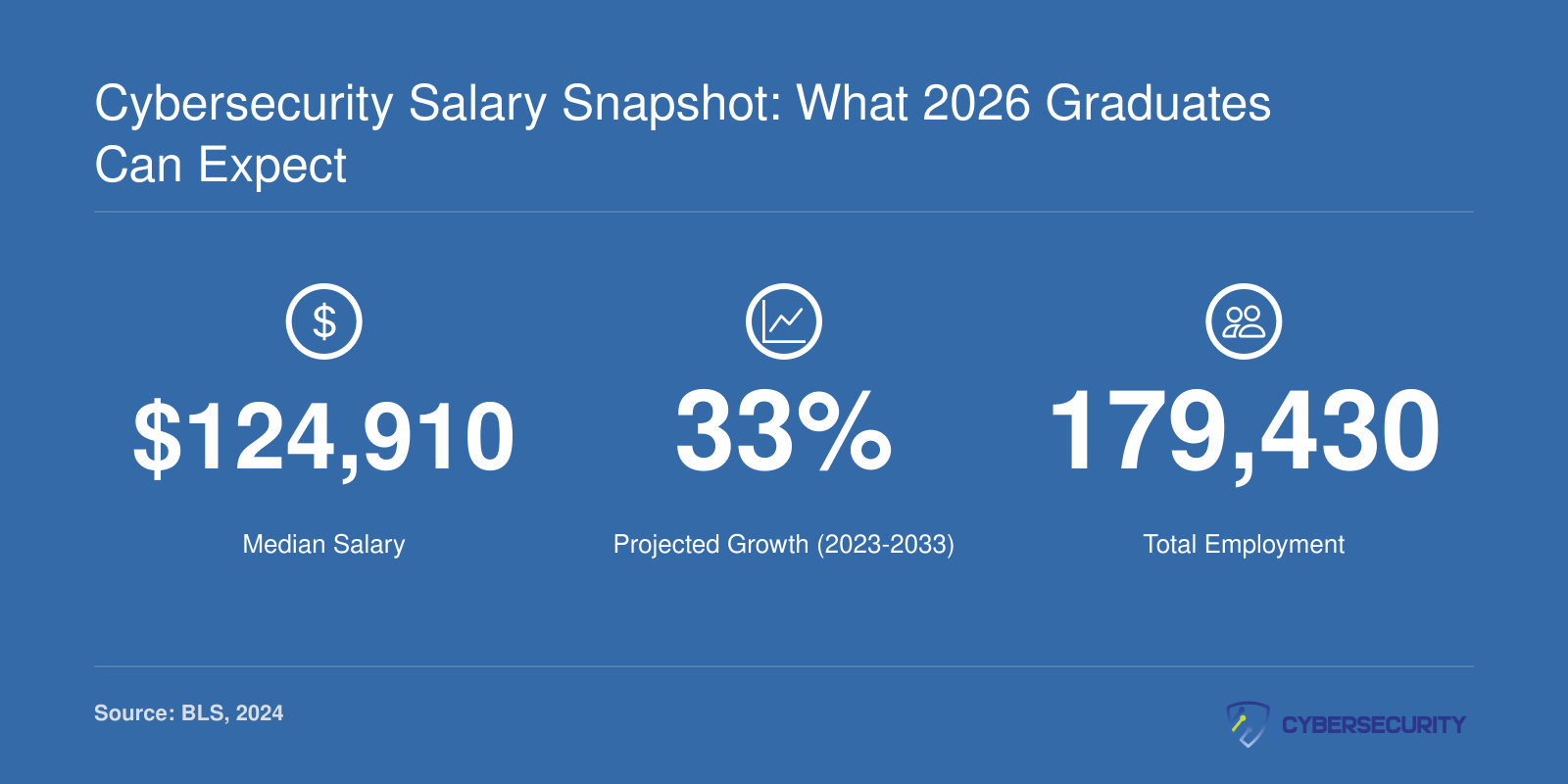
For graduates entering the field in 2026, the earning potential is strong. The national median salary for information security analysts is $124,910, with top earners exceeding $159,600. Combined with 33% projected job growth, this offers a compelling return on investment for online cybersecurity programs.
Cybersecurity Salary by State: Where the Highest-Paying Jobs Are
While cybersecurity salaries can be competitive nationwide, certain states offer significantly higher pay for information security analysts. According to the Bureau of Labor Statistics (2024), the following are the top 10 highest-paying states by median annual wage. For online degree graduates, remote work arrangements often allow them to target these high-wage markets while living in lower-cost areas.
| State | Median Annual Wage | Total Employment |
|---|---|---|
| Washington | $142,920 | 6,830 |
| California | $140,660 | 15,800 |
| Maryland | $140,480 | 8,770 |
| New Jersey | $135,390 | 4,730 |
| Delaware | $134,050 | 630 |
| New Mexico | $133,780 | 1,760 |
| Virginia | $132,460 | 18,670 |
| New York | $131,100 | 8,860 |
| Colorado | $130,570 | 5,840 |
| Connecticut | $130,500 | 1,160 |
How to Choose the Right New Program for Your Goals
Choosing the right online cybersecurity program means identifying exactly what you want to do after graduation. A general "cyber degree" may not serve you well if you're aiming for a leadership role versus a hands-on technical job. In 2026, new programs are more specialized than ever, so your first step is to map the cybersecurity degree program to your career path.
Align the Program with Your Career Track
Programs differ sharply in focus. Management-oriented tracks prepare you for roles like Chief Information Security Officer (CISO), governance, risk, and compliance (GRC) analyst, or security policy advisor. These emphasize strategy, audit frameworks, and business communication. Technical tracks target roles such as penetration tester, SOC analyst, or cloud security engineer, with heavy coursework in scripting, network defense, and incident response. Read course descriptions carefully: a program heavy on policy papers won't give you the hands-on labs you need for a technical job, and vice versa.
Look for Emerging Specializations in 2026 Curricula
The threat landscape is evolving, and the best new programs reflect that. In 2026, pay attention to curricula that include AI security (securing machine learning pipelines and detecting adversarial AI), operational technology/industrial control systems (OT/ICS) security for manufacturing and energy sectors, and cloud-native security (container and serverless architectures). Zero-trust architecture is another high-demand area. If a program prominently features these topics, it signals that the school is keeping pace with industry shifts, which can give you a competitive edge after graduation.
Use a Decision Framework to Narrow Options
Your personal circumstances will dictate the best format. Ask yourself:
- Speed: If you need to enter the field quickly, look for accelerated or self-paced programs that allow you to move through material as fast as you can master it.
- Depth: If you want a thorough, immersive experience, choose a cohort-based program with a capstone project. These often build stronger peer networks and deeper skills.
- Certifications: If your goal is to earn industry credentials, check how many certifications are embedded in the curriculum. Some programs include vouchers for CompTIA Security+, CISSP, or CEH, saving you money and study time.
Verify Accreditation and Designation as Non-Negotiables
Before you enroll, confirm that the institution holds regional accreditation, which ensures credits can transfer and your degree is widely recognized. Equally important for cybersecurity is the National Security Agency's CAE-CD (Cyber Defense) designation. This signals that the program meets rigorous federal standards. You can check a program's CAE status on the NSA's website. To compare top online cybersecurity programs side by side, look for both of these indicators prominently listed on each school's program page. These are not optional extras; they are baseline quality indicators that protect your investment and your future career mobility.
Frequently Asked Questions About New Cybersecurity Programs
Navigating the newest online cybersecurity degrees can feel overwhelming. We've answered the most common questions about program costs, certifications, admission requirements, and accreditation to help you choose the right path in 2026.
Should you start a cybersecurity degree in 2026? With a projected 29% job growth and a median salary above $124,000, the demand has never been more urgent. This year's new online programs are designed to meet that demand head-on: many are fully asynchronous, priced competitively, and align directly with industry certifications like CompTIA Security+ and CEH. You now have a clearer path from enrollment to a credential-backed career, even without a technical background. Use the cost, format, and certification comparisons in this guide to pick a program that fits your life and your goals. If you want to explore the full range of options, online cybersecurity degree programs give you a practical starting point for comparing what's available. The right time to invest in yourself is now.