
What you’ll learn in this article…
- Most cybersecurity bachelor's degrees require only college algebra and introductory statistics, not calculus.
- Over 490 U.S. institutions currently hold the NCAE-C designation jointly sponsored by the NSA and DHS.
- Top programs embed industry certifications like CompTIA Security+ and CySA+ directly into required coursework.
- Annual tuition ranges from roughly $7,000 at in-state public universities to over $40,000 at private institutions.
The Bureau of Labor Statistics projects information security analyst roles growing 33 percent through 2033, yet the degree behind that job title covers far more ground than most people expect. A cybersecurity bachelor's degree blends network defense and secure coding with digital forensics, risk management, regulatory compliance, and strategic planning. Labs and simulations sit alongside policy analysis.
That breadth is exactly what makes the decision feel overwhelming. Career changers worry about math prerequisites. Working adults weigh two to four years of tuition against current income. Traditional students wonder how the major compares to computer science. Each concern is legitimate, and each has a concrete answer once you look past the marketing copy. The real differentiator between programs often comes down to accreditation quality, embedded certifications, and how much genuine hands-on work the curriculum demands. In the sections that follow, we break down core coursework, elective tracks, prerequisite skills, practical experience requirements, certification integration, program quality signals, and the true costs of earning your degree.
Core Coursework in a Cybersecurity Degree Program
If you have ever scrolled through a program catalog and wondered what those course titles actually mean day to day, this breakdown should help. While every university structures its curriculum a little differently, a set of foundational courses appears in nearly every accredited cybersecurity program online. Understanding what each one covers will give you a clearer picture of what a typical semester looks like and how the pieces build on each other.
Foundational Courses You Will See in Almost Every Program
Expect to encounter most, if not all, of the following courses as you work through a cybersecurity degree program:
- Network Security: Teaches you how data moves across networks and how to defend those pathways against intrusion, covering firewalls, intrusion detection systems, VPNs, and segmentation strategies.
- Cryptography: Explores the mathematical principles behind encryption, hashing, and key management so you understand how sensitive data is protected at rest and in transit.
- Ethical Hacking and Penetration Testing: Puts you in the attacker's shoes, walking through reconnaissance, exploitation, and reporting so you can identify vulnerabilities before malicious actors do.
- Digital Forensics: Focuses on evidence collection, preservation, and analysis from hard drives, memory dumps, and network logs, preparing you for incident response and investigative roles.
- Operating Systems Security: Examines how Windows, Linux, and macOS handle access control, process isolation, and patching, giving you the skills to harden the platforms organizations rely on every day.
- Risk Management: Introduces frameworks for identifying, assessing, and mitigating organizational risk, including quantitative and qualitative methods used in real governance, risk, and compliance (GRC) work.
- Security Architecture and Design: Teaches you to plan secure systems from the ground up, covering defense-in-depth, zero-trust models, and secure software development lifecycles.
- Security Policy and Compliance: Surveys regulatory requirements such as HIPAA, PCI DSS, and GDPR while teaching you to draft and evaluate organizational security policies.
How the Curriculum Progresses Over Four Years
Most programs follow a deliberate progression. In your first year, you will focus on broad IT fundamentals: networking concepts, hardware basics, and introductory programming. These courses build the vocabulary and mental models you need before diving into specialized material. By the second year, the curriculum shifts toward core cybersecurity topics like network security and operating systems security. Years three and four layer on advanced subjects such as penetration testing, forensics, and capstone projects that tie everything together.
This sequencing is intentional. Each course assumes knowledge from the one before it, so you rarely feel thrown into the deep end without preparation.
General Education Courses That Actually Matter
You will also encounter general-education requirements that might look unrelated at first glance: technical writing, business communication, and introductory law or policy courses. These are not filler credits. Technical writing prepares you to author incident reports and security documentation that non-technical stakeholders can act on. Business communication skills are essential for anyone presenting risk assessments to executives. A grounding in law or policy maps directly to compliance and GRC career tracks, which represent some of the fastest-growing segments of the cybersecurity career path in 2026.
Alignment with Industry Frameworks
One detail worth knowing is that many reputable programs design their coursework to align with the NIST NICE Workforce Framework for Cybersecurity. This framework categorizes cybersecurity work into defined knowledge areas, skills, and tasks. When a program maps its courses to NICE categories, employers can quickly recognize what graduates have actually studied and which roles they are prepared to fill. If you are comparing programs, look for explicit references to NICE alignment in the curriculum documentation. It is one of the clearest signals that a program was built with workforce readiness, not just academic theory, in mind.
Elective Tracks and Specialization Options
Once you move past the core coursework, elective tracks are where cybersecurity degree programs truly diverge from one another. Two programs can look almost identical in their foundational courses yet offer very different paths once you start choosing concentrations. Spending time comparing elective catalogs before you commit is one of the smartest moves you can make.
Common Concentration Areas
Most bachelor's programs offer at least a few of the following tracks, though no single school is likely to carry all of them:
- Offensive Security / Penetration Testing: Courses in ethical hacking, vulnerability assessment, exploit development, and red-team operations. Ideal if you want to work as a penetration tester or red-team operator.
- Governance, Risk, and Compliance (GRC): Policy writing, risk frameworks (NIST, ISO 27001), audit methodology, and regulatory compliance. A natural fit for students drawn to consulting, compliance analysis, or security management.
- Cloud Security: Focuses on securing architectures in AWS, Azure, and Google Cloud environments, including identity management, container security, and zero-trust design.
- AI and Machine Learning in Security: Covers automated threat detection, behavioral analytics, and adversarial machine learning. This is one of the fastest-growing elective areas in 2025 and 2026, as programs respond to the surge in AI-driven attacks and AI-powered defense tools.
- IoT Security: Addresses the unique challenges of securing embedded systems, industrial control systems, and smart devices.
- Digital Forensics: Evidence acquisition, chain-of-custody procedures, memory and disk forensics, and incident reconstruction. Often paired with electives in legal proceedings and expert testimony.
How to Choose the Right Track
Your career goal should drive your elective decisions. If a Security Operations Center (SOC) analyst role is on your radar, look for programs with strong defensive and blue-team electives, such as SIEM administration, threat hunting, and incident response. Students interested in consulting or compliance careers will get more value from a GRC and policy track that covers frameworks and audit practices in depth; our guide on how to become a compliance analyst walks through the skills employers expect in that space.
If you are still exploring, programs that let you sample courses across multiple tracks before declaring a concentration give you the most flexibility. Some schools also allow a general cybersecurity emphasis with no formal concentration, letting you mix electives from several areas.
An Emerging Trend Worth Watching
One area that many program comparison guides overlook is the rapid expansion of AI-in-cybersecurity electives. As organizations adopt machine learning for anomaly detection, phishing analysis, and automated response, employers increasingly want graduates who understand both the defensive potential and the risks of adversarial ML. If a program added these courses in 2025 or 2026, that signals the faculty are keeping pace with industry needs rather than relying on a static curriculum.
The Bottom Line on Electives
Core courses give you a shared foundation, but elective catalogs determine how well a program prepares you for the specific role you want. Before you enroll, pull up each school's course catalog, look beyond the marketing brochures, and confirm that the specialization you care about actually appears on the schedule, not just in a program description. When tuition and core coursework are comparable across your shortlisted schools, we consistently encourage prospective students to treat elective depth as a deciding factor. Browsing our list of best online cybersecurity degrees is a good starting point for side-by-side elective comparisons.
Questions to Ask Yourself
Math, Programming, and Prerequisite Skills You'll Need
One of the most common concerns we hear from career changers is whether the math requirements will be a dealbreaker. The short answer: probably not. A cybersecurity degree program is significantly less math-intensive than a traditional computer science cybersecurity track or data science program, and most students who passed high school algebra can build the skills they need with a little preparation.
What Math Is Needed for a Cybersecurity Degree?
Most programs require college algebra and an introductory statistics course at minimum. These cover the foundational reasoning you will use when analyzing risk probabilities, interpreting log data, and understanding how encryption algorithms work at a conceptual level.
Some programs, particularly those with a heavy cryptography or network security focus, add discrete mathematics or linear algebra. Discrete math is where you will encounter Boolean algebra, set theory, and combinatorics, all of which map directly to how computers process logic and how security protocols are designed. A handful of programs list a calculus prerequisite, but this is the exception rather than the norm.
The emphasis across the board is on applied logic and probability, not abstract proofs. If you can think systematically about "if this, then that" scenarios, you already have the mental framework the coursework builds on.
Programming Prerequisites
Expect to learn Python in your first year. Python is the go-to language for scripting security tools, automating threat detection, and writing quick proof-of-concept exploits in lab environments. Many programs also introduce C (to understand memory management and low-level vulnerabilities) or Java (common in enterprise environments).
Here is the realistic picture: most programs teach these languages from scratch, so you do not need to arrive as a coder. However, career changers with zero programming experience should plan for a steeper first semester. Writing your first loops while simultaneously absorbing networking fundamentals can feel like drinking from a fire hose. Even a few weeks of self-study before classes begin can smooth that curve considerably.
Free Resources to Get a Head Start
If you want to walk into day one with some momentum, these no-cost platforms are worth your time:
- Khan Academy (Discrete Math): Covers logic, sets, and combinatorics in short video lessons with built-in practice problems.
- freeCodeCamp (Python): Offers a structured, project-based curriculum that takes you from printing "Hello World" to writing small automation scripts.
- Codecademy (Python Basics): The free tier walks you through syntax, data types, and control flow interactively in the browser.
Spending even 10 to 15 hours on discrete math concepts and another 10 to 15 hours writing basic Python scripts can make that first semester feel far more manageable. You do not need to master anything beforehand. Familiarity, not fluency, is the goal.
Hands-On Experience: Labs, Simulations, and Capstones
Classroom lectures give you the vocabulary and mental models of cybersecurity, but your ability to actually defend networks, investigate breaches, and harden systems comes from doing the work. Programs that produce job-ready graduates build practical exercises into nearly every upper-division course, not just a single "lab class" tacked on at the end. Here is what those practical components look like in practice, and what you should ask about before you enroll.
Virtual Labs and Cyber Ranges
Virtual labs are always-on, sandboxed environments where you can safely break things without real-world consequences. You might configure a firewall, patch a vulnerable web server, or analyze malware samples, all inside an isolated virtual machine that resets with a click. These labs are the daily workout of a strong cybersecurity program, reinforcing concepts from the week's lecture in a low-stakes setting.
Cyber ranges take that idea further. Think of them as full-scale network simulations: multiple subnets, active directory domains, simulated user traffic, and live adversaries (often played by classmates or instructors). A cyber-range exercise might ask your team to defend a mock hospital network while another team launches coordinated attacks. The realism is the point. You learn to triage under pressure, communicate across roles, and document your actions the way a real security operations center demands.
Capture-the-Flag Competitions
CTF events compress a semester's worth of problem-solving into a weekend. Challenges range from reverse-engineering a binary to cracking a weak encryption scheme to finding a hidden flag inside a compromised web application. Many programs run internal CTFs as graded assignments and also encourage students to compete in national events like the Collegiate Cyber Defense Competition or the National Cyber League. These competitions sharpen your skills, build teamwork, and produce concrete achievements you can reference on a resume.
Capstone Projects
The capstone is where everything converges. In most programs, you spend your final semester on a multi-week scenario that mirrors real professional work. Common formats include:
- Incident response simulation: Detect, contain, and remediate a staged breach across a mock enterprise environment, then deliver a formal after-action report.
- Security audit: Evaluate the policies, configurations, and compliance posture of a fictional (or sometimes real) organization and present findings to a panel.
- Vulnerability assessment for a nonprofit: Partner with a local nonprofit or small business, conduct authorized penetration testing, and produce a remediation roadmap they can actually use.
The deliverable, whether it is a written report, a recorded briefing, or a functioning security tool, becomes a portfolio piece that demonstrates your capabilities to future employers far more convincingly than a transcript alone.
How Much Hands-On Work Should You Expect?
This is where programs diverge sharply. Strong programs dedicate roughly 30 to 50 percent of upper-division coursework to lab activities, and they publish that ratio openly. Weaker programs may limit practical work to a handful of demonstrations. Before you commit, ask admissions or the program director directly: what is your lab-to-lecture ratio in junior and senior-level courses? If they cannot answer clearly, treat that as a red flag.
Online learners sometimes worry they will miss out on this hands-on dimension, but that concern is largely outdated. Cloud-based platforms such as Cyberbit, DVWA, and Hack The Box now deliver the same sandboxed environments and cyber-range scenarios that on-campus students use. The key differentiator is whether the program invests in this infrastructure. An online cybersecurity degree built on robust virtual labs can match or exceed the practical preparation of an on-campus program that relies on aging physical equipment. When you are comparing affordable cybersecurity programs, look for specific mentions of the platforms and tools each school provides, because that tells you how seriously they take the applied side of the curriculum.
Internships, Co-Ops, and Real-World Projects
Classroom learning builds your foundation, but internships and real-world projects are where you prove you can apply it under pressure. Most cybersecurity degree programs recognize this, which is why practical work experience is woven into the curriculum rather than treated as an afterthought.
Internship and Co-Op Norms
Many cybersecurity bachelor's programs require or strongly encourage at least one internship before graduation, typically ranging from 120 to 400 hours of supervised work. Some schools go further by offering formal co-op semesters, where you alternate between full-time coursework and full-time paid employment at a partner organization. Co-ops tend to run longer (often six months) and give you deeper exposure to enterprise security operations, incident response workflows, or compliance auditing than a shorter summer internship might.
Whether your program mandates an internship or simply recommends one, treat it as non-negotiable. Hiring managers in this field consistently rank hands-on experience among the top differentiators between entry-level candidates.
How Programs Connect You With Employers
Schools designated as National Centers of Academic Excellence in Cybersecurity (NCAE-C) often maintain direct recruiting pipelines with federal agencies such as the NSA, DHS, and DoD, along with defense contractors and Big Four consulting firms. Career services offices at these institutions host classified and unclassified job fairs, coordinate security clearance sponsorship guidance, and maintain alumni networks that funnel internship postings back to current students.
Even programs without the NCAE-C label typically partner with regional employers, managed security service providers, and financial institutions that need fresh talent in their security operations centers.
Compensation You Can Expect
Cybersecurity internships tend to pay well above the national average for undergraduate interns. According to NACE data, bachelor's-level interns across all fields earned a mean hourly wage of roughly $23 in 2024.1 Cybersecurity-specific internships frequently land in the $20 to $35 per hour range, and positions at major agencies or in high-cost metro areas like Washington, D.C. can push annual equivalent compensation to around $112,000.2 This is a field where your internship is not just a resume builder; it is a genuine income source while you finish your degree.
Alternatives When Relocation Is Not an Option
Not every student can pack up for a summer in the D.C. metro area or relocate near a defense contractor campus. Online cybersecurity degree students, working parents, and career changers often need portfolio-building alternatives that fit their circumstances. Fortunately, several paths carry real weight with employers:
- Pro-bono security assessments: Partner with a local small business or nonprofit to conduct a vulnerability assessment or policy review. Many programs facilitate these engagements through service-learning courses.
- Bug-bounty participation: Platforms like HackerOne and Bugcrowd let you legally test live systems and earn recognition (sometimes payment) for verified findings. A documented bug-bounty track record signals practical skill.
- Open-source contributions: Contributing to security tools, writing detection rules, or improving documentation for projects like OWASP, Snort, or Suricata shows initiative and technical depth.
- Capture-the-flag competitions: Competitive CTF events, whether hosted by your school or organizations like SANS and the National Cyber League, produce measurable results you can reference in interviews.
Each of these alternatives generates tangible portfolio evidence that hiring managers can evaluate, making them a credible substitute when a traditional internship slot is not accessible. If you are exploring best online cybersecurity programs, look for those that formally integrate at least one of these experiential components into their curriculum rather than leaving it entirely to the student to arrange.
Industry Certifications Embedded in Cybersecurity Degree Programs
One of the most compelling features of a modern cybersecurity bachelor's degree is the way programs weave professional certifications directly into their curricula. Instead of finishing your degree and then spending months studying for a separate credential, you can graduate with one or more industry-recognized certifications already on your resume. Understanding how this works, and which certifications to expect, will help you pick a program that maximizes your return on investment.
Embedded vs. Aligned: What's the Difference?
Not every program that mentions a certification actually pays for it or formally integrates it. Here is the distinction that matters:
- Embedded: The program maps an entire course to a specific certification exam, and the institution provides an exam voucher at no additional cost. In some cases, passing the certification exam can substitute for the course's final exam, meaning the credential is genuinely built into the academic experience.
- Aligned: The coursework covers the same body of knowledge tested by a certification, but sitting for the exam is up to you. You pay the exam fee out of pocket and schedule it independently.
Always ask admissions advisors which category applies. The financial and logistical difference between the two is significant, especially when exam fees can run several hundred dollars each.
Common Certifications You'll Encounter
Below are the five certifications most frequently tied to bachelor's-level cybersecurity programs in the 2025 to 2026 academic cycle.
- CompTIA Security+ (CompTIA): This is the single most commonly embedded certification across cybersecurity degree programs. It is also a baseline requirement under the DoD 8570 directive, which means it qualifies holders for a wide range of government and defense cybersecurity positions. Programs typically align it with an introductory security course. If you are self-funding, expect the exam to cost around $404. At institutions like the University of Maryland Global Campus, passing the Security+ exam can substitute for the final exam in the mapped course.1
- CompTIA CySA+ (CompTIA): A step above Security+, CySA+ focuses on threat detection and security analytics. It is commonly paired with an intermediate-level course covering security operations and analysis. Self-funded exam cost runs approximately $404. Programs that embed Security+ often embed CySA+ as well, creating a natural certification progression.1
- EC-Council Certified Ethical Hacker, or CEH (EC-Council): CEH maps to courses focused on penetration testing and ethical hacking techniques. It tends to appear in programs that include an offensive security track. The self-funded exam fee is roughly $550, though academic pricing through EC-Council's partner program can reduce that. UMGC, for example, aligns CEH with a course in its cybersecurity technology degree and allows the certification exam to stand in for the course final.1
- GIAC Security Essentials, or GSEC (GIAC/SANS): GSEC is a well-regarded credential that validates broad security knowledge. It is less commonly embedded because the exam fee is notably higher, often exceeding $900 for self-funded candidates. You are more likely to see GSEC alignment rather than full embedding, meaning the coursework prepares you but the voucher is not included.
- ISC2 Certified in Cybersecurity, or CC (ISC2): This is a newer entry-level credential from ISC2, the organization behind the CISSP. ISC2 has made the CC exam free through ongoing promotional programs, making it an accessible addition to any student's credential portfolio. Some programs have begun aligning foundational security courses with CC objectives, though full embedding is still emerging.
Why This Matters for Your Career
CompTIA Security+ deserves special emphasis. Because it satisfies DoD 8570 requirements, holding it opens the door to thousands of federal civilian, military, and contractor positions that mandate a baseline certification. If government cybersecurity work is even a possibility for you, prioritize a program that embeds Security+ and covers the voucher cost.
Beyond government roles, graduating with one or two certifications signals to private-sector employers that you have validated, exam-tested knowledge rather than coursework alone. For a deeper look at how cybersecurity certifications fit into broader professional development, programs at institutions like UMGC demonstrate what a strong embedded certification model looks like: courses are mapped directly to exam objectives, and passing the certification can replace the final exam, reinforcing the idea that the credential and the academic requirement are one and the same.1
When comparing programs, check whether certifications are truly embedded with vouchers included or simply aligned. That single detail can save you over $1,000 in exam fees and several months of independent study time.
Over 490 colleges and universities in the United States currently hold the NCAE-C (National Centers of Academic Excellence in Cybersecurity) designation, a credential jointly sponsored by the NSA and DHS. Graduates of many of these programs can also tap into the CyberCorps Scholarship for Service pipeline, which covers tuition in exchange for government cybersecurity service after graduation.
Accreditation, NCAE-C Designation, and Program Quality Signals
Not every cybersecurity degree program delivers the same value. Before you enroll, you need to understand the quality signals that separate a worthwhile investment from a risky one. Two layers of recognition matter most, and a third, the NCAE-C designation, can give you a meaningful edge in the job market.
Institutional Accreditation Comes First
Regional (now sometimes called institutional) accreditation is the baseline requirement. It qualifies a school for federal financial aid, allows your credits to transfer to other accredited institutions, and signals to employers that your degree meets broadly accepted academic standards. The Department of Education maintains a searchable database of accredited institutions, and checking it should be your first move before submitting an application. If a school lacks recognized institutional accreditation, walk away, regardless of how polished its marketing looks.
Beyond institutional accreditation, some programs pursue programmatic recognition from bodies like ABET, which evaluates computing and engineering curricula against detailed competency standards. ABET accreditation is not universal among cybersecurity programs, but when present it adds another layer of confidence that the coursework, faculty, and learning outcomes meet industry benchmarks.
What NCAE-C Means and Why It Matters
The National Centers of Academic Excellence in Cybersecurity program is administered by the NSA's National Cryptologic School in partnership with agencies including CISA, the FBI, NIST/NICE, NSF, DoD CIO, and USCYBERCOM.1 It is not accreditation in the traditional sense. Instead, it is a federal designation awarded to institutions whose cybersecurity curricula meet rigorous criteria: validated programs of study, curriculum mapped to defined knowledge units, demonstrated competency development, qualified faculty, community outreach, and workforce relevance.2
There are several designation tracks to be aware of:
- CAE Cyber Defense (CAE-CD): Available at the associate, bachelor's, and graduate levels. This is the most common designation and covers a broad defensive security curriculum.1
- CAE Cyber Operations (CAE-CO): Focused on offensive and operational disciplines, typically housed in computer science, computer engineering, or electrical engineering departments.1
- CAE Cyber Research (CAE-R): Geared toward PhD-producing institutions and DoD schools conducting advanced cybersecurity research.1
- CAE Cyber AI: A newer track that requires an existing CAE-CD or CAE-CO designation and addresses the intersection of artificial intelligence and cybersecurity.2
All of these tracks require the institution to hold regional accreditation as a prerequisite (with a narrow exception for certain DoD schools).1
Do Employers Actually Care About NCAE-C?
The short answer: it depends on the employer. Federal agencies and defense contractors actively recruit from NCAE-C designated schools, and the designation is a recognized quality marker in government hiring pipelines. It also opens doors to the CyberCorps Scholarship for Service program, which covers tuition and provides a stipend in exchange for a post-graduation commitment to work in government cybersecurity.
For private-sector roles, NCAE-C status is a plus on your resume but rarely a gatekeeper. Hiring managers in the commercial world tend to focus more on your technical skills, certifications, and project experience than on whether your school held a specific federal designation. That said, the curricular rigor behind an NCAE-C program often means graduates arrive better prepared, which shows up in interviews and on the job. If you are still mapping out your cybersecurity career path, understanding these distinctions early will help you choose the right program.
How to Verify Before You Enroll
Take two simple steps before committing to any program:
- Check the Department of Education's accreditation database to confirm the institution holds recognized institutional accreditation.
- Visit the NCAE-C program directory (hosted by the CAE Community) to see whether the school and specific program carry a current designation.
These checks take minutes and can save you from spending years and tens of thousands of dollars on a credential that does not carry the weight you expect. We consistently recommend that prospective students treat both of these verifications as non-negotiable parts of their school selection process.
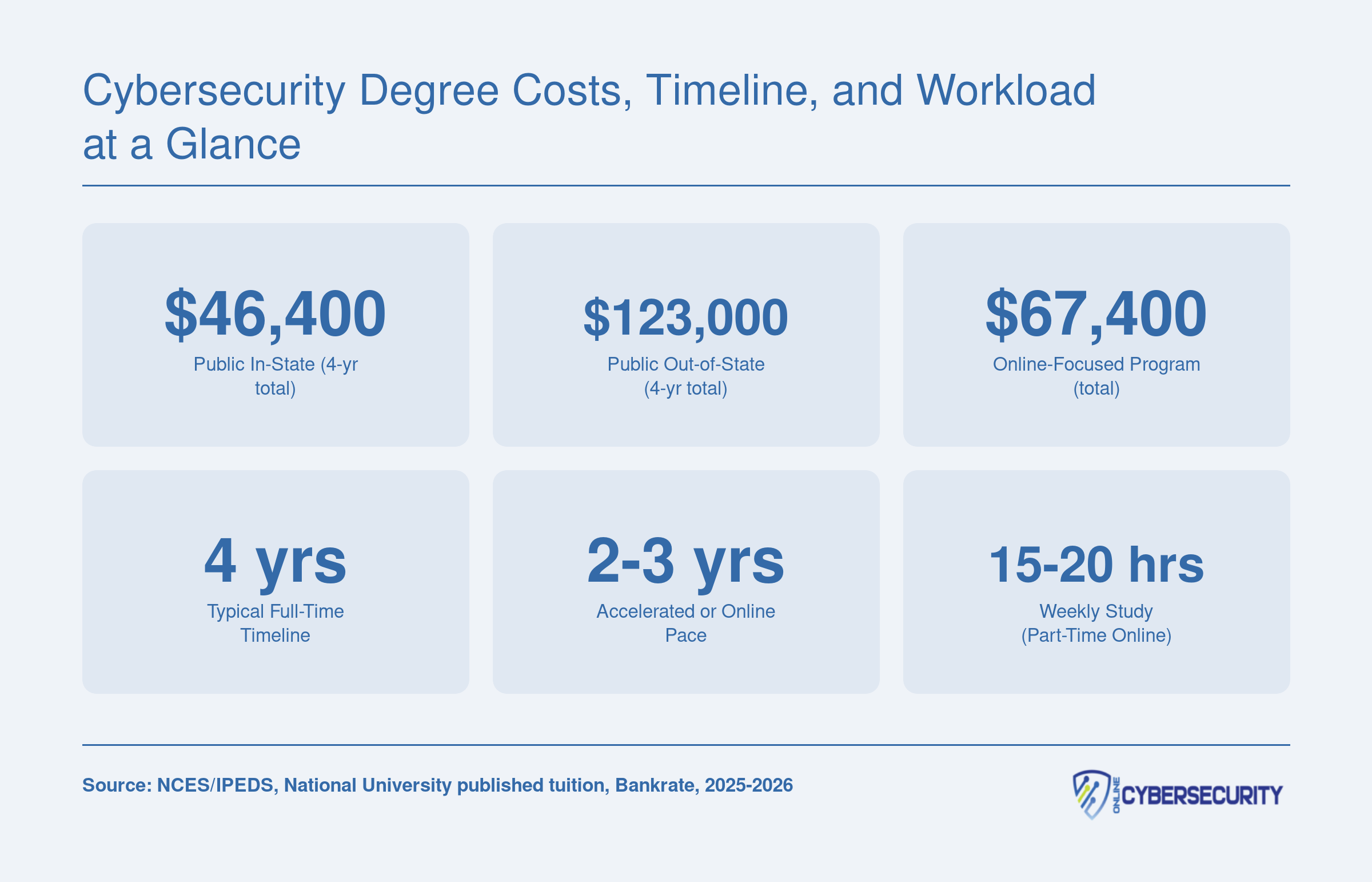
Cybersecurity Degree Costs, Timeline, and Workload at a Glance
The sticker price of a cybersecurity bachelor's degree swings dramatically depending on institution type and residency status. The figures below are median benchmarks for the 2024-2025 and 2025-2026 academic years. Always verify your actual net price with each school's net price calculator, because scholarships, employer tuition benefits, and financial aid can cut these totals significantly.
Typical Costs, Time to Completion, and Workload Expectations
Understanding what a cybersecurity degree program will cost you in dollars and hours is just as important as understanding the coursework itself. The range is wide, and the path you choose has a direct impact on both your total investment and how quickly you start earning a return.
How Much Does a Cybersecurity Degree Cost?
Tuition for a cybersecurity bachelor's degree varies significantly by institution type. Here are rough benchmarks to frame your planning:
- In-state public universities: $30,000 to $50,000 total for four years, making them the most common mid-range option.
- Private nonprofit universities: $80,000 to $120,000 total, though institutional scholarships can bring the net price down considerably.
- Competency-based online programs: Programs like those offered by Western Governors University (WGU) can come in under $20,000 total for students who move through material efficiently, since you pay a flat rate per six-month term and can accelerate.
These figures are approximate and vary by school, residency status, and fee structures. Always check the net price calculator on a program's website rather than relying on sticker price alone.
Time to Completion
The standard timeline for a full-time cybersecurity bachelor's degree is four years, or roughly 120 credit hours. But several factors can shorten or lengthen that window:
- Accelerated online programs: Competency-based or year-round enrollment models can compress completion to two to three years if you already have foundational IT knowledge or transfer credits.
- Part-time students working full-time: If you are balancing a career and coursework, plan realistically for four and a half to six years. This is a common and perfectly viable path, just one that requires sustained commitment.
- Transfer credits and prior learning: Military training, industry certifications, or an associate degree can knock a semester or more off your timeline at many schools.
Weekly Workload for Online Students
If you are considering an online cybersecurity degree, set honest expectations for the time investment. Full-time online enrollment typically requires 15 to 20 hours per week, which includes recorded or live lectures, lab exercises, reading, and assignments. Part-time enrollment usually runs 8 to 12 hours per week. Lab-heavy courses, especially those involving simulations or capstone projects, tend to push toward the higher end of those ranges during certain weeks.
The ROI Case
Cybersecurity degrees carry strong return-on-investment potential compared to many other bachelor's fields. Entry-level cybersecurity analysts typically earn between $60,000 and $85,000, with a median starting salary around $71,000 according to recent salary survey data.2 As you gain experience, the ceiling rises quickly: the Bureau of Labor Statistics reports a median annual wage of nearly $125,000 for information security analysts overall.3 The BLS also projects about 29 percent job growth for these roles through 2034, with roughly 16,000 openings anticipated each year.3 Even at the higher end of degree costs, this kind of earning trajectory means the investment pays back relatively quickly.
Financial Aid Levers Worth Exploring
Beyond standard federal financial aid, several funding sources are tailored specifically to cybersecurity students:
- CyberCorps Scholarship for Service (SFS): This program, funded by the National Science Foundation and managed by OPM, covers full tuition plus provides a generous stipend. In exchange, recipients commit to working in a government cybersecurity role for a period equal to the length of the scholarship (typically two to three years). It is one of the most valuable scholarship programs in higher education, period.
- NCAE-C school scholarships: Many schools with the National Centers of Academic Excellence in Cybersecurity designation offer institution-specific cybersecurity scholarships, sometimes funded by partnerships with federal agencies or defense contractors.
- Employer tuition assistance: A growing number of employers, especially in IT and defense sectors, will partially or fully reimburse cybersecurity coursework for current employees.
The bottom line: a cybersecurity degree is an investment, but it is one where the math tends to work out favorably. Whether you choose an affordable cybersecurity degree or a more traditional university path, the combination of strong starting salaries, rapid career growth, and dedicated scholarship opportunities makes this field more accessible than the sticker prices might suggest.
Online cybersecurity degrees from regionally accredited, NCAE-C designated schools typically use the same virtual lab platforms as their on-campus counterparts. The delivery format matters far less than a program's investment in hands-on infrastructure and certification alignment. When comparing programs, ask about lab access hours, capstone project requirements, and included certification vouchers, not just whether classes meet in person or online.
Common Questions About Cybersecurity Degree Programs
Below are answers to some of the most common questions prospective students ask before enrolling in a cybersecurity degree program. Each response ties back to topics covered earlier in this guide, so you can revisit the relevant section for a deeper look.