


What you’ll learn in this article…
- Top 25% of information security analysts earn over $157,000 annually.
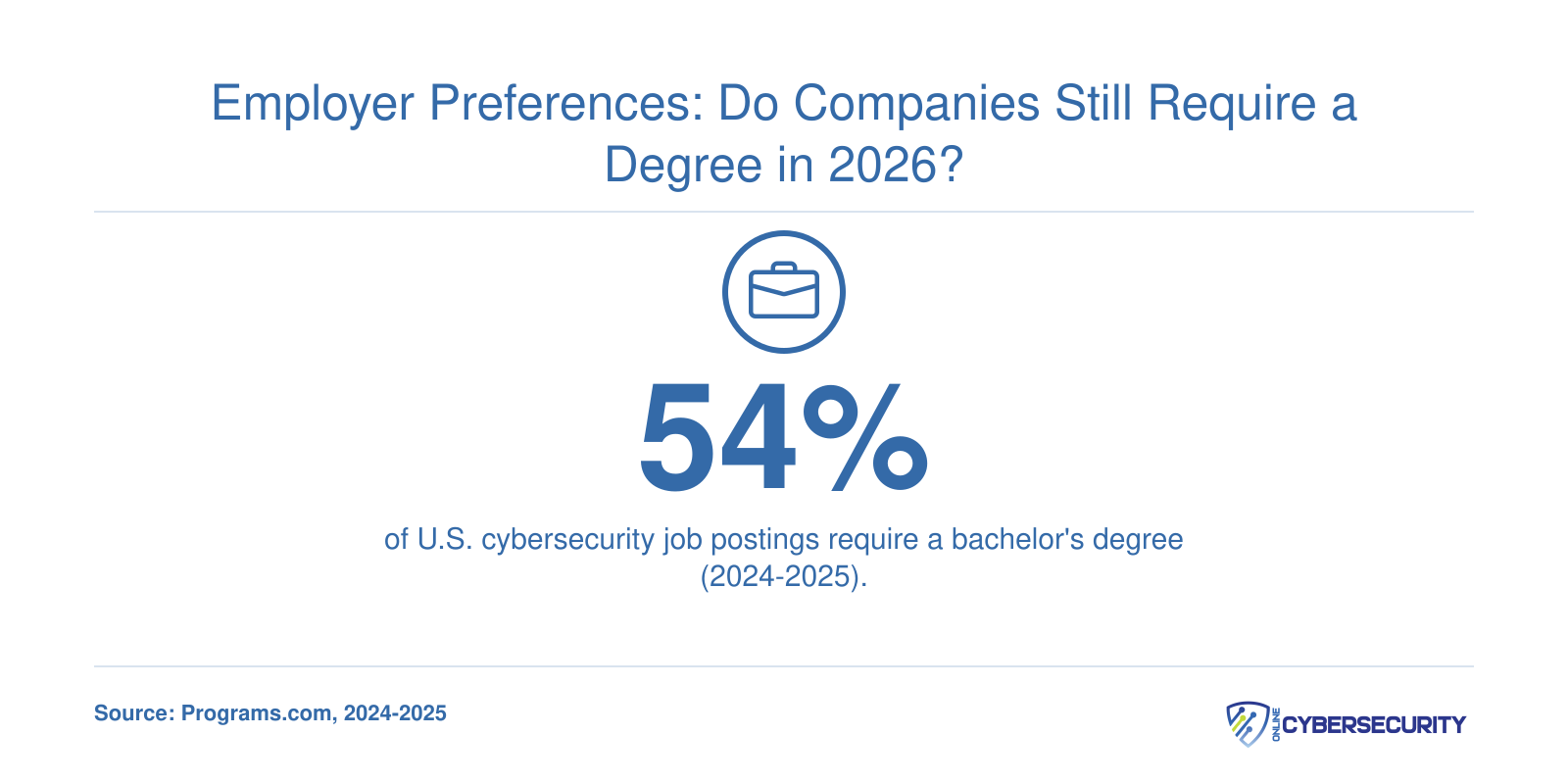
- Just over half of cybersecurity jobs still require a bachelor’s degree.
- 83% of employers rated online cybersecurity degrees as credible in 2023.
In 2026, the cybersecurity field is projected to have 3.5 million unfilled positions globally, yet certifications and bootcamps have created a noisy market where the value of a formal degree seems contestable. Starting salaries for degree holders routinely top $80,000, with experienced analysts earning median wages over $120,000 annually. While short-term credentials can land a role, employer surveys reveal that degree-holders advance faster and earn more over a career. More than half of cybersecurity job postings still require a bachelor's degree, signaling that the credential remains a clear hiring advantage.
How Much Do Cybersecurity Graduates Actually Earn? A Look at the Numbers
A cybersecurity degree remains one of the strongest salary drivers in tech, with median earnings for related roles comfortably above six figures. But what do the latest federal labor statistics really tell us about pay for Information Security Analysts, the job title most closely aligned with cybersecurity graduates? The numbers are compelling, especially when you factor in experience, location, and specialization.
National Salary Snapshot
According to the Bureau of Labor Statistics (BLS), the median annual cybersecurity salary for Information Security Analysts reached $124,910 in 2024. That's more than double the national median for all occupations, and it reflects the critical demand for professionals who can protect digital infrastructure. But median figures only tell part of the story. Entry-level roles or those in lower-cost regions may start closer to the 25th percentile, around $92,160, while seasoned experts can earn at the 75th percentile, $159,600 or higher. These numbers encompass all workers in the occupation, meaning those with a focused cybersecurity degree, industry certifications, or a few years of hands-on experience often land well above the median.
Geographic Hotspots Drive Higher Pay
Your salary can shift dramatically based on where you work. Tech-centric metros and federal hubs regularly top the charts. For instance, analysts in San Jose, CA, the heart of Silicon Valley, commonly earn above $150,000, buoyed by intense competition for talent. Similarly, Washington, D.C., with its dense concentration of government agencies and defense contractors, sees many cybersecurity roles pushing past the $160,000 mark. Even outside these extremes, cities like New York, Dallas, and Seattle offer premiums of 10-20% over the national median. Remote and hybrid roles are gradually narrowing geographic gaps, but physical proximity to major employers still carries a significant wage advantage.
What These Figures Mean for Degree Holders
It's important to note that the BLS data reflects all Information Security Analysts, from those with associate degrees and a few certifications to those with master's degrees and decades of experience. Graduates with a bachelor's or master's in cybersecurity, particularly from online cybersecurity programs that embed hands-on labs and internship placements, typically report starting salaries at the higher end of the range. Stacking an in-demand cybersecurity certification like CISSP or cloud security specialty can quickly add 10-15% to base pay. So while the national median is a useful benchmark, your personal earning potential as a degree holder is likely to land in the upper half of that spectrum, and climb steadily as you build expertise.
The top quarter of Information Security Analysts earn more than $157,000 per year, per the Bureau of Labor Statistics, revealing the impressive salary growth available to seasoned cybersecurity talent. This earning potential underscores the field's long-term value and makes the investment in education well worth it.
Related Articles
The Real Return on Investment: Degree Costs Vs. Salary Growth
When you weigh the price of a cybersecurity degree against the salary it can unlock, the long-term math often favors the degree holder. But the speed of your return depends heavily on the program you choose and the salary you command after graduation.
What a Typical Payback Looks Like
Consider an online cybersecurity bachelor's degree program from a public in-state school, where total tuition averages around $41,000.1 If you land an entry-level analyst role at $70,000 and allocate 20% of your pre-tax income to student loans, you would clear the debt in about three years. After taxes, the commitment feels even more manageable. With salaries in the $60,000 to $80,000 range,2 many graduates recoup their educational investment within three to five years when they choose a cost-effective program.
Public vs. Private: Your Choice of School Reshapes the Timeline
Tuition costs span a wide range. In-state, public online bachelor's programs average around $41,000 in total tuition, while out-of-state students at public schools pay closer to $59,000. Private online programs come in near $63,000 on average.1 Choosing a flagship state university as an in-state student can shorten your break-even point by almost two years compared to a private school. Many online cybersecurity programs from public institutions keep total costs under $45,000, making the ROI nearly immediate.
Degrees vs. Certifications: Short-Term Savings, Long-Term Ceilings
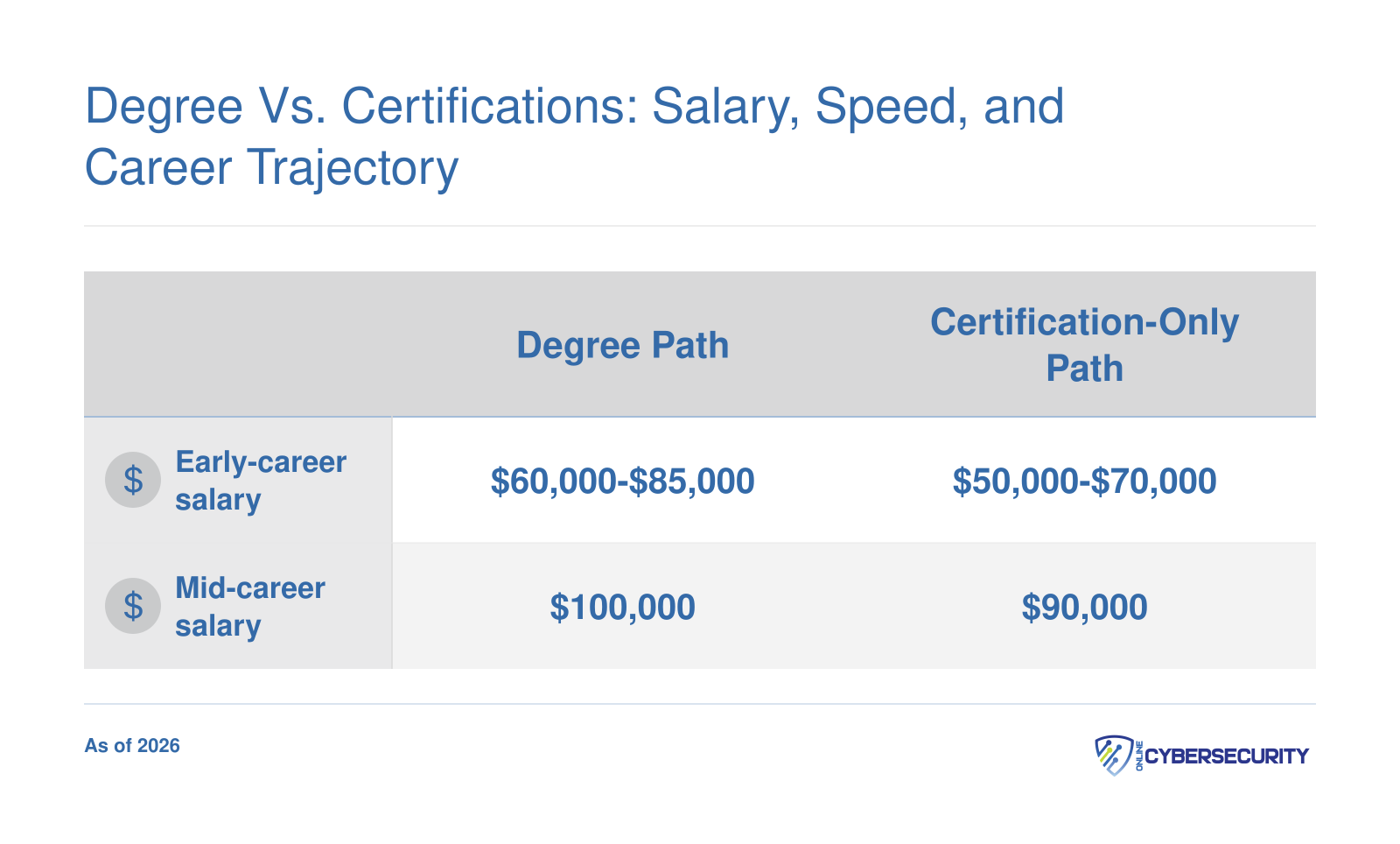
Certification-only paths typically cost a few thousand dollars, and you can start earning quickly. A CompTIA Security+ or CISSP might land you a job in the $55,000 to $70,000 range.2 However, when it comes to degree vs. certifications, data consistently shows that degree holders surpass their certification-only peers in mid-career earnings. After a decade, the salary advantage of a four-year degree often exceeds $20,000 per year, and the initial cost difference is wiped out.2
Hidden Accelerators: Tuition Reimbursement and Working Through School
Your real-world ROI can improve dramatically when you tap into employer tuition reimbursement programs. Many cybersecurity employers offer to cover a substantial portion of your educational expenses. Even without a formal program, attending part-time while working in an IT role can eliminate the need for loans altogether, turning the degree into a pure upside investment.
Employer Preferences: Do Companies Still Require a Degree in 2026?
In 2026, the cybersecurity job market shows a split: while many roles still list a degree as a requirement, a growing number accept certifications or experience. Recent data indicates that just over half of postings explicitly require a bachelor's degree, but alternative pathways are gaining traction, particularly at startups and in tech-forward sectors.
Questions to Ask Yourself
Degree Vs. Certifications: Salary, Speed, and Career Trajectory
When weighing a cybersecurity degree against certification-only paths, earnings over time often tell the clearest story. While certifications can offer a faster entry point, degree holders typically command higher salaries, especially over the long term.
Online Cybersecurity Degrees: Are They Worth the Same as On-Campus?
The line between online and on-campus degrees has blurred significantly, especially in cybersecurity, where employers increasingly prioritize verified skills over the delivery method.
Employer Attitudes Have Shifted Dramatically
In 2023, 83 percent of employers rated online degrees as credible, and by 2026, 70 percent of organizations had already hired online graduates.1 Within the cybersecurity field, the acceptance is even stronger: a 2024 survey found that 89 percent of cybersecurity employers view regionally accredited online degrees as equal to traditional programs.2 While some bias lingers (44 percent of U.S. recruiters still prefer in-person learning for technical skills, and 66 percent for soft skills), only 28 percent of hiring managers expressed a general preference for traditional degrees in 2025.1 The reality is that cybersecurity hiring rests on three pillars: certifications (47 percent of hiring managers call them most critical), experience (44 percent), and education (43 percent). Notably, 90 percent of cybersecurity hiring managers would consider a candidate without a degree if they have the right skills, so the format of your degree is rarely a dealbreaker.3
Salary Outcomes Tell a Similar Story
Data shows that online cybersecurity graduates earn competitively: the 2026 median starting salary for holders of an online cybersecurity degree is $65,000.3 That sits comfortably within national salary ranges for roles like security analyst ($65,000 to $85,000), incident response specialist ($70,000 to $90,000), and cybersecurity consultant ($75,000 to $95,000).4 Since the curriculum and accreditation status drive employer confidence, not whether you attended class in person, your earning potential hinges far more on the program’s quality than on its modality.
Reputation and Accreditation Make the Difference
Top online cybersecurity programs from well-known universities, such as Western Governors University, Southern New Hampshire University, and state flagship schools, carry the same recruiting weight as their on-campus counterparts. These institutions are regionally accredited and often hold programmatic accreditation like ABET, which signals rigorous standards. The real risk lies in unaccredited for-profit diploma mills that promise quick degrees but leave graduates with little recognition and poor job prospects. Before enrolling, verify both institutional and programmatic accreditation. A degree from a respected, accredited online program is not just as good as one earned on campus; it opens the same doors.
Which Degree Level Is Right for You: Associate, Bachelor’s, or Master’s?
The right cybersecurity degree level depends on where you are in your career and how quickly you want to step into a security role. Each tier serves a distinct purpose, and your choice should align with your current qualifications, budget, and long-term goals.
Mapping Degrees to Career Stages
An online associate degree in cyber security typically covers foundational skills and can qualify you for entry-level positions like IT support or junior security analyst. It is often a faster, lower-cost option, but it may limit your initial earning potential and advancement speed.
A bachelor’s degree is the most common entry point for mid-level roles such as security engineer or incident responder. Many employers view it as a baseline credential, and graduates generally see stronger salary growth over the first five to ten years of their career. If you are switching from another field, a cybersecurity bachelor's degree often provides the broad credibility needed to make the jump.
A master’s degree is best suited for those aiming at leadership or specialized roles, like chief information security officer or security architect. It can accelerate promotion timelines and unlock management tracks, but the added cost and time commitment make sense primarily when you already have some industry experience or a clear career ladder in mind.
Where to Find Reliable Salary Data by Education
You don’t have to guess about earning potential. Public resources can help you compare outcomes for each degree level:
- U.S. Bureau of Labor Statistics (BLS): The Occupational Outlook Handbook and Occupational Employment Statistics break down median wages by education and experience. You can look at national averages and filter by region.
- CyberSeek Career Pathway Tool: This interactive platform maps common cybersecurity roles to salary ranges, certifications, and education levels, showing you what a given degree unlocks at each career stage.
- ISC2 and ISACA Studies: Professional associations publish workforce surveys that often include salary breakdowns by degree level and years in the field. These reports give insight into what credentialed professionals actually earn, and you can map those earnings to specific roles with a cybersecurity career guide.
- University Career Outcomes Pages: Many schools publish graduate employment data, including salaries by major and degree type, so you can see real-world results from specific programs.
Comparing early- and mid-career earnings across these sources will reveal how quickly you might recoup your education investment. In general, a bachelor’s degree provides the strongest balance of opportunity and cost for most career changers, but the right answer always depends on your personal situation.
Key Factors That Boost (Or Undermine) Your Cybersecurity Degree’s Value
A cybersecurity degree is not a magic ticket to a six-figure job. Its value depends heavily on factors that many students overlook. By focusing on accreditation, experiential learning, and the right sources of labor market data, you can turn a degree into a genuine career accelerator.
Accreditation Signals Quality to Employers
Programmatic accreditation provides an objective stamp of quality that many cybersecurity hiring managers recognize. Look for designations like ABET (the Accreditation Board for Engineering and Technology) or the National Security Agency’s Centers of Academic Excellence (CAE) program. You can verify a school’s CAE status directly on the NSA’s website or check ABET accreditation through the ABET site. Graduating from an accredited program tells employers you have met rigorous, industry-aligned standards.
Internships and Career Services Drive Placement
Even a strong curriculum cannot replace hands-on experience. Before enrolling, research internship placement rates by contacting the school’s career center or reviewing publicly available employment reports. Schools that proactively connect students with internship opportunities, career fairs, and resume workshops tend to have stronger graduate outcomes. A cybersecurity degree’s payoff rises sharply when combined with real-world exposure, whether through cooperative education, capture-the-flag competitions, or organized lab work.
Data-Backed Research Gives You Negotiating Power
To understand your degree’s market value, turn to trusted sources. The U.S. Bureau of Labor Statistics (BLS.gov) projects strong growth for information security analysts, and its Occupational Outlook Handbook offers national-level salary and job outlook data. Supplement this with information from your state labor department for regional demand. Professional associations like (ISC)² and CompTIA publish regular reports on hiring trends and the relative value of cybersecurity degree vs certifications. These resources help you align your studies with actual market gaps.
By actively examining accreditation, internship pipelines, and reliable workforce data, you move from hoping a cybersecurity degree is worth it to knowing how to make it so.
FAQ: Your Biggest Questions About Cybersecurity Degrees in 2026
Still weighing the pros and cons of a cybersecurity degree in 2026? We’ve gathered the most common questions from students and career switchers to help you decide with confidence.