
What you’ll learn in this article…
- West Liberty University launched a fully online cybersecurity major in July 2026.
- Information security analyst jobs will grow 33% from 2023 to 2033.
- Look for accreditation, CompTIA alignment, and virtual labs in 2026 programs.
Introduction: New Online Cybersecurity Degrees Launching in 2026
Cybersecurity demand keeps climbing: the Bureau of Labor Statistics projects 33 percent job growth for information security analysts from 2023 to 2033, with a median wage of $124,910 in 2024. Responding to that demand, colleges are launching new online bachelor’s programs tailored to today’s threat landscape. These degrees blend business, hands-on labs, and direct paths to certifications like CompTIA A+, Network+, and Security+. Choosing a program that launched in 2026 means evaluating fresh curriculum against a limited graduate record: a trade-off worth scrutinizing carefully.
Why Choose a Newly Launched Cybersecurity Degree in 2026?
West Liberty University's new fully online cybersecurity major, announced July 17, 2026, arrives with built-in preparation for the four foundational CompTIA cybersecurity certifications (A+, Network+, Security+, and ITF+), a clear signal that programs launching this year are engineered for immediate industry relevance. Unlike older curricula that may lag behind evolving attack vectors, a degree debuting in 2026 reflects the current threat landscape: ransomware-as-a-service, AI-driven phishing, cloud misconfigurations, and zero-trust architectures aren't footnotes: they're woven into core coursework from day one.
Curriculum Built for 2026 Threat Landscapes
When you enroll in a newly launched cybersecurity degree program, you're not learning security through the lens of 2019. Faculty design these degrees with input from employers actively hiring now, ensuring you graduate fluent in modern frameworks like MITRE ATT&CK, cloud security posture management, and identity threat detection. Many new programs directly map to the National Initiative for Cybersecurity Education (NICE) Workforce Framework, aligning every class with specific work roles, so you know exactly which job titles your skills target.
Integrated Certifications and Hands-On Labs
Perhaps the biggest advantage: certification prep is baked in, not tacked on. In West Liberty's case, the four CompTIA exams are woven into the curriculum, so you earn credits while preparing for credentials employers require. Beyond that, look for hands-on labs that mirror real security operations centers, with sandboxed environments where you respond to live breach simulations, dissect malware, and configure firewalls. These aren't static multiple-choice quizzes; they're hands-on experiences that build problem-solving muscle memory.
Flexible and Career-Focused for Working Adults
A 2026 degree is designed with your schedule in mind. Fully online, asynchronous delivery means you can keep your day job while pivoting into cybersecurity. Programs launched this year often feature accelerated terms, stackable certificates, and no requirement to set foot on campus. For career changers, the blend of business and security skills, as emphasized in West Liberty's program through its business school accreditation, means you graduate not just as a technician, but as someone who understands risk management, governance, and how security supports organizational goals.
New Online Cybersecurity Degrees Launching in 2026
Choosing a new online cybersecurity degree means weighing a fresh, career-aligned curriculum against the limited track record of a brand-new program. New launches often reflect current employer needs, but verifying quality and accreditation takes extra effort. In 2026, several institutions have introduced or expanded fully online cybersecurity programs that merit a close look.
West Liberty University: Business-Focused Cybersecurity
West Liberty University has launched a new Bachelor of Science in Business Administration with a major in Cybersecurity,1 built inside the Gary E. West College of Business. The program holds IACBE accreditation and integrates business and security skills from day one. Students prepare for the four foundational CompTIA exams: A+, Network+, Security+, and IT Fundamentals (ITF+). The curriculum uses theory and simulated learning environments to give hands-on practice, and the entire degree is delivered 100% online with no campus visits required. Because the program is new, tuition and fee details may still be finalizing, so contacting admissions directly for the latest cost is wise.
Liberty University: Flexible and Affordable Pathway
Liberty University’s Bachelor of Science in Computer Science with a concentration in Cybersecurity is now offered 100% online in 8-week courses with no set login times. The current per-credit rate is $250, and Liberty provides tuition discounts for veterans and first responders. The program aligns with various IT certifications, though the specific exams covered may vary. With multiple start dates each year, you can enter quickly and progress at your own pace. Accreditation is through SACSCOC, a recognized regional body.
Evaluating Unfamiliar Programs
When a degree is brand new, there may be no graduate outcome data yet. That makes it even more important to cross-check claims with independent sources. Start by visiting the university’s official page for the program to confirm delivery mode, curriculum, and accreditation. Then use BLS.gov to research cybersecurity job growth and typical wages, solid numbers can help you estimate return on investment. Contact admissions or the program coordinator with direct questions about launch dates, lab platforms, and instructor backgrounds. A responsive department is a positive sign. Finally, monitor professional associations like CompTIA and ISC2 for announcements about academic partnerships or certification prep agreements. These endorsements can validate a program’s industry relevance even when it lacks a long history.
Even if a program is not listed here, many schools are launching or refreshing cybersecurity programs in 2026. Directly researching each option helps you find the fit that balances cost, flexibility, and career preparation.
The Bureau of Labor Statistics projects a 33 percent increase in information security analyst jobs from 2023 to 2033, far outpacing most occupations. Their median annual wage reached $124,910 in 2024, reflecting strong demand for cybersecurity professionals.
What to Look for in a 2026 Online Cybersecurity Program
Choosing an online cybersecurity degree means weighing accreditation and curriculum against convenience; a program may look good on paper but lack the hands-on experience employers demand. As new programs launch in 2026, these criteria help you identify the ones that truly prepare you for the field.
Accreditation Matters
Regional accreditation is the baseline, and West Liberty University’s new online Cybersecurity major checks that box through a CHEA-recognized accreditor.1 Even more telling is specialized accreditation for the business school offering the degree. West Liberty’s Gary E. West College of Business holds IACBE accreditation through 20312, which means the Bachelor of Science in Business Administration with a Cybersecurity concentration meets international business education standards. When evaluating any new program, confirm both institutional and programmatic accreditation status, and if the degree is brand new, ask whether specialized accreditation is in progress.
Hands-On Practice: Labs and Cyber Ranges
Cybersecurity isn't learned solely from textbooks. The best online programs embed virtual lab environments, cloud-based simulations, and cyber ranges that let you defend against real-time attacks. While West Liberty’s initial announcement doesn’t detail its hands-on components, prospective students should ask directly: does the curriculum include dedicated lab time using platforms like Cyberbit or RangeForce? Look for programs that describe specific tools or exercises, not just recorded lectures. A degree that logs your hours in a virtual security operations center provides a hiring advantage over one without applied practice.
Certification Preparation Built In
Industry certifications are a direct path to entry-level jobs, and a strong 2026 program aligns coursework with CompTIA’s foundational exams, a key advantage when weighing a Cybersecurity Degree vs. Certifications. West Liberty explicitly states its major prepares students for the A+, Network+, Security+, and ITF+ certifications. That built-in alignment saves you from extra prep courses. When comparing programs, verify whether exam vouchers, study guides, or review sessions are included. A curriculum mapped to these outcomes signals employer-ready skills.
Student Support for Distance Learners
Online success depends on more than content. Check for 24/7 tutoring, dedicated career advisors who understand cybersecurity recruiting, and access to alumni networks. A program like West Liberty’s, housed in a business college, may also connect you to internship pipelines and employer partnerships. Ask about job placement assistance and whether career services are available remotely. Robust support turns a solitary online experience into a launchpad.
Comparing Costs and Flexibility of New Programs
Understanding the cost of an online cybersecurity degree goes beyond the headline tuition number. Per-credit rates, total program credits, and term structure all shape the overall investment, while delivery formats determine how easily the program fits into a working professional's life.
West Liberty University
West Liberty's new online Cybersecurity major carries a per-credit cost of $3751. For the full 120-credit bachelor's program, total tuition comes to $45,0002. The program follows a traditional semester-based calendar1 and is delivered fully online, with no on-campus components required2. While specific synchronous session requirements may vary by course, the structure allows students to plan around fixed academic terms.
Liberty University
Liberty University's online Bachelor’s in Computer Science , Cybersecurity charges $410 per credit for the 2026-2027 academic year, totaling an estimated $49,200 for the complete program3. Liberty stands out with its 8-week terms4 and primarily asynchronous delivery5, meaning most coursework can be completed on your own schedule with no set class meeting times. This accelerated term model can help students finish faster while balancing work and family commitments.
Other New Programs to Watch
Eastern Michigan University has announced a 2026 online cybersecurity degree, but specific per-credit costs and total program fees have not yet been published. Prospective students should monitor EMU's website for tuition details and any associated lab or technology fees. Additionally, other institutions are expected to launch new online cybersecurity majors this year; always confirm that published estimates include all mandatory charges, as some programs layer on fees for virtual labs, proctoring, or course materials.
Choosing the Right Fit for Your Budget and Schedule
When comparing costs, look at the total program expense, not just the per-credit rate. A lower per-credit rate in a semester system might still require more total credits than an 8-week term model, so calculate the overall cost. Flexibility varies too: fully asynchronous programs offer the greatest convenience, while those with occasional synchronous components may provide more direct interaction. Verify whether schools lock in your tuition rate upon enrollment or raise it annually, as this can impact long-term affordability.
Questions to Ask Yourself
Career Paths and Certifications in Cybersecurity
Deciding which certification to pursue first is a classic early-career dilemma: do you go for something like CompTIA Security+ to get your foot in the door, or invest more time and money in a specialized credential like CISSP for longer-term payoff?
Mapping Certifications to Career Stages
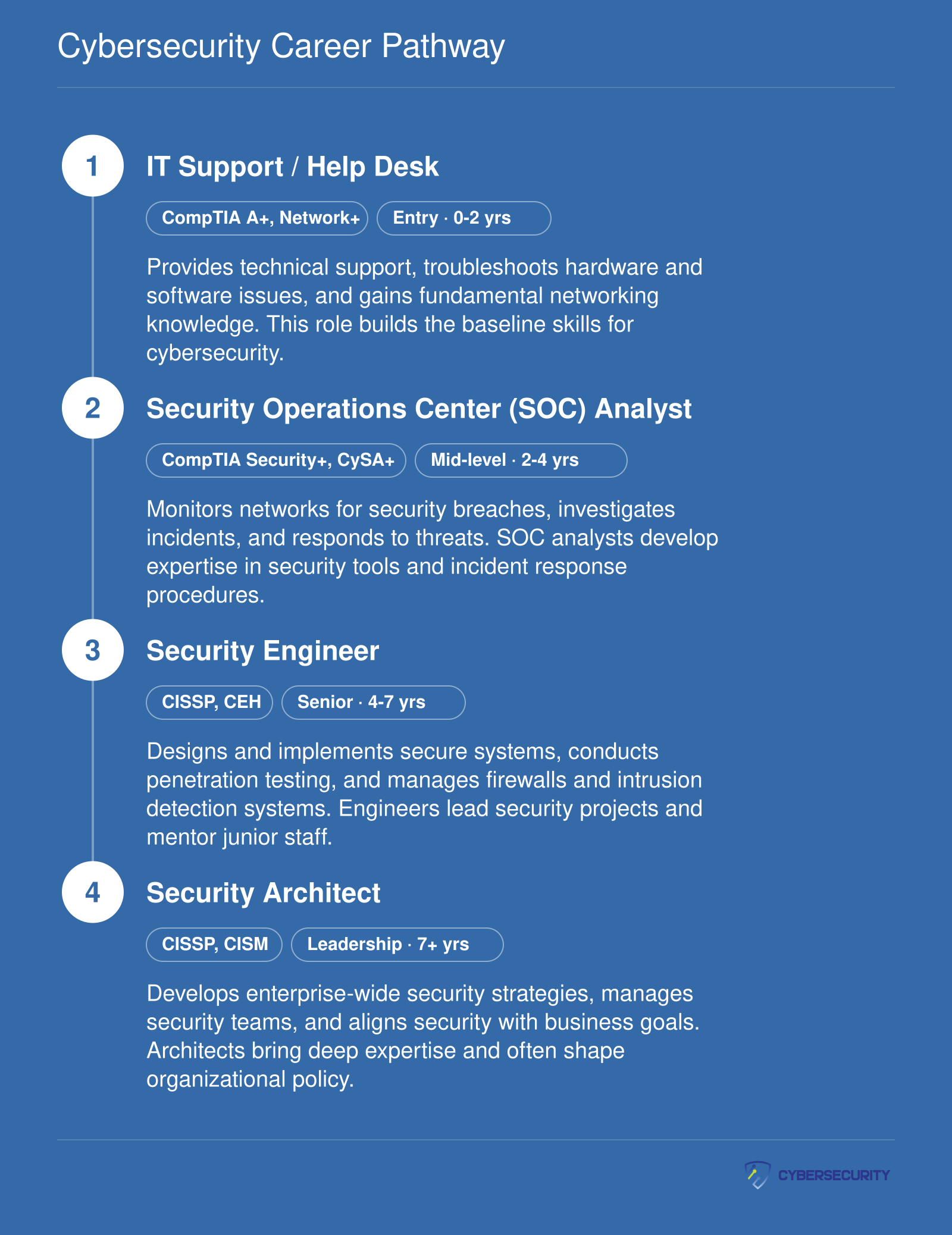
Certifications in cybersecurity often line up with experience levels. Entry-level roles typically call for CompTIA A+, Network+, Security+, or IT Fundamentals (ITF+). These validate foundational hardware, networking, and security skills. Many online cybersecurity degree programs now bake this prep into their curriculum, so you can graduate with both a diploma and an industry-recognized cert. Mid-career professionals often target advanced credentials like Certified Information Systems Security Professional (CISSP) or Certified Ethical Hacker (CEH), which require several years of work experience. Checking the websites of organizations like (ISC)², CompTIA Cybersecurity Career Pathway, and EC-Council gives you clear roadmaps for each track.
Using Data to Make Informed Decisions
Rather than guessing which certifications will pay off, tap into free labor market data. The U.S. Bureau of Labor Statistics Occupational Outlook Handbook provides up-to-date cybersecurity salaries and job growth projections for information security analysts, a broad category that covers many cybersecurity roles. Job boards like LinkedIn, Glassdoor, and Indeed let you compare advertised salaries and cert requirements for specific titles , penetration tester, security engineer, or SOC analyst , in your geographic area. This real-world snapshot helps you decide whether to prioritize a quick entry-level cert or pursue a more demanding credential right away.
The Degree-Certification Connection
When researching online cybersecurity programs, visit each program’s curriculum page or “program requirements” section. Many schools are transparent about which certifications their courses align with. Some even include exam vouchers or boot camps as part of tuition. This integrated approach can streamline your path, letting you earn both a degree and multiple certifications without doubling your study time , essentially an accelerated cybersecurity certification program. Ultimately, pairing a formal degree with stackable certifications builds a resume that stands out to employers, and gives you flexibility as the field evolves.
Cybersecurity Career Pathway
A career in cybersecurity often begins with foundational IT roles and advances through specialized security positions. Each stage requires additional certifications and hands-on experience, leading to higher responsibility and earning potential.
How to Apply and Admission Requirements
A minimum high school GPA of 2.0 and an SAT score of 950 or ACT score of 18 are the baseline freshman admission requirements at West Liberty University, one of the programs launching a new online cybersecurity degree in 2026. However, every school has its own criteria, so it is essential to review each program's official admissions page directly.
Getting Started with Your Application
Begin by visiting the university's admissions website for the most accurate and up-to-date requirements. For example, West Liberty University's admissions website outlines two freshman admission paths:
- Path 1: Minimum 2.0 GPA with ACT 18 or SAT 950 (combined Evidence-Based Reading and Math)
- Path 2: Minimum 3.0 GPA, which waives the test score requirement
Required high school units include 4 English, 3 Social Science, 4 Math (including Algebra II), 3 lab Science, 1 Art, and 2 Foreign Language.
Liberty University's online B.S. in Computer Science , Cybersecurity, another new 2026 launch, requires a minimum 2.0 GPA for admission and carries a $50 application fee.1 The program totals 121 credit hours,2 with a start date of May 18, 2026.3 For its online M.S. in Cyber Security, a 3.0 GPA is required, along with prerequisite coursework in algebra, computer programming, networks, and statistics.4
Understanding Transfer and Prior Learning Credits
Transfer credit policies can significantly impact your time to degree and total cost. Because these details are often not fully published online, contact the admissions office or program coordinator directly. Ask about credit for prior coursework, industry certifications, or military training. Industry-recognized certifications, such as top cybersecurity certifications like CompTIA Security+, can sometimes translate into college credit, so inquire about that possibility.
Application Deadlines and Next Steps
Review application deadlines for upcoming terms on the university's academic calendar or apply page. Note that priority deadlines may differ from final deadlines. For instance, Liberty University's program start date of May 18, 2026, suggests an application window several months prior. Always confirm dates directly with the institution to avoid missing a key cutoff. After submitting your application, follow up with the admissions office to ensure all transcripts, test scores, and supplementary materials have been received.
Frequently Asked Questions About New Online Cybersecurity Degrees
Whether you're considering a career change or starting college, it's natural to have questions about new online cybersecurity programs. Here are answers to some of the most common ones, based on 2026 program details and industry standards.
Conclusion: Your Next Step in Cybersecurity
2026 is a pivotal year to launch your cybersecurity career through a cutting-edge online degree program. As you weigh your options, prioritize programs that hold recognized accreditation, offer hands-on virtual labs, align with industry certifications like CompTIA, and deliver clear cost and flexibility benefits. The newest programs reflect current employer demands, giving you an edge from day one. Your next step is to visit the program websites mentioned, request detailed admissions information, and submit your application early to secure a spot in an upcoming cohort. The cybersecurity field is expanding rapidly, and understanding why cybersecurity is important can help you see the value; the right degree will position you at the forefront of this dynamic industry.