
What you’ll learn in this article…
- Alaska had roughly 1,932 cybersecurity job openings as of 2025, with only about 54% of demand filled by local workers.
- The University of Alaska Fairbanks offers the state's sole fully online cybersecurity credential, a graduate certificate in Cybersecurity Management.
- Military personnel at JBER, Eielson, and Fort Wainwright can leverage federal tuition benefits for cybersecurity programs.
- Rural Alaskans can earn cybersecurity degrees online, though satellite or cellular connectivity requires advance planning around labs and exams.
Alaska hosts roughly 1,932 unfilled cybersecurity positions as of recent CyberSeek data, with demand driven by Joint Base Elmendorf-Richardson, Eielson Air Force Base, oil and gas infrastructure, and state government networks. Supply is thin: only about 54% of cyber roles in the state are currently filled.
The in-state online program options reflect that same scarcity. The University of Alaska Fairbanks offers a Cybersecurity Management Graduate Certificate, but students seeking associate or bachelor's degrees will need to look at out-of-state online programs or SARA-participating institutions. For those exploring a broader cybersecurity career path, careful program selection around accreditation, CAE designations, and true net cost is unusually high-stakes for Alaskans.
For military-connected students and those in rural communities off the road system, connectivity logistics and tuition benefit alignment add another layer of complexity to the decision.
Best Online Cybersecurity Programs in Alaska: Our Rankings
Alaska's online cybersecurity landscape is compact. As of 2026, the state offers a single in-state, fully online cybersecurity credential: the Cybersecurity Management Graduate Certificate at the University of Alaska Fairbanks. Because the roster is small, we profile this program in depth so you can weigh it against out-of-state online options with full confidence. Our composite ranking considers institutional quality, affordability, program relevance, and graduate outcomes rather than any single metric.
- Institutional graduation and retention rates
- Net price and student debt levels
- Graduate earnings after completion
- Program format and accessibility
- Curriculum relevance and specialization
- Independent program research
- Internal program database
- NCES-IPEDS federal institutional data — nces.ed.gov
- College Scorecard graduate earnings — collegescorecard.ed.gov
- #1
University of Alaska Fairbanks
Fairbanks, AK · $11,000/yr
Best for: Alaska professionals advancing in cyber leadership
The University of Alaska Fairbanks is a public research institution with an 11:1 student-to-faculty ratio and a net price of roughly $10,892 for in-state students. Its College of Business and Security Management houses cybersecurity coursework that draws on Alaska's unique critical-infrastructure challenges, from oil and gas operations to Arctic-remote utilities. Faculty and guest instructors frequently bring practitioner backgrounds in Alaska or Arctic operations, lending real-world regional context to every course. Median earnings for UAF graduates reach approximately $48,866 ten years after enrollment, and median graduate debt sits near $20,291.
View program
- Fully online, asynchronous format built for shift and remote workers
- 12-credit program covering information assurance, risk, and cyber threats
- Requires a bachelor's degree plus IT or cybersecurity background
- Credits may stack into UAF's M.S. in Security and Disaster Management
- Curriculum aligned with DHS/NSA cyber-resilience principles
- Serves as Continuing Professional Education for industry certifications
- Admission review considers relevant Alaska practitioner experience
- Holistic director review; GPA of 3.0 or higher expected
How We Ranked Alaska's Online Cybersecurity Schools
Transparency matters when you are making a decision as significant as choosing a cybersecurity program. Most competitor rankings leave you guessing about what drives their lists. Ours does not. Every factor we used is published here so you can weigh the results for yourself.
What Goes Into the Composite Score
Each school's score draws on a blend of quality and value indicators. Programs that offer fully online or primarily online delivery receive a boost, since flexibility is essential for students across a state as vast as Alaska. If you are also comparing options beyond the state level, our national list of best online cybersecurity programs provides a useful benchmark. Beyond the delivery factor, the composite balances several dimensions:
- Affordability: We use a sector-conditional average net price, meaning the figure reflects the type of institution (public four-year, private nonprofit, etc.) rather than a one-size-fits-all sticker price.
- Completion rates: Graduation rates are institution-wide figures, not specific to the cybersecurity program. We flag this because no perfect program-level completion metric exists across all schools, and we would rather be upfront about the approximation.
- Earnings outcomes: Program-level median earnings at one year and at multiple years after graduation inform the return-on-investment picture. Where those figures are available, they carry meaningful weight.
- Debt levels: Median borrowing for program completers helps us gauge whether the credential pays for itself within a reasonable timeframe.
Why a Small Pool Is Actually an Advantage
Alaska's eligible universe of online cybersecurity programs is compact compared to states like Texas or California. That smaller pool lets us evaluate each school more thoroughly rather than running hundreds of entries through a coarse filter. We reviewed curriculum details, student support structures, and how well each program serves remote learners, including those connecting from prior-service military backgrounds or rural communities off the road system.
Our Commitment to Honesty
No ranking methodology is perfect. Institutional graduation rates can obscure strong outcomes in a specific department, and net price averages may not match every student's financial situation. We chose to work with the best available data while being candid about its limits. If a particular data point is not yet published for a program, we say so plainly rather than guessing. That honesty is what sets our approach apart: you see exactly what we measured, and you can decide how much each factor matters to your own goals.
Questions to Ask Yourself
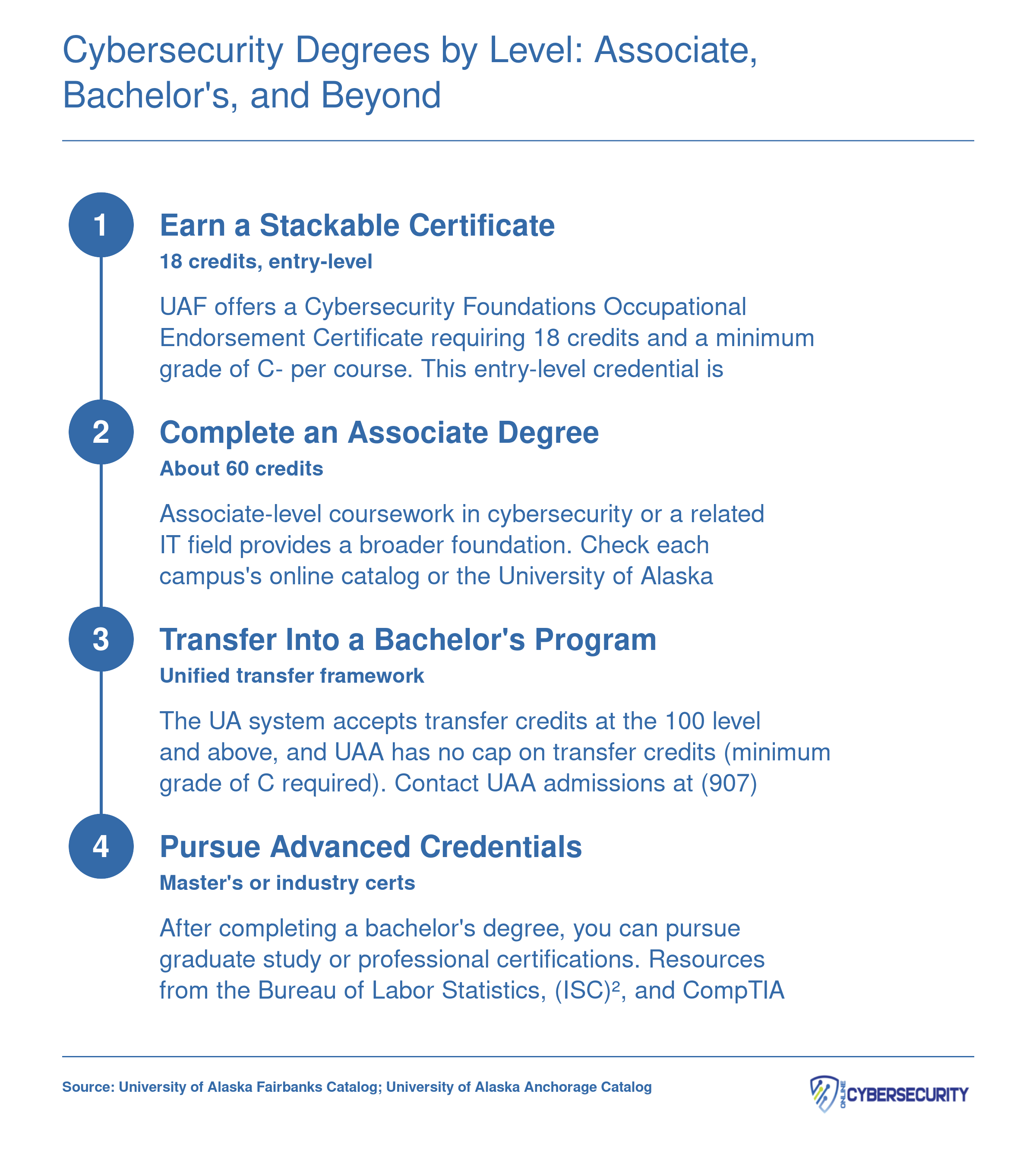
Cybersecurity Degrees by Level: Associate, Bachelor's, and Beyond
Alaska's cybersecurity education landscape is built around stackable credentials, meaning you can start small and build toward higher degrees over time. The University of Alaska system uses a unified general education transfer framework, so credits earned at one campus (such as UAA or a community campus) can move with you. Before enrolling, visit the official program pages at uaa.alaska.edu and uaf.edu, or contact admissions directly, to confirm which cybersecurity degrees are currently offered fully online.
Accreditation and CAE Designations for Alaska Cybersecurity Programs
Understanding the accreditation landscape in Alaska is essential before you commit to a cybersecurity program. Two designations matter most in this field: regional and programmatic accreditation (such as ABET) and the NSA/DHS Center of Academic Excellence (CAE) designation. Here is where Alaska stands on both fronts as of 2026.
CAE Designation Status in Alaska
As of the latest data, no institution in Alaska holds a Center of Academic Excellence designation in any category, whether Cyber Defense (CAE-CD), Cyber Operations (CAE-CO), or Research (CAE-R).12 This means the University of Alaska Anchorage, the University of Alaska Fairbanks, and every other in-state school fall outside the CAE network. That is a significant gap, and it is worth understanding what it means for your career path.
Why the CAE Designation Matters
The CAE program is jointly managed by the NSA and the Department of Homeland Security.3 Schools that earn the designation have met rigorous curriculum standards mapped to specific cybersecurity knowledge units. For students, the practical benefits include:
- Federal hiring preference: Many federal agencies, including the Department of Defense, give preference to graduates of CAE-designated programs when filling cybersecurity roles.
- DoD Cyber Scholarship Program eligibility: This competitive scholarship covers tuition, fees, and a stipend, but it is only open to students at CAE-designated institutions.
- GI Bill alignment: While GI Bill benefits work at any accredited school, CAE designation provides an added layer of assurance that the curriculum aligns with government workforce needs.
Without a CAE-designated program in state, Alaska students pursuing federal or defense cybersecurity careers may want to consider enrolling in an online program offered by a CAE-designated school in another state. Many such programs accept students nationwide and deliver the same curriculum remotely. Exploring online cybersecurity programs from CAE-designated institutions is a practical way to bridge that gap.
ABET Accreditation in Alaska
On the programmatic accreditation side, the University of Alaska Fairbanks holds ABET accreditation through the Computing Accreditation Commission for its Bachelor of Science in Computer Science. This is a general computer science program rather than a dedicated cybersecurity degree, but it provides a strong technical foundation that translates well into security-focused roles. Students interested in a more targeted credential may also want to look into a computer science cybersecurity degree offered online. No other Alaska institution currently holds ABET accreditation for a computing or cybersecurity program, and UAA does not have an ABET-accredited computer science program at this time.
What This Means for You
The absence of CAE designations in Alaska does not make in-state programs worthless, far from it. A regionally accredited degree from UAA or UAF still carries weight with employers, and hands-on skills matter enormously in cybersecurity hiring. However, if your goal is to enter federal service, intelligence work, or defense contracting, you should factor the CAE gap into your decision. Enrolling in an accredited cybersecurity program online based outside Alaska can keep you competitive in those pipelines while still letting you live and study from anywhere in the state.
Cybersecurity Costs, Financial Aid, and ROI in Alaska
Understanding the true cost of a cybersecurity program in Alaska means looking past the sticker price. Between state-specific scholarships, federal programs, and military benefits, many students can significantly reduce what they actually pay out of pocket.
What You Can Expect to Pay
Among the Alaska-based programs we evaluated, the University of Alaska Fairbanks stands out as one of the most affordable options. Its effective net price for in-state students is approximately $10,892 per year after institutional aid, with a published in-state tuition around $8,736 at the undergraduate level. Graduate-level cybersecurity certificates carry tuition closer to $13,040 for in-state students. Median graduate debt at UAF sits near $20,291, which is considerably lower than the national average for four-year graduates. If you are comparing costs across the broader landscape, our guide to affordable cybersecurity programs can help you benchmark Alaska against other states.
Alaska-Specific Financial Aid
Alaska residents have access to the Alaska Performance Scholarship, a merit-based award available for up to eight semesters (within eight years of high school graduation).1 Awards are tiered by academic achievement:
- Level 1: Up to $7,000 per year for students with a 3.5 GPA and a minimum ACT score of 25, SAT of 1210, or WorkKeys score of 18.
- Level 2: Up to $5,250 per year for students with a 3.0 GPA and a minimum ACT score of 23, SAT of 1130, or WorkKeys score of 15.
- Level 3: Up to $3,500 per year for students with a 2.5 GPA and a minimum ACT score of 21, SAT of 1060, or WorkKeys score of 12.
Beyond the state scholarship, the UA Foundation offers additional scholarships for STEM and technology students.2 At the federal level, CyberCorps Scholarship for Service (SFS) covers tuition, fees, and provides a stipend in exchange for government service after graduation. It is one of the most generous programs available to cybersecurity students nationwide.
Military and Veteran Benefits
Given Alaska's large military population, it is worth highlighting the cost-offset tools available to service members and their families. Active-duty personnel can use Tuition Assistance (TA), and Post-9/11 GI Bill benefits can cover tuition entirely at public institutions like UAF. Military spouses in eligible pay grades (E-1 through E-5, W-1 through W-2, and O-1 through O-2) may qualify for the MyCAA program, which provides up to $4,000 toward a certificate or associate degree in a high-demand field like cybersecurity.
Framing the Return on Investment
So is the investment worth it? Consider a concrete scenario. A student who completes a cybersecurity program at UAF with a net cost around $10,892 per year and graduates with roughly $20,291 in debt enters a job market where Alaska cybersecurity professionals regularly earn well above the state median. Institutional data shows that UAF graduates across all fields earn approximately $48,866 within ten years of enrollment, and cybersecurity roles in Alaska typically command salaries that exceed that figure, often reaching into the $80,000 to $100,000 range depending on role and clearance level.
Even in a conservative estimate, a graduate earning in the mid-$60,000s in their first year post-graduation can cover their total student debt within a single year of working while still meeting living expenses. By four years out, the earnings gap between degree holders and those without credentials widens substantially, making the payback timeline for a cybersecurity associate's degree online or bachelor's one of the shortest among technology fields.
The bottom line: when you layer Alaska Performance Scholarship funds, federal aid, and military benefits on top of already-moderate in-state tuition, the out-of-pocket cost for an Alaska cybersecurity degree can drop to a level that pays for itself quickly in the job market.
According to CyberSeek data, Alaska had roughly 1,932 cybersecurity job openings as of 2025, yet the state's workforce could only fill about 54% of that demand. That means nearly half of all cyber positions in Alaska go unfilled, creating strong opportunities for anyone entering the field.
Cybersecurity Job Market and Salaries in Alaska
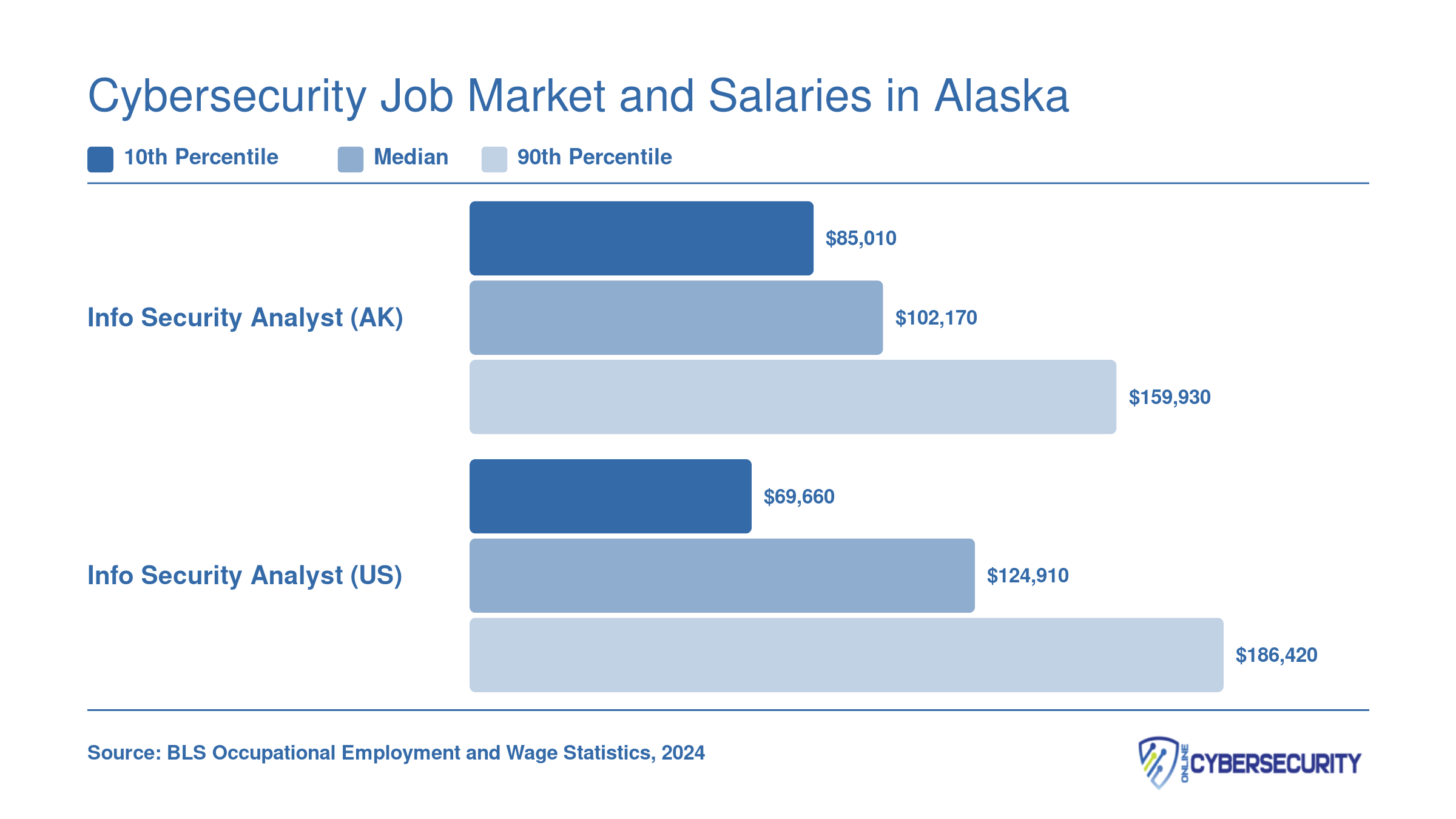
Alaska's cybersecurity workforce is anchored by major employers including Joint Base Elmendorf-Richardson (JBER), Eielson Air Force Base, defense contractors like Booz Allen Hamilton and Leidos, oil and energy companies, and state and federal agencies. Anchorage tends to concentrate the largest share of cyber openings, while Fairbanks positions often tie to military and defense operations near Eielson AFB. When you compare the median information security analyst salary of roughly $102,170 to the tuition ranges discussed earlier, the return on investment for an Alaska cybersecurity degree becomes clear: even entry-level analysts here earn well above the state's median household income, and senior professionals can reach nearly $160,000.
Studying Online From Rural Alaska: What to Know
If you live in a village off the road system or in one of Alaska's many remote communities, earning a cybersecurity degree online is absolutely possible, but it requires some planning around connectivity, testing, and occasional travel. This section covers the practical realities that most guides overlook.
Internet Connectivity and Bandwidth
Online cybersecurity coursework involves video lectures, virtual labs, and proctored exams, each with its own bandwidth demands. As a general rule, you will want a minimum of 5 Mbps download speed for reliable video conferencing, with 10 to 15 Mbps or higher recommended for virtual lab environments where you interact with remote servers in real time. Proctored exams typically require a stable connection of at least 3 to 5 Mbps, plus a webcam and microphone.
In many rural Alaska communities, satellite internet has historically been the primary option, and traditional satellite connections often introduce latency that can interfere with live proctoring software. However, low-earth-orbit satellite services have expanded their footprint across Alaska in recent years, delivering speeds that generally meet or exceed these minimums. If you are relying on older satellite or cellular hotspot connections, test your setup with your program's learning management system and proctoring platform before the semester begins.
Proctoring Options for Limited Connections
Most online programs use remote proctoring services that monitor you through your webcam during exams. If your connection is unreliable, look for programs that offer alternatives:
- Flexible proctoring: Some services allow you to record your exam session and upload it afterward rather than streaming live, which is more forgiving of connection drops.
- In-person testing sites: The University of Alaska system maintains rural learning centers and campus sites in communities across the state where students can take proctored exams in person. UAF's eCampus, which delivers over 500 courses across 60-plus disciplines through Canvas, has experience coordinating testing for students in remote locations.1 UAF also operates dedicated Rural Student Services to help students navigate logistics like these.2
- Community partnerships: Some programs accept proctoring through approved community libraries, school district offices, or tribal education centers. Ask your program's testing coordinator about approved sites near you.
Hybrid Requirements and Travel Logistics
While many cybersecurity programs are fully online, a few may require brief on-campus intensives, capstone presentations, or hands-on lab sessions. If you are in bush Alaska, that could mean a flight to Anchorage or Fairbanks, so factor in travel costs and scheduling when comparing programs. Programs within the University of Alaska system tend to be more attuned to this reality and often minimize or eliminate mandatory campus visits. When in-person components do exist, they are usually concentrated into a few days to reduce travel burden.
The UA System's Rural Infrastructure
The University of Alaska system stands out nationally for its long track record of serving remote learners. UAF's eCampus is purpose-built for students who may never set foot on campus, and UAF Rural Student Services provides advising, academic support, and logistical help tailored to students outside urban areas.2 UAA offers its Indigenous and Rural Student Center for Alaska Native, Indigenous, and rural students, and Alaska Pacific University operates Alaska Native and Rural Services through its Shel ch'naq'ahnilu Center.34 These resources are genuine differentiators: they exist because Alaska's geography demands them, and they can make the difference between struggling alone and having a support network that understands the realities of studying from a village with 200 residents.
Before you enroll, reach out to these offices. They can help you troubleshoot technology, connect you with local testing options, and advise on financial aid that may cover equipment or internet costs. Earning a cybersecurity degree from rural Alaska takes some extra coordination, but the infrastructure and support systems are more robust than most people realize.
Military and Veteran Pathways to Cybersecurity in Alaska
Alaska is home to one of the largest concentrations of military personnel in the United States, spread across Joint Base Elmendorf-Richardson (JBER), Eielson Air Force Base, Fort Wainwright, and several Coast Guard installations. That creates a sizable population of service members, veterans, and military spouses who already hold security clearances, understand operational discipline, and often have hands-on experience with defense networks. Transitioning that experience into a cybersecurity career is a natural fit, and online degree programs make it possible without relocating from Alaska's remote duty stations.
Which Military Roles Map to Cybersecurity Careers
Several military occupational specialties translate directly to civilian cybersecurity work. Army MOS codes like 17C (Cyber Operations Specialist) and 25D (Cyber Network Defender), Air Force AFSCs such as 1D7 (Cyber Defense Operations) and 17S (Cyber Warfare Operations Officer), and Coast Guard IT and cybersecurity ratings all develop skills that employers value. The challenge is that civilian hiring managers want to see those skills validated through industry-recognized credentials and, increasingly, a degree. An online cybersecurity program bridges that gap by organizing military experience into a formal academic framework while adding coursework in governance, risk management, and emerging threat domains that may not have been part of your service training.
Funding Options for Military-Connected Students
Military-connected learners have several funding mechanisms beyond standard financial aid:
- Post-9/11 GI Bill: Covers tuition, fees, and provides a housing allowance for eligible veterans and dependents. Most regionally accredited online cybersecurity programs qualify.
- Tuition Assistance (TA): Active-duty personnel can use TA to cover up to $250 per credit hour while still serving, which pairs well with online coursework completed during off-duty hours.
- MyCAA: The Military Spouse Career Advancement Account offers up to $4,000 for spouses pursuing portable career credentials, including associate degrees and certificates in cybersecurity.
- VET TEC: This VA program funds short-term, high-tech training programs at no cost to the veteran. VET TEC covers cybersecurity bootcamp online options and accelerated training, and participants receive a housing allowance during enrollment. Availability can shift year to year, so confirm current program status through the VA before enrolling.
The costs section of this article covers tuition ranges in more detail, but stacking these military benefits can reduce or eliminate out-of-pocket expenses entirely.
Aligning with DoD 8140 Certification Requirements
If you plan to work in a DoD cybersecurity role, either as a contractor or a civilian employee, you need to meet DoD 8140 requirements. This framework, which replaced the older 8570 mandate in February 2023, organizes the cyber workforce into specific work roles mapped to the DoD Cyber Workforce Framework (DCWF).1 Each role is assigned a proficiency level (Basic, Intermediate, or Advanced), and workers must hold ANAB-accredited certifications, relevant training, or qualifying degrees to meet foundational qualification standards.2
Key certifications recognized under DoD 8140 include:
- CompTIA Security+: Satisfies Basic and Intermediate role requirements. This is often the first cert transitioning service members pursue.3
- CISSP: Recognized for Advanced-level roles, making it a strong long-term goal for career progression.4
- CEH (Certified Ethical Hacker): Accepted when issued under ANAB accreditation aligned with ISO/IEC 17024 standards.2
The Cyberspace IT workforce element reached its compliance deadline in February 2026, which means demand for qualified professionals holding these credentials is especially high right now.3 Look for Alaska-accessible online programs that embed Security+ or CISSP preparation into their curricula, so you graduate with both a degree and a certification rather than needing to study separately.
DoD 8140 also requires 20 hours of continuous professional development per year, so choosing a program that instills a habit of ongoing learning will serve you well beyond graduation.1
Why This Matters for Alaska Specifically
Most competitor guides overlook Alaska's military population entirely, but the reality on the ground is clear: thousands of active-duty and recently separated service members at JBER, Eielson, and Fort Wainwright are looking for career pathways that work from where they are stationed. Online cybersecurity programs remove the geography barrier, and military funding benefits cover most or all of the cost. If you are serving or have served in Alaska, you are already closer to a cybersecurity career than you might think.
When choosing an Alaska cybersecurity program, weigh three factors above all else. First, a CAE designation can open doors to federal cybersecurity roles and scholarships. Second, calculate the true net price after military benefits or state financial aid. Third, confirm the program works from your actual location: rural internet connectivity and exam proctoring requirements can make or break your experience.
Frequently Asked Questions About Cybersecurity Programs in Alaska
Below are answers to the most common questions prospective students ask about cybersecurity education in Alaska. Each answer draws on data and insights covered throughout this guide to help you make a confident, informed decision.