
What you’ll learn in this article…
- Florida hosts multiple NSA CAE designated cybersecurity programs, signaling rigorous curriculum standards validated by federal reviewers.
- The global cybersecurity workforce gap hit 4.8 million unfilled positions in 2024, fueling strong graduate demand.
- Online cybersecurity degrees in Florida span associate through master's levels across 27 tracked program listings.
- Florida residents can save thousands annually through in-state tuition at public universities offering fully online options.
Florida's cybersecurity workforce demand is accelerating across defense contracting hubs like Tampa and Pensacola, a financial services corridor stretching from Jacksonville to Miami, and healthcare systems that collectively process millions of patient records daily. For career changers weighing an online degree, the practical tension is real: in-state tuition at public colleges can run under $2,500 per year, while private university programs charge ten times that, and employer expectations increasingly split between hands-on technical credentials and management-focused MBAs.
The 14 schools and 27 program listings ranked here span associate through doctoral levels, with options fully online or hybrid. Several hold NSA Centers of Academic Excellence designations. Notably, the gap between the lowest-cost bachelor's pathway and the priciest master's track exceeds $30,000 in total tuition, a spread that makes program-level ROI comparisons essential rather than optional. If you are also exploring affordable cybersecurity programs nationwide, those benchmarks can help you put Florida's pricing in context.
2026 Rankings: Best Online Cybersecurity Schools in Florida
The following rankings highlight Florida's best online cybersecurity programs for 2026, ordered by a composite quality score that weighs institutional outcomes, program strength, and online delivery accessibility. This is not a cost ranking or an earnings ranking: it reflects a holistic view of academic quality, student support, and how well each school prepares cybersecurity professionals. Whether you are pursuing your first degree or advancing to a doctorate, these ten schools represent the strongest options available to online learners in the Sunshine State.
- Institutional graduation and retention rates
- Graduate earnings and debt outcomes
- Online delivery and program breadth
- Admissions selectivity and student support
- Program relevance and industry alignment
- NCES-IPEDS federal institutional data — nces.ed.gov
- College Scorecard graduate earnings — collegescorecard.ed.gov
- Independent program research
- Internal program database
- #1
Florida International University
Miami, FL · ~$9,000/yr (est.)
Best for: Career changers seeking multiple degree levels
Florida International University pairs a nationally recognized CAE-CD designation with one of the most distinctive cybersecurity program portfolios in the state. Its fully online B.S. in Cybersecurity offers multiple concentrations, while the hybrid MBA in Cybersecurity Risk Management delivers a STEM-designated business degree in just 16 months with cohorts capped at 20 students. FIU's Miami location fuels real-world case studies drawn from finance, logistics, and healthcare, and online students gain remote access to the university's dedicated cyber range.
View 2 programs
- Fully online bachelor's degree with multiple cybersecurity concentrations
- Part of FIU's CAE-CD designated Cybersecurity@FIU initiative
- Remote access to Miami-based cyber ranges and labs
- Prepares students for federal and private-sector security roles
- Certification preparation and professional education courses available
- Strong pipeline to FIU's graduate cybersecurity programs
- STEM-designated 16-month hybrid MBA program
- Small cohort sizes of up to 20 students for personalized learning
- 21 hours of MBA core plus 24 hours of cybersecurity specialization
- Online synchronous classes with two optional in-person residencies
- ISACA certification waivers available to enrolled students
- Covers cybersecurity governance frameworks and legal regulatory issues
- Experiential learning with South Florida industry partners
- #2
Florida State University
Tallahassee, FL · $11,000/yr
Best for: Intelligence-focused professionals adding credentials
Florida State University's Cyber Intelligence Graduate Certificate is a focused 12-credit online credential rooted in FSU's intelligence and information science ecosystem. The program trains students in cybersecurity defense, privacy, and ethics, with optional tracks in Cybersecurity Technology and Intelligence Analytics. FSU's CAE-CD designation and connections to state and federal intelligence agencies add weight to this credential, and completers can stack their certificate credits toward a master's or specialist degree.
View program
- 12-credit fully online graduate certificate
- Optional areas: Cybersecurity Technology or Intelligence Analytics
- Credits can stack toward a master's or specialist degree at FSU
- Covers organizational information security and data networks
- Electives in policy analysis and data mining available
- Requires bachelor's degree with minimum 3.0 GPA
- Aligned with FSU's CAE-CD designated cyber defense programs
- Prepares students for analyst, investigator, and policy roles
- #3
Eastern Florida State College
Melbourne, FL · $5,000 – $10,000/yr
Best for: Associate degree holders targeting cybersecurity
Eastern Florida State College offers a Bachelor of Applied Science in Computer Information Systems Technology with a Cybersecurity Specialization, built for students who already hold an associate degree. Concentrations in database security, network security, and forensics let learners tailor the 120-credit program to their career goals. Situated on the Space Coast near Kennedy Space Center, EFSC's curriculum is shaped by aerospace and defense employer feedback, making it especially practical for critical-infrastructure security roles.
View program
- 120-credit BAS with concentrations in database, network, and forensic security
- Hybrid delivery at the Palm Bay campus with online components
- Built on 2+2 transfer pathways from Florida A.S. or A.A. programs
- Covers cybersecurity fundamentals, network defense, and advanced concepts
- Internship option available for hands-on experience
- No limited-access application or separate program testing required
- Curriculum informed by Space Coast aerospace and defense employers
- Financial aid eligible with no additional application fees
- #4
Pensacola State College
Pensacola, FL · $4,000/yr
Pensacola State College delivers two Bachelor of Applied Science options in cybersecurity, one with a general focus and another with a Cyber Forensics concentration. Both programs blend 84 credit hours of cybersecurity coursework with 36 hours of general education and emphasize hands-on preparation for industry certifications such as CISSP. Located near Naval Air Station Pensacola, PSC's Cybersecurity Center feeds graduates directly into military, federal, and contractor roles across the Gulf Coast.
View 2 programs
- 84 credit hours of cybersecurity coursework plus general education
- Hands-on labs in network security, cloud security, and risk management
- Prepares for CISSP and other industry standard certifications
- Hybrid delivery with access to PSC's Cybersecurity Center
- Courses in operating system security, ethics, and security testing
- Strong pipeline to DoD and federal contractor positions
- Cyber Forensics concentration within the BAS framework
- Prepares for up to 17 industry certifications including CISSP
- Covers database security, cloud security, and digital forensics
- Hands-on learning environment with practical lab exercises
- Preferred pathway begins with an Associate in Science degree
- Curriculum shaped by Northwest Florida military and defense employers
- #5
St Petersburg College
St. Petersburg, FL · $1,000/yr
St. Petersburg College's Bachelor of Applied Science in Cybersecurity is a professional workforce degree designed for students who already hold an associate credential in cybersecurity or a related field. Embedded in SPC's workforce development mission, the program draws on Tampa Bay's financial services and healthcare industries for curriculum relevance. At a net price of approximately $1,471 per year for aided students, it is one of the most affordable bachelor's-level cybersecurity options in Florida.
View program
- Professional workforce BAS focused on information protection strategies
- Requires an A.S. or cybersecurity certificate with 60 credits for admission
- Minimum 2.0 GPA and 15 general education credits required
- Hybrid delivery connected to Tampa Bay's cyber employer network
- Curriculum addresses practical technology and threat mitigation
- Extremely low net price for in-state students receiving financial aid
- Advisory board includes Tampa Bay financial and healthcare firms
- #6
University of South Florida
Tampa, FL · $10,000/yr
The University of South Florida offers two distinct online master's-level cybersecurity pathways: a 33-credit M.S. in Cybersecurity Intelligence and Information Security and an MBA with a Cybersecurity concentration. The M.S. is a fully online, STEM-based program covering threat identification, cryptography, and network security, while the MBA concentration layers cybersecurity onto a broader business management framework. USF's CAE-CD designation and proximity to MacDill Air Force Base and U.S. Special Operations Command infuse both programs with defense-relevant content.
View 2 programs
- 33-credit STEM-based program completable entirely online
- Curriculum spans threat identification, cryptography, and network security
- Cyber intelligence coursework with technical-analytic emphasis
- Scholarship opportunities through the School of Information
- Aligned with USF's CAE-CD designation and federal partnerships
- Designed for working adults with flexible online delivery
- 12 credit hours of cybersecurity courses within the online MBA
- Covers information security management and business continuity
- Graduate Certificate in Information Assurance option available
- Capstone integrates cybersecurity with broader business strategy
- Leverages Tampa Bay defense and corporate employer connections
- Multiple elective options to tailor the concentration
- #7
University of West Florida
Pensacola, FL · $5,000 – $10,000/yr
The University of West Florida pairs an AACSB-accredited online MBA with a Cybersecurity Management emphasis alongside a 12-credit online Cybersecurity Certificate available in Data Security and National Security tracks. UWF's Center for Cybersecurity serves as a regional hub for virtual cyber ranges, capture-the-flag competitions, and workforce development programs. The university is especially strong for military-connected students, with programs aligned to DoD workforce frameworks and GMAT/GRE requirements currently waived for MBA applicants.
View 2 programs
- AACSB-accredited online MBA with cybersecurity management focus
- GMAT and GRE requirements currently waived for all applicants
- Courses in advanced cybersecurity risk management and legal ethics
- Designed for working professionals seeking executive-level roles
- Access to UWF's virtual cyber ranges and competition teams
- Connected to Northwest Florida's military and defense employers
- 12-credit online graduate certificate in cybersecurity
- Tracks available in Data Security and National Security
- Core courses: Cybersecurity Principles, System and Network Security
- Electives include Digital Forensics and Secure Software Development
- Open to degree-seeking and non-degree-seeking students
- Must be completed within five years with a minimum 3.0 GPA
- Hands-on experiences and real-world requirements emphasized
- #8
Nova Southeastern University
Fort Lauderdale, FL · ~$30,000/yr (est.)
Nova Southeastern University offers one of Florida's few online-accessible Ph.D. programs in Cybersecurity Management, aimed squarely at working professionals who want to pursue original research without relocating. The program requires 51 credits for students entering with a master's degree or 66 credits from a bachelor's, and it carries no residency requirement. NSU's College of Computing, AI, and Cybersecurity holds both CAE-R and CAE-CD designations, giving doctoral candidates access to federally recognized research infrastructure and South Florida industry advisory networks.
View program
- Doctoral program with no residency requirement for working professionals
- 51 credits (M.S. track) or 66 credits (B.S. track) required
- Blend of online and optional campus-based coursework
- Start dates in August, January, and May for flexible entry
- Emphasis on original research in cybersecurity policy and risk
- Housed in NSU's CAE-R and CAE-CD designated college
- Covers incident response, governance, and risk assessment
- Admission requires 3.2 GPA from an accredited institution
- #9
Rasmussen University
Ocala, FL · $20,000 – $25,000/yr
Rasmussen University's fully online Bachelor of Science in Cyber Security is built for speed and career readiness, with a 90-credit curriculum that can be completed in as few as 18 months for students transferring existing credits. The program emphasizes hands-on training with tools like Windows, Linux, Cisco, VMware, and Microsoft Azure, and prepares graduates for certifications such as SSCP, CCNP, and CISA, with Rasmussen reimbursing up to three exam fees. As a multi-state institution with uniform tuition regardless of location, it removes geographic pricing barriers for online learners.
View program
- Fully online program completable in as few as 18 months
- 90 total credit hours across 23 courses
- Hands-on labs with Windows, Linux, Cisco, VMware, and Azure
- Prepares for SSCP, CCNP, and CISA certifications
- Rasmussen reimburses up to three certification exam fees
- Self-directed assessments award credit for prior learning
- Uniform tuition regardless of student location
- Financial aid, military benefits, and employer reimbursement accepted
- #10
St. Thomas University
Miami Gardens, FL · $26,000/yr
St. Thomas University spans more degree levels in cybersecurity management than almost any other Florida school, offering a fully online MBA, a hybrid BBA, and a fully online Doctor of Business Administration, all centered on Cyber Security Management. The online MBA can be completed in as few as 12 months through accelerated seven-week courses at a total tuition of $19,500, while the DBA prepares experienced professionals for CISO and executive governance roles. As a private university, St. Thomas charges the same tuition for all students regardless of state residency.
View 3 programs
- 30-credit fully online MBA completable in as few as 12 months
- Total program tuition of $19,500 at $625 per credit hour
- No GMAT required; minimum 2.33 GPA for admission
- Accelerated 7-week courses with six start dates per year
- Covers cybersecurity law, enterprise security, and risk management
- Same tuition for in-state and out-of-state students
- Hybrid BBA integrating business fundamentals with cybersecurity
- Hands-on learning through internship opportunities
- Curriculum blends ethics, governance, and technical security skills
- Small class sizes with personalized faculty attention
- South Florida location provides access to cybersecurity employers
- Prepares graduates for analyst and junior management roles
- 60-credit fully online DBA with applied research focus
- Coursework completable in 1 to 1.5 years before dissertation
- Total tuition of $65,300 at $1,055 per credit
- Prepares professionals for CISO and executive governance roles
- Covers cybersecurity law, risk management, and governance principles
- Requires a master's degree for admission
- Small class sizes with personalized doctoral mentoring
How We Ranked Florida's Online Cybersecurity Schools
Transparency matters when you are choosing a program that could shape the next decade of your career. Many competing lists rank cybersecurity schools without explaining how they arrived at the order, leaving you to guess whether the list reflects advertising spend or genuine quality. Our approach is different: every factor that influences a school's position is documented, and the data comes from publicly available federal sources so you can verify it yourself.
Quality Composite: What Goes Into the Score
Each school's ranking starts with a baseline quality composite built from three pillars:
- Graduation rate: An institution-wide measure reported to the federal government. Because program-level graduation data is not consistently published, this figure reflects the school as a whole rather than its cybersecurity department alone. It still tells you something important: how well a university supports students through to completion.
- Net price after aid: This is a sector-conditional average, meaning the figure adjusts depending on whether a school is public, private nonprofit, or private for-profit. It represents what students actually pay after grants and scholarships, not the sticker price.
- Outcomes data: Post-graduation earnings and employment metrics drawn from federal Scorecard reporting help us gauge the real-world return on your investment.
Online-Delivery Boost
Because this guide focuses specifically on online programs, schools that deliver their cybersecurity curriculum fully or primarily online receive an additional weighting boost. This ensures the rankings reward institutions that have genuinely invested in remote instruction rather than simply listing an on-campus program with a single online elective. If you want to compare options beyond Florida, our broader list of best online cybersecurity programs uses the same methodology nationwide.
Degree-Aware Tuition Figures
Not every ranking makes this distinction, but it matters: when we report tuition for a master's program, we use graduate-level tuition figures. For online cybersecurity associate's degree and bachelor's programs, we use undergraduate tuition. Mixing the two would distort cost comparisons and could mislead you about what you will actually pay.
Why This Matters for Your Search
Many prospective students tell us they feel overwhelmed by program lists that seem arbitrary. By anchoring our rankings to verifiable data points and clearly explaining what each factor measures, we aim to give you a trustworthy starting point. You deserve to know not just which schools made the list, but why they earned their spot. From there, you can layer on your own priorities, whether that is location flexibility, certification alignment, or specialization options, and narrow down the right fit with confidence.
Cost Comparison: Tuition and ROI for Florida Online Cybersecurity Programs
The table below puts tuition, average net price, median graduate debt, and ROI ratio side by side so you can compare Florida's online cybersecurity programs at a glance. Net price figures are institution-wide averages drawn from federal data; your actual out-of-pocket cost will vary depending on financial aid, residency status, and enrollment intensity. Programs are grouped by degree level so you can compare apples to apples. Among bachelor's programs, Pensacola State College stands out with the lowest median debt ($7,500) and the strongest ROI ratio (4.90). For master's and graduate programs, Florida International University delivers the highest median earnings ten years out ($60,249) and a solid ROI of 3.65, while the University of South Florida is close behind at 3.21.
| School | Degree Level | In-State Tuition | Out-of-State Tuition | Avg. Net Price | Median Debt at Graduation | Median Earnings (10 yr) | ROI Ratio |
|---|---|---|---|---|---|---|---|
| St Petersburg College | Bachelor's | $2,682 | $9,286 | $1,471 | $16,868 | $42,557 | 2.52 |
| Pensacola State College | Bachelor's | $2,361 | $9,463 | $3,957 | $7,500 | $36,739 | 4.90 |
| Eastern Florida State College | Bachelor's | $2,791 | $10,976 | $6,440 | $12,250 | $37,195 | 3.04 |
| Rasmussen University | Bachelor's | $16,256 | $16,256 | $21,909 | $20,899 | $39,080 | 1.87 |
| DeVry University (Florida) | Bachelor's | $17,008 | $17,008 | $29,477 | $24,807 | $45,987 | 1.85 |
| Florida International University | Master's | $11,334 | $24,439 | $9,288 | $16,500 | $60,249 | 3.65 |
| University of West Florida | Master's | $9,062 | $24,894 | $9,364 | $16,624 | $49,137 | 2.96 |
| University of South Florida | Master's | $10,428 | $21,126 | $9,812 | $17,988 | $57,743 | 3.21 |
| Saint Leo University | Master's | $12,870 | $12,870 | $21,293 | $25,278 | $48,364 | 1.91 |
| St. Thomas University | Master's | $12,440 | $12,440 | $26,312 | $19,125 | $54,272 | 2.84 |
| Southeastern University | Master's | $10,659 | $10,659 | $31,942 | $21,500 | $46,744 | 2.17 |
| Florida Institute of Technology | Master's | $24,320 | $24,320 | $35,639 | $27,000 | $43,137 | 1.60 |
| Florida State University | Graduate Certificate | $10,553 | $26,707 | $11,297 | $18,000 | $61,675 | 3.43 |
| Nova Southeastern University | Doctorate | $24,830 | $24,830 | $30,371 | $24,250 | $59,209 | 2.44 |
Questions to Ask Yourself
Online Cybersecurity Degrees by Level: Associate, Bachelor's, Master's, and Beyond
Florida's cybersecurity education landscape covers every rung of the academic ladder, so whether you are just starting out or eyeing a senior leadership role, there is a program designed for your career stage. Across the 27 program listings tracked on onlinecybersecurity.org, here is how the options break down by degree level.
Associate Degrees
Associate-level cybersecurity programs in Florida are relatively limited among the schools in our data set, but they serve an important purpose: giving career changers and recent high school graduates a fast, affordable entry point. In-state tuition at Florida's state colleges can start below $2,500 per year, making this tier the most budget-friendly path into the field. Graduates typically pursue roles such as help-desk technician, junior network administrator, or SOC analyst, and many use associate credits as a stepping stone into a bachelor's completion program.
Bachelor's Degrees
Bachelor's programs represent one of the largest segments among Florida's online cybersecurity offerings. Schools like Eastern Florida State College, Pensacola State College, St Petersburg College, Rasmussen University, and DeVry University-Florida all offer bachelor's-level pathways. Annual in-state tuition ranges widely, from roughly $2,400 at Pensacola State College to around $17,000 at for-profit institutions. Concentrations at this level include database security, cyber security operations, and network defense. A bachelor's degree is the sweet spot for mid-career changers who want to qualify for analyst, engineer, or incident-response positions without committing to a graduate program right away. If you are curious about what a typical cybersecurity degree program covers day to day, that context can help you compare curricula.
Master's Degrees
The master's tier is the most populated category in our Florida data, with programs at Florida International University, University of South Florida, University of West Florida, St. Thomas University, Saint Leo University, Florida Institute of Technology, and Southeastern University. Most are structured as online MBA in cybersecurity programs with a cybersecurity management or cybersecurity risk management specialization, while USF offers a Master of Science in Cybersecurity Intelligence and Information Security for students who prefer a more technical track. Tuition at the master's level ranges from about $9,100 per year at the University of West Florida to roughly $24,800 at Florida Institute of Technology. These programs target working professionals looking to move into management, governance, or strategic security roles, and many can be completed in 12 to 16 months.
Graduate Certificates
Florida State University's Cyber Intelligence Graduate Certificate is a standout option for professionals who already hold a bachelor's or master's degree and want a focused credential without the full commitment of a graduate program. At 12 credit hours, it covers intelligence analytics and cybersecurity technology. In-state tuition sits around $10,500 annually. This tier is ideal for experienced workers pivoting from adjacent fields like IT, intelligence analysis, or law enforcement. You can explore additional best online graduate certificate in cybersecurity options nationwide for comparison.
Doctoral Programs
For those aiming at research, teaching, or C-suite security leadership, Nova Southeastern University offers a Ph.D. in Cybersecurity Management through a hybrid format. The program requires 51 to 66 credit hours depending on whether you enter with a master's or bachelor's degree, and tuition runs approximately $24,800 per year. Nova's NSA CAE-R designation adds credibility for students interested in government or defense-sector careers. A doctorate is best suited for seasoned professionals ready to contribute original research or shape organizational cybersecurity strategy at the highest level.
Choosing the Right Tier
As a general rule, match the degree level to where you are right now:
- New to tech: An associate or bachelor's program builds foundational skills and qualifies you for entry-level roles.
- Working professional seeking advancement: A master's or graduate certificate sharpens leadership and management competencies.
- Aspiring researcher or executive: A doctoral program positions you for the most senior roles in the industry.
Florida's range of fully online and hybrid options means you can move through these tiers at your own pace, often stacking credits from one level into the next.
Related Articles
NSA CAE-Designated Cybersecurity Programs in Florida
The National Security Agency's Centers of Academic Excellence (CAE) designations are among the most meaningful quality markers in cybersecurity education. Schools that earn one of these designations have met rigorous curriculum standards reviewed by the NSA, and graduates of CAE programs often get a closer look from federal agencies, defense contractors, and Fortune 500 employers.1 If you are weighing Florida cybersecurity programs, understanding which schools hold these designations, and what each type means, can help you make a more informed choice.
What the Designations Mean
The NSA awards three main CAE designations, each reflecting a different curricular focus:
- CAE-CD (Cyber Defense): The most common designation, awarded to programs that cover core defensive cybersecurity topics such as network security, systems hardening, and incident response.
- CAE-R (Cyber Research): Reserved for institutions with active, published cybersecurity research programs, typically at the doctoral or advanced graduate level.
- CAE-CO (Cyber Operations): Focused on offensive and technical operations curricula. As of 2025-2026, no Florida institution holds this designation.1
Holding a CAE designation signals that a program's curriculum aligns with national workforce standards. For career changers, it can also unlock scholarship opportunities through programs like the Department of Defense's CySP (Cybersecurity Scholarship Program).
Florida's CAE-Designated Schools
Florida has a strong showing on the national CAE map. Here are the institutions currently designated for the 2025-2026 cycle, along with their designation types and known online availability:1
- Florida A&M University: CAE-CD; online options available2
- Florida Atlantic University: CAE-CD
- Florida Institute of Technology: CAE-R; online options available3
- Florida International University: CAE-CD and CAE-R
- Florida State University: CAE-CD and CAE-R
- Nova Southeastern University: CAE-CD
- Saint Leo University: CAE-CD
- University of Central Florida: CAE-CD
- University of Florida: CAE-CD
- University of South Florida: CAE-CD and CAE-R
- Daytona State College: CAE-CD
- Embry-Riddle Aeronautical University (Daytona Beach): CAE-CD and CAE-R
- ECPI University: CAE-CD; online options available4
Overlap With Ranked Programs
Several of these CAE-designated schools also appear in our 2026 rankings of the best online cybersecurity schools in Florida, which means they scored well on factors like affordability, graduate outcomes, and program flexibility in addition to meeting NSA curriculum benchmarks. Schools such as the University of Central Florida, Florida International University, the University of South Florida, and Florida State University frequently stand out both for their CAE credentials and for their robust online program offerings.
If you are also considering a computer science cybersecurity degree, many of these CAE-designated institutions offer concentrations that blend both disciplines. If earning a degree from a nationally recognized program matters to you, and it should if you plan to work in government, defense, or critical infrastructure, filtering your search by CAE designation is one of the smartest first steps you can take. Florida offers more CAE-designated options than most states, giving online learners here a genuine competitive edge.
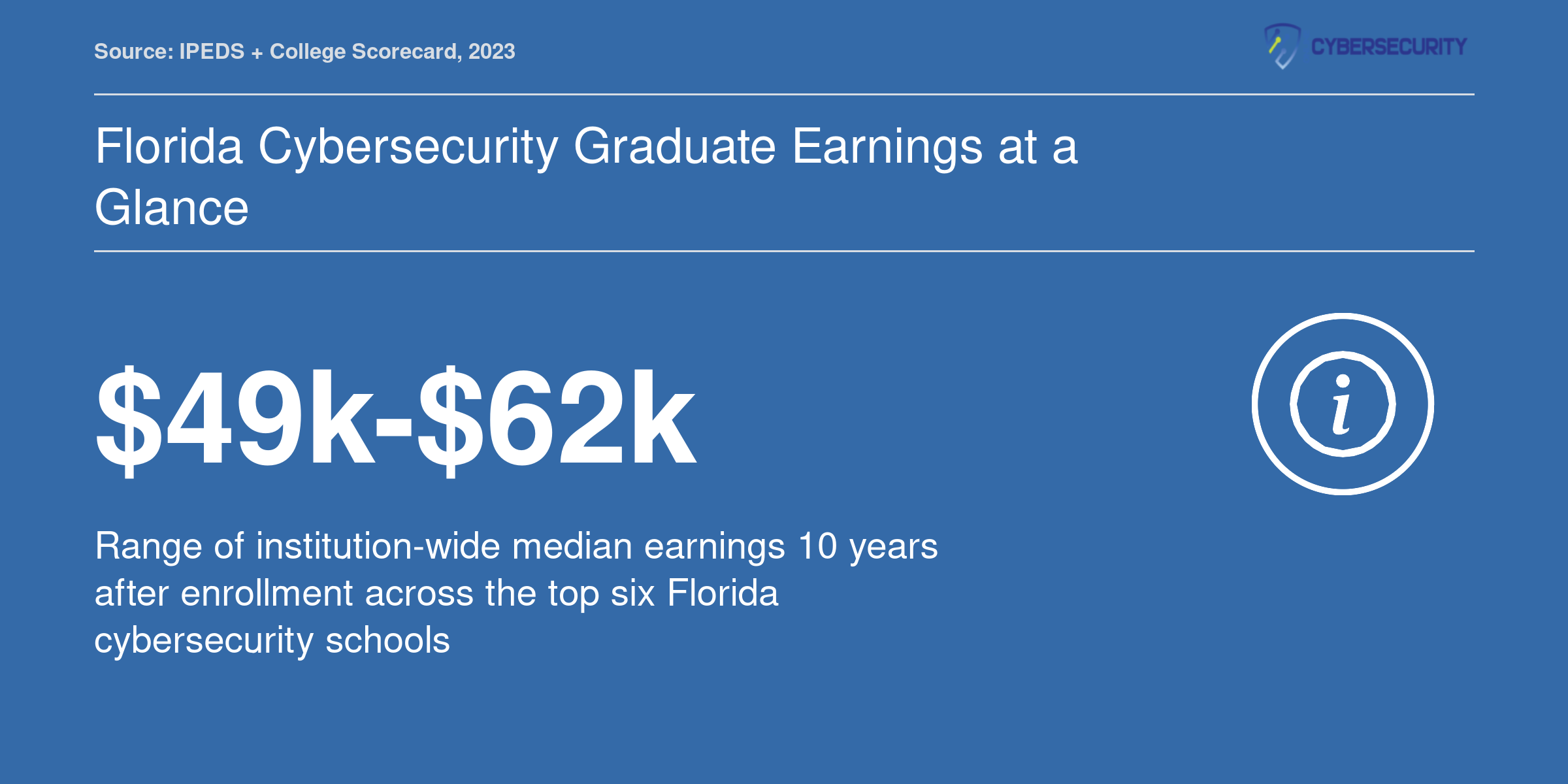
Florida Cybersecurity Graduate Earnings at a Glance
Program-level median earnings one year and four years after completion are not yet available for these Florida cybersecurity programs. The U.S. Department of Education has not published program-specific outcome data for the cybersecurity credentials offered at these schools. The institution-wide median earnings shown below reflect all graduates at each university, not cybersecurity graduates specifically.
Career Outcomes for Florida Online Cybersecurity Graduates
Florida's cybersecurity graduates step into one of the strongest job markets in the Southeast, backed by a combination of defense installations, a booming financial sector, and a growing space industry. Here is what the numbers say and what you can realistically expect after earning your degree.
Program-Level Earnings: What the Data Shows So Far
Program-specific earnings figures from the federal College Scorecard are not yet available for the online cybersecurity programs in our 2026 rankings. Because many of these programs are relatively new or have small cohort sizes, the government has not released median earnings at one, two, four, or five years after completion. The same is true for post-graduation employment rates and share of graduates earning above the poverty line. As these programs mature, expect those figures to be published in coming Scorecard updates. In the meantime, broader salary benchmarks give you a solid frame of reference.
Statewide and National Salary Benchmarks
Information security analysts in Florida earned a mean annual wage of roughly $111,870 as of the most recent Bureau of Labor Statistics data, with total statewide employment exceeding 10,800 positions.1 For context, the national median annual wage for this occupation reached $124,910 in 2024.2 The full national pay spectrum paints a useful picture:
- Entry level (10th percentile): approximately $69,660
- Early career (25th percentile): approximately $92,160
- Mid-career (median): approximately $124,910
- Senior level (75th percentile): approximately $159,600
- Top earners (90th percentile): approximately $186,4202
Florida's major metro areas each have their own dynamics. Tampa, home to MacDill Air Force Base and U.S. Central Command, tends to pay competitive wages driven by defense and government contracting demand. Miami's financial services and international trade sectors create steady need for compliance-oriented security professionals. Orlando benefits from its growing tech corridor and simulation/defense contractors, while Jacksonville draws demand from banking giants and healthcare networks. Metro-level wage data can shift from year to year, so check the latest BLS releases for the most current figures in the city you are targeting.
Where Florida Graduates Are Working
The state's cybersecurity talent pipeline feeds directly into several high-demand sectors:
- Defense and intelligence: MacDill AFB, CENTCOM, SOCOM, and a dense network of cleared contractors across Tampa Bay and the Panhandle create thousands of positions requiring security clearances and cyber operations skills.
- Finance and insurance: Major institutions headquartered or heavily operating in Jacksonville, Miami, and Tampa need analysts for fraud detection, regulatory compliance, and incident response.
- Healthcare: Hospital systems and health insurers across the state face mounting threats to patient data, making security teams a budget priority.
- Space and aerospace: The Space Coast corridor around Cape Canaveral, Kennedy Space Center, and private launch companies is expanding its cybersecurity workforce as missions and satellite systems grow more complex.
- State and local government: Florida's Department of Management Services and various agency CISOs actively recruit graduates for roles in network defense and policy.
For a broader look at where these roles lead over time, our cybersecurity career guide breaks down typical progression paths across industries.
Long-Term Career Value
The Bureau of Labor Statistics projects 29 percent job growth for information security analysts nationally between 2024 and 2034, a rate far outpacing most occupations.3 Florida's combination of population growth, expanding tech infrastructure, and federal investment in military cyber operations suggests the state will track at or above that national pace. Whether you are completing a bachelor's degree, a master's with a cybersecurity management concentration, or a graduate certificate, the career runway is long. Graduates from programs at schools like the University of South Florida, Florida International University, and Florida State University are positioned to enter a job market where qualified candidates remain in short supply.
If you are weighing a career change or first-time entry into the field, Florida's employment landscape offers a rare combination: strong starting salaries, diverse industry options, and sustained long-term demand. Investing in an accredited online cybersecurity programs|online cybersecurity program is a practical way to access those opportunities without relocating or pausing your career.
What to Look for in a Florida Online Cybersecurity Program
Choosing the right online cybersecurity program involves more than comparing tuition prices. The factors below can make the difference between a degree that opens doors and one that leaves you scrambling to fill gaps after graduation.
Accreditation: Your Non-Negotiable Starting Point
Regional accreditation (now called institutional accreditation) is the baseline you should verify first. In Florida, schools accredited by the Southern Association of Colleges and Schools Commission on Colleges (SACSCOC) meet the standard that employers and licensing boards recognize. If you are considering a computing-focused program, look for ABET accreditation as well. ABET evaluates whether curriculum, faculty qualifications, and lab resources meet industry benchmarks. A degree from an ABET-accredited program carries extra weight with hiring managers and is often required for certain government cybersecurity roles. Without proper accreditation, your credits may not transfer, and some employers will not consider your degree at all. When comparing accredited cybersecurity programs online, accreditation status should always be your first filter.
NSA CAE Designation and How to Verify It
The National Security Agency's Centers of Academic Excellence (CAE) designation signals that a program's curriculum aligns with a rigorous, government-defined knowledge framework. Florida is home to several CAE-designated institutions across the Cyber Defense and Cyber Operations tracks. To confirm a school's current status, visit the official NSA CAE community website and search by state. Designations are time-limited, so always check the expiration date listed for each institution rather than relying on a school's marketing materials alone.
Online Format: Matching Delivery to Your Life
This is where many career changers stumble. Not every "online" program works the same way.
- Asynchronous delivery: Lectures, discussions, and assignments are available on your schedule. This is ideal if you are working full time or managing family obligations.
- Synchronous sessions: Live virtual classes at set times. These can be valuable for hands-on labs and group projects but demand calendar flexibility.
- Accelerated terms: Some Florida programs compress courses into seven or eight-week sessions, letting you finish faster. The trade-off is a heavier weekly workload.
- Self-paced options: Less common at traditional universities, but a few programs allow you to move through material at your own speed.
Before enrolling, ask the admissions office exactly how labs and proctored exams are handled. Some programs require specific software, virtual lab environments, or scheduled proctoring windows that may affect your flexibility.
Certification Alignment: Building Credentials as You Learn
Several Florida online cybersecurity programs explicitly map their coursework to professional certification exam objectives. The most common alignments include CompTIA Security+, the Certified Ethical Hacker (CEH) exam, and the Certified Information Systems Security Professional (CISSP). Pensacola State College's BAS in Cybersecurity, for example, maps to 17 industry certifications across its curriculum.1 Programs that embed certification preparation into their courses can save you months of separate study time and hundreds of dollars in prep materials. When evaluating a program, ask whether certification vouchers or discounted exam fees are included.
Transfer-Friendliness and Florida's 2+2 Articulation System
Florida's 2+2 articulation framework is one of the most transfer-friendly systems in the country. If you earn an Associate in Arts (AA) degree from a Florida College System institution, you are guaranteed admission to the upper division of a State University System or FCS best online bachelor's degrees in cybersecurity, with up to 36 credits transferring toward your four-year degree.2 Associate in Science (AS) graduates follow a conditional pathway, meaning acceptance depends on the specific program and institution, but dedicated articulation agreements smooth the process.3
Several schools have formalized cybersecurity-specific transfer pathways. Pensacola State College partners with Northwest Florida State College1, and the University of West Florida has an articulation agreement with Miami Dade College that feeds directly into its graduate cybersecurity program.4 Daytona State College and New College of Florida also offer a structured 2+2 agreement.5 Florida's reverse-transfer policy even allows students who have completed more than 30 credits at a university to apply those credits back toward an associate degree they started but did not finish.2
If you are beginning at a two-year school, confirm that the bachelor's program you are targeting has an active articulation agreement in place. Limited-access programs may impose additional GPA or prerequisite requirements beyond the standard guarantee6, so review the fine print early in your academic planning.
According to the ISC2 Cybersecurity Workforce Study, the global cybersecurity workforce gap reached 4.8 million unfilled positions in 2024. That shortage means qualified professionals are in extraordinary demand, making this one of the strongest job markets for graduates entering the field in 2026.
How to Get an Online Cybersecurity Degree in Florida
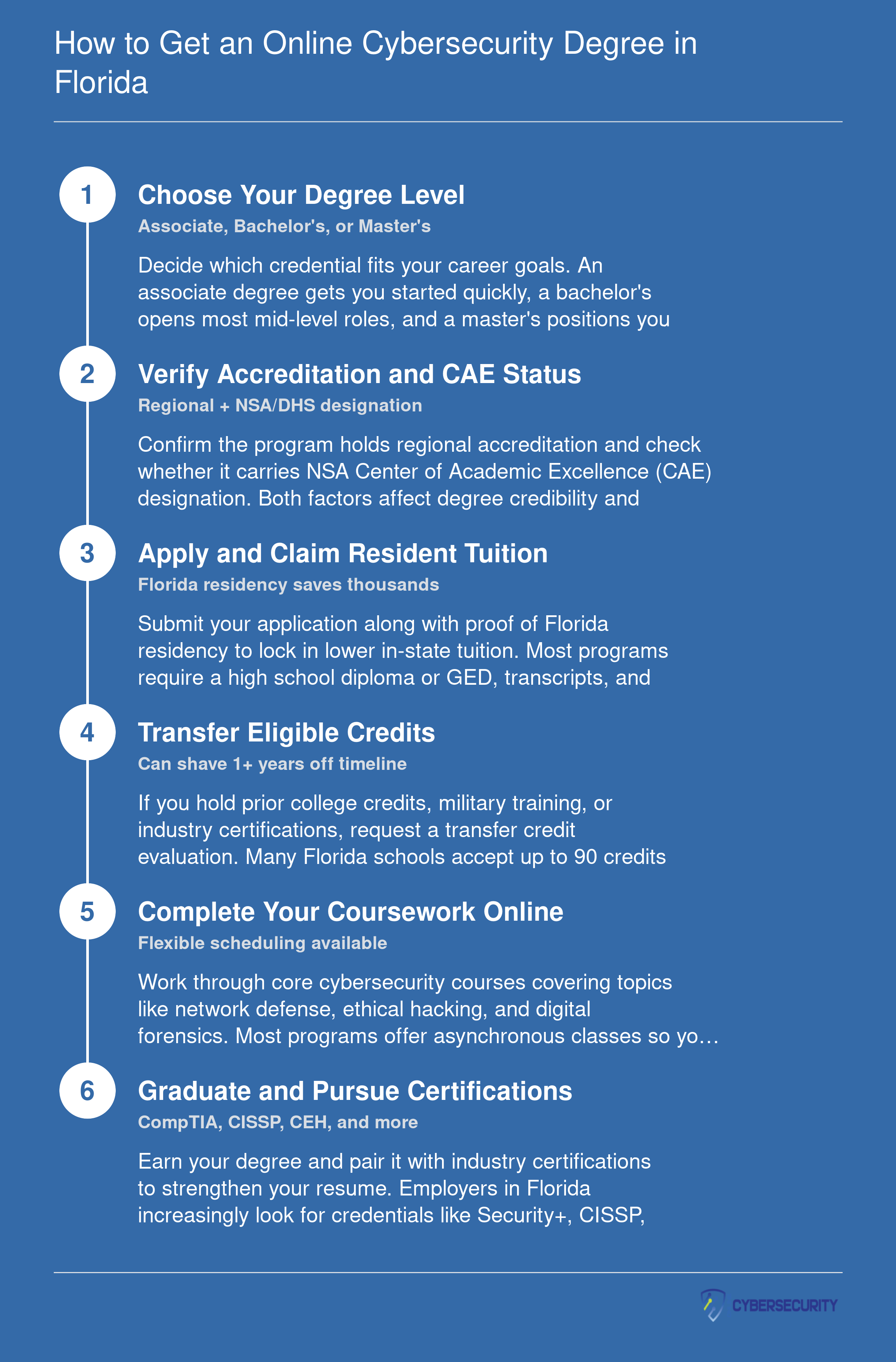
Earning an online cybersecurity degree in Florida is a straightforward process once you map out your path. Florida residents benefit from in-state tuition rates that can save thousands of dollars per year at public universities. Typical timelines range from about 2 years for an associate degree, 4 years for a bachelor's (faster with transfer credits), and 1 to 2 years for a master's program.
Frequently Asked Questions About Online Cybersecurity Schools in Florida
Choosing the right online cybersecurity program in Florida means weighing cost, format, timeline, and career outcomes. Below are answers to the questions prospective students ask most often, drawing on the data and analysis covered throughout this article.