
What you’ll learn in this article…
- Hawaii Pacific University leads the 2026 rankings as the top online cybersecurity program for Hawaii students.
- Military residents near Pearl Harbor and Schofield Barracks can use VA and DoD benefits to cut tuition significantly.
- NSA Centers of Academic Excellence designation signals employer-trusted program quality beyond standard regional accreditation.
- Hawaii's cybersecurity job market is compact but resilient, driven by federal and military installations statewide.
Hawaii is home to U.S. Indo-Pacific Command, dozens of DOD installations, and a dense network of federal agencies that generate persistent demand for cybersecurity professionals. The Bureau of Labor Statistics projects information security analyst roles nationally will grow 33 percent through 2033, and Hawaii's concentration of defense and intelligence infrastructure means local demand tracks even higher in specialized areas like network defense and secure communications.
The practical challenge for Hawaii residents is limited in-state options. Only one locally based institution, Hawaii Pacific University, currently offers an online cybersecurity master's degree at the graduate level. Most students end up evaluating mainland programs that accept out-of-state enrollees at competitive tuition rates or participate in interstate tuition reciprocity agreements. That reality makes cost comparison, accreditation verification, and transfer credit policies especially important before committing to a program.
Best Online Cybersecurity Programs for Hawaii Students
The following program is curated for Hawaii students seeking an online cybersecurity degree that balances accessibility, program quality, and regional relevance. Rather than ranking by a single metric like cost or earnings alone, our selection weighs a composite of institutional outcomes, program structure, workforce alignment, and flexibility for working professionals. Hawaii's unique position within the Indo-Pacific defense and cybersecurity ecosystem makes regionally connected programs especially valuable for students planning to build careers in the islands.
- Institutional graduation and retention rates
- Program delivery flexibility
- Regional workforce alignment
- Graduate debt and earnings outcomes
- Admissions accessibility
- College Scorecard graduate earnings — collegescorecard.ed.gov
- Independent program research
- NCES-IPEDS federal institutional data — nces.ed.gov
- Internal program database
- #1
Hawaii Pacific University
Honolulu, HI · $30,000/yr (net price)
Best for: Defense-connected professionals in the Pacific
Hawaii Pacific University, based in Honolulu, offers a cybersecurity education pathway that spans certificates through graduate study, making it a natural fit for Hawaii residents building long-term careers in the field. The university serves a diverse student body, with over 60% of undergraduates receiving Pell Grants, and maintains a 15:1 student-to-faculty ratio that supports meaningful interaction even in online courses. HPU's deep ties to Oahu's military community and the broader Indo-Pacific defense sector give its cybersecurity graduates a regional advantage that few mainland online programs can match.
View program
- Available fully online or in a hybrid format for flexible scheduling
- Accelerated 12-month completion option for full-time students
- Structured around 8-week terms with fall, spring, and summer entry
- Curriculum aligned with CompTIA CySA+, PenTest+, and Server+ certifications
- No GRE required; admissions need transcripts, resume, and $55 fee
- Hands-on learning approach rooted in real-world cyber scenarios
- Optional personal statement and letters of recommendation accepted
- Strong pipeline into Hawaii's defense, government, and critical infrastructure roles
How Much Does an Online Cybersecurity Degree Cost in Hawaii?
Tuition for an online cybersecurity degree varies widely depending on the institution, degree level, and whether you qualify for in-state rates. Understanding the full cost picture before you enroll helps you plan smarter and avoid unnecessary debt. Here is a practical breakdown of what Hawaii students can expect and where to find financial relief.
Tuition Benchmarks for Hawaii Students
At the graduate level, Hawaii Pacific University's online Master of Science in Cybersecurity runs about $1,200 per credit for 30 required credits, bringing the total program cost to roughly $36,000.1 On the bachelor's side, the University of Hawaii West Oahu offers a CAE-CD aligned B.S. in Cybersecurity through an online/hybrid format, and Honolulu Community College provides a CAE-CD designated Associate in Science in Cybersecurity for students looking for a more affordable cybersecurity degree entry point. Nationally available programs such as Purdue Global's ExcelTrack Bachelor's in Cybersecurity are also open to Hawaii residents, though you should compare per-credit rates carefully since credit requirements can differ significantly from one school to another.3
State Grants and Workforce Development Funding
Hawaii residents should visit the Hawaii State Postsecondary Education Commission website at hawaii.gov/hed to explore state-specific grants, scholarships, and workforce development programs. The Hawaii Career and Technical Education program, in particular, may offer funding pathways for students pursuing technology and cybersecurity credentials. Because the state has a growing interest in building its local cybersecurity workforce, new funding opportunities can appear between legislative sessions, so checking in regularly is worthwhile.
Tuition Reciprocity Through WICHE
Hawaii is a member of the Western Interstate Commission for Higher Education, which administers the Western Undergraduate Exchange (WUE) and the Professional Student Exchange Program (PSEP). These agreements can reduce out-of-state tuition at participating institutions across 16 western states and Pacific territories. If a specific cybersecurity degree program you are considering is not offered locally, WICHE reciprocity through wiche.edu may cut your tuition to 150% of the host school's in-state rate, a meaningful savings compared to full out-of-state pricing.
Cybersecurity-Specific Scholarships and Organizational Aid
Professional organizations are another often-overlooked funding source. Groups like (ISC)² at isc2.org and CompTIA at comptia.org offer cybersecurity-specific scholarships, with some awards reaching $5,000 or more. These scholarships typically do not restrict applicants by state, so Hawaii residents are eligible alongside candidates nationwide.
A few additional steps can stretch your budget further:
- Contact financial aid offices directly: Ask about institutional aid, residency exceptions, or state-specific partnerships that may not appear on a school's website.
- File the FAFSA early: Every program on this list participates in federal financial aid. Hawaii Pacific University's FAFSA code, for example, is 007279.1
- Stack funding sources: Combine state grants, WICHE savings, organizational scholarships, and employer tuition assistance to minimize out-of-pocket costs.
The bottom line is that an online cybersecurity degree does not have to be prohibitively expensive for Hawaii students. With some upfront research into reciprocity agreements, state programs, and professional scholarships, you can assemble a funding package that makes the investment manageable.
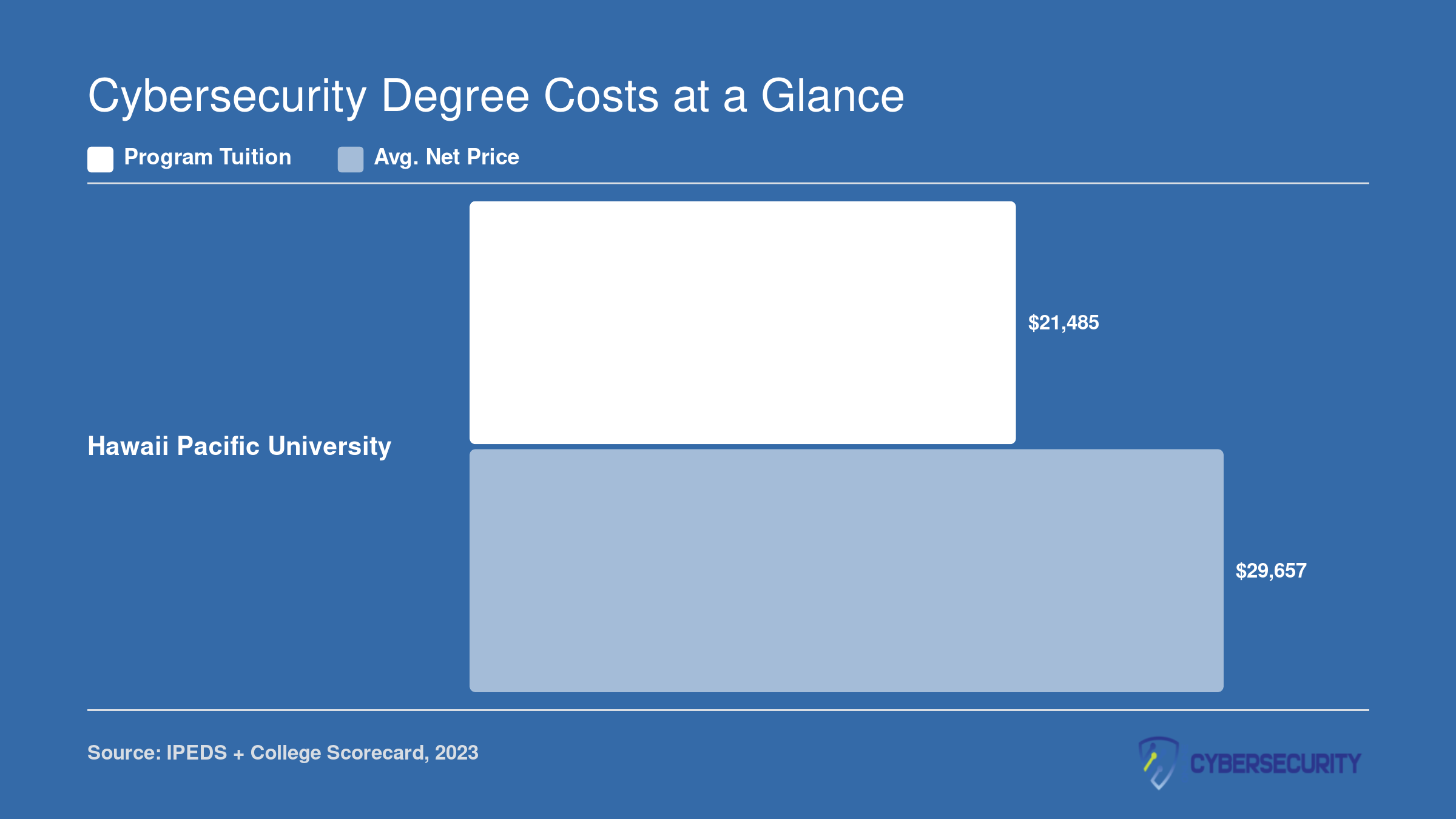
Cybersecurity Degree Costs at a Glance
When comparing cybersecurity programs, it helps to see published tuition alongside the average net price students actually pay after institutional aid. Hawaii Pacific University, the top-ranked online option for Hawaii students in 2026, illustrates why sticker price alone can be misleading. Keep in mind that net price figures reflect an institution-wide average; your individual aid package may be higher or lower depending on financial need, merit scholarships, and military benefits.
Accreditation and CAE Designation: What Hawaii Students Should Know
Accreditation is your baseline for quality, but in cybersecurity there is an additional credential that carries real weight with employers: the NSA Centers of Academic Excellence (CAE) designation. Understanding how to verify both will save you time and tuition dollars.
Verify CAE Designations Directly
The NSA maintains an official list of CAE-designated institutions through its National Centers of Academic Excellence in Cybersecurity program. You can find the current roster at iad.gov/NIETP. Once you identify schools with active designations, visit each institution's website and search for terms like "online" or "distance learning" on their cybersecurity program pages. A school may hold the CAE designation for an on-campus program but not offer the same curriculum online, so this step matters. Not every CAE program is structured identically, and availability can shift year to year, so always confirm details for the 2026 academic cycle. If you want to compare CAE-designated options across degree levels, our guide to best online cybersecurity programs is a good starting point.
Confirm Hawaii Residency Eligibility
Living in Hawaii adds a layer of complexity because some online programs carry state-authorization restrictions. Before you invest time in an application, contact the admissions office or an academic advisor at any CAE school you are considering. Ask specifically whether their online cybersecurity degree is open to Hawaii residents, and whether you qualify for in-state, out-of-state, or a special distance-learner tuition rate. A quick phone call or email can prevent surprises on your tuition bill.
Align Your Degree With Career Outcomes
A CAE designation signals rigor, but it helps to cross-reference your program choices with real labor market data. Use BLS.gov to look up current salary ranges and job outlook projections for roles like information security analyst. Then compare those career paths against the concentrations or tracks offered by each CAE-designated online program. For students exploring advanced study, an online cybersecurity master's with CAE designation can open doors to leadership and research roles. This approach helps you prioritize degrees that match the positions you actually want, rather than choosing a program based on reputation alone.
Tap Into Professional Networks
Professional associations such as (ISC)² and ISACA are more than certification bodies. Both organizations maintain scholarship directories and program listings that can surface online cybersecurity degrees you may not have found on your own. Their member forums and community boards are also valuable for firsthand accounts from students who completed CAE programs remotely, sometimes from Hawaii itself. Peer advice on topics like transfer credits, course load flexibility, and employer recognition can be difficult to find elsewhere.
- Start at the source: Check iad.gov/NIETP for the current CAE list before exploring any school.
- Ask about state authorization: Confirm online enrollment is available to Hawaii residents and clarify tuition structures.
- Use labor data: Match program tracks with BLS salary and demand projections for your target roles.
- Leverage associations: (ISC)² and ISACA offer scholarships, directories, and peer communities worth exploring early in your search.
Career Outcomes and Earning Potential After Graduation
Understanding what a cybersecurity degree can do for your earning power is just as important as choosing the right program. For Hawaii students weighing this investment, the data paints a promising picture, though some program-level outcome details are still catching up with reporting timelines.
Early Career Earnings and Workforce Entry
Program-level earnings data for many cybersecurity programs in Hawaii has not yet been published at the one-year, two-year, or four-year post-graduation marks. This is common for newer or smaller programs where federal reporting thresholds have not been met. That said, industry-wide trends are encouraging. Cybersecurity graduates across the country tend to enter the workforce quickly, and the specialized nature of the degree means that employers are actively recruiting from these programs.
When program-specific employment rates and poverty-threshold comparisons become available, they will offer a clearer snapshot of how effectively graduates are transitioning into full-time roles. For now, the strong national demand for cybersecurity professionals suggests that graduates from accredited programs are landing jobs at rates well above average for other fields.
Long-Term Earning Benchmarks
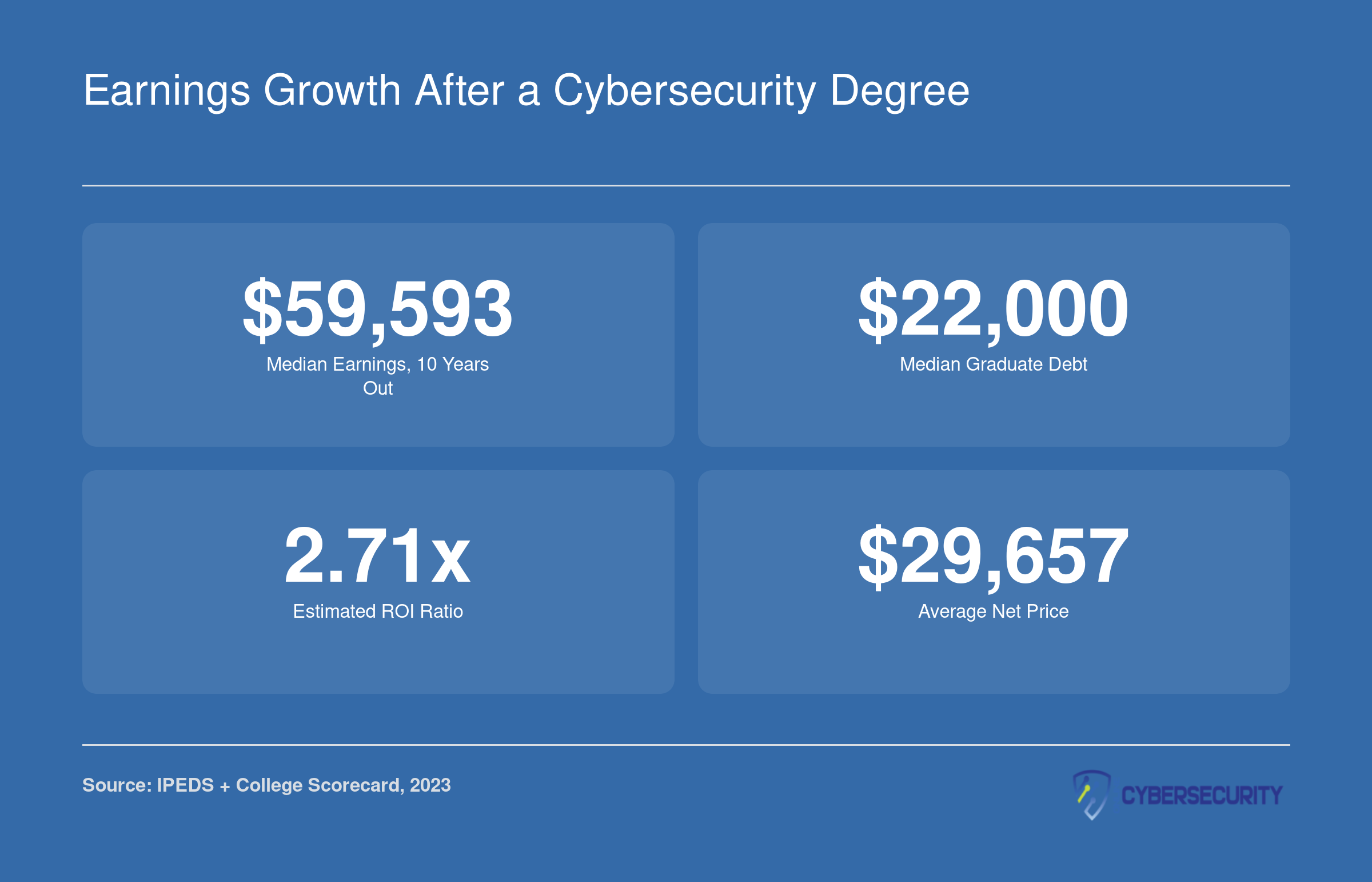
While granular post-graduation salary trajectories are still emerging for some programs, broader institutional data offers a useful long-term reference point. At Hawaii Pacific University, for example, the institution-wide median earnings for graduates ten years after enrollment sit at roughly $59,593. Cybersecurity roles typically outpace general institutional medians, so this figure serves as a conservative floor rather than a ceiling for what cybersecurity graduates can expect over time.
Given that senior cybersecurity analysts, penetration testers, and security architects in Hawaii often command salaries well above $80,000, the long-term trajectory for degree holders is strong. For those considering whether to push further into academia, it is worth exploring whether a cybersecurity PhD salary justifies additional years of study.
Debt vs. Earnings: Framing ROI
Hawaii Pacific University reports a median graduate debt of around $22,000, and the program carries an ROI ratio of approximately 2.7. In practical terms, that means graduates can expect to earn back roughly 2.7 times their educational investment over the course of their careers. When you consider that the M.S. in Cybersecurity at HPU can be completed in as little as 12 months, the time-to-return is compressed even further, a factor that also appeals to students searching for the fastest online cyber security degree.
Here is how to think about your own ROI calculation:
- Total program cost: Compare tuition against any scholarships, employer tuition assistance, or military benefits you may qualify for.
- Time to completion: Faster completion means earlier entry into the workforce and less opportunity cost.
- Credential stacking: Programs that prepare you for industry certifications (like CompTIA) add value on top of the degree itself.
- Local demand: Hawaii's unique position as a hub for federal and military cybersecurity operations can translate to higher starting salaries than national averages suggest.
What This Means for You
Even where detailed program-level salary data is not yet available, the combination of manageable debt, strong ROI ratios, and robust long-term earning potential makes an online cybersecurity degree a sound financial decision for most Hawaii students. As more program-specific outcomes are reported in coming years, expect these numbers to reinforce what the broader market already signals: cybersecurity is one of the highest-return fields you can enter with a graduate degree.
Earnings Growth After a Cybersecurity Degree
How do cybersecurity graduates from top-ranked Hawaii programs fare financially? The figures below reflect institution-level and program-level medians for Hawaii Pacific University, the top-ranked online cybersecurity program available to Hawaii students. Note that program-level earnings and employment outcomes are not yet published for this program, so we have included the broader institutional medians where available.
Hawaii Cybersecurity Job Market and Workforce Demand
Hawaii's cybersecurity job market is smaller than those in mainland tech corridors, but it is remarkably concentrated and surprisingly resilient. Understanding where the openings are, who is hiring, and which resources can help you track demand will give you a real advantage as you plan your cybersecurity career path.
Job Market Snapshot for 2025 and 2026
Hawaii supports an estimated cybersecurity workforce of 4,000 to 6,000 professionals, with roughly 1,500 to 2,500 positions opening annually through both new roles and turnover.1 At least 80 percent of those positions are clustered in the Honolulu metro area, which makes sense given the concentration of military installations, government agencies, and financial services headquartered there.1 Entry-level roles typically expect one to two years of relevant experience, though internships, lab work, and industry certifications often count toward that threshold.2
To find current wage benchmarks, search the Bureau of Labor Statistics Occupational Employment and Wage Statistics page for SOC 15-1212 (Information Security Analysts) filtered to the Honolulu metropolitan area. That will give you median and percentile pay figures updated on a regular cycle.
Where to Find Open Positions
Several tools make it easy to monitor Hawaii openings in real time:
- CyberSeek heat map: Use the interactive map at CyberSeek.org to see open cybersecurity positions by state and metro area. It also breaks demand into specific role categories like penetration testing, incident response, and security architecture.1
- General job boards: Filter Indeed and LinkedIn by location (Hawaii or Honolulu) and keywords such as "cybersecurity," "information security," or "SOC analyst" to catch listings from private employers, healthcare systems, and state agencies.
- State resources: The Hawaii Department of Business, Economic Development and Tourism publishes workforce initiative updates and sometimes partners with local institutions on cybersecurity training pipelines.
The Military and Federal Dimension
Hawaii is home to U.S. Indo-Pacific Command and several major military installations, making the defense sector one of the largest employers of cyber professionals in the state. Civilian cyber roles tied to the Department of Defense are regularly posted on USAJOBS and on local base job boards at Joint Base Pearl Harbor-Hickam and elsewhere. Programs connected to U.S. Cyber Command and the Defense Cyber Crime Center also operate from Hawaii, creating positions that range from forensic computer analyst roles to network defense. If you hold or can obtain a security clearance, this pipeline of federal and contractor roles significantly expands your options.
University and State Workforce Partnerships
The University of Hawaii system plays a direct role in building the local talent pipeline. University of Hawaii West Oahu, for example, offers a Bachelor of Applied Science in Cybersecurity and holds a Center of Academic Excellence in Cyber Defense (CAE-CD) designation from NSA and DHS.3 Visiting UH system websites, particularly UH West Oahu's cybersecurity program page, can help you find internship leads, employer partnerships, and scholarship opportunities that connect classroom learning to Hawaii-specific hiring needs.
Keeping tabs on these resources regularly, rather than checking only when you are ready to apply, will help you spot trends in which roles are growing and which certifications local employers value most.
Military-Friendly Online Cybersecurity Programs for Hawaii Residents
Hawaii's large military and veteran population, anchored by installations like Joint Base Pearl Harbor-Hickam and Schofield Barracks, means many prospective cybersecurity students are eligible for education benefits that can dramatically reduce the cost of an online degree. Navigating those benefits takes a few deliberate steps, but the payoff is well worth the effort.
Using Federal Military Education Benefits
The GI Bill Comparison Tool on the Department of Veterans Affairs website is one of the best starting points. You can filter results by online programs and see which schools participate in the Yellow Ribbon Program, which covers tuition costs that exceed the GI Bill's annual cap. Many nationally recognized online cybersecurity programs are Yellow Ribbon participants, but the number of slots and dollar amounts vary by institution, so checking each year's availability matters.
Beyond the GI Bill, active-duty service members should verify whether a program accepts Military Tuition Assistance directly. This information is typically found on a school's admissions or dedicated military and veteran services page. Schools that maintain a military student support office, assign a dedicated military enrollment advisor, or hold designations as a Military Friendly institution tend to offer smoother processes for applying benefits and managing deployment-related schedule changes.
Hawaii State Veteran Benefits
Federal benefits are not the only option. The Hawaii Department of Veterans Services administers state-level programs that may include tuition waivers or supplemental scholarships for residents who are veterans or dependents of veterans. These benefits can sometimes stack with federal aid, further lowering out-of-pocket costs for online learners. Because eligibility criteria and funding levels can shift, contacting the department directly is the most reliable way to confirm what is available in 2026.
Industry Scholarships for Veterans
Professional organizations in the cybersecurity field actively support veterans transitioning into the workforce. Groups such as (ISC)² and SANS offer scholarships, free training vouchers, and certification exam discounts specifically for military veterans and active-duty personnel. These resources complement a degree program nicely, helping you build cybersecurity certifications online alongside your coursework.
- GI Bill Comparison Tool: Filter for online cybersecurity programs and Yellow Ribbon participation on the VA website.
- School military pages: Confirm tuition assistance acceptance and look for dedicated veteran support staff.
- Hawaii Department of Veterans Services: Ask about state tuition waivers or scholarships beyond federal benefits.
- (ISC)² and SANS: Explore veteran-specific scholarships, training, and certification discounts.
Taking advantage of every layer of support, federal, state, and industry, can make an online cybersecurity degree far more affordable than many Hawaii residents realize.
How to Choose the Right Online Cybersecurity Program
Picking the right online cybersecurity program takes more than scanning a tuition page. With dozens of accredited options available to Hawaii students, a structured comparison can help you land on a program that fits your goals, your schedule, and your budget.
Start With Accreditation and CAE Status
Regional accreditation is the baseline for any legitimate program, but cybersecurity students should look further. Programs designated as Centers of Academic Excellence (CAE) by the NSA and CISA meet rigorous curriculum standards aligned with real workforce needs. A CAE designation signals that the coursework maps to recognized knowledge units, which can matter when employers or federal agencies review your credentials.
Look for Embedded Industry Certifications
Some programs weave certification preparation directly into their coursework. If a degree embeds CompTIA Security+, Certified Ethical Hacker (CEH), or CISSP prep into its curriculum, you can graduate ready to sit for those exams without paying separately for online cybersecurity bootcamp sessions or self-study materials. That kind of integration can save hundreds or even thousands of dollars while accelerating your path into the job market.
Compare Net Price, Not Sticker Tuition
Tuition rates vary widely, and the published figure rarely reflects what you will actually pay. Always check the net price after financial aid, scholarships, and any Hawaii resident discounts. Review each school's transfer credit policy as well. If you have prior college coursework or military training, generous transfer policies can trim both cost and time to completion.
Prioritize Flexibility for Your Lifestyle
If you are working full time or managing family responsibilities, asynchronous coursework and part-time enrollment options are essential. Confirm whether the program requires synchronous sessions, set exam windows, or in-person residencies. A truly flexible format lets you study on your schedule, which is especially valuable for Hawaii residents navigating time zone differences with mainland institutions.
Consider Federal Workforce Alignment
Hawaii is home to significant military and federal installations, and cybersecurity roles across these agencies often follow the DoD Cyber Workforce Framework. If you are targeting federal positions, verify whether the program's curriculum aligns with that framework. Programs that map coursework to specific DoD work roles can give you a clearer path into government cybersecurity careers and may also support tuition assistance eligibility for active duty service members. Exploring best online bachelor's degrees in cybersecurity is a strong starting point for comparing curriculum alignment across schools.
Taking the time to evaluate these factors side by side will help you invest wisely in a program that delivers real career returns.
Frequently Asked Questions About Online Cybersecurity Degrees in Hawaii
Choosing an online cybersecurity program from Hawaii comes with unique considerations, from tuition structures to military benefits and local job demand. Below are answers to the questions Hawaii students ask most often.
For students in Hawaii, online cybersecurity degrees remove the barrier of geographic isolation and open the door to nationally accredited, CAE-designated programs without the cost or disruption of relocating to the mainland. Hawaii's concentrated federal and military cyber job market rewards graduates who hold credentials from recognized institutions, and the earning trajectory after graduation reinforces the value of this investment.
Use the program ranking and cost breakdowns earlier in this guide to build a focused shortlist, then reach out to admissions offices directly. Ask about transfer credit policies, military benefit processing, and any cohort start dates that align with your timeline. If you are still weighing degree levels, comparing options through a resource like online cybersecurity associate's degree programs can help clarify your starting point. A quick conversation with an admissions advisor can surface details that no website fully captures. The demand for cybersecurity talent in Hawaii is real, and the right program positions you to meet it.