
What you’ll learn in this article…
- Massachusetts information security analysts earned a median annual wage of $127,610 as of 2024, above the national average.
- Our 2026 ranking covers 13 institutions offering 21 distinct online cybersecurity programs across multiple degree levels.
- Online tuition ranges from roughly $9,300 per year at Bridgewater State to over $66,000 at Northeastern University.
- The state posted approximately 19,600 cybersecurity job openings between 2023 and 2024, per CyberSeek.
Massachusetts employers posted roughly 19,600 cybersecurity job openings between 2023 and 2024, driven largely by the state's concentration of defense contractors, financial institutions, and healthcare systems. That demand has pushed median pay for information security analysts in the state above $127,000, well over the national figure.
For career changers weighing an online degree, the practical challenge is matching the right program level and price to your timeline. Tuition across the 13 Massachusetts schools ranked here spans from about $9,300 to over $66,000 a year, with 21 online program listings covering bachelor's, master's, and graduate certificate options. NSA-designated programs, state workforce grants, and employer tuition assistance can offset costs, but availability varies sharply by school and credential level.
Best Online Cybersecurity Programs in Massachusetts: 2026 Rankings
Massachusetts is home to a strong and growing cluster of online cybersecurity programs, spanning graduate certificates and bachelor's completions to full master's degrees. Our 2026 ranking covers 13 institutions offering 21 distinct programs that can be completed online or in a hybrid format, giving career changers and working professionals across the state practical pathways into one of the fastest growing fields in tech. Below, each school is profiled with program details, tuition context, and the highlights that matter most when you are comparing options.
- Online delivery and flexibility
- Institutional graduation and retention rates
- Tuition affordability and net price
- Program breadth and depth
- Regional employer and workforce alignment
- Internal program database
- College Scorecard graduate earnings — collegescorecard.ed.gov
- Independent program research
- NCES-IPEDS federal institutional data — nces.ed.gov
- #1
University of Massachusetts-Lowell
Lowell, MA · $17,000/yr
Best for: Career changers seeking affordable CAE credentials
UMass Lowell is a public research university whose online cybersecurity portfolio is among the deepest in the state. Its Master of Science in Security Studies with a Cybersecurity concentration can be finished entirely online in as little as 18 months for under $20,000, while a stackable Graduate Certificate in Cybersecurity takes just nine months. The university holds an NSA/DHS National Center of Academic Excellence in Cyber Defense designation, and faculty with active security clearances bring real world threat intelligence into the curriculum. In state tuition runs about $16,434 per year, and the institution wide graduation rate is 64.8%.
View 3 programs
- 10 course, 30 credit fully online program
- Tuition of $610 per credit, total under $20,000
- No GRE required for admission
- Completable in as few as 18 months
- Combines criminal justice and IT coursework
- Covers network security, digital forensics, and intelligence analysis
- Faculty with active security clearances
- Credits may build from the graduate certificate
- 30 credit program with cybersecurity track
- No GRE required for admission
- Part time or full time study options
- Optional master's thesis pathway
- STEM OPT eligible for international students
- Core coursework in algorithms and security
- Financial aid and scholarships available
- Four course certificate, completable in nine months
- Fully online with asynchronous delivery
- $610 per credit tuition, same rate for all students
- Credits stack into the MS in Security Studies
- Covers network security, digital forensics, and cloud computing
- Bachelor's degree with 3.0 GPA required for admission
- No GRE required
- #2
Bay Path University
Longmeadow, MA · $14,000/yr (net price)
Best for: Adult learners new to cybersecurity
Bay Path University, a private institution in Longmeadow, pairs its CAE Cyber Defense designation with two fully online cybersecurity programs: an MBA with a Cybersecurity concentration and a BS in Cybersecurity focused on Digital Forensics and Incident Response. The online bachelor's uses accelerated seven week courses and requires no prior IT background, while the MBA blends business leadership with emerging threat strategy. With a net price near $14,271 and an 8:1 student to faculty ratio, Bay Path delivers a notably personal online learning experience. The institution wide graduation rate is 43.9%.
View 2 programs
- Comprehensive 30 credit online MBA
- Strategic courses on emerging cyber threat landscapes
- Integrates business leadership with technology management
- Designed for working professionals
- Flexible online delivery format
- Financial aid available
- Fully online bachelor's program, 120 credits total
- Accelerated 7 week asynchronous courses
- No IT background required to start
- Hands on lab based coursework
- Covers forensic acquisition, mobile forensics, and intrusion analysis
- 15 credit certificate option available within the degree
- National Center of Academic Excellence designation
- #3
University of Massachusetts-Amherst
Amherst, MA · $20,000 – $25,000/yr
Best for: Budget minded professionals exploring stackable certificates
UMass Amherst, the flagship of the state university system, offers three fully online Graduate Certificates in Information Security through its College of Information and Computer Sciences. Concentrations in Digital Forensics and Secure Distributed Systems let learners customize a 15 credit, five course credential for about $11,250 total. Certificate credits can stack into campus or online master's programs, making this a low risk entry point for professionals testing the waters. The university posts an 83.3% graduation rate and median earnings of roughly $71,631 a decade after enrollment.
View program
- 15 credits, five courses, fully online
- $750 per credit, approximately $11,250 total
- Minimum 3.0 GPA required, no grade below C
- Credits may transfer into UMass master's programs
- Open to both graduate and non degree students
- Core topics include computer security and network defense
- Electives in digital forensics and secure distributed systems
- Registration through Continuing and Professional Education
- #4
Bridgewater State University
Bridgewater, MA · $16,000/yr (net price)
Bridgewater State University serves South Shore and Greater Boston professionals with a hybrid Graduate Certificate in Cybercriminology and Cybersecurity. The 15 credit program blends criminology with digital security strategy and forensic investigation, and its credits can count toward BSU's Master of Science in Cybercriminology and Cybersecurity. In state tuition is approximately $9,297, and rolling admissions across fall, spring, and summer terms keep start dates flexible. The institution wide graduation rate stands at 53.4%.
View program
- 15 credit hybrid graduate certificate
- Rolling admission for fall, spring, and summer
- Courses include cybercriminology and forensic investigation
- Credits apply toward the MS in Cybercriminology
- Combines online and on campus delivery
- One letter of recommendation required for admission
- Personal statement and resume required
- #5
Northeastern University
Boston, MA · ~$31,000/yr (est.)
Northeastern University's Bachelor of Science in Cybersecurity combines a strong computer science foundation with the school's signature co op experiential learning model. While predominantly campus based with hybrid flexibility, the program leverages an extensive employer network across Boston's finance, healthcare, tech, and defense sectors. Published tuition is $66,162, though a net price of about $30,915 reflects generous financial aid. The institution wide graduation rate is 90.5%, among the highest on this list.
View program
- Bachelor's level program with cybersecurity focus
- Experiential co op learning integrated into curriculum
- Covers IT tools, policy, law, and social behavior
- Laboratory exercises reinforce practical skills
- Hybrid delivery with campus and online components
- Strong employer network in Greater Boston
- Computer science foundational courses included
- #6
Boston College
Chestnut Hill, MA · ~$42,000/yr (est.)
Boston College's Woods College of Advancing Studies houses a Master of Science in Cybersecurity Policy and Governance, a 10 course, 30 credit program designed for professionals with three to five years of experience. The hybrid format mixes online and evening on campus sessions and carries Department of Homeland Security recognition. A B.A. in Cybersecurity with hybrid delivery is also available at the undergraduate level. The institution wide graduation rate is an impressive 90.8%, and median earnings ten years out reach roughly $103,937.
View 2 programs
- 10 course, 30 credit hybrid master's program
- Flexible online and evening campus learning
- Approved by Department of Homeland Security
- Focuses on policy, governance, and strategic leadership
- Designed for professionals with 3 to 5 years experience
- $3,654 per course tuition
- Six core and four elective courses
- Hybrid bachelor's program with online course options
- 10 major courses in the cybersecurity track
- Covers ethical hacking, cloud security, and incident response
- Rolling admission with $45 application fee
- Financial aid available
- Prepares for industry certifications
- #7
University of Massachusetts-Boston
Boston, MA · $18,000/yr (net price)
UMass Boston's fully online Cybersecurity Management Certificate is built for aspiring and current managers in Greater Boston's finance, biotech, and healthcare sectors. The 12 credit, four course program blends technical and managerial skills covering risk management, cloud computing security, and forensics. Credits can stack into UMass Boston's graduate business and IT programs. In state tuition is approximately $20,456 per year, and net price comes in around $17,707. The institution wide graduation rate is 49.4%.
View program
- Fully online graduate certificate, 12 credits
- Two required courses plus two electives
- Covers risk management, auditing, and cloud security
- Bachelor's degree with 3.0 GPA required
- Rolling admissions with fall and spring deadlines
- Credits can apply toward a graduate degree
- $75 application fee, alumni fee waiver possible
- #8
College of Our Lady of the Elms
Chicopee, MA · $18,000/yr
Elms College in Chicopee offers a fully online bachelor's completion program in Computer Information Technology and Security that is especially well suited for transfer students and working adults in western Massachusetts. Students can transfer up to 90 credits and finish in as few as 10 months through accelerated eight week sessions, and credit is awarded for existing IT certifications. The net price is about $17,545, and the institution wide graduation rate is 68.1%.
View program
- Fully online bachelor's completion program
- Transfer up to 90 credits from prior coursework
- Accelerated 8 week sessions, finish in 10 months
- Credit awarded for existing IT certifications
- Two courses taken at a time
- Financial aid available for eligible students
- Prepares for IT and cybersecurity professional roles
- #9
Anna Maria College
Paxton, MA · $28,000/yr
Anna Maria College's Bachelor of Science in Cybersecurity is a four year hybrid program grounded in an interdisciplinary curriculum spanning computer science, law, and mathematics. Students study ethical hacking, network security, cloud computing, and forensics while preparing for certifications such as Certified Ethical Hacker and CISSP. Small class sizes and a 12:1 student to faculty ratio support mentorship and internship guidance. Listed tuition is $44,571, with a net price of approximately $28,333.
View program
- Four year hybrid program, online and on campus
- Interdisciplinary focus: computer science, law, mathematics
- Prepares for CEH, CISSP, and Certified Forensic Examiner
- 10 required cybersecurity courses
- Internship opportunities encouraged
- No prior experience required to start
- Small class sizes with faculty mentorship
- #10
Endicott College
Beverly, MA · $40,000 – $45,000/yr
Endicott College offers a Master of Science in Homeland Security Studies with a cybersecurity concentration designed for law enforcement, first responders, and public sector professionals. The 36 credit program takes about 18 months and is available in hybrid format with evening, Saturday, and fully online class options. Faculty include practitioners from agencies such as the FBI, DHS, and FEMA. Endicott participates in the Yellow Ribbon program and holds a Military Friendly designation. In state tuition is listed at $15,534, though the net price is higher at about $40,654 because of limited institutional aid at the graduate level.
View program
- 36 credit hybrid master's program
- Completable in approximately 18 months
- Evening, Saturday, and online class options
- No GRE required for admission
- Faculty from FBI, DHS, and FEMA
- Yellow Ribbon and Military Friendly eligible
- Personal advising and job placement support
- #11
Merrimack College
North Andover, MA · $38,000/yr
Merrimack College delivers a fully online Master of Science in Information Technology with a cybersecurity concentration that can be completed part time in 16 to 18 months for under $24,000 total. The 32 credit curriculum includes ethical hacking, penetration testing, and digital forensics, and an optional standalone cybersecurity certificate is available. No GRE, GMAT, or prior tech experience is required, and six enrollment windows per year offer flexible start dates. The institution wide graduation rate is 70.1%.
View program
- 100% online, 32 credits total
- $725 per credit, under $24,000 total
- Part time completion in 16 to 18 months
- No GRE, GMAT, or prior IT experience required
- Courses in ethical hacking and penetration testing
- Optional standalone cybersecurity certificate
- Six enrollment starts per year in 8 week terms
- Personal success coaching and career services included
- #12
Dean College
Franklin, MA · $31,000/yr
Dean College offers a Bachelor's Degree in Business with a Concentration in Cybersecurity geared toward working adults in a part time, hybrid format. The 121 credit curriculum blends a broad business foundation with cybersecurity topics such as incident response, risk assessment, and forensic analysis. No prior IT background is needed. Listed tuition is $46,526, and the net price comes in around $30,684. The institution wide graduation rate is 53.6%.
View program
- 121 credit hybrid bachelor's program
- Part time format designed for working adults
- Covers incident response and risk assessment
- Careers in network design and forensic analysis
- Case study and real world learning approach
- No IT background required to start
- Interaction with business leaders through TeamOps partnerships
- #13
Cambridge College
Boston, MA · $30,000 – $35,000/yr
Cambridge College provides a hybrid Bachelor of Science in Cybersecurity with a Network Security concentration. The 120 credit program costs $502 per credit and prepares students for CompTIA Security+ and CISM certifications. Night and weekend classes, combined with online coursework, give flexibility to adult learners in the Boston area. No SAT is required, and the next cohort begins in May 2026. Tuition is $18,378 per year, and the institution wide graduation rate is 11.1%, reflecting a student body composed largely of nontraditional adult learners.
View program
- 120 credit hybrid program, $502 per credit
- Prepares for CompTIA Security+ and CISM certifications
- Night, weekend, and online class options
- No SAT required for admission
- Covers digital forensics and incident response
- Stackable credential options available
- Next cohort starts May 2026
Online Cybersecurity Degrees by Level: Associate, Bachelor's, Master's & Beyond
Choosing the right degree level is one of the most consequential decisions you will make when planning a cybersecurity career. Each tier opens different doors, and Massachusetts has built a transfer-friendly system that makes it easier to climb from one level to the next without losing credits or momentum. Here is a practical breakdown of what to expect at each stage, along with tips for finding reliable details on your own.
Associate Degrees: The On-Ramp
Massachusetts is home to 15 community colleges, many of which offer associate-level programs in cybersecurity, information technology, or computer information sciences.1 These two-year programs are typically the most affordable entry point and can qualify you for roles like security operations center analyst or IT support specialist. An online cybersecurity associate's degree can serve the same purpose if no local program fits your schedule.
The real power of an associate degree in this state is its transferability. The MassTransfer program, administered by the Massachusetts Department of Higher Education, lets community college graduates carry 60 to 75 credits into a participating four-year institution.2 If you maintain at least a 2.5 GPA, you qualify for general MassTransfer benefits.3 Hit a 3.0 GPA and you unlock the A2B (Associate to Bachelor's) pathway as well as the MassTransfer tuition credit, which can meaningfully reduce the cost of finishing a bachelor's degree at a UMass campus.2
To research specific pathways, start at your community college's transfer office website and look for articulation agreements that map directly to cybersecurity or IT bachelor's programs.
Bachelor's Degrees: The Career Launchpad
A bachelor's degree remains the most commonly requested credential for mid-level cybersecurity positions. UMass Lowell, for example, offers an online Bachelor of Science in Information Technology that maintains formal articulation agreements with several community college programs, including associate degrees in Computer Information Technology, Information Technology, and Computer Information Sciences with an IT concentration.4 That means your coursework transfers cleanly and you are not repeating material you have already mastered.
When evaluating bachelor's programs, check each school's website for curriculum details, faculty credentials, and any hands-on lab components. Look for programs that embed industry certifications like CompTIA Security+ or Certified Ethical Hacker preparation into the coursework.
Master's Degrees and Graduate Certificates
If you already hold a bachelor's degree, a master's in cybersecurity or information assurance positions you for leadership roles such as security architect, chief information security officer, or cybersecurity consultant. Graduate certificates, often 12 to 18 credits, offer a faster alternative if you want to specialize without committing to a full master's program.
For salary benchmarks at this level, the Bureau of Labor Statistics (BLS.gov) publishes occupation-specific data for information security analysts that you can filter by state. This is the most reliable government source for wage information and job outlook projections.
How to Research Programs on Your Own
Navigating all of these options can feel overwhelming, but a few authoritative sources will keep you grounded:
- School websites: Always verify tuition, curriculum, and admission requirements directly with the institution. Program pages change from year to year.
- MassTransfer program page: The Massachusetts Department of Higher Education maintains a current list of participating schools and linked programs, so you can confirm which credits will transfer before you enroll.2
- BLS.gov: Use the Occupational Outlook Handbook to review salary ranges, growth projections, and typical education requirements for cybersecurity roles.
- Professional associations: Organizations like (ISC)² and ISACA publish workforce studies, certification roadmaps, and competency frameworks that help you understand what employers actually expect at each career stage.
Taking 30 minutes to cross-reference these sources before you apply can save you thousands of dollars and months of rework down the line. Start with the degree level that matches your current experience, confirm the transfer pathway if you plan to continue, and keep your eye on where the field is heading in 2026 and beyond.
How Much Does an Online Cybersecurity Degree Cost in Massachusetts?
Tuition for online cybersecurity programs in Massachusetts ranges widely, from roughly $9,300 per year at Bridgewater State University to over $66,000 at Northeastern University. Public institutions tend to offer the lowest sticker prices, especially for in-state students, while private colleges often offset higher published tuition with generous financial aid. Keep in mind that the average net price shown below is an institution-wide figure reflecting typical aid packages across all programs; your actual out-of-pocket cost will depend on your specific financial aid offer, not on a program-level guarantee.
| School | Type | Degree Level | Annual Tuition (In-State) | Annual Tuition (Out-of-State) | Avg. Net Price After Aid |
|---|---|---|---|---|---|
| Bridgewater State University | Public | Graduate Certificate | $9,297 | $9,297 | $16,383 |
| Bay Path University | Private | Master's | $15,162 | $15,162 | $14,271 |
| Endicott College | Private | Master's | $15,534 | $15,534 | $40,654 |
| University of Massachusetts Lowell | Public | Master's | $16,434 | $29,118 | $17,163 |
| University of Massachusetts Amherst | Public | Graduate Certificate | $17,410 | $35,726 | $22,383 |
| Cambridge College | Private | Bachelor's | $18,378 | $18,378 | $31,072 |
| University of Massachusetts Boston | Public | Graduate Certificate | $20,456 | $39,352 | $17,707 |
| Merrimack College | Private | Master's | $36,800 | $36,800 | $37,927 |
| Boston College | Private | Master's | $37,520 | $37,520 | $41,704 |
| College of Our Lady of the Elms | Private | Bachelor's | $43,325 | $43,325 | $17,545 |
| Anna Maria College | Private | Bachelor's | $44,571 | $44,571 | $28,333 |
| Dean College | Private | Bachelor's | $46,526 | $46,526 | $30,684 |
| Northeastern University | Private | Bachelor's | $66,162 | $66,162 | $30,915 |
Related Articles
Questions to Ask Yourself
NSA CAE-CD and Accredited Online Cybersecurity Programs in Massachusetts
If you are evaluating online cybersecurity programs in Massachusetts, you have probably come across the acronym CAE-CD. Understanding what it means, and which schools actually carry the designation for fully online programs, can save you time and steer you toward credentials that carry real weight with employers.
What the CAE-CD Designation Means
The Center of Academic Excellence in Cyber Defense (CAE-CD) is a designation jointly awarded by the National Security Agency and the Department of Homeland Security.1 Schools earn it by mapping their curriculum to a rigorous set of knowledge units that cover network defense, secure software development, risk management, and more. The designation signals to hiring managers, especially in federal agencies and defense contractors, that a graduate's coursework meets nationally validated standards. For students interested in clearance-track careers or government cybersecurity roles, a degree from a CAE-CD institution can be a meaningful differentiator on a resume.
Massachusetts also has institutions holding the related CAE-R (Research) designation, including the University of Massachusetts Lowell and Worcester Polytechnic Institute.2 CAE-R focuses on cybersecurity research output rather than curriculum mapping, so it serves a different purpose. If your goal is an applied, career-ready degree rather than a research path, the CAE-CD label is the one to look for.
Which Massachusetts Schools Hold CAE-CD Designation?
As of 2024, three Massachusetts institutions carry the CAE-CD designation:3
- Boston University: Designated through its Department of Computer Science. However, its CAE-CD cybersecurity program is not currently available in a fully online format.
- Northeastern University: Designated for its Information Assurance and Cybersecurity program. Northeastern does offer a fully online cybersecurity degree, making it the clearest option for remote learners who want the CAE-CD credential from a Massachusetts school.
- MassBay Community College: Received its CAE-CD designation in 2024, becoming the third community college in the country to earn it. Whether its cybersecurity program is available fully online has not been confirmed, so prospective students should contact the college directly for the latest delivery options.6
The short answer to the common question, "Are there NSA-designated online cybersecurity programs in Massachusetts?" is yes, but options are limited. Northeastern University is currently the standout choice for students who need a fully online, CAE-CD-designated program based in the state.
ABET and Other Program-Level Accreditations
It is worth separating two layers of accreditation. Every reputable school in Massachusetts holds institutional accreditation from a recognized regional accreditor (such as the New England Commission of Higher Education). That accreditation covers the university as a whole and ensures credit transferability and financial aid eligibility.
Program-specific accreditation, like ABET accreditation for computing or engineering programs, goes a step further. ABET evaluates the curriculum, faculty qualifications, and student outcomes of individual degree programs. While ABET-accredited online cybersecurity programs at Massachusetts institutions are uncommon, the distinction matters: a program can be regionally accredited without holding ABET accreditation, and vice versa. For a closer look at what a typical cybersecurity degree program covers, including how accreditation shapes coursework, that context can help you compare options more effectively.
For most cybersecurity careers, regional accreditation paired with the CAE-CD designation is a strong combination. If you plan to pursue roles in software engineering or systems engineering where ABET carries extra weight, check the ABET program directory to confirm whether your specific degree is covered. Students weighing graduate-level options may also want to explore an online cybersecurity master's degree, where CAE-CD designation and accreditation play a similar role in program quality.
Practical Takeaways
- Prioritize CAE-CD-designated programs if you are targeting federal, military, or defense-sector cybersecurity jobs.
- Northeastern University is currently the only confirmed fully online, CAE-CD-designated option in Massachusetts.
- Always verify that any school you consider holds regional institutional accreditation, regardless of additional designations.
- Contact MassBay Community College directly to confirm current online availability for its newly designated program.
Cybersecurity Salaries and Career Outcomes for Massachusetts Graduates
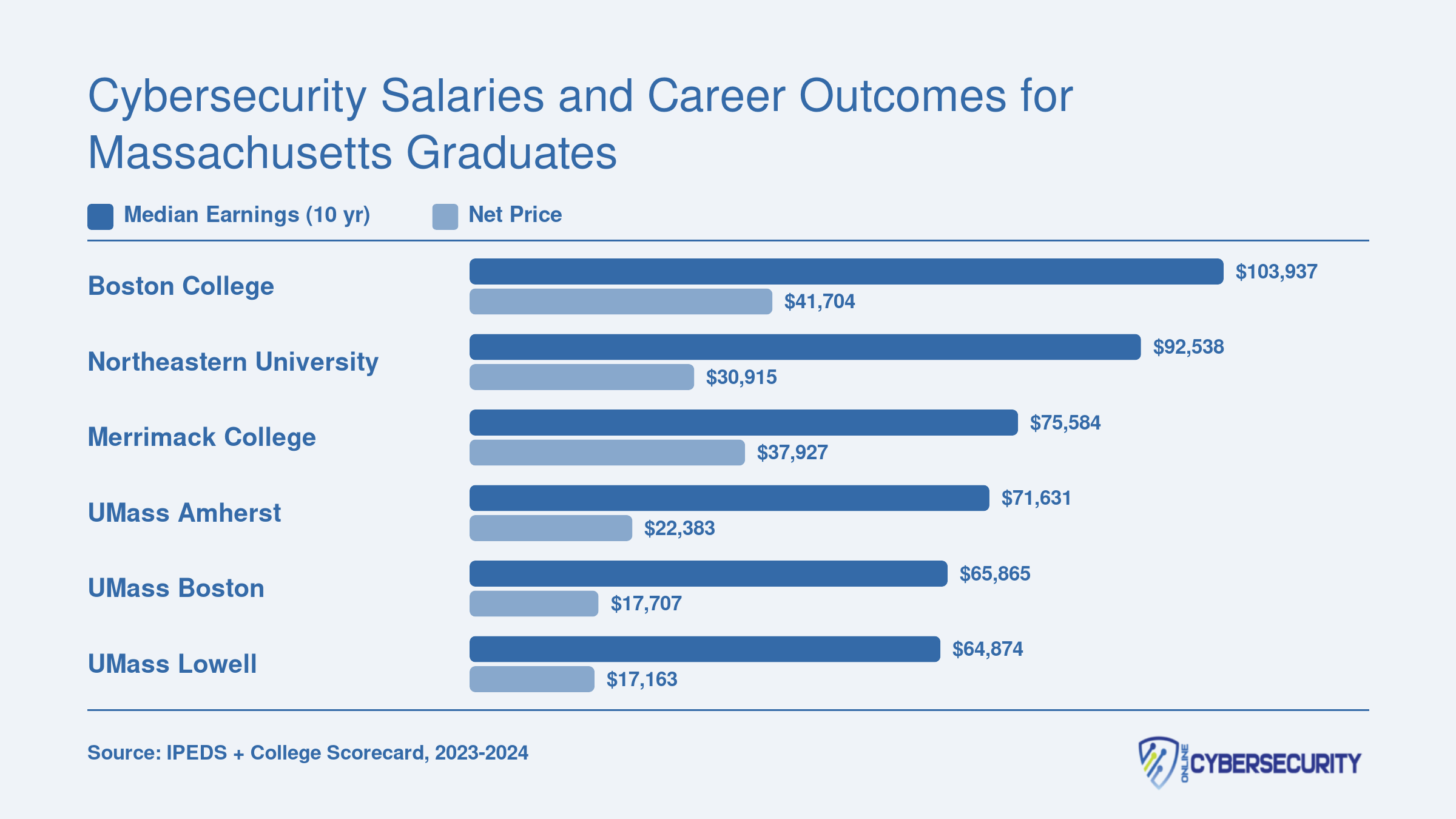
If you're researching an online cybersecurity degree in Massachusetts, salary potential is likely top of mind. The Bureau of Labor Statistics reports that information security analysts in Massachusetts earned a median annual wage of $127,610 as of 2024, slightly above the national median of $124,910. Program-level post-completion earnings for these specific cybersecurity programs are not yet published, so we use each school's institution-wide median earnings at 10 years after enrollment alongside estimated return-on-investment ratios to give you a debt-to-earnings perspective. Boston College graduates see the highest institution-wide median earnings at roughly $104,000 with an ROI ratio of about 5.5, while UMass Lowell offers a compelling ratio near 2.7 at a much lower net price.
Online Cybersecurity Bootcamps vs. Degree Programs in Massachusetts
Choosing between a cybersecurity bootcamp and a full degree program is one of the most common crossroads for career changers in Massachusetts. Both paths can lead to rewarding roles, but they differ in cost, time commitment, depth of study, and long-term career positioning. Here is how to evaluate each option with reliable, up-to-date information.
What Each Path Offers
Bootcamps, such as the cybersecurity bootcamp affiliated with UMass Boston, typically run anywhere from 12 to 30 weeks and focus on job-ready skills like penetration testing, network defense, and Security Operations Center (SOC) workflows. For a broader look at accelerated programs nationwide, our guide to the best cybersecurity bootcamp options compares formats and outcomes. Degree programs, whether at the associate, bachelor's, or master's level, provide broader foundational knowledge in computer science, policy, risk management, and research methods alongside hands-on cybersecurity coursework.
A bootcamp can make sense if you already hold a related degree or significant IT experience and need a focused upskilling sprint. A degree is often the better long-term investment if you are entering the field from scratch, pursuing management or federal roles, or planning to sit for advanced certifications that list education requirements.
Verify Pricing, Format, and Outcomes Directly
Bootcamp tuition, schedules, and delivery formats (fully online, hybrid, or in-person) change frequently. Before committing, visit the official website of UMass Boston's bootcamp or any other Massachusetts-based program to confirm the most current pricing and session dates. Reach out directly to the bootcamp's admissions or career services team to request published job placement and completion rate data. These figures are often not listed publicly, and a willingness to share them is itself a useful quality signal.
Use Public Data to Contextualize Program Value
The U.S. Bureau of Labor Statistics (BLS.gov) publishes Massachusetts-specific employment projections and median salary data for information security analysts and related occupations. Reviewing these numbers helps you compare what a bootcamp or degree investment might return relative to regional demand and pay scales. This context is especially valuable when a program quotes placement statistics without specifying salary ranges or job titles.
Tap Professional Networks for Candid Feedback
Numbers only tell part of the story. For on-the-ground perspectives, consider these steps:
- Professional associations: Organizations like (ISC)2 and CompTIA maintain certification roadmaps and local chapters that can clarify which credentials Massachusetts employers prioritize.
- Local meetups: Groups such as the Boston Cybersecurity Meetup offer a low-pressure way to hear candid opinions from practitioners who have completed specific bootcamps or degree programs.
- Alumni outreach: Ask the bootcamp or school for alumni contacts. A short conversation with a recent graduate can reveal details about career support, curriculum relevance, and employer recognition that marketing materials leave out.
Making the Decision
Neither option is universally superior. The right choice depends on your current education, budget, timeline, and career goals. Many professionals combine both paths over time, starting with a bootcamp to land an entry-level role and later pursuing a degree for advancement. Our cybersecurity career guide walks through how these credentials map to specific job titles and salary tiers. Whatever direction you choose, grounding your decision in verified data and firsthand community input will serve you far better than relying on any single program's promotional claims.
Massachusetts posted roughly 19,600 cybersecurity job openings between 2023 and 2024, according to CyberSeek. That volume places the state among the top markets nationwide for cyber talent, fueled by its dense concentration of defense contractors, healthcare systems, financial firms, and university research labs.
Massachusetts Scholarships, Financial Aid & Workforce Programs for Online Cybersecurity Students
Paying for an online cybersecurity degree in Massachusetts is more manageable than many students realize, thanks to a layered system of state grants, federal programs, and workforce-development funds. Filing the FAFSA early is the single most important step, because virtually every program listed below requires it.
Massachusetts State Grants for Online Students
Several need-based grants administered by the Office of Student Financial Assistance (OSFA) are open to students enrolled in online programs at eligible Massachusetts institutions.1
- MASSGrant: Available to Massachusetts residents pursuing a first undergraduate degree at an eligible in-state college. Online students qualify as long as their program meets minimum credit-load requirements. Awards are need-based and require FAFSA filing.2
- MASSGrant Plus: Covers remaining tuition and mandatory fees at public Massachusetts colleges after other grants are applied. Residents enrolled at least part-time (six or more credits) at a community college or full-time (twelve or more credits) at a four-year public institution may qualify. Online-only enrollment does not disqualify you.2
- Gilbert Matching Student Grant: A need-based award in which state funds are matched by the participating institution. Full-time and part-time students at eligible Massachusetts schools can apply through FAFSA.1
- Massachusetts Part-Time Grant: Designed specifically for residents enrolled part-time, making it a natural fit for career changers balancing work and coursework.1
Because eligibility hinges on attending an institution recognized by OSFA, confirm that your chosen online program is at an approved Massachusetts college before counting on state aid.
Workforce Development and Cybersecurity Training Funds
MassHire Career Centers offer Individual Training Accounts funded through the Workforce Innovation and Opportunity Act (WIOA). If a cybersecurity program appears on the state's Eligible Training Provider List, MassHire may cover a significant share of tuition or training costs.3 This funding is especially relevant for career changers who meet income or employment-status criteria.
The state has also invested in non-degree cyber training through initiatives like the ACE Grant Program, which targets young adults and career changers with alternative training pathways.3 Organizations such as Per Scholas Greater Boston offer no-cost virtual and hybrid cybersecurity programs that can serve as stepping stones toward a full degree.
Federal Programs Worth Exploring
Two federal options deserve attention from Massachusetts cybersecurity students.
- CyberCorps Scholarship for Service (SFS): Funded by the National Science Foundation, this program provides full tuition, a generous living stipend, and a book allowance. In return, recipients commit to working in a government cybersecurity role after graduation. U.S. citizenship is required. UMass Amherst holds NSF designation and funding in cybersecurity, so students at that institution should investigate SFS eligibility directly with the department.2
- GI Bill and military education benefits: Most regionally accredited online programs at Massachusetts schools accept GI Bill funding. Veterans and active-duty service members should verify that their chosen program is approved for VA education benefits before enrolling.
Making the Most of Available Aid
The net price figures you see in program rankings reflect average aid packages, but your actual cost will depend on household income, enrollment intensity, and the specific school. If cost is your top concern, reviewing affordable cybersecurity programs across the country can help you benchmark Massachusetts options against national alternatives. Do not stop at state and federal grants. Many Massachusetts institutions maintain their own cybersecurity-specific scholarships or departmental awards that never appear in broad searches. Contact each school's financial aid office, and reach out to OSFA at (617) 391-6070 with questions about state eligibility.1 Stacking multiple sources of aid, from MASSGrant Plus to WIOA funding to institutional scholarships, can reduce out-of-pocket costs dramatically.
How We Ranked These Online Cybersecurity Schools
Transparency matters when you are making a decision as important as choosing a school. Here is a clear look at how we built the 2026 rankings you see on this page, what data feeds into them, and where the limitations lie.
What the Ranking Measures
Every program in our list starts from a baseline quality composite that weighs several factors together:
- Tuition and fees: We use degree-aware figures, meaning graduate tuition rates apply to master's programs and undergraduate rates apply to bachelor's and associate programs. This keeps cost comparisons fair across degree levels.
- Graduation rates: Institutional completion rates help gauge how well a school supports students through to the finish line.
- Post-graduation earnings: Program-level salary outcomes give a window into the real economic value graduates receive.
- Student debt metrics: Average borrowing and repayment indicators reflect whether graduates leave school on solid financial footing.
Programs offered fully or primarily online then receive an additional boost in the composite score, since online delivery is core to what our readers need.
Where the Data Comes From
We draw on two primary federal sources. The U.S. Department of Education's College Scorecard provides program-level outcome data, including earnings and debt figures tied to specific fields of study. The Integrated Postsecondary Education Data System (IPEDS) supplies institution-level information such as tuition, enrollment, and graduation rates.
Important Caveats to Keep in Mind
No ranking is perfect, and ours is no exception. A few points worth noting:
- Graduation rates reflect the entire institution, not individual cybersecurity programs. A university with a strong overall completion rate may still have variation across departments.
- Net price figures represent an average across all aided students. Your actual cost will depend on your financial aid package, residency status, and enrollment intensity.
- Where program-level earnings or debt data have not yet been published by federal sources, we rely on broader institutional metrics. We note these gaps rather than fill them with estimates.
What the Ranking Does Not Cover
Our methodology does not attempt to score factors like faculty credentials, student satisfaction surveys, or hands-on lab quality, all of which matter but are difficult to measure consistently across dozens of programs. We encourage you to pair these rankings with your own research into curriculum details, career services, and student reviews. You can also compare how schools stack up nationally by browsing our best online cybersecurity programs list. The goal at onlinecybersecurity.org is to give you a strong, data-grounded starting point, not a final answer. Your priorities, budget, and career goals should always drive the decision.
Frequently Asked Questions About Online Cybersecurity Programs in Massachusetts
Below are some of the most common questions prospective students ask about pursuing an online cybersecurity degree in Massachusetts. Each answer draws on information covered earlier in this article, including cost estimates, salary data, and program details.