
What you’ll learn in this article…
- Michigan net prices for online cybersecurity degrees range from about $7,000 to over $19,000 per year.
- Several Michigan universities hold NSA Centers of Academic Excellence designations, a top program quality signal.
- Cybersecurity job growth in Michigan far outpaces most industries, with salaries well above state averages.
- Programs span associate through doctorate levels, with flexible scheduling designed for working professionals.
Michigan's automotive, defense, and financial sectors collectively employ tens of thousands of IT security professionals, and demand continues to outpace the supply of qualified candidates. The state's Bureau of Labor Market Information projects double-digit growth for information security analyst roles through 2030, a pace that keeps starting salaries competitive and mid-career earnings well above the state median.
Nine ranked institutions now offer online or hybrid cybersecurity programs in Michigan, spanning bachelor's degrees, master's programs, and graduate certificates. Net prices after aid vary widely, from roughly $7,000 per year at University of Michigan-Flint to over $19,000 at Davenport University. Several hold NSA Centers of Academic Excellence designations, a credential that matters to federal employers and DoD contractors. For career changers weighing cost against credential value, that spread in price and recognition is the real decision point. If you are exploring how Michigan compares to the national landscape, our cybersecurity career guide offers broader context on roles and growth trajectories.
2026 Best Online Cybersecurity Schools in Michigan: Rankings
Michigan is home to a strong mix of public universities, private colleges, and career-focused institutions offering online and hybrid cybersecurity programs at every degree level. The schools below are ordered by a composite quality score that weighs graduation outcomes, affordability after financial aid, and program depth, so the list reflects overall value rather than any single metric. Keep in mind that the graduation rates shown are institution-wide figures, and net prices represent averages after aid, so your actual cost may differ.
- Graduation and retention outcomes
- Net price after financial aid
- Program breadth and depth
- Institutional earning potential
- Accreditation and designation status
- College Scorecard graduate earnings — collegescorecard.ed.gov
- Independent program research
- Internal program database
- NCES-IPEDS federal institutional data — nces.ed.gov
- #1
Michigan Technological University
Houghton, MI · $10,000 – $15,000/yr
Best for: Research-minded professionals seeking graduate credentials
Michigan Technological University pairs a nationally recognized research reputation with a focused Graduate Certificate in Foundations of Cybersecurity. The 9-credit online certificate can be finished in as little as one semester, and credits apply toward a full master's degree in Cybersecurity or Computer Science. With an institution-wide graduation rate of about 68% and an average net price near $14,182 after aid, Michigan Tech offers a strong return for students seeking a research-backed credential.
View program
- 9-credit online certificate completable in one semester
- Credits apply toward a master's in Cybersecurity or Computer Science
- Three-semester pacing option for working professionals
- Requires undergraduate GPA of 3.0 or higher
- No GMAT or GRE required for admission
- Covers securing systems, networks, and software development
- Designated National Center of Academic Excellence
- #2
Ferris State University
Big Rapids, MI · $9,000/yr
Best for: Career changers building stackable cyber credentials
Ferris State University stands out for the breadth of its cybersecurity catalog, spanning a bachelor's, a master's, and a graduate certificate, all available fully online. The ABET-accredited bachelor's program offers concentrations in penetration testing and digital forensics, while the M.S. in Information Security and Intelligence features stackable certificates. The average net price of roughly $8,624 after aid and an NSA Center of Academic Excellence designation make Ferris one of Michigan's most accessible and credentialed options, even with an institution-wide graduation rate of about 47%.
View 3 programs
- ABET-accredited with concentrations in penetration testing and digital forensics
- Available fully online with hybrid and on-campus options
- NSA and DoD designated Center of Academic Excellence
- Research funded by NSF, NSA, and DoD
- Reported 98.4% graduate satisfaction rate
- Covers cloud security, network forensics, and risk analysis
- Fully online or on-campus master's degree
- Stackable graduate certificates in related specialties
- NSA Center of Academic Excellence designation
- GMAT or GRE is optional for admission
- Faculty bring direct industry and courtroom experience
- Focuses on digital forensics and incident response
- 12-credit undergraduate certificate available online
- Admission requires a 2.35 high school or college GPA
- Offers pathway to industry certifications
- National Center of Academic Excellence in Digital Forensics
- Flexible online or in-person delivery
- Can serve as a stepping stone to bachelor's enrollment
- #3
Davenport University
Grand Rapids, MI · $18,000/yr
Best for: Working adults pursuing management-oriented cybersecurity
Davenport University blends technology and management in its cybersecurity programs, offering a bachelor's in Cyber Defense, a master's in Information Assurance, and a graduate certificate in Cybersecurity Management. The curriculum aligns with CISSP certification prep, and full-tuition Department of Defense scholarships may be available. The institution-wide graduation rate sits near 57%, and the average net price after aid is approximately $17,707. A CAE designation and six annual start dates add flexibility for working adults.
View 3 programs
- 120-credit program with health care and information security specialties
- Available online, on campus, or in hybrid format
- Hands-on internship opportunities with industry partners
- Prepares students for CISSP and other industry exams
- Full-tuition scholarships available through CAE designation
- Employment guarantee qualification for eligible graduates
- 31-credit program completable in under two years
- No GRE or GMAT required for admission
- Online and on-campus delivery with six start dates per year
- Curriculum covers risk management, legal, and ethical issues
- Credit awarded for prior professional experience
- Full-tuition DoD scholarship opportunities available
- Four-course, one-year program
- Covers cybersecurity strategy, risk assessment, and resource planning
- Open to students of all experience levels
- Taught by industry-experienced faculty
- DoD Cyber Scholarship Program eligible
- Flexible online or in-person formats
- #4
Walsh College
Troy, MI
Walsh College, based in the Detroit metro area, focuses its cybersecurity offerings on governance, risk, and compliance, a niche that appeals to business-oriented professionals. The school offers a 12-credit Cybersecurity Certificate and a distinctive Automotive Cybersecurity Certificate developed in partnership with industry. With a 12-to-1 student-to-faculty ratio and tuition around $17,157 before aid, Walsh is designed for working professionals who need focused, graduate-level training without a multi-year commitment. Note that institution-wide graduation rate data is not currently reported for Walsh.
View 2 programs
- 12 graduate credits across six courses
- Covers governance, risk, compliance, and intelligence analysis
- Mandatory online orientation before courses begin
- Must maintain 3.0 GPA with C or better in each course
- Maximum completion timeframe of 48 months
- Up to 3 transfer credits accepted
- Four-course graduate certificate with automotive focus
- Aligned with UN automotive cybersecurity standards
- Covers vehicle ecosystem security and regulations
- Hands-on training with industry partnership component
- Includes cybersecurity strategies and risk management
- SAE committee involvement opportunities
- #5
University of Michigan-Dearborn
Dearborn, MI · ~$9,000/yr (est.)
The University of Michigan-Dearborn leverages the UM brand and its metro Detroit location to deliver a 30-credit M.S. in Cybersecurity and Information Assurance with three concentration tracks. Evening, online, and hybrid course formats make the program practical for working professionals. With an average net price near $9,492 for in-state students after aid and a roughly 58% institution-wide graduation rate, UM-Dearborn offers strong value paired with flexible scheduling. No GRE is required, and students can choose a coursework, project, or thesis completion path.
View program
- 30-credit program with three concentration options
- Concentrations: Network and System Security, Data and Application Security, Software Security
- Evening classes designed for working professionals
- Online, on-campus, and hybrid delivery available
- No GRE required for admission
- Coursework, project, or thesis completion paths
- Covers cloud computing security and intelligent vehicle systems
- #6
Western Michigan University
Kalamazoo, MI · $15,000 – $20,000/yr
Western Michigan University offers cybersecurity programs from the bachelor's through the graduate certificate level, all available in hybrid online and in-person formats. The M.S. in Cybersecurity features concentrations in Computer Information Systems and Computer Science, and coursework prepares students for CompTIA Network+ and Security+ certifications. The institution-wide graduation rate is approximately 58%, and the average net price after aid is around $15,273 for in-state students. Fall and spring enrollment windows and asynchronous options make it accessible to students across the state.
View 3 programs
- 122 credit hours with capstone project
- Covers cryptology, data analytics, and secure systems design
- No minor required
- Hybrid delivery with transfer options available
- Programming and system administration coursework included
- Free electives allow tailored study
- 30 credit hours completable in about two years
- Concentrations in Computer Information Systems and Computer Science
- No GRE required for admission
- Asynchronous and synchronous online formats
- Prepares for Network+ and Security+ certifications
- Up to 6 transfer credits accepted
- Financial aid and assistantships may be available
- 15 credit hours completable in about one year
- Tracks in information security management and secure software engineering
- No GRE required
- Online or in-person with asynchronous options
- Prepares for Network+ and Security+ certifications
- Fall or spring start dates available
- #7
University of Michigan-Flint
Flint, MI · $15,000 – $28,000/yr
The University of Michigan-Flint offers a 32-credit M.S. in Cybersecurity with four concentration tracks, including Network and System Security, Application and Software Security, and Cyber-Physical Systems Security. Most students finish in 16 to 20 months through hybrid delivery. With the lowest average net price on this list at roughly $7,007 after aid, UM-Flint is an especially affordable public option, though its institution-wide graduation rate is about 40%. Non-resident tuition scholarships and a joint BS/MS pathway add further flexibility.
View program
- 32-credit program with four concentration options
- Completable in 16 to 20 months
- Hybrid online and on-campus delivery
- Rolling admissions with multiple start windows
- Prerequisite certificates available for non-CS backgrounds
- Non-resident tuition scholarships offered
- Joint BS/MS pathway available for undergraduates
- Fast-track options for qualified applicants
- #8
Spring Arbor University
Spring Arbor, MI · $19,000/yr
Spring Arbor University is a faith-based private institution offering a B.S. in Cybersecurity that integrates Christian values with technical training. The curriculum covers network security, cryptography, and ethical hacking through hands-on simulations, and students can earn up to five industry certifications during the program. The institution-wide graduation rate is approximately 64%, and the average net price after aid is about $19,353. An accelerated path to a graduate degree is also available for qualifying students.
View program
- Online program with hands-on training and real-world simulations
- Opportunity to earn five industry certifications
- Covers network security, cryptography, and ethical hacking
- Christian values integrated into the curriculum
- Accelerated graduate degree pathway available
- Small-school environment with faculty mentorship
- Project-based learning throughout the program
- #9
Baker College
Owosso, MI · $13,000/yr
Baker College rounds out the list with a B.S. in Information Technology and Cybersecurity, a 120-credit program available online and at two Michigan campuses. The curriculum includes ethical hacking, network defense, computer forensics, and a required 150-hour work experience, giving graduates real-world exposure before they finish. Baker holds a National Center of Academic Excellence in Cyber Defense Education designation and prepares students for CompTIA Security+ and Network+ certifications. The average net price is roughly $13,157 after aid, though the institution-wide graduation rate of about 36% is notably lower than peers on this list.
View program
- 120 credit hours completable in 3 to 4 years
- Online and on-campus delivery at Owosso and Royal Oak
- Required 150-hour work experience component
- Prepares for CompTIA Security+ and Network+ certifications
- National Center of Academic Excellence in Cyber Defense Education
- Courses in ethical hacking, network defense, and computer forensics
- Extended Reality learning experiences incorporated
- Financial aid, scholarships, and grants available
How We Ranked Michigan's Online Cybersecurity Schools
Transparency matters when you are comparing programs that could shape your career for years to come. Here is exactly how we built the 2026 rankings for online cybersecurity schools in Michigan, so you can judge for yourself whether a program fits your priorities.
What Goes Into the Composite Score
Every school on our list is evaluated through a baseline quality composite that blends several measurable factors:
- Tuition and net price: We use institution-reported cost data to approximate what a typical student actually pays after grants and scholarships, giving weight to affordability.
- Graduation rate: Completion rates tell us something meaningful about student support and institutional follow-through.
- Program-level outcomes: Where available, we incorporate earnings data and debt levels for graduates of specific cybersecurity or related programs, giving you a sense of the return on your investment.
On top of that composite, programs offered in a fully online or primarily online format receive a delivery-mode boost. Since this guide is built for students who need remote flexibility, that adjustment ensures the list highlights schools that genuinely serve distance learners. You can compare how Michigan stacks up against the broader landscape in our directory of best online cybersecurity programs.
Where the Data Comes From
We draw from federal data systems that track higher education outcomes nationwide. Tuition figures come from IPEDS, the federal database that colleges and universities report to each year. Earnings and debt metrics are sourced from the College Scorecard, which links education records to tax data. Program completion counts help us verify that a school is actively graduating cybersecurity students, not simply listing a catalog entry.
Important Caveats to Keep in Mind
No ranking is perfect, and we want you to understand the limitations before you rely on ours.
Graduation rates reflect the institution as a whole, not a single department or program. A university with a strong overall completion rate may still have variation across majors. Likewise, net price is calculated at the sector level (public four-year, private nonprofit, and so on) and represents an average, not a personalized quote. Your actual cost will depend on residency status, financial aid eligibility, and any employer tuition benefits you bring to the table.
When program-specific outcome data has not yet been published for a particular school, we note that clearly rather than guessing. Our goal is to give you the most honest picture possible so you can make a well-informed decision about your cybersecurity education in Michigan.
Michigan Online Cybersecurity Degree Costs Compared
The table below sorts Michigan's online cybersecurity programs by net price after financial aid, from least to most expensive. Net prices range from roughly $7,000 to over $19,000 per year, with graduate certificates and master's programs at public universities generally landing at the lower end and bachelor's or private university programs costing more. Median graduate debt across these schools clusters between $21,000 and $26,400. When you compare that debt to institutional median earnings of $35,800 to $78,200 ten years after enrollment, most graduates can expect earnings that are roughly two to three times their total borrowed amount, a healthy ratio that underscores the long-term value of a cybersecurity credential in Michigan.
| School | Degree Level | In-State Tuition | Out-of-State Tuition | Net Price After Aid | Median Graduate Debt | Median Earnings (10 Yr) |
|---|---|---|---|---|---|---|
| University of Michigan, Flint | Master's | $14,473 | $21,390 | $7,007 | $25,000 | $53,230 |
| Ferris State University | Master's | $9,538 | $9,538 | $8,624 | $21,000 | $54,735 |
| University of Michigan, Dearborn | Master's | $17,126 | $30,350 | $9,492 | $22,500 | $59,649 |
| Baker College | Bachelor's | $13,000 | $13,000 | $13,157 | $25,000 | $35,833 |
| Michigan Technological University | Graduate Certificate | $25,916 | $25,916 | $14,182 | $24,990 | $78,198 |
| Western Michigan University | Master's | $20,103 | $29,681 | $15,273 | $26,188 | $53,562 |
| Davenport University | Master's | $20,098 | $20,098 | $17,707 | $26,000 | $45,099 |
| Spring Arbor University | Bachelor's | $34,014 | $34,014 | $19,353 | $26,375 | $51,732 |
Questions to Ask Yourself
CAE-Designated and Accredited Cybersecurity Programs in Michigan
If you are evaluating online cybersecurity programs in Michigan, one of the strongest quality signals you can look for is the National Security Agency's Centers of Academic Excellence (CAE) designation.1 Understanding what this designation means, and which Michigan schools hold it, can save you time and help you target programs that carry real weight with employers.
What Are CAE-CD and CAE-CO Designations?
The NSA, in partnership with the Department of Homeland Security, awards two primary designations to colleges and universities.1 CAE-CD (Cyber Defense) recognizes programs that meet rigorous curriculum standards in defensive cybersecurity, covering topics like network security, digital forensics, and secure software development. CAE-CO (Cyber Operations) is a more selective designation focused on offensive and technical cyber operations, typically tied to intelligence and military career tracks.
For career changers, these labels matter for a practical reason: employers in government, defense contracting, and regulated industries often prefer or require degrees from CAE-designated schools. If you are interested in positions that involve a security clearance, graduating from a CAE program can give your resume a meaningful edge.
As of 2026, no Michigan institution holds the CAE-CO designation.2 However, several schools across the state carry CAE-CD status, and a number of them deliver cybersecurity coursework online.
Michigan CAE-CD Schools With Online Options
Here are the Michigan institutions currently holding CAE-CD designation that also offer at least some cybersecurity coursework online:2
- Davenport University: Offers both an AAS in Cyber Defense and a master's in Information Assurance with a cybersecurity focus. Both undergraduate and graduate programs are available online or in hybrid format.
- Eastern Michigan University: Holds CAE-CD designation and offers graduate-level cybersecurity programs online.
- Central Michigan University: A CAE-CD designee with online bachelor's and graduate programs in cybersecurity-related fields.
- University of Detroit Mercy: Has held CAE-CD designation since 2004 and offers an online MS in Cybersecurity Management.
- Ferris State University: Carries CAE-CD designation and delivers its MS in Information Security online, with some undergraduate coursework available in a partially online format.
- Walsh College: A CAE-CD institution since at least 2016, offering online bachelor's and graduate programs, including a cybersecurity certificate.
- Michigan Technological University: Holds CAE-CD and CAE-R (Research) designations through the 2027-28 cycle.3 Michigan Tech offers a graduate certificate in cybersecurity foundations online, though it does not currently have a fully online bachelor's degree in the field.
How CAE Designation Relates to Accreditation
CAE designation is not a substitute for institutional accreditation. Instead, it layers on top of it. All of the schools listed above hold regional accreditation through the Higher Learning Commission, which is the baseline you need for financial aid eligibility and credit transferability. Some programs may also carry ABET accreditation for their computing or engineering curricula, a separate credential focused on the technical rigor of the program itself. If you are comparing accredited cybersecurity programs online, keep in mind that CAE status adds a layer of validation beyond what standard accreditation covers.
Think of it this way: regional accreditation confirms the institution meets broad educational standards, ABET accreditation validates the technical depth of a specific program, and CAE designation signals that the cybersecurity curriculum aligns with national defense workforce needs. A program that checks all three boxes offers the strongest credentialing package.
Cross-Referencing With the Rankings
Several of the CAE-CD schools above also appear in the rankings section of this article, including Michigan Technological University, Ferris State University, Davenport University, and Walsh College. If national security recognition is a priority for you, use the rankings table to compare those schools on cost, format, and degree level, then confirm their CAE status here. For those interested in a shorter credential, Michigan Tech's graduate certificate or Walsh College's cybersecurity certificate may be worth exploring alongside the options in our guide to the best online graduate certificate in cybersecurity. Choosing a CAE-designated program does not guarantee a specific career outcome, but it does tell employers and credentialing bodies that your education met a federally validated standard, and in cybersecurity, that distinction carries weight.
Career Outcomes and Earning Potential for Michigan Cybersecurity Graduates
A cybersecurity degree from a Michigan institution positions you to enter one of the fastest-growing and highest-paying segments of the tech workforce. Here is what the data tells us about where graduates land and what they earn.
What Michigan Cybersecurity Professionals Earn
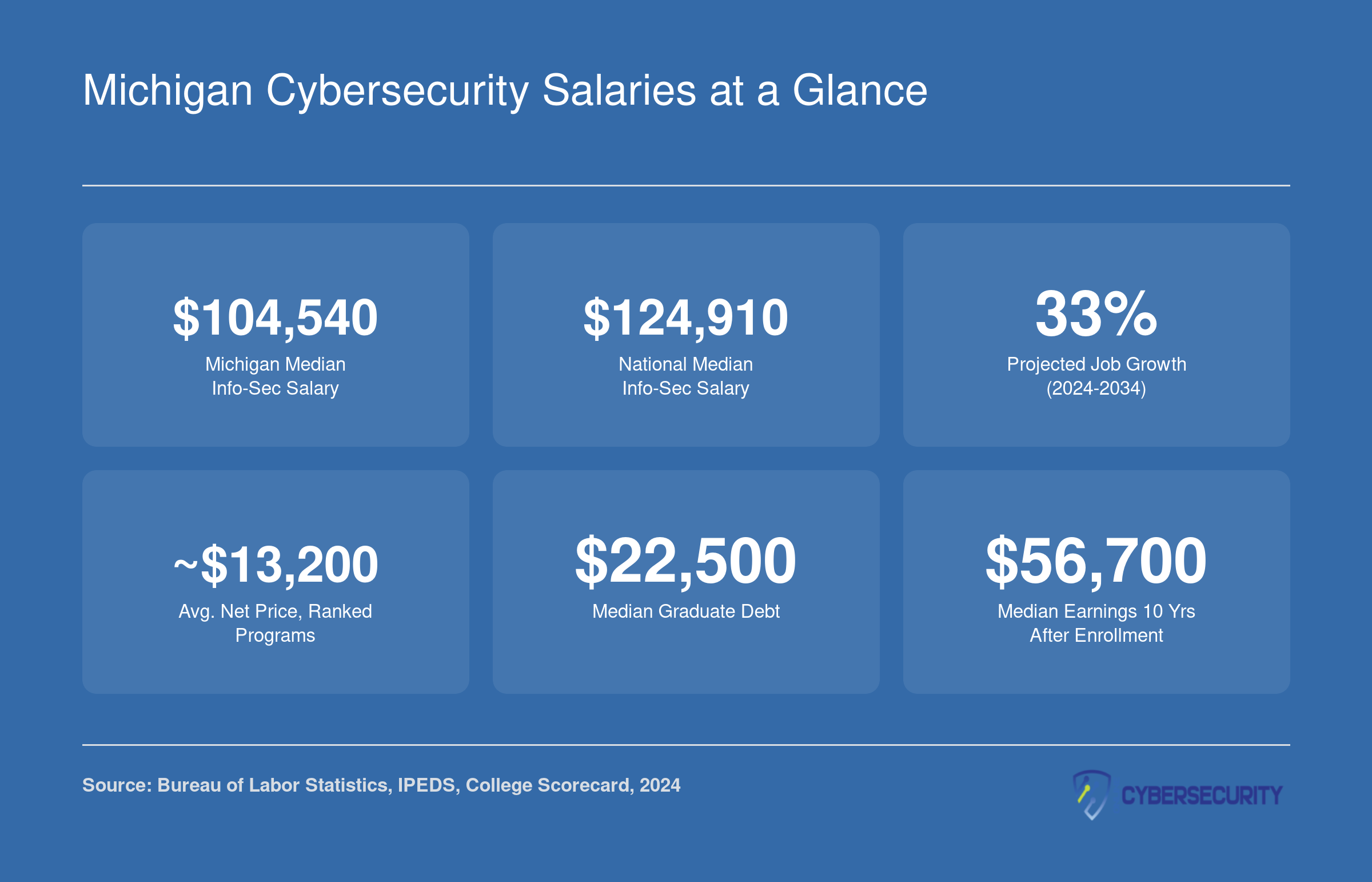
Information security analysts in Michigan earn a median annual wage of approximately $104,540, according to the latest available labor market data.1 The statewide mean wage climbs even higher, to roughly $128,829, reflecting the premium that experienced professionals command.2 Nationally, the Bureau of Labor Statistics reports a median of $124,910 for the same occupation, so Michigan salaries are competitive, especially when you factor in the state's lower cost of living compared to coastal tech hubs.3 Cybersecurity roles in Michigan also carry about a 9% salary premium over general IT positions, underscoring the specialized value employers place on security expertise.4
Program-level earnings data for most of the schools in our rankings have not yet been published at the individual program level, so we cannot cite specific one-year or four-year post-graduation medians for these cybersecurity degrees. At the institutional level, however, schools like Michigan Technological University report median earnings of $78,198 ten years after enrollment, and the University of Michigan-Dearborn reports $59,649, giving you a sense of the long-term value these institutions deliver across all programs.
Where the Jobs Are
Michigan's cybersecurity job market is concentrated in three metro areas. The Detroit-Warren-Dearborn corridor leads in volume and pay, with data security analyst roles ranging from $110,095 to $155,200.4 Grand Rapids and Ann Arbor also offer strong demand, with Ann Arbor roles at the top of the pay scale thanks to the concentration of tech firms and research institutions in that area. The BLS projects a national job growth rate of 33% for information security analysts through 2034, and Michigan's expanding digital economy is expected to keep pace.3
Major Employers Driving Demand
Michigan's diverse industrial base means cybersecurity graduates can pursue cybersecurity career paths across several high-profile sectors:
- Automotive OEMs: Ford, General Motors, and Stellantis all maintain large cybersecurity teams focused on connected-vehicle security, manufacturing systems protection, and supply chain risk.
- Defense contractors: Companies like General Dynamics and Raytheon Technologies have significant Michigan operations with ongoing needs for cleared cybersecurity professionals.
- Health systems: Organizations such as Beaumont Health (now Corewell Health) and Henry Ford Health require specialists to protect patient data and meet HIPAA mandates.
- Financial services: Firms like Ally Financial and Quicken Loans (Rocket Companies), both headquartered in Detroit, invest heavily in application security and fraud prevention.
- Academic and government partnerships: The Michigan Cyber Range, built on the NIST NICE curriculum framework, connects university programs directly with state and local government agencies, giving students hands-on exercises that mirror real-world incident response.4
Job Placement Context
While program-specific employment rates are not yet available for most of the schools in our rankings, the broader labor market context is encouraging. Michigan's unemployment rate for tech professionals remains well below the state average, and employers consistently report difficulty filling cybersecurity vacancies. Schools like Davenport University and Ferris State University, both designated National Centers of Academic Excellence, emphasize employer partnerships and hands-on capstone projects that help bridge the gap between coursework and a job offer. Baker College requires a 150-hour work experience component, and the University of Michigan-Dearborn's location in the heart of the automotive corridor gives students direct access to Fortune 500 hiring pipelines.
If you are evaluating Michigan cybersecurity programs by career return on investment, look beyond sticker-price tuition. Consider each school's industry connections, proximity to major employers, and whether the program includes practical experiences like internships, labs, or capstone projects that translate directly into employability.
Michigan Cybersecurity Salaries at a Glance
Michigan's cybersecurity field offers strong earning potential relative to what you'll invest in your education. With job growth far outpacing most industries and average net prices well below six figures, the return on a Michigan cybersecurity degree is compelling.
Online Cybersecurity Degree Levels: Associate to Doctorate
Cybersecurity programs are offered at every academic level, and choosing the right one depends on where you are in your career and where you want to go. Here is a practical overview of each tier, along with guidance on verifying specifics for the Michigan schools on your shortlist.
Associate Degree
An associate degree in cybersecurity typically requires around 60 credit hours and takes about two years of full-time study. This level is a solid entry point if you are new to IT and want to qualify for roles like security technician, help desk analyst, or junior network administrator. Many Michigan community colleges and some four-year institutions offer this credential online, and it can often be applied toward a bachelor's degree later. If you want to compare options nationwide, our guide to the online cybersecurity associate's degree is a useful starting point. Keep in mind that credit requirements vary from school to school, so always check the program page at each university to confirm the exact number.
Bachelor's Degree
A bachelor's program generally runs around 120 credit hours and four years of full-time enrollment. This is the degree level most commonly sought by employers hiring information security analysts, penetration testers, and security engineers. Several Michigan schools on this list provide accelerated tracks or generous transfer-credit policies that can shorten the timeline, so reaching out to admissions offices directly is a smart move if a faster path matters to you.
Master's Degree
Master's programs in cybersecurity usually fall in the 30 to 36 credit-hour range, with completion timelines of roughly 1.5 to 2 years. A graduate degree positions you for leadership and specialized roles such as security architect, chief information security officer, or cybersecurity consultant. Some Michigan programs offer part-time schedules designed for working professionals, which may extend the timeline but keep your career on track while you study.
Doctoral Degree
Doctoral programs, whether a Ph.D. or a professional doctorate like a D.Sc. in cybersecurity, typically require around 60 credit hours and take three to five years. These are research-intensive and best suited for professionals pursuing academic careers, senior research positions, or high-level policy roles. For a deeper look at what these programs involve, see our overview of the online cybersecurity Ph.D.. Availability at the doctoral level is more limited, so verify program offerings and dissertation requirements carefully.
Verifying Program Details
The credit ranges and timelines described above are general guidelines, not guarantees for any specific institution. Before committing, take these steps:
- College Scorecard: Use the U.S. Department of Education's College Scorecard or the National Center for Education Statistics to look up program lengths and credit loads for the schools you are considering.
- Bureau of Labor Statistics: Visit BLS.gov for up-to-date career outlook data tied to each degree level, including employment projections and typical educational requirements for cybersecurity roles.
- Professional associations: Organizations like (ISC)² and CompTIA maintain directories and resources that can help you confirm whether a program carries recognized accreditation or aligns with industry certification pathways.
- Admissions offices: Contact each school directly. Many online programs offer accelerated, part-time, or cohort-based options that alter the standard completion timeline significantly.
Taking the time to verify these details ensures the program you choose fits both your career goals and your schedule.
Certifications, Flexible Scheduling, and Financial Aid for Michigan Students
If you are weighing an online cybersecurity program in Michigan, three practical questions tend to come up fast: Will the coursework help me earn industry certifications? Can I study around a full-time job or military commitments? And how do I pay for it? Let's break each one down.
Industry Certifications Built Into the Curriculum
Many Michigan online cybersecurity programs align their coursework with recognized certification exams, and some go further by embedding dedicated exam prep modules. The certifications you will encounter most often include:
- CompTIA Security+: Widely regarded as the entry-level benchmark for cybersecurity roles and frequently woven into foundational courses.
- CompTIA CySA+ (Cybersecurity Analyst): Targets intermediate analysts. Central Michigan University, for example, offers an online CySA+ Training Boot Camp that compresses preparation into five days of intensive instruction.1
- Certified Ethical Hacker (CEH): Common in programs that emphasize penetration testing and offensive security.
- CISSP: Typically addressed at the graduate level or as a capstone prep track, given the experience requirement attached to the credential.
Published pass-rate data for Michigan programs is limited; most institutions do not release program-specific exam outcomes. When evaluating a program, ask the admissions team directly whether they track certification pass rates and whether exam vouchers or discounts are included in tuition.
Part-Time Pacing and Asynchronous Options
Most of the ranked online programs in Michigan offer asynchronous coursework, meaning you log in and complete assignments on your own schedule rather than attending live sessions at set times. Several schools also provide part-time enrollment tracks that let you take one or two courses per term, a pace that works well for working adults or active-duty and veteran students managing GI Bill timelines. If synchronous components exist (labs, group projects, virtual residencies), they are usually scheduled during evenings or weekends. Confirm the specifics with each program, because "online" does not always mean the same thing from one university to the next.
Michigan Financial Aid You Should Know About
Beyond federal grants and loans, Michigan residents have access to a few state-level programs that can significantly reduce out-of-pocket costs. For a broader look at tuition strategies, see our guide to affordable cybersecurity programs.
- Michigan Reconnect: This grant covers in-district tuition and mandatory fees for eligible adults (age 25 and older without a previous degree) pursuing an associate degree or skills certificate at a participating Michigan community college. Many community colleges with cybersecurity associate programs qualify, so this can effectively eliminate tuition for the first two years of your education.
- Futures for Frontliners: Originally designed for essential workers during the pandemic, this program offered last-dollar tuition assistance for associate degrees. Enrollment windows have closed for new applicants, but students already approved may still be drawing on their benefits through 2026. Check with your institution's financial aid office for current status.
- Institutional Cybersecurity Scholarships: Some Michigan universities offer department-level scholarships or assistantships tied to STEM and cybersecurity fields. These awards vary widely in amount and eligibility, so it is worth reaching out to each program's financial aid and department offices early in the application process.
The bottom line: fitting an online cybersecurity degree into a busy life and a real budget is more achievable in Michigan than many career changers realize. Start by confirming certification alignment, schedule flexibility, and financial aid eligibility before you apply, and you will be in a much stronger position to choose the right program.
How to Choose the Right Online Cybersecurity Program in Michigan
Picking the right online cybersecurity program is one of the most consequential decisions you will make in your career. Rather than scrolling through dozens of program pages and hoping for the best, use a structured approach that matches your goals, budget, and lifestyle.
Five Factors That Should Drive Your Decision
Before you request information from any school, weigh each program against these five criteria:
- Accreditation and CAE status: Regional accreditation is non-negotiable for credit transferability and employer credibility. Programs with a National Security Agency Center of Academic Excellence (CAE) designation meet rigorous federal curriculum standards, which can open doors to government and defense sector roles. Refer to our earlier breakdown of CAE-designated programs in Michigan for specifics.
- Total cost and net price: Sticker price tells only part of the story. Compare net price estimates, which factor in scholarships, grants, and employer tuition assistance. The cost comparison table earlier in this article gives you side-by-side figures for Michigan's top online options.
- Certification integration: The strongest programs embed preparation for industry certifications like CompTIA Security+, CISSP, or Certified Ethical Hacker directly into coursework. This means you graduate ready to sit for exams, saving months of independent study.
- Career services and employer pipelines: Ask each school about internship placement rates, employer partnerships, and alumni hiring networks within Michigan. Programs with active connections to employers in the Detroit, Grand Rapids, and Lansing metro areas can significantly shorten your job search. Our career outcomes section highlights the earning potential that comes from strong placement support.
- Schedule flexibility: Asynchronous coursework, part-time pacing options, and multiple start dates per year make a meaningful difference when you are balancing work or family responsibilities.
Tailoring Your Search to Your Situation
Not every learner needs the same thing. Here is how to prioritize based on where you are right now:
Career Changers
Look for accelerated bachelor's completion programs or bootcamp-to-degree bridge pathways that give credit for prior learning or industry training. If you are considering an intensive format first, exploring an online cybersecurity bootcamp can help you build foundational skills before committing to a full degree. Programs that let you apply professional experience toward elective credits can cut your time to graduation significantly.
Working Adults
Prioritize fully asynchronous programs with part-time enrollment options. Schools that offer eight-week course terms or rolling start dates let you fit coursework around a job schedule without waiting for a traditional semester to begin.
Military Members and Veterans
Seek out programs that are eligible for Department of Defense Tuition Assistance and carry military-friendly designations. Many Michigan schools accept Joint Services Transcripts for transfer credit, and veteran-specific support services can smooth the transition from active duty or reserve service to the classroom.
Your Concrete Next Step
Narrowing your list is simpler than it sounds. Start by requesting information from two or three programs that align with your priorities. If you are weighing a graduate-level path, our guide to the best online master's in cybersecurity can help you benchmark Michigan programs against national options. Then run each school's net price calculator to get a personalized cost estimate. Finally, contact each admissions office to verify transfer credit policies, especially if you hold prior college credits, military training, or industry certifications. Comparing real numbers and real answers side by side will give you far more clarity than any ranking alone.
Frequently Asked Questions About Michigan Cybersecurity Programs
Choosing the right cybersecurity program raises a lot of practical questions, especially when you are balancing a career change with online coursework. Below are answers to the questions Michigan students ask most often, drawn from the program details and labor market data covered throughout this guide.