
What you’ll learn in this article…
- Missouri offers online cybersecurity programs from associate to master's level, with annual tuition starting at $7,500.
- Major employers in St. Louis and Kansas City fuel one of the Midwest's strongest cybersecurity job markets.
- The U.S. cybersecurity workforce gap exceeded 700,000 unfilled positions as of 2024, and demand keeps growing.
- State grants, federal aid, and institutional scholarships can significantly reduce out-of-pocket costs for Missouri students.
The Bureau of Labor Statistics projects information security analyst roles will grow 33 percent through 2033, and Missouri sits at a crossroads of sectors that drive that demand: defense contractors clustered around Fort Leonard Wood and Whiteman AFB, major financial institutions headquartered in St. Louis and Kansas City, and a healthcare corridor anchored by BJC HealthCare and Cerner. For career changers weighing an online degree, the practical challenge is sorting 25 program listings across 16 accredited schools, from certificates that finish in one semester to full master's programs, with annual tuition ranging from roughly $7,500 to over $33,000. Neighboring states like online cybersecurity schools in Kansas face similar demand, but Missouri's employer diversity creates uniquely broad career pipelines.
That spread matters. A graduate certificate at Southeast Missouri State can cost under $8,000 a year, while a private-university master's tops $25,000. Choosing the right credential level and price point depends on where you are now and where Missouri's employer pipelines can realistically take you.
Best Online Cybersecurity Programs in Missouri
This list covers associate through master's-level cybersecurity programs delivered fully or partially online by Missouri institutions for 2026. Each school was evaluated using a quality composite that emphasizes online availability alongside graduation rates, net price, and program-level outcomes. Whether you are a career changer exploring your first cybersecurity credential or an IT professional looking to advance, these programs offer flexible pathways that fit around work and life.
- Online delivery availability
- Institutional graduation rate
- Net price and affordability
- Program-level outcome indicators
- Breadth of cybersecurity offerings
- NCES-IPEDS federal institutional data — nces.ed.gov
- Internal program database
- College Scorecard graduate earnings — collegescorecard.ed.gov
- Independent program research
- #1
Missouri State University
Springfield, MO · $18,000/yr (net price)
Best for: Career changers seeking multiple credential options
Missouri State University stands out with one of the broadest online cybersecurity portfolios in the state, spanning a bachelor's track, a 30-credit master's, and a graduate certificate. The university holds NSA National Center of Academic Excellence in Cyber Defense designation through 2030, which signals alignment with federal workforce standards. Its STEM-field classification makes certain programs eligible for the Missouri Fast Track Workforce Incentive Grant, adding an affordability edge for in-state students.
View 3 programs
- 30-credit fully online graduate program
- Hands-on labs covering technical, legal, and human factors
- Prepares for CISO and senior management roles
- Accredited by the Higher Learning Commission
- Up to 6 transfer credits accepted with advisor approval
- Research-oriented capstone seminar available
- Financial aid and scholarships available
- 100% online bachelor's degree with cybersecurity track
- Co-developed with IT industry partners
- Covers data protection, system security, and legal topics
- Same curriculum delivered as the on-campus version
- STEM field eligible for Missouri Fast Track Grant
- Taught by full-time faculty
- Prepares for a variety of cybersecurity entry-level roles
- 12-credit-hour online certificate
- Taught by the same full-time faculty as degree programs
- Covers hacker analysis, breach identification, and legal reporting
- Costs noted as below the national average
- Can serve as a stepping stone to the MS program
- Designed for professionals seeking focused upskilling
- #2
Missouri University of Science and Technology
Rolla, MO · ~$16,000/yr (est.)
Best for: STEM professionals building advanced credentials
Missouri University of Science and Technology pairs a strong engineering reputation with a focused four-course Graduate Certificate in Cyber Security delivered entirely online. The certificate aligns with NICE cybersecurity workforce standards, and all credits can roll into the university's Master of Science in Computer Science. With an institution-wide graduation rate of 64.4% and median earnings of roughly $83,000 ten years after enrollment, Missouri S&T graduates tend to see strong long-term returns.
View program
- Four-course certificate delivered fully online
- Covers Security Operations, Cryptography, and electives
- No GRE required for admission
- Credits count toward MS in Computer Science
- Aligns with NICE national cybersecurity standards
- Must maintain 3.0 GPA for certificate completion
- Three-year completion window for working professionals
- Bridge courses available for non-CS backgrounds
- #3
Saint Louis University
Saint Louis, MO · $24,000/yr (net price)
Best for: Working adults targeting cyber leadership roles
Saint Louis University offers a 33-credit Master of Science in Cybersecurity through its School for Professional Studies, with concentrations in Organizational Leadership and Applied Analytics. The program runs on six accelerated, eight-week terms per year, giving working adults frequent entry points. SLU also provides a stackable post-baccalaureate certificate and an accelerated bachelor's-to-master's pathway, making it one of the most flexible graduate cybersecurity options in the St. Louis metro area.
View 3 programs
- 33-credit fully online master's program
- $810 per credit for online students
- Concentrations in Organizational Leadership and Applied Analytics
- Eight-week terms with fall or spring start options
- Covers digital investigations, cloud security, and networking
- Culminates in a master's research project
- Academic coach support throughout the program
- Up to 12 graduate credits count during undergrad
- Requires 3.00 overall GPA and 3.50 major GPA
- No separate graduate application needed
- Saves time and tuition for qualifying SLU undergrads
- Automatic graduate matriculation upon completion
- Designed for high-performing undergrads in related fields
- Nine-credit fully online certificate
- Tuition of $810 per credit hour
- Courses include Cybersecurity Principles and Cyber Threats
- Credits may apply toward the full master's degree
- Eight-week flexible terms for working professionals
- Prepares for network administrator and analyst roles
- #4
Missouri Baptist University
Saint Louis, MO · $25,000 – $30,000/yr
Missouri Baptist University houses its Bachelor of Science in Cybersecurity within the College of Business, blending core business and accounting coursework with technical security training. The 66-major-hour program is built for online flexibility, featuring interactive labs and collaborative projects. Students prepare for roles such as security analyst and network defender while developing an ethical leadership framework.
View program
- Fully online bachelor's degree program
- 66 major credit hours with business core integration
- Hands-on labs and real-world simulation projects
- Minimum 2.50 GPA required for admission
- 120 total credit hours for graduation
- Emphasizes ethical leadership and practical security skills
- Prepares for security analyst and network defender careers
- #5
Southeast Missouri State University
Cape Girardeau, MO · $16,000/yr (net price)
Southeast Missouri State University offers a 12-credit-hour Graduate Certificate in Cybersecurity through its Department of Computer Science in the Harrison College of Business and Computing. The certificate is open to professionals holding bachelor's degrees in any field, making it an accessible entry point for career changers. Credits earned can stack toward a master's degree at SEMO, and courses are available in both online and face-to-face formats.
View program
- 12-credit-hour program with four courses
- Available online and in person
- Open to bachelor's holders in any discipline
- Credits apply toward SEMO master's programs
- Offered through the Harrison College of Business and Computing
- Targets working professionals seeking system security skills
- #6
University of Central Missouri
Warrensburg, MO · $14,000/yr
The University of Central Missouri combines a Master of Science in Cybersecurity and Information Assurance with a shorter graduate certificate, both offered in a hybrid format that includes synchronous online classes. UCM holds a National Center of Academic Excellence designation and boasts SANS GIAC-certified faculty, lending industry weight to its curriculum. Students get 24/7 access to NDG NetLab for remote hands-on practice, and named scholarships like the Chelsoft and Cooper awards help offset the program's already competitive net price of about $14,462.
View 2 programs
- Hybrid program with synchronous online delivery
- Two-year estimated completion timeline
- 24/7 remote access to NDG NetLab
- SANS GIAC-certified faculty
- Covers risk management, threat intelligence, and policy
- Graduate assistantships and internship opportunities
- National Center of Academic Excellence designation
- Hybrid delivery at Warrensburg and Lee's Summit campuses
- Can be completed in approximately one year
- Covers cryptographic algorithms and ethical hacking
- Prepares for CISSP, CSSLP, and Security+ exams
- State-of-the-art computer labs with licensed software
- Feeds into the full master's program
- #7
Northwest Missouri State University
Maryville, MO · $15,000 – $20,000/yr
Northwest Missouri State University delivers a fully online Bachelor of Science in Management Information Systems with a Cybersecurity concentration. At $347 per credit hour and with up to 90 transfer credits accepted, the program is designed to be both affordable and accessible for community college graduates and returning students. Accelerated course formats with multiple start dates throughout the year help learners finish on their own timeline.
View program
- 100% online with accelerated course format
- $347 per credit hour flat tuition rate
- Accepts up to 90 transfer credits
- 120 total credit hours for graduation
- Covers digital forensics, networking, and programming
- Multiple start dates each year
- Accredited by the Higher Learning Commission
- Minimum 2.0 GPA for admission
- #8
Evangel University
Springfield, MO · ~$19,000/yr (est.)
Evangel University offers an online Bachelor of Science in Computer Information Systems with a Cybersecurity concentration, paired with a standalone 12-credit Cybersecurity Certificate designed around CISSP exam content. Both programs operate through the College of Adult and Graduate Studies, using an accelerated five-week course format that suits working adults. At $285 per credit hour, the certificate is one of the most affordable short-form cybersecurity credentials in the state.
View 2 programs
- Fully online bachelor's designed for adult learners
- $285 per credit hour
- Cybersecurity concentration with ethics coursework
- Prepares for systems analyst and IT management roles
- Prior college credits or work experience required
- Flexible scheduling for work-life balance
- 12-credit standalone online certificate
- Four accelerated five-week courses
- Curriculum aligned to CISSP exam domains
- Total estimated cost around $3,420
- Can be stacked into the CIS bachelor's degree
- Designed for quick professional upskilling
- #9
Hannibal-LaGrange University
Hannibal, MO · $23,000/yr
Hannibal-LaGrange University offers a Bachelor of Science in Computer Sciences with a Cybersecurity concentration in a hybrid format. The curriculum spans programming, security, databases, networking, and operating systems, capped by internships and an individualized capstone project. With an 8-to-1 student-to-faculty ratio and a reported 93% graduate placement rate, the program provides personalized mentoring that larger institutions rarely match.
View program
- Hybrid delivery with online coursework
- Covers programming, security, databases, and networking
- Internship and individualized capstone project required
- 93% reported graduate placement rate
- 8-to-1 student-to-faculty ratio
- Small class sizes with dedicated faculty mentoring
- #10
Webster University
Saint Louis, MO · $27,000/yr
Webster University rounds out this list with a Graduate Certificate in Cybersecurity focusing on Threat Detection, available both online and at the St. Louis main campus. Students gain access to the UNCOMN Cybersecurity Center lab, which provides world-class research technologies. Webster also offers a companion certificate in Information Assurance, letting professionals stack two credentials to broaden their expertise across detection and policy domains.
View program
- Available fully online or on campus in St. Louis
- Focus on threat detection and cyber-forensics
- Access to UNCOMN Cybersecurity Center lab resources
- Designed for professionals with IT or CS backgrounds
- Companion Information Assurance certificate available
- Part of Webster's global campus network
- Prepares for public and private sector security roles
How We Ranked Missouri's Online Cybersecurity Schools
Selecting the right online cybersecurity program is a significant decision, and we want to be transparent about how we arrived at this list. Our rankings are built on a composite methodology designed to surface programs that genuinely serve online learners in Missouri, using publicly available federal data rather than subjective opinions.
Starting With Online Delivery
Before any scoring takes place, every program must meet one threshold: it needs to be offered in an online or primarily online format. This filter ensures that every school on our list is a realistic option for students who need the flexibility of remote learning, whether they are working professionals in St. Louis, military-connected students at Fort Leonard Wood, or career changers anywhere in the state.
What the Composite Score Measures
Once a program clears the online-delivery filter, we evaluate it across several weighted factors:
- Graduation rate: How successfully does the institution guide students to completion? This is an institution-wide average, not specific to the cybersecurity program, so it reflects the broader support environment.
- Net price after aid: What do students actually pay once grants and scholarships are applied? Again, this figure is an institution-level average drawn from federal data, giving you a realistic sense of cost rather than sticker price alone.
- Program-level earnings: When available, we incorporate what graduates of a specific cybersecurity program earn at one, two, and four years after completing their credential. These figures offer a more targeted picture of return on investment than institution-wide salary averages.
- Median graduate debt: We also factor in how much debt program completers typically carry, helping you weigh earning potential against borrowing.
Where the Data Comes From
All of the metrics feeding our rankings are sourced from the Integrated Postsecondary Education Data System (IPEDS) and the U.S. Department of Education's College Scorecard, updated to reflect the most recent reporting year available. Graduation rates and net prices come from institution-level Scorecard records, while earnings and debt data are pulled from program-level outcomes when the Department of Education publishes them. In cases where program-level figures are not yet available for a particular school, we note that rather than estimate or omit the school entirely.
This approach keeps our methodology grounded in verified, government-collected data, so you can trust that the rankings reflect measurable outcomes rather than marketing claims. We apply the same framework across all of our best online cybersecurity programs, so you can compare Missouri schools against the national landscape. If you want to dig deeper into any individual school's numbers, the College Scorecard is a great free resource to explore on your own.
Missouri Online Cybersecurity Tuition Comparison
Missouri's online cybersecurity programs span a wide range of price points. At the low end, Central Methodist University's College of Graduate and Extended Studies posts an annual tuition of just $7,500 with an average net price of $14,601, while the University of Central Missouri offers a competitive net price of $14,462. At the high end, Missouri Baptist University lists tuition at $33,122 with an average net price of $27,006 and Webster University follows closely at $27,047. That means the gap between the lowest and highest average net price across these programs is roughly $12,600. Keep in mind that tuition figures shown here are degree-aware: graduate tuition is listed for master's and graduate certificate programs, while undergraduate tuition applies to bachelor's programs and below. Also note that the net price column reflects an institution-wide average after financial aid; your individual cost will vary depending on the aid package you receive.
| School | Degree Level | In-State Tuition | Out-of-State Tuition | Avg. Net Price After Aid |
|---|---|---|---|---|
| University of Central Missouri | Master's | $10,296 | $19,092 | $14,462 |
| Central Methodist Univ. (Graduate & Extended Studies) | Bachelor's | $7,500 | $7,500 | $14,601 |
| Southeast Missouri State University | Graduate Certificate | $7,702 | $7,702 | $15,882 |
| Northwest Missouri State University | Bachelor's | $10,611 | $17,324 | $16,244 |
| Missouri University of Science and Technology | Graduate Certificate | $14,944 | $26,056 | $16,298 |
| Missouri State University | Master's | $8,204 | $14,990 | $17,613 |
| Missouri Valley College | Bachelor's | $23,700 | $23,700 | $18,086 |
| Evangel University | Bachelor's | $28,548 | $28,548 | $18,669 |
| Lincoln University | Graduate Certificate | $7,782 | $13,236 | $19,092 |
| Lindenwood University | Bachelor's | $21,600 | $21,600 | $19,638 |
| Central Methodist Univ. (Liberal Arts & Sciences) | Bachelor's | $28,620 | $28,620 | $22,766 |
| Hannibal-LaGrange University | Bachelor's | $26,880 | $26,880 | $22,814 |
| Saint Louis University | Master's | $25,590 | $25,590 | $24,398 |
| William Woods University | Bachelor's | $30,340 | $30,340 | $26,569 |
| Missouri Baptist University | Bachelor's | $33,122 | $33,122 | $27,006 |
| Webster University | Graduate Certificate | $13,736 | $13,736 | $27,047 |
Questions to Ask Yourself
Accreditation and Program Quality in Missouri
When searching for online cybersecurity schools in Missouri that are accredited, you will encounter two distinct layers of quality assurance. Understanding the difference between them can save you time, money, and frustration as you evaluate programs.
Institutional Accreditation vs. Specialized Designations
Every school ranked on this list holds institutional accreditation recognized by the U.S. Department of Education. This is the baseline requirement that ensures a college or university meets broad academic standards, qualifies for federal financial aid, and produces degrees that employers and graduate schools accept. In Missouri, most four-year institutions are accredited by the Higher Learning Commission.
Specialized designations go a tier above. For cybersecurity specifically, two frameworks stand out:
- ABET accreditation: This applies to computing and engineering programs and signals that a curriculum meets rigorous, outcome-based standards reviewed by industry and academic professionals. ABET-accredited cybersecurity or information security programs are still relatively uncommon nationwide.
- NSA/DHS CAE designations: The National Security Agency and the Department of Homeland Security jointly recognize schools as Centers of Academic Excellence. The two primary categories are CAE-CD (Cyber Defense), which validates that a program covers a comprehensive body of knowledge in defensive cybersecurity, and CAE-CO (Cyber Operations), which focuses on offensive and highly technical skill sets.
Missouri Schools With CAE Designations
As of 2024, three four-year institutions in Missouri hold the CAE-CD designation:1
- Southeast Missouri State University, with its designation valid through 20292
- University of Central Missouri, initially designated in 20223
- University of Missouri, St. Louis4
Missouri University of Science and Technology holds a CAE-R (Research) designation, which recognizes doctoral-level cybersecurity research programs.5 Currently, no Missouri institution holds the CAE-CO designation for cyber operations.1
Why CAE Status Matters for Students
Attending a CAE-designated school opens doors that other programs simply cannot. Students at CAE institutions are eligible for the DoD Cyber Scholarship Program and other federal scholarship opportunities specifically reserved for CAE schools. Employers in defense, intelligence, and federal contracting often prioritize candidates from CAE programs because the designation serves as independent validation of curriculum quality. If you are pursuing cybersecurity roles with government agencies or defense contractors in places like St. Louis or Fort Leonard Wood, a CAE credential on your transcript carries real weight.
That said, a school without a CAE designation can still deliver an excellent cybersecurity education. To get a clearer picture of what a typical cybersecurity degree program covers, look for institutional accreditation, strong faculty, hands-on labs, and industry certifications woven into coursework. The CAE and ABET labels are meaningful differentiators, not absolute gatekeepers. Use them as one factor in your decision, alongside cost, flexibility, and alignment with your career goals.
Related Articles
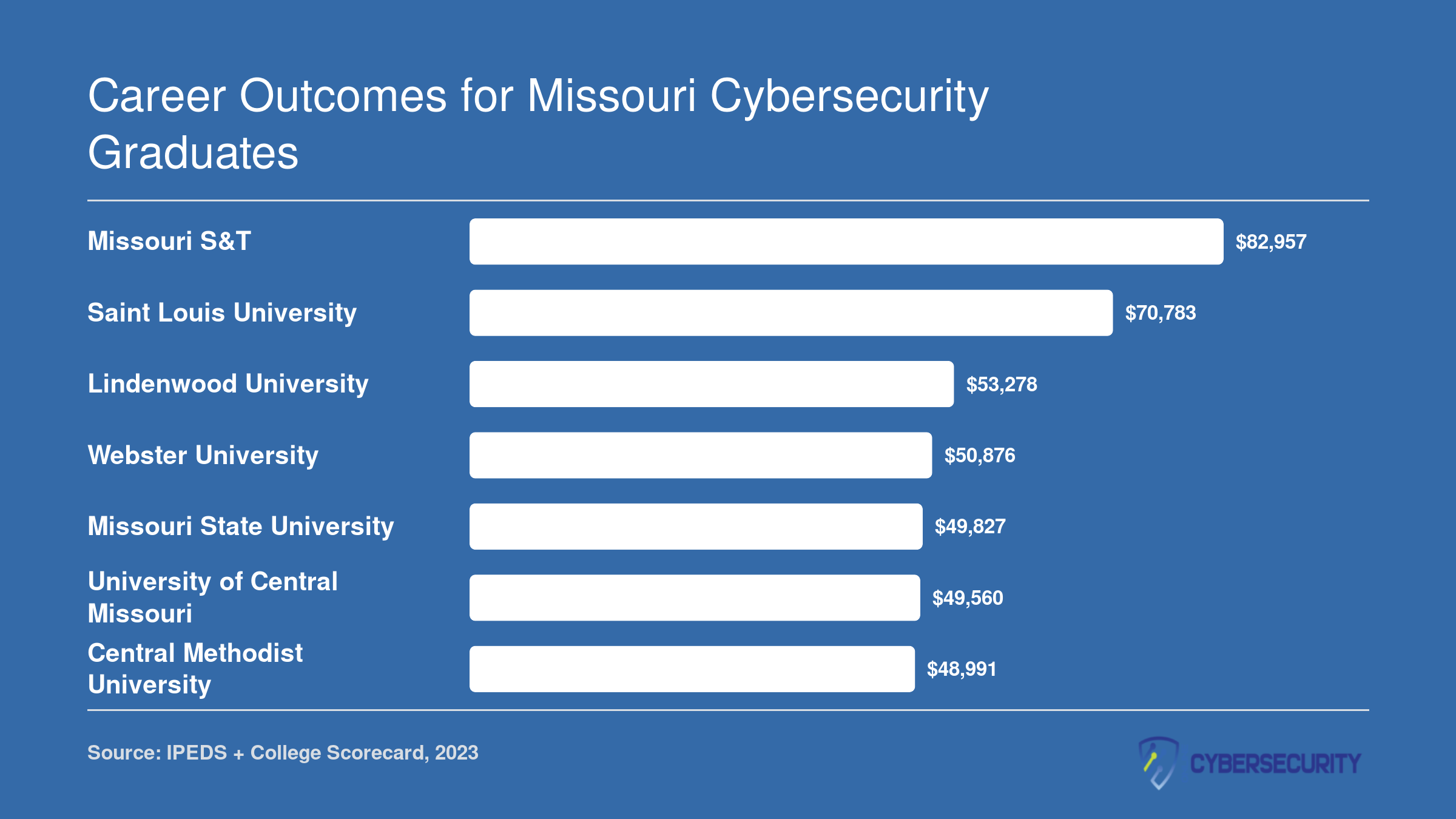
Career Outcomes for Missouri Cybersecurity Graduates
Program-level earnings at one year and four years after completion are not yet published for Missouri's cybersecurity programs, so the chart below uses institution-wide median earnings at ten years post-enrollment as a proxy for long-term earning power. Similarly, program-specific employment rates and poverty-threshold metrics have not been released for these schools, though cybersecurity completers nationwide consistently earn well above the federal poverty line. For a closer look at Missouri-specific wages and the employers driving demand in the state, see the next section on cybersecurity jobs and employers.
Cybersecurity Jobs and Employers in Missouri
Missouri's cybersecurity job market is one of the strongest in the Midwest, driven by a unique mix of defense, finance, healthcare, and technology employers concentrated in two major metro areas. If you are planning your education around career outcomes, understanding where the jobs are and what they pay will help you make sharper decisions.
What Cybersecurity Analysts Earn in Missouri
Information security analysts in Missouri earn competitive wages that compare favorably with the national picture, especially when you factor in the state's lower cost of living. The Bureau of Labor Statistics publishes detailed wage data for this occupation (SOC 15-1212) broken out by state and metro area. To find the most current numbers, visit BLS.gov and search for the Occupational Employment and Wage Statistics program, then filter by Missouri, the St. Louis MSA, or the Kansas City MSA. Historically, median annual wages in both metro areas have tracked in the mid-to-upper $90,000 range, with experienced professionals in specialized roles clearing well over six figures. The Missouri Economic Research and Information Center (MERIC) also publishes state-specific employment projections and industry trend reports that can give you a forward-looking view of demand for cybersecurity talent through the end of the decade. For a broader look at the field, our cybersecurity career guide breaks down roles, salary ranges, and advancement paths.
Major Employers Across the State
Missouri's employer landscape for cybersecurity professionals is remarkably diverse:
- Defense and intelligence: The area surrounding Scott Air Force Base in southern Illinois (part of the greater St. Louis region) hosts U.S. Transportation Command, U.S. Cyber Command support operations, and the National Geospatial-Intelligence Agency (NGA). Defense contractors like Boeing, Leidos, and SAIC maintain significant operations nearby, and these organizations hire heavily for roles in network defense, threat intelligence, and secure systems engineering.
- Financial services: St. Louis and Kansas City are home to major financial institutions with large cybersecurity teams. Mastercard's global technology hub in the Kansas City metro and Edward Jones in St. Louis both invest substantially in information security. Smaller fintech firms and regional banks add further depth to this sector.
- Healthcare: Organizations like Oracle Health (formerly Cerner) in Kansas City and BJC HealthCare in St. Louis manage enormous volumes of protected health information, creating steady demand for security analysts, compliance specialists, and incident responders.
- Technology and consulting: Both metro areas have growing tech ecosystems. Local organizations like the KC Tech Council and the St. Louis Technology Alliance maintain employer directories and host networking events that can connect you with hiring managers.
Connecting Education to Employers
Many Missouri universities with cybersecurity programs maintain employer partnerships that translate directly into internships and job placements. When evaluating online programs, look for schools that publish placement data or name specific hiring partners. Programs at institutions like the University of Missouri system campuses often highlight relationships with regional defense contractors and Fortune 500 firms. These partnerships can shorten your path from graduation to employment, especially if you are making a career change and lack an existing professional network in the field.
If defense-sector roles interest you, exploring how to become a cyber threat intelligence analyst can help you understand the skills and certifications those employers value most. Searching current job postings on platforms like Indeed and LinkedIn for cybersecurity roles in Missouri will also give you a real-time snapshot of which skills employers are prioritizing right now, which can help you choose the right program focus.
Cybersecurity Degree Levels Available in Missouri
Missouri offers a surprisingly full range of online cybersecurity credentials, from undergraduate certificates all the way to graduate-level master's programs. Knowing what each tier involves, and how quickly you can finish, helps you pick the path that matches your career goals and the time you have to invest.
Bachelor's Degree Programs
The bachelor's level represents the largest share of online cybersecurity programs in Missouri, with roughly eight ranked options available in 2026. Schools like Northwest Missouri State University, Central Methodist University, Missouri Baptist University, Lindenwood University, Evangel University, William Woods University, and Missouri Valley College all offer fully online or hybrid B.S. programs in cybersecurity or closely related concentrations. A standard bachelor's requires about 120 credit hours and takes around four years of full-time study. However, generous transfer credit policies can cut that timeline significantly. Northwest Missouri State, for example, accepts up to 90 transfer credits toward its 120-credit B.S. in MIS with a Cybersecurity concentration, and Maryville University similarly accepts up to 90 credits.1 The University of Missouri system schools generally accept 60 to 64 credits from two-year institutions, and WGU Missouri uses a competency-based model that lets you accelerate through material you already know, even awarding credit for industry certifications you hold. For a broader look at top undergraduate options nationwide, see our guide to best online bachelor's degrees in cybersecurity.
Master's Degree Programs
Three Missouri schools appear in our ranked data with online master's options: Missouri State University, Saint Louis University, and the University of Central Missouri. These programs typically run 30 to 33 credit hours and take about two years to complete at a part-time pace, which is common since most graduate students are working professionals. Transfer credit allowances are tighter at this level. Missouri State University, for instance, allows a maximum of six semester hours of transfer credit into its M.S. in Cybersecurity.3
Graduate Certificates
For professionals who already hold a bachelor's degree and want a focused credential rather than a full master's, graduate certificates offer a faster route. Missouri University of Science and Technology, Southeast Missouri State University, Webster University, and Lincoln University all offer online cybersecurity certificates ranging from 12 to 18 credit hours. Many of these credits can later be applied toward a full master's degree if you decide to continue.
Associate Degrees and Undergraduate Certificates
Dedicated online associate degrees in cybersecurity from Missouri-based schools are less common in our ranked data, but the state's Reverse Transfer program is worth knowing about. If you started at a community college, earned at least 15 credit hours there, and then transferred to a four-year university without finishing the associate degree, Missouri's Reverse Transfer initiative can retroactively award you that credential once you accumulate enough combined hours.4 This is especially helpful for career changers who pieced together early coursework at multiple schools.
Accelerated Pathways for Career Changers and Military Students
If you are pivoting from another field or transitioning out of the military, look for schools that maximize what you have already accomplished. WGU Missouri's competency-based approach lets you test out of subjects where you have real-world expertise, potentially finishing a bachelor's well ahead of the four-year mark. Northwest Missouri State's willingness to accept up to 90 transfer credits, paired with a low 2.0 GPA admission threshold, makes it another practical option for nontraditional students. Several national online universities that serve Missouri students, like Colorado Technical University, accept up to 75 percent of a program's credits through transfer and award experiential learning credit for documented professional or military experience.6 If speed is your priority, our list of fastest online cybersecurity degree programs highlights additional accelerated options.
How Bootcamps Compare
Missouri is home to several cybersecurity bootcamps that offer a much shorter path to entry-level skills. Claim Academy runs an online cybersecurity bootcamp lasting roughly three and a half months at a cost of about $12,998. Northwest Missouri State University offers a six-month online bootcamp for around $4,315, and Washington University in St. Louis runs a similar six-month online bootcamp priced at about $12,245. These programs are useful for building practical skills quickly, but they do not result in an academic degree. Most employers in Missouri's larger cybersecurity hubs treat bootcamp completions as supplemental credentials rather than substitutes for a degree, so a bootcamp works best when paired with a degree program or significant prior experience.
According to the ISC2 Cybersecurity Workforce Study, the United States faced a cybersecurity workforce gap of roughly 700,000 unfilled positions as of 2024. That shortage continues to grow, making cybersecurity one of the most in-demand career fields for Missouri graduates entering the job market in 2026.
Missouri Scholarships and Financial Aid for Cybersecurity Students
Paying for a cybersecurity degree can feel daunting, but Missouri students have access to a solid mix of state, federal, and institutional aid programs. Understanding what is available, and applying early, can significantly lower your out-of-pocket costs.
Missouri State Aid Programs
The Missouri Department of Higher Education and Workforce Development (MDHEWD) administers several programs worth exploring:
- Access Missouri Financial Assistance Program: A need-based grant for Missouri residents enrolled at approved institutions. Award amounts vary by school type (public, private, or proprietary) and are based on your Expected Family Contribution from the FAFSA.
- Bright Flight (Missouri Higher Education Academic Scholarship): A merit-based award for students who score in the top percentiles on the ACT or SAT. It can be applied at participating Missouri colleges and universities.
- A+ Scholarship Program: Originally designed for community college students, A+ covers tuition and fees at participating two-year schools and some four-year institutions. If you are starting with an associate degree before transferring into a bachelor's-level cybersecurity program, this is a strong option to investigate.
All three programs require you to complete the FAFSA, so file it as early as possible each cycle.
CyberCorps Scholarship for Service
One of the most generous opportunities for cybersecurity students specifically is the federal CyberCorps Scholarship for Service (SFS) program. It covers full tuition, provides an annual living stipend, and includes a professional development allowance.1 In return, recipients commit to working in a cybersecurity role for the U.S. government for a period equal to the length of the scholarship.1
In Missouri, both Missouri State University and the University of Missouri-Columbia participate in the SFS program.2 If you are admitted to a cybersecurity or related program at either school, you can apply for this scholarship through the institution. Competition is stiff, but the payoff is substantial: you graduate debt-free and walk into a guaranteed government position.
Institutional Scholarships at Missouri Schools
Many of the schools on our ranked list offer their own departmental and program-specific scholarships. Missouri State University has a dedicated scholarship search system3, and the University of Central Missouri uses its AcademicWorks platform to match students with available awards, including scholarships like the Chelsoft and Cooper Scholarships earmarked for cybersecurity students.4 It is worth checking each school's financial aid portal early in your application process, since deadlines and eligibility requirements vary.
How Much Need-Based Aid Are Students Receiving?
Across the ranked Missouri cybersecurity programs on onlinecybersecurity.org, a large share of undergraduates receive federal Pell Grants, with many schools reporting that roughly 58 to 84 percent of their students qualify. That tells you these institutions serve a significant number of students with demonstrated financial need, and that aid packages at these schools tend to be meaningful rather than token.
Compare Net Price, Not Sticker Price
One practical tip: never judge affordability by published tuition alone. Every accredited school is required to provide a net price calculator on its website. That tool factors in your family income, academic record, and other details to estimate the actual cost you would pay after grants and scholarships are applied. For example, a school listing annual tuition above $20,000 may have a net price closer to $14,000 or $15,000 for students who qualify for aid. If you are comparing programs across multiple states, our guide to affordable cybersecurity programs can help you benchmark costs. Run the calculator at each school you are considering so you can make genuine apples-to-apples comparisons before committing.
Frequently Asked Questions About Missouri Cybersecurity Programs
Choosing the right cybersecurity program means sorting through a lot of details. Below are answers to the questions we hear most often from career changers and students exploring online cybersecurity schools in Missouri for 2026.
More Online Cybersecurity Programs in Missouri
Beyond our top 10, these additional Missouri schools offer online cybersecurity programs at various levels and price points. Each entry includes the degree type, format, and estimated net price to help you compare your options. Click through to learn more and request information.
Greater St. Louis
- Cybersecurity (BS)
- Cybersecurity, BS (Online)
- Cybersecurity (BS)
- Cybersecurity, BS (Online)
Central Missouri
- Bachelor of Science in Cybersecurity
- Bachelor of Science in Cybersecurity
- Bachelor of Science (BS) in Cybersecurity Online
- Cybersecurity Certificate
Western Missouri
- Cybersecurity