

What you’ll learn in this article…
- Entry-level CTI analysts can start without direct experience by building a portfolio of threat briefs and adversary profiles.
- The national median salary for information security analysts, including CTI roles, exceeds $120,000 as of 2025 BLS data.
- Stacking certifications in order, from Security+ through GCTI, matters more than collecting them at random.
- Defense contractors, financial institutions, big tech firms, consulting agencies, and government agencies are the five top hiring sectors.
Employer job postings mentioning "cyber threat intelligence" have roughly doubled since 2022, yet qualified analysts remain in short supply. The gap exists because the role sits at a very specific crossroads: cybersecurity operations, intelligence tradecraft, and strategic decision-making. Organizations need people who can not only dissect malware campaigns and track adversary infrastructure but also translate technical findings into action for executives and policy teams.
Breaking in is the hard part. Most openings list three to five years of security experience, a relevant degree, and at least one specialized certification. For career changers, that combination can feel like a locked door. It does not have to be. The path is structured, and the steps are more flexible than the job postings suggest.
What Does a Cyber Threat Intelligence Analyst Do?
A cyber threat intelligence (CTI) analyst does far more than watch dashboards for red alerts. The core mission is to collect, analyze, and contextualize threat data so an organization can preempt attacks rather than simply react to them.1 Think of it this way: a SOC analyst responds to what is happening right now, while a threat intelligence analyst explains who is behind it, why they are targeting your sector, and what they are likely to do next. The end product is actionable intelligence, not raw data.
A Typical Day on the Job
Most CTI analysts cycle through roughly four distinct work loops during a given day or week.
- Morning threat briefing: The day usually starts with open-source and commercial feed review. Analysts scan platforms like Recorded Future, Anomali, or ThreatConnect for newly reported campaigns, vulnerabilities, and adversary infrastructure changes.
- IOC triage and enrichment: When indicators of compromise surface, analysts enrich them using investigation tools such as Maltego and SpiderFoot, cross-reference malware samples in sandboxes like ANY.RUN or Hybrid Analysis, and package the results in STIX 2.1 format so they can flow directly into the organization's SIEM, XDR, or SOAR platform.
- Finished intelligence production: A significant portion of the week goes to writing deliverables. These range from short tactical threat briefs (typically one to three pages) to longer adversary profiles that map techniques, tactics, and procedures against the MITRE ATT&CK framework. Analysts also handle ad hoc requests for information from SOC or incident response teams, usually tracked through collaboration tools like JIRA, ServiceNow, or TheHive.
- Stakeholder briefings: Findings need to reach the right audience. Tactical IOC packages and hunting packages go to SOC analysts, IR responders, and security engineer career path professionals. Strategic threat landscape reports land with management and executive leadership.
Key Deliverables
Not every organization asks for the same outputs, but the standard menu includes:
- Tactical IOC feeds pushed to detection platforms on a rolling basis
- TTP-focused adversary profiles mapped to MITRE ATT&CK
- Campaign tracking reports that follow threat actor activity over a 24 to 72 hour evaluation window
- Strategic quarterly reviews (refreshed every three to six months) that translate technical risk into business language for board-level audiences
All sharing follows the Traffic Light Protocol (TLP) to control distribution.1
Tactical vs. Strategic Intelligence
One important nuance for anyone exploring this career: different organizations weight the tactical and strategic sides very differently. A managed security provider might lean heavily tactical, expecting analysts to churn out real-time indicator packages that feed automated blocking rules through SOAR platforms like Cortex XSOAR, Splunk SOAR, or Swimlane. A Fortune 500 enterprise, on the other hand, may prioritize strategic assessments that inform risk appetite and capital allocation decisions, the kind of work that often flows up to a chief information security officer.
Neither emphasis is better. Understanding where your interests fall, fast-paced indicator operations or longer-horizon analytical writing, will help you target the right roles when you start your job search.
Cyber Threat Intelligence Analyst Vs. SOC Analyst Vs. Threat Hunter
These three roles sit along a shared security operations spectrum, but they differ meaningfully in focus, pace, and the kind of thinking they reward. Understanding where each one lives will help you aim your career moves more precisely.
Primary Focus and Daily Workflow
A SOC analyst is the front line of defense. Day to day, you are triaging alerts from a SIEM platform, investigating potential incidents, and escalating confirmed threats. The work is largely reactive: something fires, you investigate. It is fast-paced, shift-based, and detail-oriented. If you are curious about this entry point, our guide on how to become a security analyst covers the full onboarding path.
A cyber threat intelligence analyst steps back from individual alerts and asks bigger questions. Who is attacking organizations like ours, and why? What tactics, techniques, and procedures (TTPs) are trending across the threat landscape? Your output is finished intelligence, such as adversary profiles, threat assessments, and strategic briefings that inform the rest of the security team before an incident occurs.1
A threat hunter operates somewhere in between. You develop hypotheses about threats that existing detection tools may have missed, then actively search inside the network for evidence. Think of it as offense-minded defense: you assume something slipped through and go looking for it.
Key Tools and Entry Requirements
- SOC analyst: SIEM platforms (Splunk, Microsoft Sentinel), EDR tools, ticketing systems. Typically entry- to mid-level, making it one of the most accessible starting points in cybersecurity.
- CTI analyst: Threat intelligence platforms (MISP, Recorded Future, Anomali), the MITRE ATT&CK framework, OSINT collection tools, and structured analytic techniques. Generally a mid- to senior-level role that expects prior security operations experience.
- Threat hunter: Advanced query languages, endpoint telemetry, network forensics tools, and custom scripting. Also mid- to senior-level, with a strong expectation of hands-on incident responder or detection engineering background.
Salary Ranges at a Glance
Compensation reflects the seniority and specialization each role demands:
- SOC analyst: roughly $90,000 to $120,000
- CTI analyst: roughly $110,000 to $150,0001
- Threat hunter: roughly $120,000 to $160,000
These ranges can vary significantly by geography, industry, and clearance status, topics covered in more detail later in this guide.
How Professionals Move Between Roles
Career paths across these three roles are fluid, not fixed. The SOC analyst position is the most common feeder role into both threat intelligence and threat hunting because it builds the foundational skills (log analysis, incident triage, familiarity with attacker behavior) that the other two roles build upon. Many CTI analysts spent their first two to four years on a SOC before shifting toward intelligence production. Similarly, threat hunters often start in incident response or SOC work before specializing.
The key takeaway: these roles are not competing career tracks. They are connected stages in a broader cybersecurity career path, and moving between them is not only possible but expected.
Questions to Ask Yourself
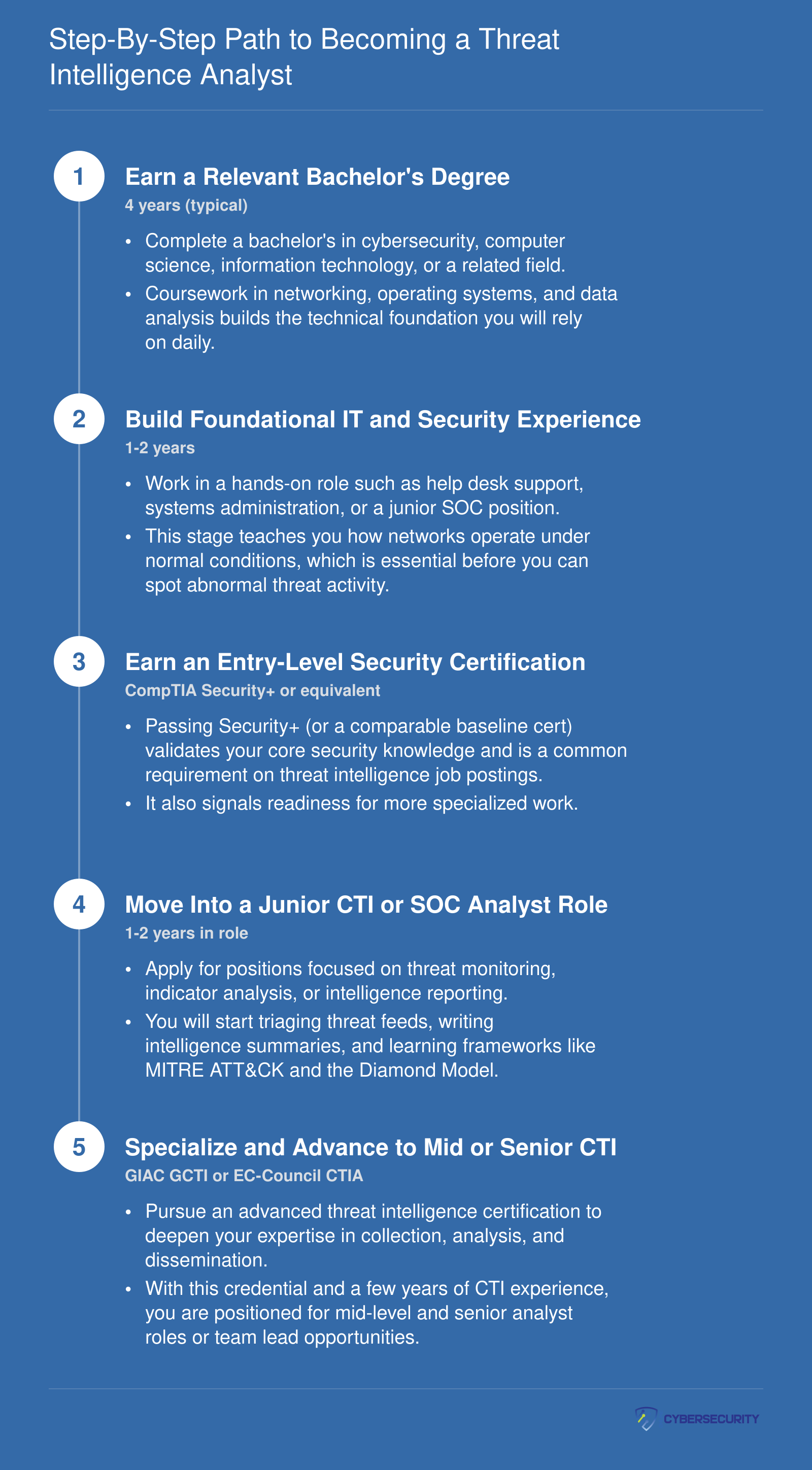
Step-By-Step Path to Becoming a Threat Intelligence Analyst
Most cyber threat intelligence analysts follow a progression that blends formal education, hands-on security work, and targeted certifications. The timeline below maps the five core milestones. If you come from a military intelligence or law enforcement background, your analytical tradecraft and clearance eligibility can let you compress or skip the early experience stages.
Related Articles
How to Break Into Threat Intelligence With No Experience
Breaking into cyber threat intelligence without direct professional experience is more achievable than most job postings suggest. The key is recognizing that CTI draws on analytical skills found in many fields, then building a visible portfolio that proves you can do the work.
Common Transition Paths
There is no single pipeline into threat intelligence, and that is actually good news. The most well-trodden routes include:
- SOC analyst: This is the most common jumping-off point. Time spent triaging alerts, investigating indicators of compromise, and writing incident summaries builds the exact muscle CTI teams need. If you are already in a security operations center, start volunteering for deeper-dive investigations and pivot reports.
- Military or intelligence community: Analysts with a background in signals intelligence, all-source analysis, or counterintelligence bring structured analytical tradecraft that translates directly. An active security clearance is a major asset here. Many defense contractors and government agencies will hire candidates with a clearance and strong analytical experience even without a cybersecurity-specific degree.
- Help desk or IT support: You will need to build network fundamentals first, so pursue your CompTIA Network+ or Security+ while you study threat landscapes on the side. Understanding how systems communicate gives your future intelligence products technical credibility. This path mirrors the progression many follow when moving from help desk to security engineer roles.
- Adjacent analytical fields: Journalists, political scientists, and fraud investigators already know how to research open sources, synthesize findings, and write concise assessments. The analytical writing overlap is significant; what you add is domain-specific technical knowledge.
Free and Low-Cost Entry Ramps
You do not need expensive training to start building real skills. Consider these hands-on options:
- Participate in Trace Labs OSINT search-party CTFs, which task you with finding real missing-persons data using open-source techniques.
- Work through challenges from the OSINT Curious community or try weekly exercises on platforms like CyberDefenders.
- Stand up a home-lab MISP (Malware Information Sharing Platform) instance and practice ingesting, correlating, and tagging indicators from public threat feeds.
- Analyze publicly available malware samples on ANY.RUN or Hybrid Analysis and document your findings in structured reports.
- Contribute to open-source threat intelligence projects on GitHub, even if your first contributions are small data enrichments or typo fixes in YARA rules.
Build a Portfolio, Not Just a Resume
Here is the piece most career-change guides skip: a portfolio of written intelligence products carries more weight than certifications alone when you lack professional CTI experience. Draft practice adversary profiles using public APT reporting. Write mock threat briefs that assess a fictional company's exposure to a specific threat actor. Create a weekly intelligence summary on a topic like ransomware trends or hacktivist campaigns and publish it on a personal blog or LinkedIn.
Hiring managers want to see that you can collect information from disparate sources, analyze it against a specific context, and communicate it clearly to both technical and non-technical audiences. A handful of polished, well-sourced intelligence products demonstrates that ability far more convincingly than a line item on a resume ever could. If you are still building foundational knowledge, a cybersecurity degree program can provide structured coursework that complements your self-directed projects.
The bottom line: pick the transition path closest to where you are now, invest your free time in OSINT exercises and home-lab projects, and turn everything you learn into written deliverables you can show a future employer.
Essential Skills, Tools, and Methodologies
Becoming an effective cyber threat intelligence (CTI) analyst means building competence across three distinct buckets: technical skills, analytical frameworks, and soft skills. Neglect any one of these and you will hit a ceiling quickly. Here is what hiring managers and team leads expect in 2026.
Technical Skills You Need to Build First
At the core, CTI work is about making sense of adversary behavior using raw data. That requires hands-on comfort with:
- Network analysis: Understanding packet captures, DNS logs, and NetFlow data. Wireshark remains the go-to tool for deep packet inspection.
- Malware triage: You do not need to be a full reverse engineer, but you should be able to detonate samples safely, pull indicators of compromise, and describe basic behaviors. Sandbox environments like ANY.RUN and Joe Sandbox let you do this without standing up your own lab.
- Log parsing: Familiarity with SIEM platforms is essential. Splunk and Microsoft Sentinel top job listings in 2025 and 2026, with IBM QRadar, Elastic Security, and Google Chronicle also appearing frequently.2 Know how to write queries, build dashboards, and correlate events across data sources.
- Scripting in Python: Automating indicator enrichment, parsing structured threat data (STIX/TAXII), and pulling from APIs are daily tasks. You do not need software-engineering depth, but functional scripting ability is expected.
On the platform side, you should also get familiar with the leading threat intelligence platforms (TIPs). MISP leads open-source adoption, while Recorded Future, ThreatConnect, OpenCTI, and Anomali are the commercial platforms you will encounter most often. Many of these now include AI-assisted features for automated enrichment and triage, so learning how to validate and tune those outputs is becoming a valuable skill in its own right.
For open-source intelligence gathering, prioritize Maltego, Shodan, VirusTotal, URLScan, and SpiderFoot.2 These tools surface infrastructure relationships, exposed services, and file reputation data that feed directly into your finished intelligence products.
Analytical Frameworks: The Language of CTI
Tools are only useful when guided by structured thinking. Three frameworks dominate the field:
- MITRE ATT&CK: Proficiency here is essentially table stakes. Nearly every CTI job posting in 2025 and 2026 references ATT&CK, and for good reason: it gives analysts and their audiences a shared vocabulary for describing adversary techniques. If you learn one framework deeply, make it this one.
- Lockheed Martin Cyber Kill Chain: Useful for mapping intrusion phases from reconnaissance through actions on objectives. It provides a linear lens that complements ATT&CK's matrix view.
- Diamond Model of Intrusion Analysis: This framework links adversaries, infrastructure, capabilities, and victims into a structured relationship model. It is especially helpful when you are producing strategic or operational intelligence for leadership.
Using these frameworks together, rather than treating them as competing options, gives you richer analysis and makes your reports more actionable.
The Soft Skill That Separates Good Analysts From Great Ones
Writing quality is the single most underrated differentiator in this field. CTI analysts produce the reports that shape executive decisions, inform incident response playbooks, and guide security investments. If your analysis is brilliant but your writing is unclear, it will not drive action.
Clear, concise analytical writing is non-negotiable. Practice structuring intelligence products with a bottom-line-up-front format: lead with the key finding, support it with evidence, and close with recommended actions. You will also spend time briefing executives and collaborating closely with incident response and SOC teams, so the ability to translate technical detail into business-relevant language matters just as much as the technical work itself. Professionals interested in the consulting side of this skill set may want to explore how to become a cybersecurity consultant, where communication and stakeholder management are equally central.
Invest in all three buckets, and you will be prepared not just to land a CTI role but to grow within one.
Best Certifications for Threat Intelligence Analysts, in Order
Not every certification carries the same weight in the threat intelligence hiring process, and the order you earn them matters more than most people realize. The sequence below moves from foundational to advanced, letting you stack credentials as your experience grows. Each certification listed here is current as of the 2025 to 2026 exam cycle.1
Start With the Baseline: CompTIA Security+
Security+ is the certification most employers expect to see before they will even consider you for a cyber threat intelligence role. It validates your understanding of core security concepts, network architecture, and risk management. There are no formal prerequisites, and the exam fee runs roughly $392 to $440.1 If you are coming from IT support, help desk, or a non-technical background, this is where you prove you speak the language of cybersecurity. For a broader look at entry-level options, see our guide to Cybersecurity Certifications.
Build Detection Skills: CompTIA CySA+
Once Security+ is in hand, CySA+ deepens your ability to analyze security events, triage alerts, and work inside a SOC environment. The exam cost is similar to Security+ (around $392 to $439), and while there are no hard prerequisites, most candidates benefit from at least a year of hands-on monitoring experience. This certification is especially useful if you plan to transition from SOC analyst work into threat intelligence.
The Gold Standard for CTI: GIAC GCTI
If one certification screams "I am a threat intelligence professional," it is GIAC GCTI. This is widely regarded as the gold-standard, CTI-specific credential. It covers intelligence lifecycle management, collection planning, structured analytic techniques, and adversary attribution. The exam fee lands between $949 and $1,199. There are no formal prerequisites, but the material assumes you already have a working knowledge of security fundamentals. Earning GCTI signals to hiring managers that you can produce finished intelligence, not just consume threat feeds.
Mid-Career Options: EC-Council CTIA and GIAC GCIH
EC-Council's Certified Threat Intelligence Analyst (CTIA) targets entry-to-mid-level analysts and costs roughly $550 to $800. You will need to complete EC-Council's official training or demonstrate at least two years of relevant experience.4 It is a solid option if GCTI's price tag is out of reach and you want a CTI-focused credential sooner.
GIAC GCIH focuses on incident handling and response, skills that overlap heavily with threat intelligence work. The exam fee mirrors GCTI at $949 to $1,199, with no formal prerequisites. Incident responders who earn GCIH often find the pivot into intelligence roles smoother because they already understand adversary behavior from the defensive side.
Senior-Level Credentialing: CISSP
CISSP from ISC2 is not a threat intelligence certification per se, but it is the credential that opens doors to senior analyst, team lead, and management positions. The exam costs $749 to $799, and you must have five years of cumulative, paid experience in two or more security domains. If your long-term goal is leading a threat intelligence program rather than staffing one, CISSP belongs on your roadmap. Professionals eyeing the executive track may also want to explore how to become chief information security officer.
Quick Reference Table
- CompTIA Security+: $392 to $440, no prerequisites, entry-level difficulty, best for building the baseline employers require.
- CompTIA CySA+: $392 to $439, no prerequisites, intermediate difficulty, best for SOC analysts and detection-focused roles.
- GIAC GCTI: $949 to $1,199, no prerequisites, intermediate to advanced difficulty, best for dedicated threat intelligence analysts.
- EC-Council CTIA: $550 to $800, training or two-plus years of experience, intermediate difficulty, best for entry-to-mid-level CTI professionals.
- GIAC GCIH: $949 to $1,199, no prerequisites, intermediate to advanced difficulty, best for incident responders pivoting into intelligence.
- CISSP: $749 to $799, five years of experience required, advanced difficulty, best for senior analysts and security managers.
A practical approach is to earn Security+ first, layer on CySA+ or GCIH while gaining operational experience, then target GCTI once you are ready to specialize. Pursuing them in this order keeps your spending efficient and ensures each credential lands on your resume at the moment it will make the biggest difference to recruiters.
Cyber Threat Intelligence Analyst Salary by Experience, State, and Industry
Understanding what threat intelligence analysts earn requires a bit of detective work, which is fitting for the role. No single source tells the whole story, so the best approach is to cross-reference several datasets and adjust for your own situation.
What Federal Data Tells Us
The Bureau of Labor Statistics (BLS) groups threat intelligence analysts under the broader "Information Security Analysts" category. As of its most recent published data, the national median annual wage for that umbrella occupation sits around $120,000, with the top ten percent earning above $175,000. However, the BLS does not break this figure down by experience level or by niche specialty, so it serves as a useful baseline rather than a precise target for threat intelligence roles specifically.
Salary Ranges by Experience Level
To get experience-level detail, look to aggregators like Glassdoor, Payscale, and CyberSeek, which collect self-reported and employer-reported compensation filtered by job title and tenure. Based on data reported through early 2026, approximate ranges for cyber threat intelligence analysts in the United States look roughly like this:
- Entry level (0 to 2 years): $70,000 to $95,000, depending heavily on location, clearance status, and employer size.
- Mid level (3 to 5 years): $95,000 to $130,000, with premiums for candidates who hold active security clearances or specialized certifications.
- Senior level (6 or more years): $130,000 to $175,000 and above, particularly in leadership, principal analyst, or threat intelligence management tracks.
Professional association surveys from organizations like ISACA, CompTIA, and ISC2 tend to confirm these bands and sometimes publish even more granular breakdowns by region, industry, and credential held. SANS also releases annual salary surveys that let you filter by job function.
How Location and Industry Shift the Numbers
Geography matters more in this field than many people realize. Metropolitan areas like Washington, D.C., New York, San Francisco, and Seattle consistently show salaries 15 to 25 percent above the national median, partly because of cost of living and partly because of concentrated demand from the federal government and major tech employers. CyberSeek provides interactive state-level supply and demand data that can help you gauge how competitive your local market is. For a broader look at compensation trends across the profession, our cybersecurity salary guide breaks down pay by state, certification, and role.
Industry also plays a role. Defense contractors and financial services firms tend to pay at the top of the range, while healthcare and education organizations often fall slightly below the median, though they may offer other benefits. Government positions (federal civilian or military-adjacent) sometimes appear lower on paper but frequently include locality pay adjustments, clearance premiums, and strong retirement benefits that close the gap.
How to Research Your Own Target Salary
Rather than relying on a single number, build a realistic range by combining several approaches:
- Review current job postings on LinkedIn, Indeed, and Dice. Many employers, especially government agencies and large tech firms, now list salary bands directly in the posting.
- Check your target region against a cost-of-living calculator to adjust national averages to local purchasing power.
- Look at professional association salary surveys, which often let you filter by certification, years of experience, and job function.
- Use CyberSeek to understand whether your state or metro area has a surplus or shortage of cybersecurity talent, since tight labor markets generally push compensation upward.
The bottom line: threat intelligence is among the higher-paying cybersecurity specialties, and the field rewards both depth of expertise and breadth of analytical skills. Starting salaries are competitive even for career changers, and the ceiling rises quickly as you build a track record of producing actionable intelligence. If you hold (or are pursuing) a doctorate, our analysis of cybersecurity PhD salary expectations can help you estimate the additional return on that investment.
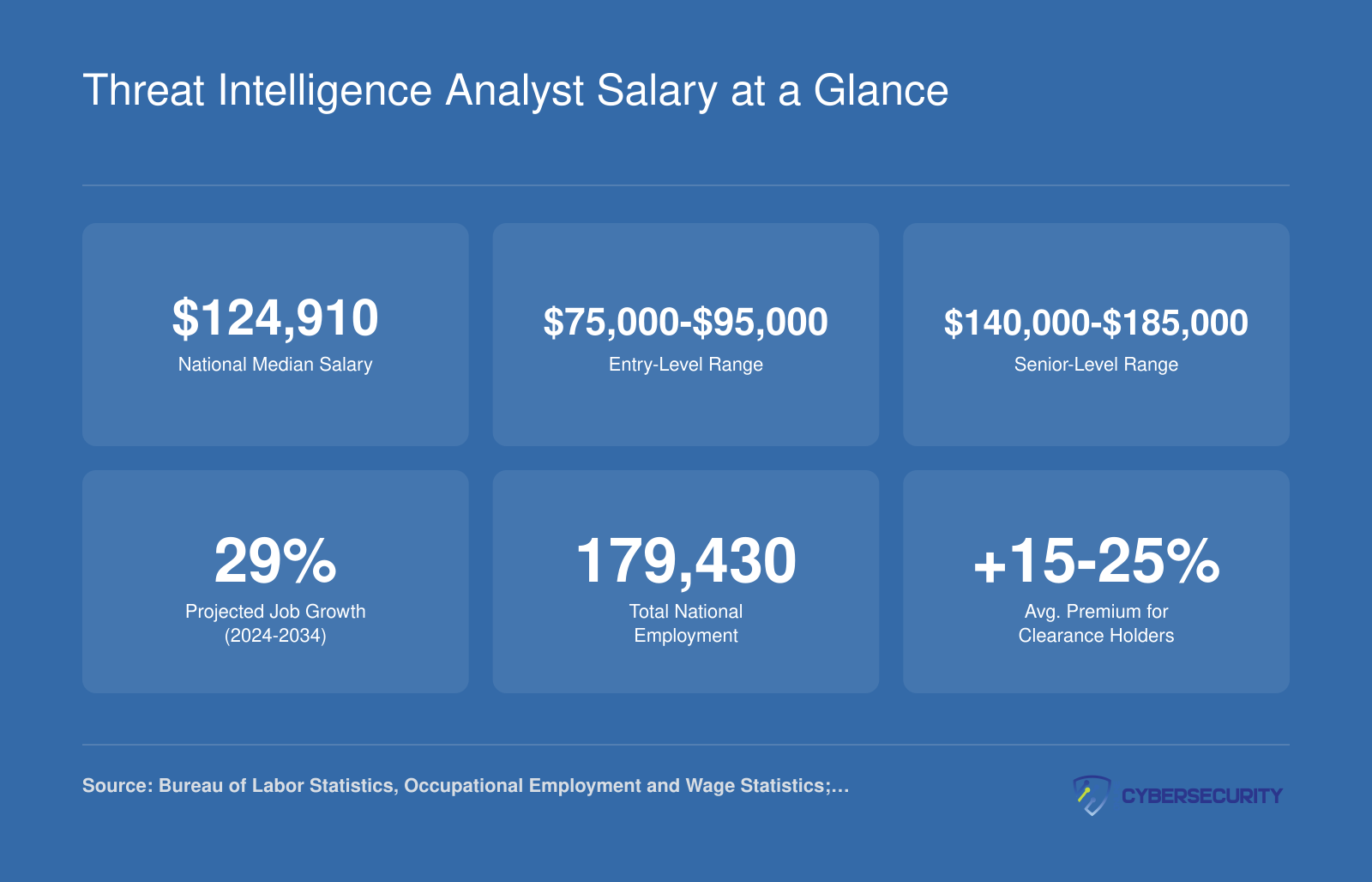
Threat Intelligence Analyst Salary at a Glance
Here is a quick snapshot of compensation and career outlook for cyber threat intelligence analysts. These figures draw from national data for information security analysts, the occupational category that includes threat intelligence roles. Screenshot this for your career planning folder.
Where Threat Intelligence Analysts Work: Top Industries and Employers
Threat intelligence is one of those specialties where your choice of employer shapes nearly every aspect of your day, from what you wear to whether you can work from your couch. Here is a breakdown of the five major hiring sectors and what to expect from each.
Federal Government and the Intelligence Community
Government and defense organizations remain the single largest employer category for cyber threat intelligence professionals.1 Agencies such as NSA, CIA, DIA, and CISA maintain dedicated threat intelligence teams that track nation-state adversaries, terrorist networks, and emerging cyber weapons. These roles almost always require a Top Secret/SCI (TS/SCI) security clearance, and some demand a full-scope polygraph. You do not need to arrive with a clearance in hand; the sponsoring agency or contractor initiates and funds the investigation, though the process can take six months to over a year. Senior CTI positions requiring a full-scope polygraph routinely pay between $150,000 and $300,000, reflecting the scarcity of cleared talent and the sensitivity of the work.2
Defense Contractors
Firms like Booz Allen Hamilton, Raytheon, and Lockheed Martin hire heavily for CTI roles that support government missions. Work is typically performed on-site or inside a Sensitive Compartmented Information Facility (SCIF), meaning remote work is rare.1 Holding a TS/SCI clearance can add a salary premium in the range of 15 to 25 percent compared to equivalent uncleared positions, making this sector financially attractive even at the mid-career level.1
Financial Services
Banks and investment firms such as JPMorgan Chase and Goldman Sachs run some of the largest private-sector security operations. Financial institutions often staff security teams three to five times larger than comparably sized companies in other industries, and threat intelligence is a core function within those teams.1 These employers value analysts who understand fraud ecosystems, ransomware economics, and regulatory compliance. Hybrid and remote arrangements are more common here than in government work.
Big Tech and Cybersecurity Vendors
Microsoft, Google, CrowdStrike, and Mandiant (now part of Google Cloud) produce threat intelligence as both an internal capability and a commercial product. Cloud and IT services companies have been among the most aggressive recruiters for CTI talent heading into 2026.3 These roles often offer fully remote or hybrid schedules, competitive total compensation, and access to enormous telemetry datasets that make the analytical work especially rewarding. If the vendor side of the industry appeals to you, building skills in security engineering or penetration testing can strengthen your candidacy for these teams.
Consulting Firms and MSSPs
Managed Security Service Providers and consulting practices give you exposure to a wide variety of clients and threat landscapes. The trade-off is a faster operational tempo and, in some cases, on-call expectations. Remote and hybrid work is common in this sector, making it a solid option if you want geographic flexibility.
Geographic Hubs and the Rise of Remote
The Washington, D.C., and Northern Virginia corridor dominates CTI job postings, largely because of proximity to federal agencies and defense contractors. Roles in that region often carry a 15 to 25 percent salary premium over the national median.1 San Francisco, New York, and Austin are secondary hubs driven by tech and finance employers. That said, access is broadening: roughly 56 percent of cybersecurity workers held remote or hybrid arrangements as of recent industry surveys, and threat intelligence roles are generally well suited to flexible work, at least in the private sector.1 If your goal is to work from anywhere, prioritize Big Tech, MSSP, or financial services employers. If you want the highest clearance-driven salaries, plan to be near D.C. and comfortable working on-site.
Frequently Asked Questions About Threat Intelligence Careers
Below are answers to the most common questions career changers and students ask about breaking into cyber threat intelligence. Where possible, figures reflect 2025 and 2026 industry data.