
What you’ll learn in this article…
- New Hampshire offers online cybersecurity programs from associate through master's level at three ranked schools for 2026.
- The University of New Hampshire holds CAE designation, a top quality marker awarded jointly by the NSA and DHS.
- New Hampshire cybersecurity salaries benefit from proximity to the Boston tech corridor and a strong defense contractor presence.
- Bootcamps and industry certifications provide faster alternatives for career changers who do not need a full degree.
Defense contractors, financial services firms, and a growing cluster of tech companies along the Manchester-Nashua corridor have pushed cybersecurity hiring in New Hampshire well beyond what the state's small population might suggest. For career changers eyeing this demand, the challenge is a limited but focused set of in-state online programs: just three New Hampshire institutions currently offer cybersecurity degrees online or in hybrid formats, spanning associate through master's levels.
Tuition across those programs ranges from roughly $6,900 to over $17,000 per year depending on degree level and residency, and two of the three hold NSA/DHS Center of Academic Excellence designation. That concentration of CAE-recognized programs in a state this size is unusual and worth weighing against out-of-state alternatives.
Top Online Cybersecurity Schools in New Hampshire: 2026 Rankings
New Hampshire may be a small state, but it punches above its weight in cybersecurity education. The three schools below offer online or hybrid cybersecurity programs spanning associate through master's levels, each serving a different kind of learner. Our 2026 rankings use a blended quality composite that weighs academics, affordability, and outcomes rather than relying on any single metric. Keep in mind that graduation rates listed are institution-wide figures, not specific to cybersecurity programs, and program-level earnings data is not yet available for these programs.
- Academic quality indicators
- Net price and affordability
- Graduate earnings outcomes
- Program delivery flexibility
- Institutional retention and completion
- NCES-IPEDS federal institutional data — nces.ed.gov
- College Scorecard graduate earnings — collegescorecard.ed.gov
- Internal program database
- Independent program research
- #1
University of New Hampshire College of Professional Studies Online
Manchester, NH · ~$11,000/yr (est.)
Best for: Working professionals seeking a graduate credential
UNH's College of Professional Studies in Manchester offers two distinct master's pathways in cybersecurity: a hands-on Cybersecurity Engineering M.S. delivered in a hybrid format and a fully online Cybersecurity Policy and Risk Management M.S. designed for professionals without a technical background. Both carry the NSA/DHS Center of Academic Excellence designation, and the school's integration with New Hampshire's tech corridor and UNH's InterOperability Laboratory gives students access to real-world projects and regional employer networks. With in-state tuition around $10,448, out-of-state tuition near $11,708, and a net price of roughly $10,864 after aid, UNH CPS delivers strong value. The institution-wide graduation rate sits at about 29.5%, though this figure reflects UNH CPS's adult and part-time student population broadly, not the cybersecurity programs specifically. Median earnings for graduates ten years out reach approximately $66,479 at the institutional level.
View 2 programs
- Hybrid format blending on-campus and online coursework
- Choose thesis track or professional capstone with internship
- Covers cryptography, secure networking, and machine learning
- No entrance exam (GRE) required for admission
- Accelerated 4+1 master's option for UNH undergraduates
- Full-time and part-time enrollment with fall, spring, and summer starts
- NSA/DHS Center of Academic Excellence designation
- Fully asynchronous online delivery in 8-week terms
- 30 credit hours across 10 courses
- No prior technical background required
- Capstone addresses real-world organizational challenges
- Faculty include full-time academics and industry practitioners
- Five terms per year allow flexible pacing
- Focused on regulatory compliance, risk frameworks, and policy
- #2
River Valley Community College
Claremont, NH · $15,000/yr (net price)
Best for: Budget-minded career changers in healthcare IT
River Valley Community College, part of the Community College System of New Hampshire, offers a Cyber Security and Healthcare IT Associate in Science degree through a hybrid format with centers in Claremont, Keene, and Lebanon. The 62 to 66 credit program blends digital forensics, network security, and electronic medical records coursework, preparing graduates for entry-level roles at the intersection of cybersecurity and healthcare IT. In-state tuition runs about $6,940, while out-of-state students pay approximately $15,190. The net price after aid is around $14,804, and median graduate debt is notably low at roughly $16,226. The institution-wide graduation rate is about 21.9%, a figure common among open-enrollment community colleges that serve many part-time and nontraditional students. Credits are designed to transfer into New Hampshire public four-year institutions, giving graduates a clear pathway to a bachelor's degree.
View program
- Associate in Science, 62 to 66 total credits
- Hybrid delivery with virtual labs for remote learners
- Open enrollment with no admissions barriers
- Industry certification preparation built into coursework
- Healthcare IT focus including EMR systems and compliance
- Covers Linux, C++, network security, and digital forensics
- Credits transfer to NH public four-year institutions
- Capstone course and faculty with industry experience
- #3
Southern New Hampshire University
Manchester, NH · $37,000/yr (net price)
Best for: Transfer students maximizing prior college credits
Southern New Hampshire University's fully online cybersecurity programs serve learners nationwide from its Manchester campus. SNHU offers both a Bachelor of Science and an Associate of Science in Cybersecurity, each delivered in convenient 8-week terms at $342 per credit. The bachelor's program accepts up to 90 transfer credits, while the associate's accepts up to 45, making either a practical choice for students with prior coursework or military training. SNHU holds National Center of Academic Excellence in Cyber Defense status and requires no application fee, test scores, or essay. Tuition is a flat $17,200 with no in-state versus out-of-state distinction. Net price after aid averages around $36,708, and median graduate debt is about $21,082. The institution-wide graduation rate is approximately 42.8%, with median earnings reaching roughly $50,318 ten years after enrollment. Active-duty military members pay a reduced $250 per credit.
View 2 programs
- Fully online with 40 courses in 8-week terms
- Transfer up to 90 credits to accelerate completion
- $342 per credit, $250 per credit for active-duty military
- No application fee, test scores, or essay required
- Curriculum covers incident response, risk management, and ethics
- Virtual labs with industry-standard tools
- National Center of Academic Excellence in Cyber Defense
- 20 courses, fully online in 8-week terms
- Transfer up to 45 credits toward the degree
- Total estimated tuition around $20,520 before aid
- Covers cybersecurity foundations, networking, and OS security
- Designed as a seamless pathway to the bachelor's program
- Hands-on labs and industry-aligned curriculum
- Free application with no entrance exam required
Online vs. On-Campus: Understanding NH Cybersecurity Program Formats
Choosing between online and on-campus delivery is one of the first practical decisions you will make when pursuing a cybersecurity degree in New Hampshire. The good news is that several of the state's universities offer flexible formats designed for working adults and career changers, not just traditional students living near campus.
Asynchronous, Synchronous, and Hybrid Options
Most online cybersecurity programs at New Hampshire institutions lean heavily on asynchronous coursework, meaning you complete lectures, labs, and assignments on your own schedule within a given window. This is the format you will typically find at SNHU, which runs accelerated eight-week terms and lets you start a new term multiple times per year. Granite State College, now integrated into the University System of New Hampshire, has historically offered a similar asynchronous model with short terms geared toward adult learners.
UNH takes a somewhat different approach. Some of its graduate-level cybersecurity courses blend synchronous sessions (live virtual meetings at scheduled times) with asynchronous material. If your work schedule is unpredictable, pay close attention to whether a program expects you to attend live sessions or simply watch recorded content.
On-campus programs, by contrast, follow a traditional semester calendar (roughly 15 weeks per term) and may include dedicated lab time with physical hardware and networking equipment. That hands-on element can be valuable, but it is increasingly replicated in virtual lab environments used by online programs.
How Program Format Affects Completion Time
The format you choose directly influences how quickly you can finish a degree. Online programs with shorter terms and year-round scheduling often allow students to complete a best online bachelor's degrees in cybersecurity in three to four years at a full-time pace, or faster if you transfer credits. A master's program online typically runs 18 months to two years. On-campus programs generally follow a fixed two-semester-per-year rhythm, which can stretch the timeline. If you are earlier in your education journey, an online cybersecurity associate's degree can serve as a faster on-ramp before you progress to a four-year program.
Part-time enrollment is available at most NH schools and is worth exploring if you plan to keep working while you study. Contact each school's admissions office directly to ask about part-time course loads and realistic completion estimates for your situation, because advertised timelines assume full-time enrollment.
Doing Your Own Research
Before committing, take a few concrete steps to compare formats:
- Visit official program pages: Look for sections labeled "Program Details," "Curriculum," or "Online Learning" on the websites of SNHU, UNH, and Granite State College. These pages spell out pacing options, term lengths, and start dates.
- Check BLS.gov: The Bureau of Labor Statistics outlines typical education requirements for cybersecurity roles like information security analyst, which helps you gauge whether you need an associate, bachelor's, or master's degree and how long each path realistically takes.
- Call or email admissions: Advisors can clarify nuances that websites leave vague, such as whether you can mix online and on-campus courses or switch between full-time and part-time status.
- Consult industry associations: Organizations like CompTIA, (ISC)², and ISACA publish guidance on choosing accredited programs and understanding which delivery formats align with employer expectations. Their resources can help you confirm that an online degree carries the same weight as an on-campus one in hiring decisions.
The bottom line is that online and on-campus programs in New Hampshire lead to the same credentials. Your choice should hinge on your schedule, learning preferences, and how quickly you want to enter the workforce.
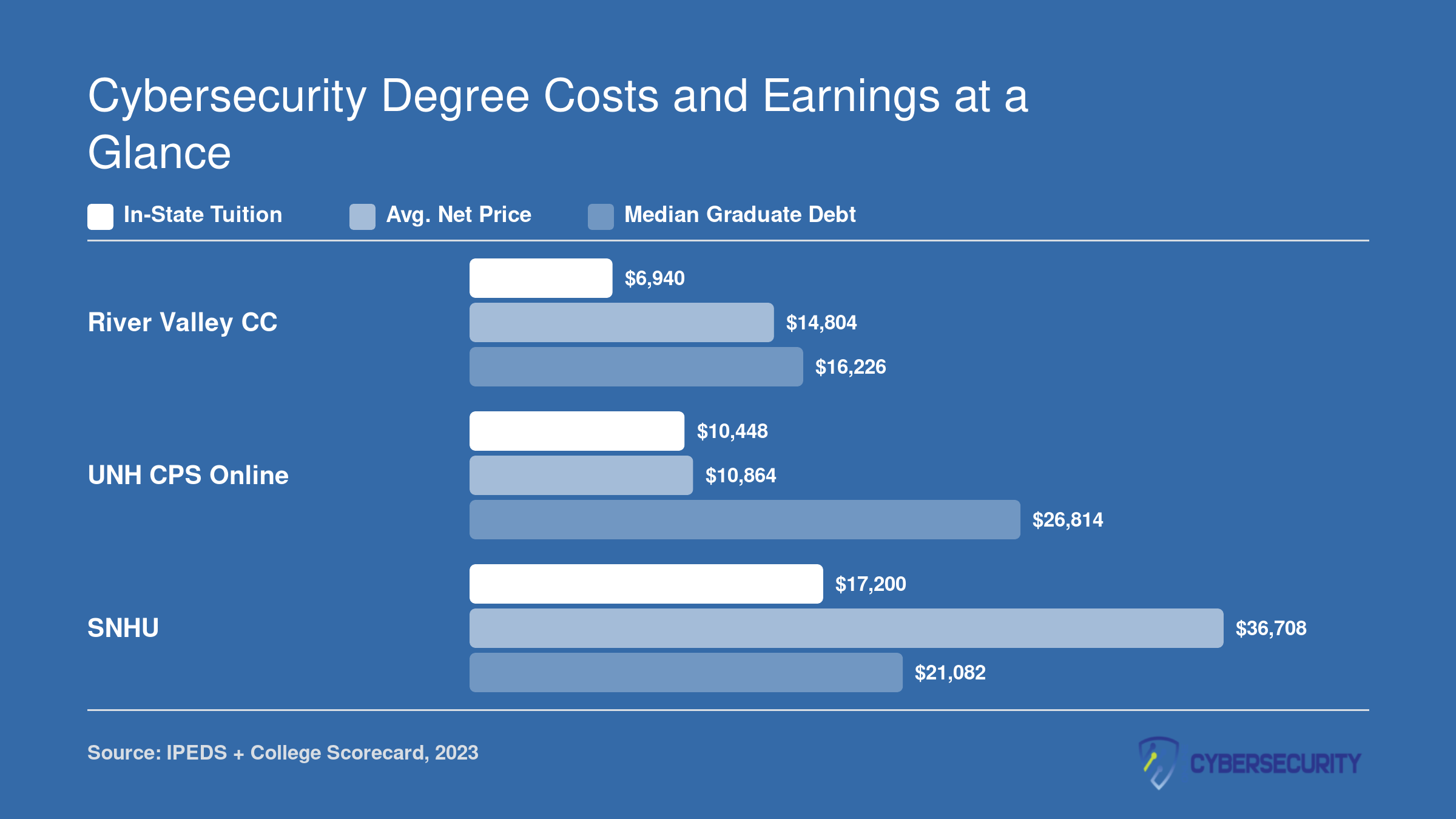
Cybersecurity Degree Costs and Earnings at a Glance
How do New Hampshire's three ranked cybersecurity programs compare on sticker-price tuition, typical net cost after aid, and median graduate debt? The chart below puts the key dollar figures side by side. Note that net price is an institution-wide average and actual costs vary by student based on financial aid, enrollment status, and other factors. Program-level earnings shortly after graduation are not yet available for these programs, so the 10-year median earnings figure is included for longer-term context.
Degree Levels: Associate Through Master's in NH Cybersecurity
New Hampshire offers cybersecurity credentials at three distinct levels, each opening different career doors. Understanding what each tier provides, and which schools offer it, helps you invest your time and tuition wisely.
Associate Level: Your Entry Point
River Valley Community College offers an Associate in Science in Cyber Security and Healthcare IT through a hybrid format. At 62 to 66 credits, this program is designed to get you workforce-ready in roughly two years. In-state tuition sits at about $6,940 per year, making it one of the most affordable options in the state. The curriculum covers digital forensics, network security, Linux systems, and even electronic medical records, giving graduates a dual edge in cybersecurity and healthcare IT.
With an associate degree, you can pursue entry-level positions such as SOC analyst, help desk technician, or junior network administrator. These roles let you build hands-on experience while many employers offer tuition reimbursement for further education. River Valley also emphasizes that credits transfer to four-year institutions, so this credential can serve as a stepping stone rather than a stopping point.
Bachelor's Level: The Industry Standard
Southern New Hampshire University (SNHU) delivers a fully online Bachelor of Science in Cybersecurity at $342 per credit, structured in eight-week terms across 40 courses. SNHU holds a National Center of Academic Excellence designation and allows up to 90 transfer credits, which is especially appealing if you already hold an associate degree or have prior college coursework.
A bachelor's degree is where most hiring managers draw the line for mid-level roles. Positions like security engineer, penetration tester, and incident response analyst typically require a four-year degree or equivalent experience. SNHU's program incorporates virtual labs and industry-standard tools, building the practical skill set that employers look for alongside the credential itself.
Master's Level: Leadership and Specialization
The University of New Hampshire College of Professional Studies Online offers a Cybersecurity Engineering M.S. in a hybrid format, with both synchronous and asynchronous options designed for working professionals. In-state tuition runs approximately $10,448 per year, with no entrance exam required. The program starts in fall, spring, or summer and includes thesis or capstone options, giving you flexibility in how you demonstrate mastery.
A master's degree positions you for senior and executive roles: CISO, security architect, director of information security, or specialized consulting. These titles come with significantly higher earning potential and strategic influence within organizations. For a deeper look at compensation benchmarks across the field, see our breakdown of cybersecurity salary by state. UNH's NSA/DHS Center of Academic Excellence designation adds credibility that resonates with both employers and government agencies.
A Note on Program-Level Outcomes
Program-specific earnings and debt figures for these New Hampshire cybersecurity programs are not yet available at the credential level. That said, institution-wide data provides useful context. UNH graduates report median earnings of roughly $66,479 ten years after enrollment, while SNHU graduates land near $50,318 and River Valley graduates near $44,700, reflecting the general pattern where higher credentials correlate with higher long-term earnings.
Cohort size data for these specific programs has not been published, so it is difficult to gauge the size of your peer group from numbers alone. Reaching out to admissions offices directly is a practical step if learning community size matters to you. Smaller cohorts often mean more faculty interaction, while larger ones may offer richer networking opportunities.
When mapping your path, think of these three tiers less as separate tracks and more as a connected ladder. Starting at the associate level and working your way up is a proven, affordable strategy, and New Hampshire's transfer-friendly landscape makes that progression smoother than in many other states.
Related Articles
CAE-Designated Cybersecurity Programs and Accreditation in New Hampshire
If you are evaluating cybersecurity programs in New Hampshire, one of the most meaningful quality markers to look for is the National Centers of Academic Excellence in Cybersecurity (CAE) designation, jointly awarded by the NSA and DHS. This designation tells you that a program's curriculum has been rigorously reviewed against federal knowledge unit standards, and it opens doors to scholarships and employer recognition that non-designated programs simply cannot match.
Which NH Schools Hold CAE Designation?
As of 2026, two universities in New Hampshire carry the CAE in Cyber Defense (CAE-CD) designation:
- University of New Hampshire (UNH): First designated in 2019 and redesignated through 2030, UNH was the state's pioneer in earning this credential.1 Its cybersecurity curriculum aligns with federal knowledge units spanning network defense, operating system hardening, and risk management.
- Southern New Hampshire University (SNHU): Also holding the CAE-CD designation, SNHU brings this distinction to its large online student population, making it one of the more accessible CAE-designated options for distance learners nationwide.2
Neither institution holds a CAE in Cyber Operations (CAE-CO) or CAE in Research (CAE-R) designation, and no New Hampshire community colleges currently carry any CAE designation.3 If you are specifically seeking a CAE-CO program, which focuses on offensive operations and is far less common nationally, you would need to look at institutions in neighboring states. You can verify current designations anytime through the interactive map on the NCAE-C website.
What the CAE Designation Means for You as a Student
The practical benefits of enrolling in a CAE-designated program go beyond curriculum quality:
- DoD CySP Scholarship Eligibility: Students at CAE-designated schools can apply for the Department of Defense Cyber Scholarship Program, which covers tuition and provides a stipend in exchange for a service commitment. This is one of the most generous cybersecurity scholarship programs available, and it is restricted to CAE institutions.
- Employer Recognition: Federal agencies, defense contractors, and large enterprises routinely prioritize graduates from CAE-designated programs. Hiring managers at organizations like MITRE, Raytheon, and BAE Systems, all of which have a presence in the greater New England region, understand what this designation represents.
- Structured Rigor: The curriculum must cover defined knowledge units that map closely to real workforce needs, so you graduate with fewer gaps in foundational skills.
If you are still weighing how a cybersecurity degree program is structured day to day, understanding the CAE framework will help you compare schools more effectively.
CAE Status and Industry Certifications
Holding a CAE designation does not automatically mean a program bundles industry certification exams like CompTIA Security+, Certified Ethical Hacker (CEH), or CISSP prep into its coursework. However, the knowledge units required for CAE-CD alignment overlap significantly with the domains tested in Security+ and similar certifications. At both UNH and SNHU, coursework is designed to prepare you for those exams even when a voucher or formal test prep module is not included in tuition.
Before enrolling, ask the program coordinator directly whether certification exam vouchers are bundled, offered at a discount, or simply supported through aligned coursework. That distinction can affect your out-of-pocket costs and timeline toward earning credentials that employers expect to see alongside your degree. For a broader look at how programs compare across the country, you can also explore accredited cybersecurity programs online.
Verifying Designation Status
Designations are awarded for defined periods and must be renewed. Because status can change, always confirm a school's current designation on the official NCAE-C website rather than relying solely on a university's marketing materials. For New Hampshire specifically, the landscape is straightforward: UNH and SNHU are your CAE-CD options, and neither the state's community colleges nor any other institution currently holds a designation.
Questions to Ask Yourself
Tuition, Financial Aid, and ROI for NH Cybersecurity Programs
Understanding what you will actually pay for a cybersecurity degree in New Hampshire requires looking beyond sticker prices. Published tuition rates, institutional aid, state scholarships, and long-term earning potential all factor into the real cost of your education.
Comparing Sticker Prices Across Program Levels
New Hampshire's Community College System (CCSNH) remains the most affordable entry point. At roughly $215 to $230 per credit for the 2025-26 year, a 60- to 72-credit associate degree in cybersecurity runs between approximately $13,000 and $16,000 for in-state students.1 That is a fraction of what you would pay at a four-year school.
At the bachelor's level, Southern New Hampshire University lists online tuition at $342 per credit, with no difference between in-state and out-of-state students. A 120-credit bachelor's in cybersecurity would total around $41,000 before aid, though SNHU's generous transfer policy (up to 90 credits accepted) can cut that figure dramatically. Active-duty military members pay a reduced rate of $250 per credit.
For a master's degree, the University of New Hampshire College of Professional Studies posts in-state tuition near $10,448 and out-of-state tuition around $11,708 for its cybersecurity engineering program, making it one of the more competitively priced graduate options in the region.
Keep in mind that institution-wide average net prices (the figure you often see on federal data sites) reflect all students across every major and financial situation. They are useful for broad comparisons but should not be treated as a guaranteed quote for cybersecurity students specifically.
Evaluating Return on Investment
When comparing programs, the ratio of median earnings to median debt offers a practical gauge of long-term value. Among ranked New Hampshire programs, River Valley Community College and UNH's graduate program both show favorable earnings-to-debt ratios, suggesting graduates tend to earn comfortably relative to the debt they carry. SNHU's ratio is solid as well, particularly for students who transfer in credits and reduce their total borrowing.
Program-level earnings and debt figures are not yet available for several of these cybersecurity programs at the federal level, so the ratios above rely on broader institutional data. As more graduates move through the pipeline, program-specific outcomes should become clearer.
New Hampshire Financial Aid and Scholarships
Several state and regional resources can offset costs:
- NH Charitable Foundation: Distributes approximately $8 million annually to around 1,600 students. Traditional-age undergraduates (under 24) pursuing four-year degrees face an April deadline, while adult learners (24 and older) can apply through December. Graduate students also have a dedicated application track. All applications go through the foundation's ScholarshipSource portal.2
- Granite Edvance: Awards roughly $750,000 each year across a range of scholarship programs. Worth checking for cybersecurity-adjacent eligibility.3
- CCSNH Institutional Aid: Community college students can explore scholarships through the AwardSpring portal, which aggregates campus-specific and system-wide awards.1
- Governor's Scholarship Program: Offered through SNHU, this program targets New Hampshire residents and can meaningfully reduce bachelor's-level tuition.
Cybersecurity-Specific Funding
Federal programs designed for cybersecurity students deserve special attention:
- CyberCorps Scholarship for Service (SFS): A National Science Foundation program that covers tuition, fees, and a stipend in exchange for a commitment to work in government cybersecurity after graduation. Eligibility depends on whether your school participates, so confirm directly with the program you are considering.
- DoD Cyber Scholarship Program (CySP): Targets students at CAE-designated institutions, covering tuition plus a stipend. UNH's CAE designation may make its students eligible, though slots are competitive and awarded at the federal level.
Between state scholarships, federal cybersecurity programs, and institutional aid, most New Hampshire students have multiple avenues to bring their out-of-pocket costs well below listed tuition. Start applications early, especially for the NH Charitable Foundation's spring deadlines, and contact your program's financial aid office to identify every resource available to you.
Admission Requirements and Transfer Pathways in New Hampshire
Getting into a New Hampshire cybersecurity program is more straightforward than many career changers expect. Requirements vary by degree level, and the state's public higher education system offers a well-defined transfer pathway that can save you both time and money.
Undergraduate Admission Requirements
For associate-level cybersecurity programs at New Hampshire's community colleges, enrollment is generally open. Schools like River Valley Community College accept students without requiring standardized test scores or a minimum GPA, making these programs especially accessible for those entering the field later in life.
At the bachelor's level, online programs tend to keep the bar practical rather than restrictive. SNHU's online Bachelor of Science in Cybersecurity, for example, charges no application fee, requires no entrance exams, and does not ask for a college essay.1 The focus is on getting motivated learners started quickly. Transfer credits are accepted generously, with up to 90 credits eligible for transfer at SNHU, which is particularly useful for students who already hold an associate degree or have prior college coursework.1
Graduate Admission Requirements
Graduate programs raise expectations modestly. SNHU's online Master of Science in Cybersecurity recommends a minimum GPA of 2.75 from prior undergraduate work.2 The University of New Hampshire's Cybersecurity Engineering M.S. program requires at least two letters of recommendation, prerequisite coursework in relevant technical areas, and a $65 application fee. Neither program requires GRE or GMAT scores, which removes a common barrier for working professionals pivoting into cybersecurity.
The CCSNH-to-USNH Transfer Pathway
New Hampshire has a structured transfer framework connecting its Community College System of New Hampshire (CCSNH) campuses to University System of New Hampshire (USNH) institutions. Students who begin at schools like NHTI or Manchester Community College can pursue an associate degree in a technology or IT-related field, then transfer into a bachelor's program at a USNH school such as SNHU or what was formerly Granite State College (now part of UNH's College of Professional Studies).
Articulation agreements between CCSNH and USNH are designed to maximize the credits that carry over, so students do not repeat coursework unnecessarily. If you are weighing whether an affordable cybersecurity degree fits your budget, this transfer route is one of the most cost-effective strategies available. Each institution evaluates transfer credits according to its own policies, so contact the admissions office at your target bachelor's program early; an admissions counselor can map out exactly which courses will count toward your cybersecurity major.
A Note on Acceptance Rates
SNHU's institution-wide acceptance rate sits near 99%, reflecting its broad-access mission across all programs. Keep in mind that acceptance rates published for a university apply across the entire school, not to a specific cybersecurity program. Admission rate data is not published separately for individual programs at most New Hampshire schools, so treat these figures as a general indicator of accessibility rather than a guarantee for any particular degree.
Practical Tips for a Smooth Admission
- Gather transcripts early: Whether you are transferring from a community college or returning after years in the workforce, having official transcripts ready speeds up credit evaluation.
- Check for prerequisite courses: Graduate programs, especially at UNH, may require foundational coursework in networking, programming, or operating systems before you begin.
- Ask about military benefits: Several NH programs offer tuition discounts for active-duty service members and veterans, so mention your status during the application process.
- Use articulation guides: CCSNH publishes transfer guides that outline which associate-level courses align with bachelor's degree requirements at USNH institutions, helping you plan a cost-effective path from day one.
Cybersecurity Careers and Salaries in New Hampshire
New Hampshire may be a small state, but its cybersecurity job market punches well above its weight. A combination of defense contractors, financial institutions, healthcare networks, and proximity to the Boston tech corridor gives graduates a surprisingly strong set of career options right from day one.
What Cybersecurity Professionals Earn in New Hampshire
According to Bureau of Labor Statistics data from May 2023, information security analysts in New Hampshire earn a median annual wage in the range of $120,000 to $125,000, closely tracking the national median of roughly $125,000.1 Entry-level roles (10th percentile) start around $75,000 to $80,000, while experienced professionals at the 90th percentile can earn $180,000 to $190,000. The mean annual wage for the state sits at approximately $139,050, reflecting the concentration of senior and specialized roles in areas like the Manchester-Nashua metro.3
In the Manchester-Nashua MSA specifically, median wages trend slightly higher, estimated between $125,000 and $135,000, with top earners approaching $185,000 to $195,000.4 These figures make cybersecurity one of the highest-paying technology fields in the state.
Program-level graduate earnings data from New Hampshire schools is not yet available for most cybersecurity programs, so direct comparisons between specific degree outcomes and statewide wages are limited at this time. That said, the state-level salary benchmarks offer a reliable picture of what the profession pays once you are established.
Who Is Hiring in New Hampshire
Several major employers actively recruit cybersecurity talent across the state:
- BAE Systems: A global defense and security company with a significant presence in Nashua and Manchester, regularly hiring for roles in threat intelligence, secure software development, and network defense.
- Raytheon (RTX): Another major defense contractor operating in southern New Hampshire, with frequent openings in security engineering and classified systems protection.
- Fidelity Investments: Its regional operations employ security analysts and risk management professionals who safeguard financial data.
- DEKA Research and Development: Based in Manchester, this firm needs cybersecurity support for its medical device and robotics work.
- Dartmouth Health: The state's largest healthcare system hires information security professionals to protect patient data and comply with regulatory frameworks.
- New Hampshire state agencies: Departments such as the Department of Information Technology maintain their own cybersecurity teams and often partner with federal programs.
Growth Outlook and Geographic Advantages
Nationally, the BLS projects a 33 percent growth rate for information security analyst roles from 2024 to 2034, far outpacing most occupations.5 New Hampshire benefits from this trend and adds a geographic bonus: the southern part of the state sits within commuting distance of the Boston metro area, one of the largest technology and cybersecurity hubs in the country. Many professionals live in New Hampshire while working remotely or commuting to employers along the Route 128 and I-93 corridors in Massachusetts.
With approximately 630 information security analysts employed statewide as of 2023, New Hampshire's market is competitive but growing.3 Graduates from programs at schools like the University of New Hampshire, Southern New Hampshire University, and River Valley Community College are well positioned to tap into both local employers and the broader New England tech ecosystem. For a broader look at available roles and how to break in, our cybersecurity career guide covers the full range of positions. Pursuing certifications alongside a degree, such as Security+ or CISSP, can further accelerate your entry into this high-demand field.
Cybersecurity Bootcamps and Alternative Credentials in New Hampshire
Not every cybersecurity career path requires a two- or four-year degree. Bootcamps and industry certifications can get you job-ready in a fraction of the time, and New Hampshire residents have several options to consider in 2026.
NH-Based Bootcamp Options
New Hampshire has a small number of locally rooted bootcamp programs. NHTI offers an online Cybersecurity Boot Camp priced at roughly $4,525 that prepares students for the CompTIA Security+ certification, making it one of the most affordable entry-level options in the state.1 For experienced professionals looking to level up, the University of New Hampshire runs an intensive six-day CISSP training boot camp geared toward those already working in the field who want to earn one of the industry's most respected credentials.2
Beyond those two, most New Hampshire residents turn to national online cybersecurity bootcamp programs. Coding Temple and TripleTen deliver cybersecurity training entirely online and are well suited for career changers.45 TripleTen, for example, offers a part-time format spanning three to seven months, a timeline that works well if you are balancing a job or family obligations. Metana also markets a cybersecurity bootcamp to New Hampshire residents through an online delivery model.3
Timeline and Cost Compared to Degrees
Bootcamps typically run 12 to 24 weeks and cost between $5,000 and $20,000, a stark contrast to degree programs that may take two to four years and cost significantly more. The tradeoff is depth: a bootcamp will prepare you for a specific certification or entry-level role, while a degree provides broader theoretical grounding and may open doors to mid-level or management positions over time. For career changers who need to start earning quickly, a bootcamp can be the faster on-ramp.
Industry Certifications Worth Pursuing
Whether you complete a bootcamp or a degree, certain certifications carry outsized weight with employers:
- CompTIA Security+: The most common entry-level credential, and the target of several bootcamp curricula mentioned above.
- Certified Ethical Hacker (CEH): Valued in penetration testing and vulnerability assessment roles.
- CISSP: A gold-standard certification for experienced professionals pursuing senior or leadership positions.
New Hampshire community colleges within the CCSNH system also offer shorter certificate programs in cybersecurity topics, providing a middle ground between a bootcamp and a full degree. These certificates can stack toward an associate degree later if you decide to continue your education. You can compare options across degree levels on our guide to best online cybersecurity programs.
Choosing the Right Path
If you are pivoting into cybersecurity from another field, start by identifying where you want to land. An entry-level SOC analyst role pairs well with a Security+ bootcamp. A penetration testing career benefits from hands-on CEH preparation. And if you already have IT experience and want to move into security leadership, a CISSP boot camp like the one at UNH may deliver the highest return on a short time investment.
Frequently Asked Questions About Online Cybersecurity Programs in New Hampshire
Choosing an online cybersecurity program in New Hampshire raises plenty of practical questions, from cost and accreditation to career prospects. Below are answers to some of the most common questions we hear from prospective students exploring their options in the Granite State.