
What you’ll learn in this article…
- North Dakota's military bases, energy sector, and health systems drive cybersecurity hiring well above the national average per capita.
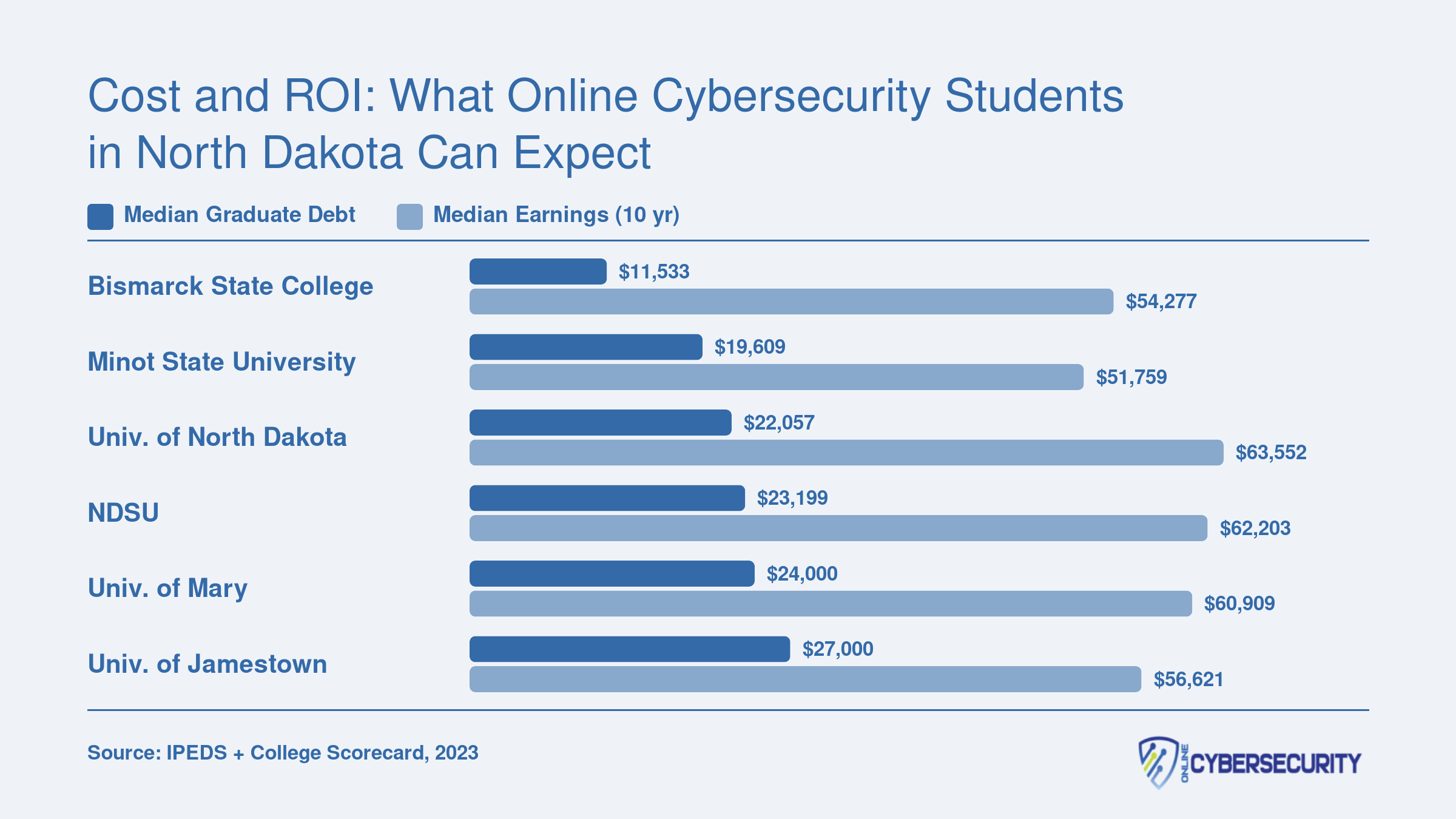
- Bismarck State College stands out for low median graduate debt relative to strong ten-year earnings among completers.
- SARA reciprocity and regional tuition agreements can cut online degree costs significantly for North Dakota residents.
- Bootcamps and certificate programs offer a faster entry point, often in under six months, for career changers.
North Dakota's combination of military installations, energy infrastructure, and a growing health-care network creates steady demand for cybersecurity professionals, yet the state produces far fewer qualified graduates than open positions require. For residents weighing an online degree, the practical challenge is balancing cost against program quality: in-state tuition for a cybersecurity bachelor's can start below $5,300 per year at a public college like Bismarck State, while a private option such as the University of Mary runs closer to $22,400.
One advantage unique to North Dakota students is access to tuition reciprocity agreements that can make out-of-state online programs nearly as affordable as in-state options. That flexibility matters, because the state's own institutions range from ABET-accredited master's programs to 12-credit graduate certificates, and no single school covers every specialization a career changer might need. If you are exploring what a cybersecurity degree program typically involves, that context can help you evaluate which North Dakota options align with your goals.
Best Online Cybersecurity Programs for North Dakota Students
The programs below are ranked using a composite that weighs online and hybrid delivery flexibility alongside institutional quality indicators such as graduation rates, net price, and post-graduation earnings. Because cybersecurity is a field where hands-on labs and real-world simulations matter as much as theory, we also factored in curriculum depth, industry-certification alignment, and stackable credential options. Program-level earnings data is not yet available for any of these schools, so the institutional median earnings figure is provided for broader context.
- Online delivery flexibility
- Institutional graduation rate
- Net price and affordability
- Post-graduation earnings context
- Curriculum depth and certifications
- College Scorecard graduate earnings — collegescorecard.ed.gov
- Independent program research
- Internal program database
- NCES-IPEDS federal institutional data — nces.ed.gov
- #1
University of North Dakota
Grand Forks, ND · $19,000/yr
Best for: Working professionals pursuing a graduate credential
The University of North Dakota is North Dakota's public flagship for graduate-level cybersecurity education, offering an ABET-accredited online Master of Science with three concentration tracks and a stackable graduate certificate. UND holds a National Center of Academic Excellence in Cyber Defense designation and maintains strong ties to state agencies and defense-sector employers in the Upper Midwest. Its 84% retention rate and school-wide graduation rate of roughly 61% reflect solid institutional support, and the university extends reciprocity-friendly online tuition that keeps costs predictable for out-of-state learners.
View 2 programs
- 36-credit, fully online program completable in about two years
- Three concentrations: Cyber Security Analyst, Ethical Hacking, Computer Forensics
- ABET-accredited with NSA CAE-CD designation
- No GRE or GMAT required for admission
- Coursework aligned with Security+, CEH, and OSCP prep
- Asynchronous classes with fall, spring, and summer start dates
- In-state tuition approximately $13,677; out-of-state approximately $19,658
- 9-credit stackable certificate completable in roughly one year
- Covers vulnerability assessment, threat analysis, and human factors
- Fully online with no campus visits required
- Credits apply directly toward the full MS degree
- Aligned with industry certification objectives
- Ideal on-ramp for ND professionals needing quick upskilling
- #2
Bismarck State College
Bismarck, ND · $10,000 – $15,000/yr
Best for: Career changers with an existing associate degree
Bismarck State College delivers one of the most affordable bachelor's-level cybersecurity pathways in the state through its Bachelor of Applied Science in Cybersecurity and Information Technology. The program is designed as a completion degree for students with an associate's credential, and BSC accepts a generous transfer-credit block from North Dakota University System schools and recognized industry certifications. With a net price near $10,270 and a 13-to-1 student-faculty ratio, BSC combines low cost with accessible, individualized instruction. The school's connection to North Dakota's energy sector adds real-world relevance for students interested in critical-infrastructure security.
View program
- Hybrid delivery with online, remote synchronous, and on-campus options
- Designed for AAS/AS holders seeking a bachelor's completion path
- Covers firewall implementation, cloud computing, and incident response
- Internship and cooperative education opportunities built into curriculum
- In-state tuition approximately $5,247; out-of-state approximately $7,331
- Accepts credit for CompTIA, Cisco, and other industry certifications
- Prepares graduates for SOC analyst and network administrator roles
- #3
University of Mary
Bismarck, ND · ~$18,000/yr (est.)
Best for: Adult learners valuing vendor certification training
The University of Mary, a private institution in Bismarck, pairs its NSA CAE-CD designation (valid through 2030) with an online Bachelor of Science in Cybersecurity Administration priced at $510 per credit. The program integrates hands-on labs and no-cost training materials from partners including Cisco, CompTIA, AWS, Palo Alto Networks, Microsoft, and Splunk, giving students direct exposure to the platforms used by regional employers. With a school-wide graduation rate of about 67% and an 84% retention rate, UMary demonstrates strong student support, and its stackable certificate structure lets learners earn micro-credentials on the way to a full degree.
View program
- Fully online with accelerated terms for working adults
- $510 per credit with no-cost lab materials included
- Completable in as few as 2.5 years with transfer credits
- NSA CAE-CD designated through 2030
- Partnerships with Cisco, CompTIA, AWS, Microsoft, Palo Alto, Splunk
- Stackable certificates: Foundations, Analyst, Systems Admin, Secure Network
- Accepts credit for prior learning and military experience
- Net price approximately $17,770 after typical institutional aid
- #4
North Dakota State University
Fargo, ND · $16,000/yr
North Dakota State University in Fargo offers a compact Graduate Certificate in Cybersecurity built around 12 credits of core and elective coursework in network security, ethical hacking, and computer crime. Available in online or hybrid formats, the certificate is designed as a fast-track upskilling option for IT professionals and can feed into longer NDSU graduate programs. The school's overall graduation rate of roughly 64% is among the highest in the state, and its deep connections to Fargo's finance, agribusiness, and healthcare employers give certificate holders a clear pipeline to local hiring.
View program
- 12-credit program available fully online or hybrid
- Three required core courses plus one elective
- Covers network security, ethical hacking, and computer crime
- Credits may apply toward related NDSU graduate degrees
- Evening and hybrid scheduling suited to full-time workers
- In-state tuition approximately $8,786; out-of-state approximately $12,578
- Supported by NDSU Distance and Continuing Education services
- #5
Minot State University
Minot, ND · $13,000/yr (net price)
Minot State University's Bachelor of Science in Cybersecurity and Operations is a 121-credit program that blends theoretical foundations with hands-on training in ethical hacking, mobile security, and wireless network defense. As a member of the North Dakota University System, MSU charges the same tuition rate to in-state and out-of-state students (approximately $8,702), making it one of the more uniformly affordable options in the region. The school's 11-to-1 student-faculty ratio is the smallest on this list, giving students more direct access to instructors. Some courses are available in hybrid and online formats, though learners should confirm delivery options each semester.
View program
- 121-credit comprehensive bachelor's degree
- Hands-on labs in ethical hacking and penetration testing
- Covers network, mobile, and wireless security domains
- Uniform tuition of approximately $8,702 regardless of residency
- 11-to-1 student-faculty ratio for personalized instruction
- Hybrid and online course sections available
- #6
University of Jamestown
Jamestown, ND · $15,000 – $20,000/yr
The University of Jamestown's online Cybersecurity Fundamentals Certificate is a four-course, 12-credit program geared toward career changers who want a structured entry point into the field without committing to a full degree right away. Coursework targets CompTIA Security+ preparation and covers networking, cybersecurity principles, security policies, and network security. Credits can transfer toward a bachelor's degree at Jamestown or other institutions, and the 24/7 online access model is especially practical for rural North Dakota residents or those on nontraditional work schedules.
View program
- 12-credit, fully online certificate with 24/7 course access
- Four courses: Networking, Cybersecurity, Security Policies, Network Security
- Prepares students for CompTIA Security+ certification
- Credits transferable toward a bachelor's degree
- Career support including resume and interview preparation
- Financial aid available for online students
- Virtual group meetings with live or replay attendance options
How We Ranked These Programs
Transparency matters when you are making a decision as significant as where to earn your cybersecurity degree. Many listicles you will find online offer little or no explanation for why one school appears above another, leaving you to wonder whether rankings reflect genuine quality or paid placements. We take a different approach.
Our Composite Ranking Method
Every program in our list is scored using a composite method that weighs multiple quality indicators rather than relying on a single metric. Schools offering a fully online or primarily online delivery format receive an additional boost in our scoring, because flexibility is a top priority for the career changers and working professionals who make up a large share of our readers. Beyond that online-delivery factor, the composite score draws on graduation rates, net price (what students actually pay after financial aid), program-level earnings after graduation, and student debt levels at completion. We apply this same methodology across all of our state guides as well as our national list of best online cybersecurity programs.
Why Some Metrics Are Institution-Wide
A few of the indicators we use, such as graduation rate and net price, reflect the institution as a whole rather than a single cybersecurity program. That is worth knowing. Program-specific versions of these figures are not consistently published across all schools. Even so, institution-wide graduation rates tell you a lot about how well a college supports its students through to completion, and net price signals overall affordability, both of which directly affect your experience regardless of major. Where program-level data is available, particularly for earnings and debt, we incorporate it to sharpen the picture.
Verifiable Federal Data
Our rankings are grounded in publicly available federal datasets, primarily the College Scorecard and the Integrated Postsecondary Education Data System. These are maintained by the U.S. Department of Education and updated on a regular cycle, so anyone can look up the underlying numbers independently. We chose these sources specifically because they are standardized, audited, and free from institutional self-reporting bias.
What This Means for You
The goal is not to hand you a mysterious "best of" list. It is to give you a defensible starting point so you can layer on your own priorities, whether that is cost, schedule flexibility, or proximity to North Dakota employers in energy, agriculture technology, or government. Use the ranking as a launchpad, then dig deeper into the programs that catch your eye.
Questions to Ask Yourself
Cost and ROI: What Online Cybersecurity Students in North Dakota Can Expect
When weighing cybersecurity programs in North Dakota, the gap between what you borrow and what you earn tells the real story. The chart below compares each school's median graduate debt against median earnings ten years after enrollment. Bismarck State College stands out as the clear high-ROI option: its graduates carry the lowest median debt (roughly $11,533) while still earning over $54,000 a decade out. Keep in mind that the net price figures shown are institution-wide averages after financial aid, not program-specific guarantees, so your actual cost may differ based on credits transferred, residency status, and aid eligibility.
Online vs. On-Campus Cybersecurity Degrees in North Dakota
North Dakota has a relatively small number of campus-only cybersecurity programs, which makes online delivery the practical choice for most residents. Whether you are a working adult, active-duty military member, or a traditional student in a rural part of the state, understanding the differences between online and on-campus formats will help you pick the path that fits your life. Here is a balanced look at each option, along with a few delivery details that matter more than you might expect.
Pros
- Asynchronous flexibility lets working adults and military personnel study on their own schedule, as programs like UND's online cybersecurity bachelor's and Williston State's AAS allow.
- North Dakota's participation in regional reciprocity agreements gives residents access to out-of-state programs, such as American Military University's fully asynchronous cybersecurity degree, often at reduced tuition.
- Online programs frequently carry a lower effective cost because students avoid room, board, and commuting expenses common with on-campus attendance.
- The Dakota Digital Academy pools courses across multiple North Dakota University System campuses, expanding online course options beyond what any single school offers.
- Virtual and remote lab environments, like those offered through the NDSCS IT Forensics and Cybersecurity Certificate, let students practice hands-on skills from home.
- On-campus programs provide direct access to physical labs and equipment, which can deepen experience with hardware-level security tasks.
- In-person networking, career fairs, and face-to-face mentorship at schools like NDSU give on-campus students a built-in professional community.
- A structured, in-person class schedule can benefit traditional students who thrive with routine and real-time interaction with instructors.
Cons
- Some online programs still require synchronous sessions; NDSU's cybersecurity bachelor's, for example, includes mandatory live class meetings that limit scheduling freedom.
- Proctored exams are common across online options, including UND's bachelor's program and Dakota Digital Academy courses, meaning you will need a webcam setup or testing center access.
- Hybrid requirements, such as those in the NDSCS certificate, may occasionally pull fully remote students to campus or a partner site for specific lab components.
- On-campus options in North Dakota are limited to a handful of institutions, restricting choices for students who strongly prefer face-to-face learning.
- Bootcamp-style offerings like the UND Cybersecurity Bootcamp require synchronous participation, which can conflict with shift work or military deployment schedules.
- On-campus attendance ties students to a single geographic location, a real drawback in a large, sparsely populated state where the nearest university may be hours away.
Admissions, Transfer Credits, and Tuition Discounts for ND Residents
North Dakota residents have several paths to reduce the cost of an online cybersecurity degree, whether they stay in-state or enroll at a partner institution in another state. Understanding the tuition reciprocity programs, transfer credit policies, and military benefits available to you can save thousands of dollars over the course of a degree.
Tuition Reciprocity: MHEC and WUE
North Dakota participates in two major regional tuition exchange programs that can dramatically lower out-of-state costs.1
- Midwest Student Exchange Program (MSEP): Administered by the Midwest Higher Education Compact, MSEP caps tuition at 150% of the host school's in-state rate for eligible students from member states.2 If you find a cybersecurity program at a participating institution in Minnesota, Wisconsin, or another MHEC state, this discount can be substantial compared to full non-resident pricing.
- Western Undergraduate Exchange (WUE): Through the Western Interstate Commission for Higher Education (WICHE), North Dakota undergraduates can enroll at participating schools in western states at no more than 150% of resident tuition.3 Graduate students may also benefit through the Western Regional Graduate Program, which can offer resident-rate tuition for select programs.
The North Dakota University System administers these exchange agreements, so start there when confirming which specific cybersecurity programs qualify.1 Keep in mind that not every online program at a partner school participates in reciprocity. Some institutions, like the University of North Dakota, use a flat per-credit online tuition model that applies to all students regardless of residency, which can sometimes be competitive with reciprocity pricing.4 If you are comparing costs across multiple states and programs, our guide to affordable cybersecurity programs is a helpful starting point.
North Dakota is also a member of the State Authorization Reciprocity Agreement (SARA), which means accredited out-of-state schools authorized under SARA can legally offer online programs to ND residents without additional state approval.5 This expands your options considerably.
Transfer Credits for Working Adults
Most online cybersecurity bachelor's programs accept 60 to 90 transfer credits from regionally accredited community colleges and four-year institutions. If you have completed an associate degree or accumulated college credits while working, you can often enter a program at junior standing. A few practical tips:
- Request an unofficial transcript evaluation before you apply. Many schools offer this at no cost and will tell you how many credits will transfer.
- General education courses transfer most reliably. Technical courses in networking, operating systems, or programming also tend to transfer well into cybersecurity curricula, though this varies by institution.
- Some programs award credit for industry certifications like CompTIA Security+ or CCNA, potentially shaving additional courses off your plan.
For a broader look at bachelor's-level options that accept generous transfer credit, see our ranking of the best online bachelor's degrees in cybersecurity.
Military Tuition Assistance
North Dakota is home to significant military installations, including Grand Forks Air Force Base and Minot Air Force Base. Active-duty service members stationed at these bases can use Department of Defense Tuition Assistance (TA), which typically covers up to $250 per credit hour and $4,500 per fiscal year. Many online cybersecurity programs are structured to align with TA benefit caps, and schools that hold designation as a Military Friendly institution often have dedicated advisors to streamline the process. Veterans can layer GI Bill benefits on top of or instead of TA, and some schools offer additional military tuition discounts that further reduce out-of-pocket costs.
State Scholarships and Workforce Development
North Dakota does not currently have a widely publicized, state-funded scholarship dedicated exclusively to cybersecurity students. However, the North Dakota University System and the ND Department of Commerce periodically fund workforce development initiatives in technology fields. It is worth checking with your intended school's financial aid office and monitoring state workforce programs, as grant opportunities in high-demand fields like cybersecurity can emerge through legislative or agency action. General state financial aid, including the ND Academic Scholarship and need-based grants, may also apply to online degree seekers who meet eligibility requirements.
Taking the time to explore these options before you enroll can meaningfully reduce your total cost and set you up for a stronger return on your education investment.
Related Articles
Cybersecurity Bootcamps and Certificates in North Dakota
Not every cybersecurity career path requires four years of coursework. If you already hold a bachelor's degree in another field, or you simply need to break into the industry fast, a bootcamp or standalone certificate can be the most direct route. Here is how these shorter options compare to a full degree, and what North Dakota learners should know heading into 2026.
UND Cybersecurity Bootcamps
The University of North Dakota partners with two bootcamp providers, both delivered 100 percent online.
- QuickStart track: An 18-week, part-time program that blends asynchronous coursework with live class sessions twice per week. Tuition is roughly $8,700 for the 18-week option, with a prepay discount available. A shorter 10-week option also exists for learners who can commit more hours per week.1
- StackRoute track: A flexible, fully online bootcamp that includes career development coaching and soft-skills training alongside technical instruction. Multiple tracks are offered (cybersecurity, cloud systems administration, and others), and scholarships or financial assistance may be available.2
Neither bootcamp explicitly names specific industry certifications in its published materials, though both note that students prepare for credentials relevant to their chosen track. If earning a particular certification matters to you, ask the admissions team exactly which exam objectives the curriculum covers before you enroll.
Bootcamp vs. Bachelor's Degree: A Quick Comparison
- Duration: Bootcamps typically run 10 to 26 weeks. A bachelor's degree takes roughly four years full-time, or two to three years if you transfer credits.
- Cost: Bootcamp tuition in the UND ecosystem starts around $8,700. A four-year online degree can range from $30,000 to $60,000 or more, depending on the institution and residency status.
- Credential earned: Bootcamps award a certificate of completion. Degree programs confer a bachelor's (B.S.) that carries broader recognition with hiring managers and is often required for management-track roles.
- Career outcome: Bootcamp graduates typically land entry-level analyst or SOC positions. Degree holders have a wider runway into roles such as security engineer, penetration tester, or eventually CISO.
- Employer recognition: Many employers accept bootcamp credentials for junior roles, but federal contractors and larger enterprises often list a bachelor's as a baseline requirement.
When a Bootcamp Makes Sense
A bootcamp is ideal when you already have a bachelor's degree in an unrelated field and want a quick pivot, when you need to start earning in cybersecurity within six months, or when you plan to stack the bootcamp with an industry certification like CompTIA Security+ to strengthen your resume. Career changers coming from IT help-desk or networking roles often find that a bootcamp fills specific knowledge gaps without redundant coursework. For a broader look at program options nationwide, see our guide to the best cybersecurity bootcamp online programs.
When a Degree Is the Better Investment
If you have no prior degree, pursuing a bachelor's gives you both the cybersecurity skill set and the general credential that opens doors across industries. It also matters if you are targeting management, government, or Department of Defense positions where education requirements are rigid. Several online degree programs accessible to North Dakota students weave certification prep into their curricula, covering exam objectives for CompTIA Security+, Certified Ethical Hacker (CEH), or CISSP foundations, so you can graduate with both a diploma and one or more industry certifications in hand.
Certifications to Keep on Your Radar
Regardless of which path you choose, industry certifications remain the currency of cybersecurity hiring. If you are considering a standalone credential, our roundup of best online cyber security certificate programs can help you compare options.
- CompTIA Security+: The most common entry-level cert, frequently embedded in both bootcamp and degree curricula.
- CEH (Certified Ethical Hacker): Often included in upper-level degree coursework; less common in shorter bootcamps.
- CISSP: Requires five years of professional experience to fully certify, so degree programs may offer prep coursework while the actual credential comes later in your career.
The bottom line: bootcamps and certificates are powerful accelerators, especially when paired with existing education or experience. A degree is the safer long-term play if you are building your career from scratch. Many learners end up doing both, starting with a bootcamp for immediate employment and completing a degree part-time once they are working in the field.
Cybersecurity Job Market in North Dakota
North Dakota may be a smaller state, but its cybersecurity job market punches above its weight thanks to a concentration of military installations, energy infrastructure, and health systems that all depend on robust digital defense. If you are earning an online cybersecurity degree and planning to work in ND, here is what the employment landscape looks like heading into 2026.
National Demand Sets the Baseline
Information security analysts are among the fastest-growing occupations in the country. Nationally, the field is projected to grow about 29 percent between 2024 and 2034, with roughly 52,100 openings expected each year.1 The national median annual wage sits around $112,000.2 North Dakota's cost of living is well below the national average, so local salaries may be somewhat lower in dollar terms, but purchasing power can be comparable or even favorable. For the most current state-level numbers, check the Bureau of Labor Statistics Occupational Employment and Wage Statistics page for North Dakota, which is updated periodically. Our broader cybersecurity career guide breaks down what each role typically pays and what credentials employers expect.
Who Is Hiring in North Dakota
Several sectors drive cybersecurity demand across the state:
- Energy companies: Organizations like MDU Resources and Basin Electric Power Cooperative manage critical infrastructure that requires constant threat monitoring, vulnerability management, and compliance with federal cybersecurity regulations.
- Health systems: Sanford Health and CHI St. Alexius handle enormous volumes of protected health information. HIPAA compliance, electronic health record security, and incident response create ongoing need for trained analysts.
- Military installations: Grand Forks Air Force Base and Minot Air Force Base support defense and intelligence missions that rely heavily on cybersecurity professionals, both uniformed and civilian. Contractor roles at these bases are a significant source of employment.
- State government and higher education: The North Dakota Information Technology Department and universities such as NDSU and UND maintain large networks and research environments that need dedicated security teams.
The North Dakota Department of Commerce also publishes workforce reports that can help you identify which regions and industries are actively recruiting.
Building Your Network Before You Graduate
Don't wait until diploma day to start making connections. Professional organizations like (ISC)² and CompTIA maintain local chapters and online communities where North Dakota practitioners share job leads and salary insights. NDSU's and UND's cybersecurity programs frequently host guest speakers from regional employers and can connect you with internship pipelines. If you need to enter the workforce quickly, a fastest online cyber security degree can accelerate your timeline without sacrificing credential quality. LinkedIn searches filtered to Fargo, Bismarck, Grand Forks, and Minot will reveal which companies are posting security roles most frequently.
The bottom line: North Dakota's mix of defense, energy, healthcare, and government employers means there is real, sustained demand for cybersecurity talent. Pairing an online degree with local networking puts you in a strong position to land a role without relocating to a coastal tech hub.
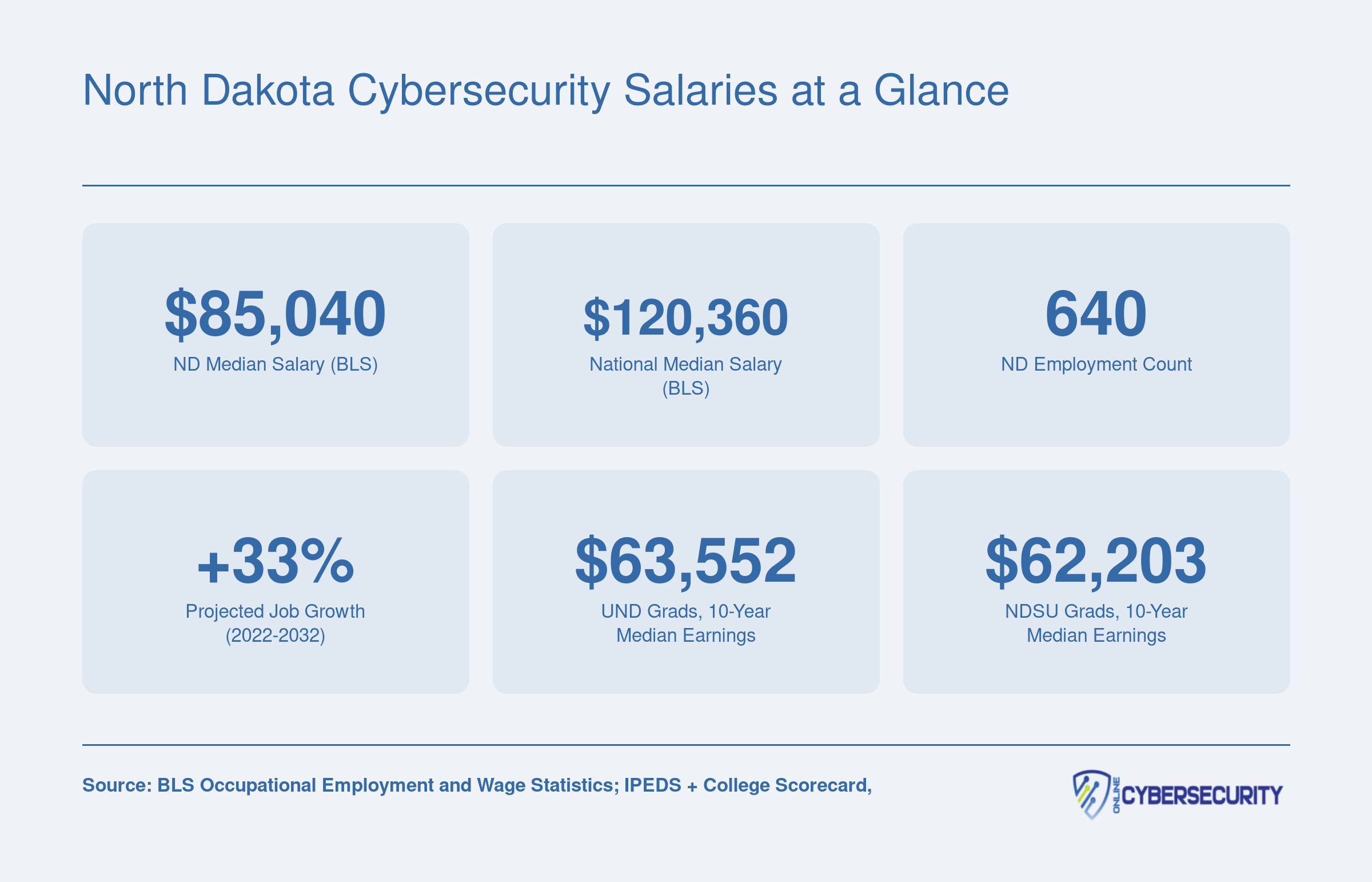
North Dakota Cybersecurity Salaries at a Glance
North Dakota offers cybersecurity professionals competitive pay that stretches further thanks to the state's low cost of living. Here's how the numbers break down for information security analysts in the state compared to the national picture, along with what graduates from top-ranked North Dakota programs typically earn.
Frequently Asked Questions About Online Cybersecurity Degrees in North Dakota
Below are the questions we hear most often from prospective cybersecurity students in North Dakota. Each answer draws on program details, cost data, and labor market information covered earlier in this guide.