
What you’ll learn in this article…
- Ohio offers 13 ranked online cybersecurity programs in 2026, spanning bachelor's through doctoral levels.
- Several Ohio schools hold NSA/DHS CAE designation, a key quality benchmark for cybersecurity curricula.
- Choose Ohio First awards reach $5,500 at participating schools, and CyberCorps covers full tuition plus a stipend.
- Shorter pathways like certificates, bootcamps, and associate degrees provide faster entry into Ohio's growing cyber workforce.
Ohio's cybersecurity labor market runs deeper than many candidates realize. Wright-Patterson Air Force Base employs thousands of cyber and intelligence professionals in the Dayton corridor, JPMorgan Chase maintains major security operations out of Columbus, and Cleveland Clinic continues to expand its health-system cybersecurity teams. That demand filters directly into the state's higher-education pipeline: 13 Ohio schools now offer ranked online or hybrid cybersecurity programs spanning bachelor's and master's levels, with total program costs ranging from roughly $12,000 to over $33,000.
The real tension for Ohio learners is matching format, price, and credential depth to career goals. A CAE-designated bachelor's program and a 12-month online master's serve very different audiences, even when both carry the "cybersecurity" label. Below, we break down rankings, tuition comparisons, transfer pathways, career outcomes, and financial aid options so you can find the right fit.
Best Online Cybersecurity Programs in Ohio: 2026 Rankings
Ohio is home to a growing roster of online and hybrid cybersecurity programs that span bachelor's, master's, and graduate certificate levels. The 2026 rankings below order these online-delivery-eligible programs by a composite quality measure that weighs factors such as delivery format flexibility, institution-wide graduation outcomes, and cost indicators. Whether you are a career changer eyeing a first bachelor's degree or an IT professional ready for a graduate credential, this list highlights what each Ohio school brings to the table.
- Online or hybrid delivery format
- Institution-wide graduation rate
- Net price and cost indicators
- Program depth and accreditation
- Student support and flexibility
- College Scorecard graduate earnings — collegescorecard.ed.gov
- NCES-IPEDS federal institutional data — nces.ed.gov
- Independent program research
- Internal program database
- #1
University of Cincinnati
Cincinnati, OH · $26,000/yr
Best for: Hands-on learners wanting co-op experience
The University of Cincinnati anchors Ohio's cybersecurity education landscape with multiple ABET-accredited bachelor's programs, five semesters of paid cooperative education, and deep ties to the Ohio Cyber Range Institute. Schools offering these programs have an institution-wide graduation rate of about 75%, and the net price sits near $25,648 after aid. UC's co-op model means students graduate with more than a year of real-world security experience, and its hybrid delivery makes coursework accessible to learners across the state.
View 3 programs
- ABET-accredited program with on-campus and online options
- Five semesters of paid cooperative education built in
- Covers digital forensics, incident response, and risk management
- Senior design project caps the curriculum
- Center of Academic Excellence (CAE) designation
- Requires 2.75 GPA for freshmen and transfer admission
- Ohio Cyber Range Institute resources integrated into labs
- Engineering-focused degree in the College of Engineering
- Concentration in cyber-attack and defense strategies
- Integrates science and engineering coursework
- Co-op program with rolling application deadlines
- Trains critical thinking through vulnerability testing
- Prepares for roles like penetration tester or threat analyst
- Concentration in network and data security
- Covers malware reverse engineering and secure system design
- Industry partnerships inform the curriculum
- Undergraduate research and certificate options available
- Scholarship deadline of November 1 for early applicants
- Career paths include security architect and intelligence analyst
- #2
Cedarville University
Cedarville, OH · ~$24,000/yr (est.)
Best for: Working professionals seeking leadership credentials
Cedarville University offers a fully online MBA in Cybersecurity Management and a companion graduate certificate, both built for working professionals. With seven-week course terms, six annual start dates, and one- or two-year completion tracks, the program is designed around busy schedules. Schools offering these programs post an institution-wide graduation rate of roughly 73%, and the net price averages $24,468. The curriculum is ACBSP-accredited and integrates a biblical worldview alongside enterprise security architecture and cyber law.
View 2 programs
- Fully online with seven-week accelerated terms
- ACBSP-accredited graduate business program
- Four dedicated cybersecurity courses in the plan
- Covers cybersecurity law, risk management, and enterprise architecture
- One-year or two-year completion tracks available
- Six start dates per year with rolling admissions
- Cohort-based model with a dedicated program adviser
- Fully online, completed in two semesters
- Four courses drawn from the MBA cyber concentration
- Stackable into the full MBA if desired later
- Focus on security laws, risk, and enterprise architecture
- Real-world case studies in every course
- Flexible for Ohio professionals needing rapid upskilling
- #3
The University of Findlay
Findlay, OH · $25,000 – $30,000/yr
Best for: Analytics-minded students in STEM fields
The University of Findlay pairs cybersecurity with big data analytics in its Master of Science in Applied Security and Analytics, available online and on campus. The two-year program blends secure coding, data mining, and leadership skills, and it carries Professional Science Master's affiliation. Schools offering this program have an institution-wide graduation rate near 58%, with a net price around $27,221. Choose Ohio First scholarship eligibility can help Ohio residents reduce out-of-pocket costs.
View program
- Two-year program with fall and spring start options
- Online and on-campus delivery available
- Courses in secure coding, predictive analysis, and data mining
- Professional Science Master's affiliation for industry engagement
- Choose Ohio First scholarship eligible for Ohio residents
- Federal Stafford loans up to $20,500 annually
- Applied projects with Ohio companies replace purely academic capstones
- Leadership and project management woven into coursework
- #4
Tiffin University
Tiffin, OH · $27,000/yr
Tiffin University holds a DHS/NSA Center of Academic Excellence designation and offers both a fully online Master of Science in Cyber Security and an online Bachelor of Science in Cybersecurity. The master's program can be completed in as few as 12 months, while the bachelor's runs about 48 months with classes starting six times per year. Schools offering these programs have an institution-wide graduation rate of about 40%, and the net price is roughly $26,500. Tiffin's Center for Cyber Defense and Forensics extends virtual lab access to remote learners.
View 2 programs
- Fully online, 30-credit program completable in 12 months
- Monthly tuition of $1,875 with six annual start dates
- Capstone project applying skills to real-world challenges
- Coursework includes AI, governance, risk, and compliance
- Hands-on experience with current security tools
- Bachelor's degree required for admission
- Online delivery with classes starting six times per year
- DHS/NSA Center of Academic Excellence designation
- 150-hour internship embedded in the curriculum
- Covers ethical hacking, penetration testing, and incident response
- Prepares students for industry certifications like Security+
- Monthly payment option of $1,312 over 48 months
- Faculty with extensive professional cybersecurity backgrounds
- #5
Miami University
Oxford, OH · $18,000 – $41,000/yr
Miami University's fully online Bachelor of Science in Cybersecurity and Networking is delivered through its Regionals campus and features formal 2+2 transfer pathways with several Ohio community colleges. The 96-credit-hour program can be finished in three to four years at roughly $350 per credit hour for Ohio residents. Schools offering this program boast a strong institution-wide graduation rate near 80%, and the net price is approximately $28,384. Capstone projects are frequently sourced from Cincinnati and Dayton employers.
View program
- 100% online delivery with flexible pacing
- 96 credit hours required for completion
- Approximately $350 per credit hour for Ohio residents
- State-of-the-art red-team and blue-team simulations
- Transfer-friendly with pre-articulated Ohio community college pathways
- Real-world capstone course involving regional employers
- Military and veteran tuition benefits accepted
- Academic and technical support included for online students
- #6
University of Toledo
Toledo, OH · $13,000 – $22,000/yr
The University of Toledo houses its Master of Science in Cyber Security within the College of Engineering and offers research and professional capstone tracks. Students choose among a thesis, project, or experiential learning option, giving them flexibility to match career goals. The institution-wide graduation rate for schools offering this program is about 57%, and the net price is one of the lowest on this list at roughly $17,249. Toledo's Cyber Range immersive game now features Ohio-based infrastructure scenarios.
View program
- 30 credit hours with research or professional track
- Three capstone options: thesis, project, or experiential learning
- Fall or spring start with no hard application deadline
- Electives available through the Law and Business colleges
- Cyber Range immersive game with Ohio infrastructure scenarios
- Faculty are active researchers in security and forensics
- Foundational courses offered for non-CS backgrounds
- Flexible part-time scheduling for working Ohio professionals
- #7
Mount Vernon Nazarene University
Mount Vernon, OH · $22,000/yr
Mount Vernon Nazarene University delivers a STEM-designated Bachelor of Science in Management Information Systems with a Cybersecurity concentration entirely online. The 120-credit-hour program takes about 40 months and costs $450 per credit hour before a built-in $125 per credit hour scholarship. Schools offering this program carry an institution-wide graduation rate near 68%, and the net price averages $22,421. The curriculum is enriched through AWS Academy partnerships, aligning coursework with in-demand cloud certifications.
View program
- Fully online with STEM designation
- 120 credit hours over approximately 40 months
- $450 per credit hour with $125 scholarship applied
- AWS Academy-enriched curriculum aligned to certifications
- Courses in ethical hacking, cryptography, and incident response
- Hands-on labs using Kali Linux and Metasploit
- Transfer pathways for Ohio community college graduates
- Textbooks embedded in course fees to simplify costs
- #8
Ashland University
Ashland, OH · ~$22,000/yr (est.)
Ashland University's Bachelor of Science in Cybersecurity emphasizes personal attention from faculty and access to state-of-the-art computer labs, including Jones and Bartlett virtual lab environments. The 120-credit-hour program blends in-person and hybrid components, and the school participates in Choose Ohio First and Dean's Scholarship programs. Schools offering this program have an institution-wide graduation rate of about 61%, and the net price comes in near $21,988. Internship and competition opportunities connect students with employers in Cleveland, Columbus, and Akron.
View program
- 120 credit hours with hybrid delivery components
- Small class sizes with personalized professor attention
- Jones and Bartlett virtual lab environments
- Cybersecurity competitions integrated into the experience
- Internship placements across Northeast and Central Ohio
- Choose Ohio First and Dean's Scholarship eligibility
- Four-year curriculum guide provided at admission
- #9
Wright State University
Dayton, OH · $15,000/yr
Wright State University sits near Wright-Patterson Air Force Base, and its Master of Science in Cyber Security and companion graduate certificate draw on Dayton's defense ecosystem. The 30-credit-hour master's program offers a CyberDefense concentration with project or thesis options, accessible through hybrid and online coursework. Schools offering these programs have an institution-wide graduation rate near 42%, and the net price is among the most affordable at roughly $15,415. The Virtual Cyber Security Lab supports remote learners across Ohio.
View 2 programs
- 30 semester hours with project or thesis option
- CyberDefense concentration tied to defense sector needs
- Virtual Cyber Security Lab available to remote students
- Must be completed within six years
- 3.0 GPA and computer science background expected
- Fall deadline March 1, spring deadline October 10
- Research collaboration with Ohio aerospace and defense firms
- Four core courses drawn from the MS program
- Online and in-class delivery options
- Stackable pathway into the full master's degree
- Builds technical foundation for mitigating cyber risks
- BS in computer science or related field required
- 3.0 minimum GPA for admission
- #10
Walsh University
North Canton, OH · $20,000/yr (net price)
Walsh University's online Bachelor of Science in Cybersecurity is built for working adults aged 21 and older, with a 12- to 24-month completion window and an average total cost near $18,000. The stackable curriculum lets students earn certificates before committing to the full degree, and transfer coursework with a C- or better is accepted. Schools offering this program have an institution-wide graduation rate near 59%, and the net price is roughly $20,493. Walsh's ties to Northeast Ohio healthcare, manufacturing, and financial employers shape career coaching and placement.
View program
- 100% online with 12- to 24-month completion
- Average total program cost around $18,000
- Stackable certificates roll into the full degree
- Accepts transfer credits with C- or higher
- Covers digital forensics, ethical hacking, and system defense
- Military Friendly designation with tuition deferment options
- Career paths include SOC Analyst and Incident Response Technician
- FAFSA and employer tuition assistance accepted
Ohio Tuition & Cost Comparison for Online Cybersecurity Degrees
The table below compares published tuition rates and estimated net prices for all 13 ranked online cybersecurity programs in Ohio, sorted from lowest to highest estimated net price. Tuition figures are degree-aware: programs listed at the master's level reflect graduate tuition, while bachelor's programs reflect undergraduate tuition. Keep in mind that the net price column is an institution-wide average after financial aid and does not represent a guaranteed quote for every student. Among the most affordable options, Cedarville University and Franklin University stand out for graduate-level tuition under $12,100, while Wright State University offers the lowest estimated net price overall at roughly $15,400, making these three strong picks for anyone searching for high-quality low-cost online cybersecurity degrees in Ohio.
| School | Degree Level | In-State Tuition | Out-of-State Tuition | Avg. Net Price (After Aid) |
|---|---|---|---|---|
| Wright State University | Master's | $15,771 | $25,759 | $15,415 |
| University of Toledo | Master's | $17,605 | $29,426 | $17,249 |
| Walsh University | Bachelor's | $33,030 | $33,030 | $20,493 |
| Ashland University | Bachelor's | $31,210 | $31,210 | $21,988 |
| Mount Vernon Nazarene University | Bachelor's | $27,193 | $27,193 | $22,421 |
| Lourdes University | Bachelor's | $28,370 | $28,370 | $23,206 |
| Wilmington College | Bachelor's | $32,082 | $32,082 | $24,153 |
| Cedarville University | Master's | $11,015 | $11,015 | $24,468 |
| Franklin University | Master's | $12,090 | $12,090 | $25,243 |
| University of Cincinnati | Bachelor's | $13,363 | $28,697 | $25,648 |
| Tiffin University | Master's | $17,000 | $17,000 | $26,500 |
| The University of Findlay | Master's | $18,706 | $18,706 | $27,221 |
| Miami University | Bachelor's | $17,519 | $38,965 | $28,384 |
Questions to Ask Yourself
CAE-Designated Online Cybersecurity Programs in Ohio
If you are comparing online cybersecurity programs in Ohio, one credential you will encounter repeatedly is the NSA/DHS Centers of Academic Excellence (CAE) designation. Understanding what it means, and which Ohio schools hold it, can help you narrow your search with confidence.
What the CAE Designation Actually Means
The CAE program is a partnership between the National Security Agency and the Department of Homeland Security that recognizes colleges and universities meeting rigorous cybersecurity curriculum standards.1 There are three main tracks:
- CAE-CDE (Cyber Defense Education): Validates that a program covers a comprehensive set of defensive cybersecurity knowledge units, from networking fundamentals through incident response.
- CAE-CO (Cyber Operations): A more selective designation focused on deeply technical, offense-oriented curricula. Only a handful of schools nationwide hold this.
- CAE-R (Research): Recognizes institutions with active, funded cybersecurity research programs at the doctoral level.
Why should this matter to you? CAE-designated schools open the door to federal scholarship opportunities such as CyberCorps Scholarship for Service (SFS), which covers tuition in exchange for a government service commitment after graduation. Employers in defense, intelligence, and federal contracting also treat CAE status as a quality signal when screening applicants.
Which Ohio Schools Hold CAE Designations in 2025-2026
As of the current designation cycle, several Ohio institutions carry active CAE status:
- The Ohio State University: Holds CAE-CDE designation through its Computer Science and Engineering department. Ohio State is a research powerhouse, though its cybersecurity coursework is primarily campus-based rather than fully online.
- University of Cincinnati: Also carries CAE-CDE status and offers a Bachelor of Science in Cybersecurity that is available in a hybrid format with online coursework. UC is one of our ranked schools and houses the Ohio Cyber Range Institute.
- Air Force Institute of Technology: Holds CAE-R designation through its Center for Cyberspace Research. Note that AFIT primarily serves military students and does not offer traditional civilian online degree programs.
- Wright State University: Was named a center for cyber defense education in 2020.3 Wright State offers a hybrid Master of Science in Cyber Security with a CyberDefense concentration and appears in our ranked list.
- Sinclair Community College: Carries a CAE two-year (CAE/IAE 2Y) designation for its Information Technology and Cyber Security program, making it one of the few community colleges in Ohio with this recognition.4
In the most recent 2025-2026 cycle, the NSA designated 29 institutions nationally.5 Ohio remains well represented, though students should watch for any changes when the next cycle is announced.
A Key Distinction for Online Learners
CAE designation is granted at the institution level, not to a specific delivery format. That means a university can hold CAE-CDE status for its on-campus program without the online version automatically covering the same knowledge units. Before enrolling, verify directly with the school that the online curriculum you will follow maps to the CAE-designated coursework. Ask the department whether online students have access to the same labs, capstone projects, and faculty who support the CAE program.
Among the Ohio schools in our rankings, the University of Cincinnati and Wright State University are the most straightforward options if you want CAE-aligned coursework with some degree of online flexibility. If you are starting at the associate level, Sinclair Community College offers a strong on-ramp with its own two-year CAE designation, and credits from Sinclair can often transfer into four-year CAE programs within the state. Neighboring states such as Indiana and Kentucky also have best online cybersecurity schools in Indiana worth exploring if you want to compare CAE options across the region.
For the latest list of designated institutions and their specific tracks, the CAE Community institution map is updated each cycle.
Related Articles
Transfer Credit & Flexible Pathways at Ohio Online Cybersecurity Programs
If you are bringing college credits from a community college, a previous university, or military training, Ohio's online cybersecurity programs are generally built to help you finish faster. Understanding how transfer credits work at each school can save you a full year or more of tuition and time.
How Many Credits Can You Transfer?
Most Ohio universities offering online cybersecurity bachelor's degrees accept up to 90 transfer credits toward a 120-credit program, leaving you with roughly 30 credits (about one year of full-time study) to complete in residence. Wright State University, the University of Cincinnati, Ohio University, and Kent State University all follow this 90-credit cap with a 30-credit residency requirement.
Franklin University stands out by accepting up to 94 credits toward its 124-credit bachelor's program, making it one of the most transfer-friendly options in the state.2 For students pursuing an associate's degree, Franklin accepts up to 44 credits toward its 60-credit program. Even at the master's level, Franklin allows up to 12 credits of the 36 required to transfer in. If speed is a priority, our guide to the fastest online cybersecurity degree with transfer credits offers a broader comparison of accelerated options nationwide.
Ohio Guaranteed Transfer Pathways and Community College Articulation
Ohio's Guaranteed Transfer Pathways program, commonly known as OGTP, is a statewide framework that maps coursework completed at Ohio community colleges directly into bachelor's degree programs at public universities. All of the major online cybersecurity programs listed above, including Wright State, University of Cincinnati, Ohio University, Kent State, and Franklin University, participate in OGTP. Community colleges like Cuyahoga Community College (Tri-C) also participate, meaning students who complete an associate's degree or designated pathway courses there can transfer seamlessly into a four-year cybersecurity program without losing credits.3
This is especially valuable for career changers: you can complete your general education and foundational IT coursework affordably at a community college, then transfer directly into an online cybersecurity degree at the bachelor's level.
Military Credit and ACE Evaluations
Given Ohio's large military community, particularly around Wright-Patterson Air Force Base, it is worth noting that every program highlighted here accepts military credit. Schools evaluate Joint Services Transcripts and apply American Council on Education (ACE) credit recommendations toward degree requirements. Wright State, located near the base, has a well-established process for translating military cybersecurity training into academic credit, which can significantly reduce your remaining coursework.
Accelerated and Competency-Based Options
Franklin University is especially known for its accelerated scheduling, offering shorter course terms that let motivated students move through their program faster.2 While fully competency-based cybersecurity degrees remain uncommon across Ohio's public universities, Franklin's flexible structure comes closest by emphasizing prior learning assessment and awarding credit for demonstrated knowledge. If speed and flexibility are priorities, it is worth comparing Franklin's model against more traditional semester-based programs at the other schools.
Cybersecurity Career Outcomes for Ohio Graduates
Choosing a cybersecurity program is ultimately an investment in your future earning power. While program-level earnings data for individual Ohio cybersecurity degrees has not yet been published by federal reporting sources, the broader labor market picture in Ohio is strong enough to give career changers and new graduates real confidence.
What Ohio's Cybersecurity Job Market Looks Like in 2026
Information security analysts across Ohio earn a median annual wage of roughly $107,570.1 That figure sits below the national median of about $124,910, but it goes further in Ohio thanks to the state's lower cost of living.2 In the Cleveland area, the mean annual wage for this role reaches approximately $123,610, pushing much closer to the national average.3
Columbus, Cincinnati, Dayton, and Cleveland each host sizable cybersecurity ecosystems. Major employers hiring across the state include:
- Wright-Patterson Air Force Base (Dayton): One of the largest defense installations in the country, with deep demand for cleared cybersecurity professionals in roles ranging from threat intelligence to secure systems engineering.
- JPMorgan Chase (Columbus): The financial giant's Columbus technology hub employs thousands of IT and security specialists, making it one of the state's top private-sector cyber employers.
- Cleveland Clinic (Cleveland): Healthcare cybersecurity is a fast-growing niche, and this world-renowned hospital system invests heavily in data protection and compliance teams.
- Nationwide (Columbus): The insurance and financial services company maintains a significant security operations presence in its home city.
Nationally, the field is projected to grow 29 percent from 2024 to 2034, with an estimated 16,000 new openings each year.2 Ohio's mix of defense, finance, healthcare, and insurance sectors means the state captures a healthy share of that demand. For a deeper look at the roles driving this growth, our cybersecurity career guide breaks down specializations and typical career paths.
Earnings vs. Debt: The ROI Picture
Granular, program-specific earnings and debt outcomes for Ohio cybersecurity programs are not yet available through federal scorecards. However, a useful proxy comes from looking at institutional-level data alongside tuition costs.
Several of the top-ranked Ohio programs on this site carry total tuition costs well below what a single year of post-graduation earnings can cover. Programs at public universities like the University of Cincinnati (in-state tuition around $13,360) and Wright State University (roughly $15,770) pair relatively modest price tags with access to the Dayton defense corridor and Cincinnati's finance sector. Even private options like Cedarville University's MBA in Cybersecurity Management, listed at about $11,015, position graduates to recover their investment quickly given Ohio's median wages for the field.
Entry-level information security analysts nationally can expect starting salaries in the $60,000 to $85,000 range. For Ohio graduates who keep student debt modest, that starting pay can translate into a strong return on investment within the first few years of employment. To compare tuition and program formats across the country, you can also browse our ranked list of best online cybersecurity programs.
What Graduates Should Watch For
As federal reporting catches up with the growth of cybersecurity degree programs, expect more detailed outcome data to become available in future years. In the meantime, prospective students should:
- Ask admissions offices directly about placement rates and employer partnerships.
- Look for programs with cooperative education or internship components, such as the University of Cincinnati's five-semester co-op requirement, which can lead to job offers before graduation.
- Consider geographic alignment: if you plan to stay in Ohio, programs with strong ties to regional employers in Columbus, Cleveland, or Dayton can give you a meaningful head start in your job search.
The bottom line is that Ohio's cybersecurity labor market is deep, diversified, and growing. Pairing a well-chosen program with the state's employer landscape puts graduates in a strong position to launch or advance a rewarding career.
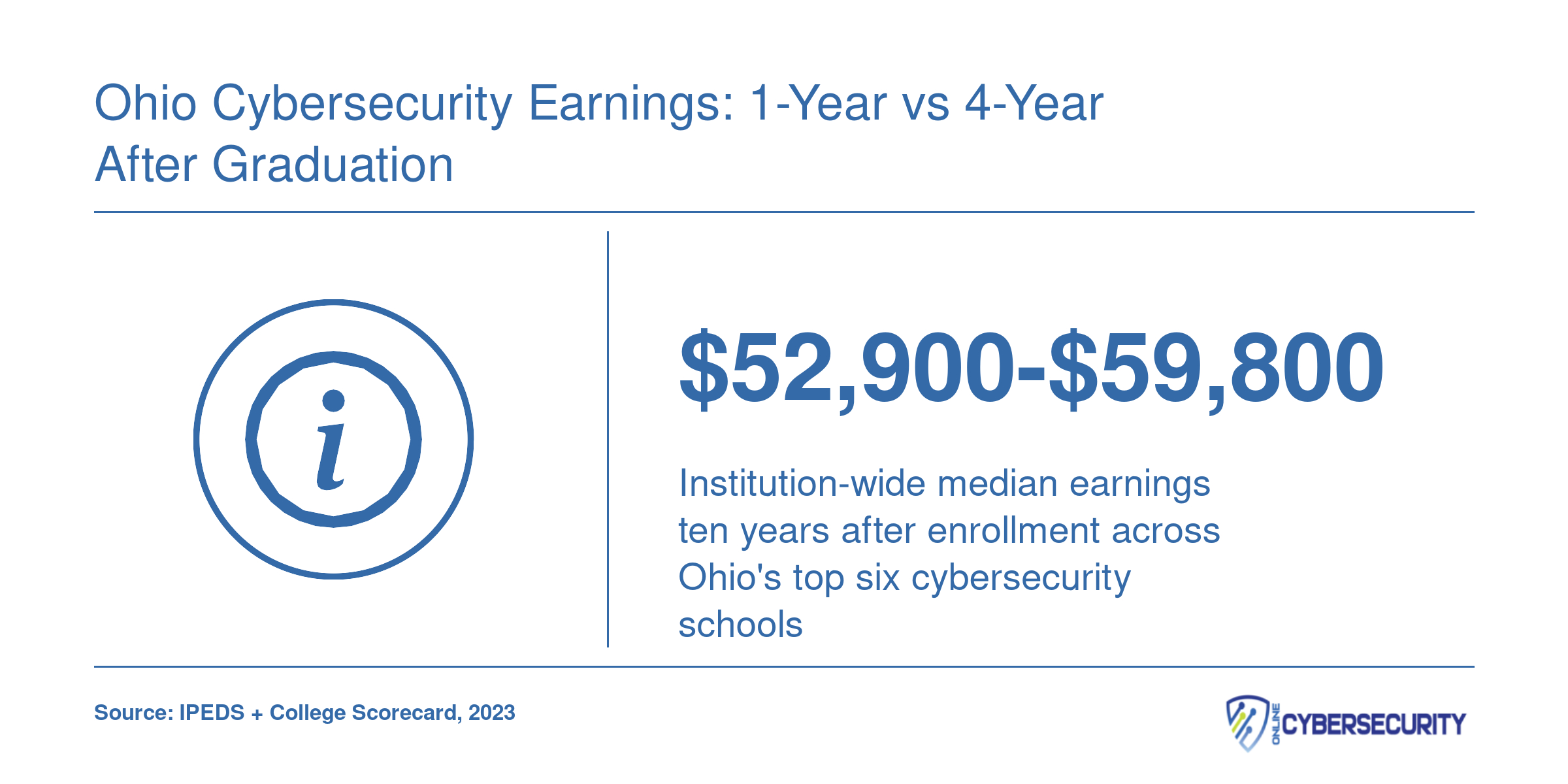
Ohio Cybersecurity Earnings: 1-Year vs 4-Year After Graduation
Program-level median earnings at one year and four years after graduation are not yet available for Ohio's top cybersecurity programs. The College Scorecard has not published these specific outcome figures for the cybersecurity programs at Walsh University, University of Findlay, Cedarville University, Miami University, University of Cincinnati, or Ashland University. Once released, these data points will help illustrate how bachelor's and master's graduates compare in early and mid-career earning power. In the meantime, institution-wide median earnings at ten years after enrollment range from roughly $52,900 (Ashland University) to nearly $59,800 (Walsh University), providing a useful baseline.
Comparing Graduate Degrees: Online Master's and Ph.D. Programs in Ohio
If you already hold a bachelor's degree and want to move into cybersecurity leadership, architecture, or research roles, an online master's program is one of the fastest ways to get there. Ohio has a solid roster of graduate-level options, and understanding how they compare to major national programs can help you spend wisely and advance quickly.
Ohio Master's Programs at a Glance
Six Ohio universities in our rankings offer master's-level cybersecurity degrees, each with a different focus and price point:
- Cedarville University (MBA in Cybersecurity Management): Total program tuition of roughly $11,015, with seven-week terms and a cohort-based format designed for working professionals. The curriculum blends core business coursework with cybersecurity law, enterprise security architecture, and risk management.
- Franklin University (M.S. in Cybersecurity): A 36-credit-hour program at about $12,090 in total tuition. Fully online and offered by a nonprofit institution in Columbus, it covers cryptography, ethical hacking, information assurance, and security governance.
- Wright State University (M.S. in Cyber Security): In-state tuition runs approximately $15,771, with a CyberDefense concentration, a virtual Cyber Security Lab, and the choice of a thesis or project track. Out-of-state students pay around $25,759.
- Tiffin University (M.S. in Cyber Security): A 30-credit, fully online program completable in about 12 months for roughly $17,000. Coursework includes AI and cybersecurity as well as governance and compliance.
- University of Toledo (M.S. in Cyber Security): In-state tuition is about $17,605, with both research and professional tracks and access to a Cyber Range immersive environment. Out-of-state tuition jumps to around $29,426.
- University of Findlay (M.S. in Applied Security and Analytics): Tuition is approximately $18,706, with a hybrid format that combines big data analytics, secure coding, and applied security principles over roughly two years.
How Ohio Programs Compare to National Online Options
Two of the most widely recognized national online master's programs are WGU's M.S. in Cybersecurity and Information Assurance and SNHU's M.S. in Cybersecurity. Here is how they stack up.
WGU charges $4,700 per six-month term, with most students finishing in about 18 months.1 That puts the total cost in the range of $14,100 for a three-term completion, though a $1,500-per-term cybersecurity scholarship can bring it closer to $9,600.2 The program is competency-based and fully asynchronous, and it bundles exam vouchers for several industry certifications, including CompTIA CySA+, PenTest+, CASP+, ISACA CISM, and the ISC2 CC.3 WGU holds a CAE designation, which adds weight if you are pursuing federal or defense-sector roles.
SNHU's M.S. in Cybersecurity is also fully online, with a more traditional term structure. It is widely accessible but does not carry a CAE designation, and it does not bundle certification exam fees the way WGU does.
Ohio programs like Cedarville and Franklin compete strongly on total tuition, coming in below or near WGU's cost. Wright State and Tiffin sit in a similar price band. Where Ohio schools may hold an edge is in specialized tracks (digital forensics at Toledo, analytics at Findlay) and the availability of hybrid or in-person lab access for students who want hands-on immersion beyond a virtual environment.
Focus Areas Across Ohio Graduate Programs
The programs above span several distinct directions within cybersecurity:
- Cybersecurity management and leadership (Cedarville, Tiffin)
- Technical defense and research (Wright State, University of Toledo)
- Applied security analytics and data-driven decision-making (University of Findlay)
- Broad cybersecurity practice with ethical hacking and governance (Franklin University)
This variety means you can align your graduate degree with a specific career trajectory, whether that is a CISO track, a security engineering role, or a position in threat intelligence and analytics. If you want to understand what a cybersecurity degree program typically covers before committing to a master's, reviewing undergraduate coursework structures can provide useful context.
A Note on Earnings Data
Program-level earnings for graduate completers at these Ohio schools are not yet available in published federal datasets. That said, the Bureau of Labor Statistics reports that information security analysts nationally earn a median above $120,000, and master's-level credentials frequently serve as a prerequisite for senior and management positions. Until program-specific salary figures are released, the broader labor market data strongly supports the return on a graduate cybersecurity investment, especially at the tuition levels Ohio schools offer.
If cost is your primary concern, Franklin University and Cedarville University deserve a close look. If you want embedded certifications and a self-paced format, WGU is hard to beat. And if you value research opportunities or hybrid lab access, Wright State and the University of Toledo round out the field nicely. Ohio doctoral programs in cybersecurity are limited in the online space, so students pursuing a Ph.D. should expect to engage with on-campus research components at institutions like Wright State or the University of Cincinnati; you can also explore our guide to online cybersecurity Ph.D. options for a broader view of what is available nationally.
Ohio students have several funding paths worth exploring: the Choose Ohio First STEM scholarship supports eligible cybersecurity majors at participating schools, with awards such as $5,500 at Marietta College for 2026 to 2027. The federal CyberCorps Scholarship for Service program covers tuition and a stipend at CAE designated institutions in exchange for government service. Check the rankings on onlinecybersecurity.org for context on Pell Grant recipient rates at each school, and always contact financial aid offices for institutional cyber specific awards.
Other Degree Pathways: Certificates, Bootcamps & Associate's in Ohio
A four-year degree is not the only way into cybersecurity. If you need a faster on-ramp or want to test the waters before committing to a bachelor's program, Ohio offers several shorter pathways worth exploring.
Sub-Bachelor's Options in the Ranked Programs
Among the schools featured in our 2026 rankings, Walsh University stands out for its stackable certificate model. Walsh's online B.S. in Cybersecurity is designed so that students can earn individual certificate credentials along the way, covering areas like digital forensic analysis, ethical hacking, and system defense. That means you can bank a marketable credential well before you finish all 120-plus credit hours, and each certificate feeds directly into the full bachelor's if you decide to continue. Walsh also accepts transfer coursework and credits for prior experience, making it especially practical for career changers.
Ohio's community college system offers associate's degrees in cybersecurity and related IT fields at institutions across the state. While no associate's-level programs appear in our university-focused ranked list, these two-year degrees are a common stepping stone. Many of the bachelor's programs we ranked, including Miami University's fully online B.S. in Cybersecurity and Networking, are explicitly transfer-friendly and accept community college credits.
Ohio Cyber Security Bootcamp Options
For the fastest possible entry, an Ohio cyber security bootcamp can get you job-ready in a matter of months rather than years. Bootcamps in the state typically run 12 to 26 weeks, though some accelerated options are shorter. Costs vary widely, from free programs to roughly $10,000 to $18,000 at paid providers.
Per Scholas Columbus is one of the most notable options. This tuition-free program runs 10 to 15 weeks and prepares students for both the CompTIA Security+ and CySA+ certifications.1 Based in Columbus, Per Scholas is specifically designed for adult learners and career changers who face barriers to traditional higher education. The zero-dollar price tag and embedded certification prep make it an exceptionally accessible entry point.
When evaluating any bootcamp, ask whether the program includes hands-on labs, employer partnerships for hiring pipelines, and dedicated career coaching.
Industry Certifications Embedded in Ohio Programs
Several ranked Ohio programs weave industry certification preparation directly into their coursework, saving you the trouble (and often the cost) of separate prep courses. For a broader look at best online graduate certificate in cybersecurity options, we maintain a dedicated guide.
- CompTIA Security+ and CySA+: Per Scholas Columbus builds its entire curriculum around these two certifications, and Mount Vernon Nazarene University's online cybersecurity concentration aligns with AWS certifications through its AWS Academy partnership.
- Certified Ethical Hacker (CEH): Franklin University's M.S. in Cybersecurity includes Certified Ethical Hacker preparation as part of its hands-on curriculum.
- CISSP preparation: While no Ohio program in our rankings explicitly advertises a dedicated CISSP prep track, several graduate programs, including those at Wright State University and the University of Toledo, cover the domain areas (risk management, security operations, cryptography) that map to the CISSP exam blueprint.
If earning a specific certification matters to you, contact the program directly to confirm which exam vouchers or prep materials are included in tuition.
Finding the Right Fit
Certificates, bootcamps, and associate's degrees are not lesser choices. They are different tools for different situations. A bootcamp like Per Scholas can launch you into a SOC analyst role within months. A stackable certificate path at Walsh lets you earn while you learn. And an associate's degree at a local community college can transfer seamlessly into a ranked bachelor's program. The key is matching the pathway to your timeline, budget, and career goals.
How to Choose the Right Online Cybersecurity Program in Ohio
Choosing the right online cybersecurity program means weighing cost, flexibility, accreditation, and career alignment. Below are the questions Ohio students and career changers ask most often, answered with the latest information available for 2026.