
What you’ll learn in this article…
- Pennsylvania offers online cybersecurity degrees from associate through master's level, including several NSA/DHS CAE-designated programs.
- In-state tuition at PA public universities can run thousands less per year than flat-rate private college options.
- Pennsylvania's cybersecurity job market features median salaries well above the national average, with strong demand projected through 2026.
- Pairing a PA online degree with certifications like Security Plus or CISSP significantly strengthens employer appeal.
Pennsylvania's cybersecurity workforce gap continues to widen, with thousands of unfilled positions across healthcare systems in Pittsburgh, defense contractors outside Philadelphia, and financial services firms statewide. For career changers and working professionals, online programs from accredited PA institutions offer a practical path into the field without relocating or pausing employment.
Across 18 schools, 29 program listings cover associate through doctoral levels, with total tuition ranging from roughly $10,500 at public universities to over $46,000 at private colleges. That spread matters: choosing the wrong price point relative to your target role can take years to recoup. Programs increasingly map coursework to certifications like CompTIA Security+, CISSP, and CEH, which Pennsylvania employers treat as near-requirements for mid-level hiring. If you want to compare PA's landscape against best online cybersecurity programs nationwide, the differences in cost and curriculum structure are worth noting.
2026 Rankings: Best Online Cybersecurity Programs in Pennsylvania
Pennsylvania is home to a growing roster of online and hybrid cybersecurity programs that span bachelor's degrees, master's degrees, and graduate certificates. The 2026 rankings below reflect a composite quality score that weighs institutional outcomes, affordability after aid, program depth, and online accessibility. Graduation rates cited are institution-wide figures, not program-specific, so treat them as one indicator of overall academic support rather than a direct measure of cybersecurity student outcomes.
- Institutional graduation and retention rates
- Net price after financial aid
- Program depth and credential variety
- Online and hybrid delivery options
- Regional partnerships and industry alignment
- NCES-IPEDS federal institutional data — nces.ed.gov
- College Scorecard graduate earnings — collegescorecard.ed.gov
- Independent program research
- Internal program database
- #1
Pennsylvania State University
University Park, PA · ~$33,000/yr (est.)
Best for: Working professionals seeking CAE-designated credentials
Penn State World Campus delivers a nationally recognized Master of Professional Studies in Cybersecurity Analytics and Operations entirely online. The 33-credit curriculum blends software security, network management, incident response, and crisis management, and it holds Center of Academic Excellence designation. With an institution-wide graduation rate of 86.1% and a 16:1 student-to-faculty ratio, Penn State pairs large-research-university resources with flexible scheduling built for working professionals.
View program
- 33-credit program at $1,037 per credit
- 100% online through Penn State World Campus
- Core courses in software, network, and analytics security
- Electives plus a culminating capstone experience
- Completable in one to four years
- Up to 9 transfer credits accepted
- Requires bachelor's degree and 3.0 GPA
- Taught by experienced industry practitioners
- #2
University of Scranton
Scranton, PA · $33,000/yr (net price)
Best for: Aspiring cybercrime investigators and forensic analysts
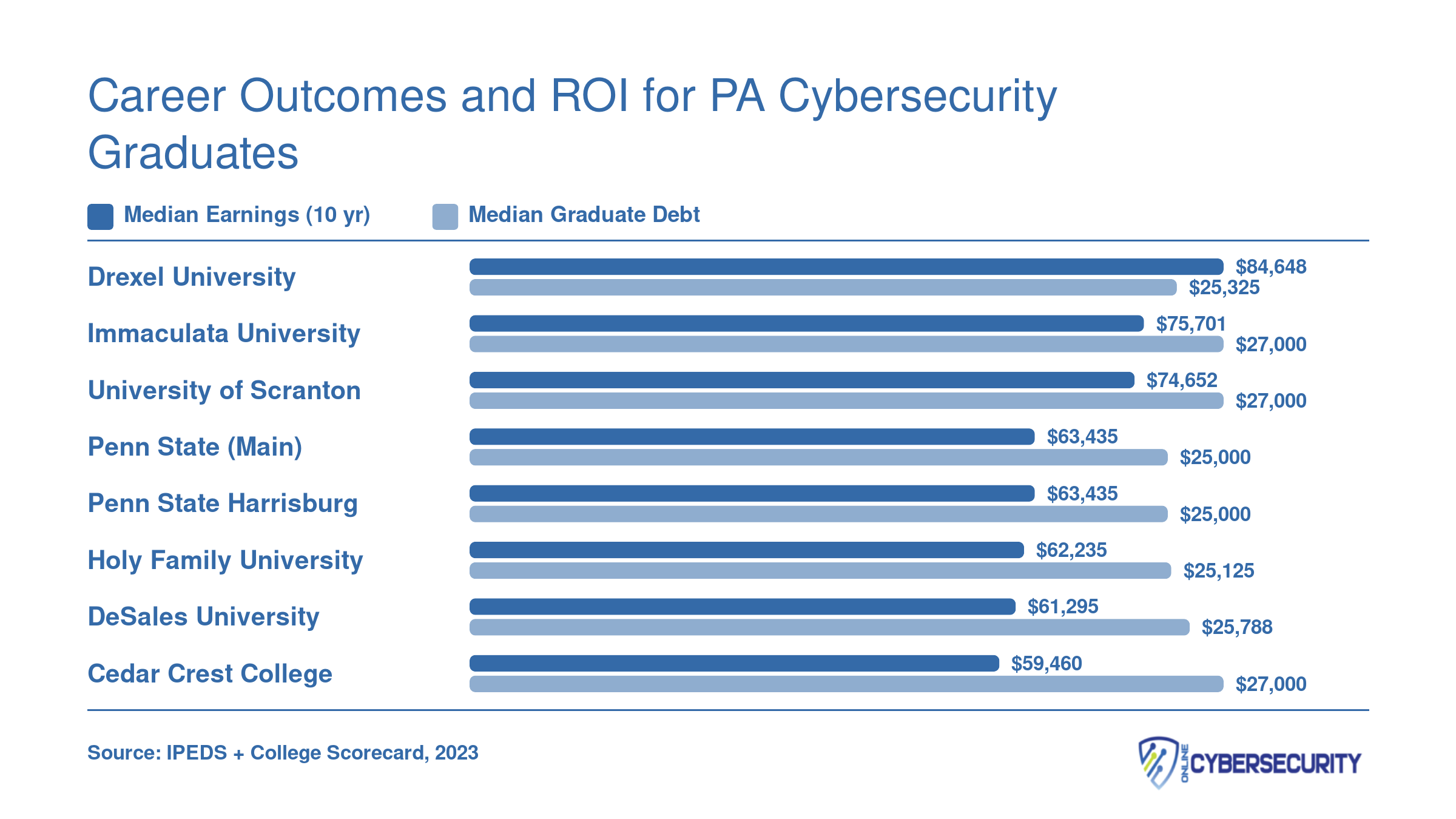
The University of Scranton offers a fully online Master's in Cybercrime Investigation and Cybersecurity that stands out for its criminological lens. The 30-credit program aligns with the NICE framework and covers digital forensics, mobile forensics, and cyber defense. Industry partnerships support both curriculum relevance and job placement, and the institution posts a strong 79.8% graduation rate along with median alumni earnings of $74,652 ten years after enrollment.
View program
- 30-credit fully online master's degree
- Aligned with NICE cybersecurity workforce framework
- Courses in digital and mobile forensics
- Prepares for CEH and CHFI certifications
- Industry partnership for curriculum and placement
- Access to campus crime prevention center
- Fall semester start date
- #3
Carlow University
Pittsburgh, PA · $20,000 – $25,000/yr
Best for: Career changers wanting rapid cybercrime credentials
Carlow University in Pittsburgh provides a focused Graduate Certificate in Cyber Threat Research and Analytics that can be completed in as few as five months. What truly sets it apart is a capstone residency at the National Cyber-Forensics and Training Alliance, giving students direct exposure to real-world cybercrime investigation. The nine-credit program covers dark web analysis, encryption, data protection, and investigative tools.
View program
- 9-credit program at $1,046 per credit
- Completable in as few as 5 months
- 100% online with capstone at NCFTA in Pittsburgh
- Covers cybercrime investigation and dark web analysis
- Includes encryption and data protection coursework
- Start terms available in April and September
- Preferred 3.0 GPA for admission
- #4
Cedar Crest College
Allentown, PA · $19,000/yr
Cedar Crest College offers a Bachelor of Science in Cybersecurity available in both fully online and hybrid formats. The curriculum spans cybercrime, network security, and ethical hacking, culminating in a capstone project. Faculty with direct industry experience prepare students for the CompTIA Security+ exam, and the Harmon Center for Technology provides a supportive community dedicated to diversifying the tech workforce. With a 9:1 student-to-faculty ratio and a net price of roughly $18,659, Cedar Crest delivers strong personal attention at a competitive after-aid cost.
View program
- Online or hybrid delivery options
- Capstone project required
- Prepares students for CompTIA Security+ certification
- Faculty drawn from the tech industry
- No application fee
- Access to the Harmon Center for Technology
- Free study abroad opportunity for traditional students
- Financial aid and scholarships available
- #5
Mercyhurst University
Erie, PA · $19,000/yr (net price)
Mercyhurst University in Erie pairs a Bachelor of Science in Cyber Security with a fully online Master of Science, creating a clear undergraduate-to-graduate pipeline (including a 4+1 accelerated option). The bachelor's program features cyber ranges, hands-on labs, and a partnership with EC-Council Academia for certification prep. The master's program adds courses in legal issues, ethical considerations, and advanced cyber threat analysis, all delivered online.
View 2 programs
- Hands-on labs and real-life client projects
- Cyber range training environments
- Partnership with EC-Council Academia
- Covers ethical hacking, network security, digital forensics
- Certification preparation opportunities
- Housed in School of Intelligence and Computing
- Fully online graduate program
- Analyzes cyber threats across business and national security
- Evaluates legal and ethical dimensions
- Online certificate credits can apply toward degree
- Faculty with direct industry experience
- 4+1 accelerated pathway from bachelor's program
- #6
DeSales University
Center Valley, PA · $32,000/yr (net price)
DeSales University delivers a 100% online Master of Science in Cyber Security with rolling admissions and multiple start dates, making it one of the most schedule-friendly options in Pennsylvania. The 30-credit program is deliberately accessible to students without a computer science background, covering IT security, cryptography, vulnerability assessment, and cyber security management. Graduate certificates are also available as standalone credentials or stepping stones toward the full master's.
View 2 programs
- 30 credits, completable in 1 to 3 years
- 100% online with rolling admissions
- No computer science background required
- Concentrations include Digital Forensics
- Prepares for CISSP, CEH, and CompTIA Security+
- Capstone course required
- Flexible full-time or part-time enrollment
- Four core courses delivered fully online
- Covers vulnerability assessment and cryptography
- Can be applied toward the M.S. degree
- Multiple start dates throughout the year
- Rolling admissions process
- Designed for working professionals
- #7
Neumann University
Aston, PA · $28,000/yr
Neumann University serves the Philadelphia-area market with a fully online Master of Science in Cybersecurity offering two distinct tracks: Managing Information Systems Security and Cyber System Engineering. The 30-credit STEM-designated program integrates AI into the curriculum and features hands-on hacking lab simulations. Completion is possible in as few as 21 months, and the program prepares graduates for CEH, SSCP, and CISM certifications.
View 2 programs
- Fully online, completable in 21 months
- 30 credits with foundational and specialized courses
- Hands-on hacking lab simulations
- Prepares for CEH, SSCP, and CISM certifications
- STEM-designated program
- AI integrated into curriculum
- Faculty with 30+ years of experience
- Fully online delivery format
- Focuses on penetration testing and network security
- Covers digital forensics and incident response
- Cryptographic concepts and cloud security topics
- Capstone project required
- Graduate assistantships available
- #8
Seton Hill University
Greensburg, PA · $22,000/yr
Seton Hill University offers a graduate-level Cybersecurity Risk Management Certificate that can be finished in under a year. Four focused courses cover enterprise security, cyber risk mitigation, security infrastructure design, and threat intelligence management, all delivered online with flexible scheduling and multiple start dates. The program appeals to professionals who want a credential quickly without committing to a full master's degree.
View program
- Graduate certificate completable in under a year
- Four fully online courses
- Covers enterprise security and cyber policy
- Includes cyber risk mitigation strategies
- Security infrastructure design coursework
- Threat intelligence management focus
- Multiple start dates with flexible scheduling
- #9
Mount Aloysius College
Cresson, PA · $20,000 – $25,000/yr
Mount Aloysius College offers a Bachelor of Science in Cybersecurity and Digital Forensics with a strong hands-on emphasis, including a dedicated cybersecurity lab with virtual Windows and Linux environments. Required internships frequently translate into job offers, and courses are available in hybrid, online, and accelerated evening formats. The 11:1 student-to-faculty ratio supports individualized attention, and the curriculum is designed to adapt alongside evolving technology.
View program
- Hybrid and online delivery options
- Dedicated cybersecurity lab with virtual environments
- Required internships with real-world employers
- Prepares for industry certifications
- Evening and accelerated course schedules
- Participation in cyber defense team competitions
- Faculty with professional industry experience
- #10
Slippery Rock University of Pennsylvania
Slippery Rock, PA · $20,000/yr
Slippery Rock University is one of only two public institutions on this list, and its in-state tuition of $10,568 makes it the most affordable entry point for Pennsylvania residents pursuing a cybersecurity bachelor's. The B.S. in Cybersecurity offers multiple concentrations, including Secure Software Development and Security Governance, allowing students to tailor coursework to career goals. The university's public-system status also means broad access to state financial aid.
View 2 programs
- Public university with in-state tuition of $10,568
- Focus on secure coding and vulnerability analysis
- Defensive programming and threat modeling
- Part of the College of Engineering and Science
- Cybersecurity minor also available
- Hybrid delivery format
- Governance-focused cybersecurity concentration
- Multiple concentration options under one major
- Public-system tuition rates for PA residents
- Undergraduate program with broad elective flexibility
- Certificate and minor pathways also offered
How We Ranked Pennsylvania's Online Cybersecurity Schools
Transparency matters. Many ranking sites publish ordered lists without ever explaining what drives the order, leaving you to wonder whether the results reflect genuine academic quality or something else entirely. Our approach is different: we want you to understand exactly how these programs earned their positions so you can weigh the rankings alongside your own priorities.
What Goes Into the Rankings
Every program on this list first had to meet a core eligibility requirement: the degree must be available through online delivery for Pennsylvania students. From there, each school is scored on a quality composite that factors in several institution-level indicators.
- Graduation rate: A signal of how well a school supports students through to completion.
- Net price: An institution-wide, sector-conditional average that reflects what students typically pay after grants and scholarships. This is an approximate benchmark, not a personalized financial aid estimate, and your actual cost may differ after you apply.
- Post-graduation earnings: Drawing from federal scorecard data, these figures help illustrate economic outcomes for graduates.
These factors are weighted together to produce a single composite score, and the schools are ranked accordingly.
How We Handle Tuition Across Degree Levels
Not all cybersecurity programs sit at the same level, and tuition structures vary between undergraduate and graduate study. To keep comparisons fair, our tuition figures are degree-aware. If a program awards a master's or doctoral credential, the listed cost reflects graduate tuition rates. For bachelor's degrees, associate degrees, and cyber security certificates online, we use undergraduate tuition instead. This prevents misleading apples-to-oranges comparisons when you scan the list.
Why This Matters for You
When a ranking source hides its methodology, you are essentially trusting a black box. By explaining the criteria openly, we give you the context to decide how much weight to place on our list versus your own research. If affordability is your top concern, you might sort differently than someone focused on completion rates. The goal is to arm you with enough information to make a decision that fits your career goals and financial situation, not just to hand you a number and expect you to trust it.
Online Cybersecurity Tuition in Pennsylvania: A Cost Comparison
Tuition for online cybersecurity programs in Pennsylvania varies widely depending on institution type, degree level, and residency status. Public universities offer a clear in-state tuition advantage, while many private colleges charge a flat rate regardless of where you live. The net price column below reflects the average annual cost after grants and scholarships, giving you a more realistic picture of what students actually pay. Keep in mind that per-credit rates, technology fees, and program-specific surcharges can shift your total cost significantly, so always check individual program pages for the latest breakdowns.
| School | Type | Degree Level | Published Tuition (In-State) | Published Tuition (Out-of-State) | Avg. Net Price (After Aid) |
|---|---|---|---|---|---|
| Peirce College | Private | Bachelor's | $15,060 | $15,060 | $12,148 |
| Holy Family University | Private | Bachelor's | $35,330 | $35,330 | $13,143 |
| Pennsylvania Western University | Public | Master's / Grad Certificate | $11,261 | $12,386 | $18,256 |
| Cedar Crest College | Private | Bachelor's | $46,314 | $46,314 | $18,659 |
| Mercyhurst University | Private | Bachelor's | $45,770 | $45,770 | $19,444 |
| Slippery Rock University | Public | Bachelor's | $10,568 | $14,676 | $19,608 |
| Rosemont College | Private | Bachelor's | $23,854 | $23,854 | $20,150 |
| Carlow University | Private | Graduate Certificate | $24,816 | $24,816 | $20,786 |
| Wilson College | Private | Bachelor's | $27,100 | $27,100 | $21,741 |
| Seton Hill University | Private | Graduate Certificate | $17,714 | $17,714 | $22,204 |
Questions to Ask Yourself
Online Cybersecurity Degree Levels Available in PA
Pennsylvania offers online cybersecurity programs spanning every major credential level, from associate degrees up through graduate certificates and master's programs. Understanding the timeline and structure at each level helps you plan your education around work, family, and career goals.
Associate Degrees
Associate of Applied Science (A.A.S.) programs in cybersecurity provide the quickest path to an entry-level credential. Community College of Philadelphia and Pennsylvania Highlands Community College both offer cybersecurity A.A.S. programs requiring roughly 60 to 65 credits and designed for completion in about two years of full-time study.12 These programs tend to focus on network fundamentals, operating system security, and foundational IT skills, giving graduates enough preparation to pursue help-desk, junior analyst, or network support roles while they continue their education. If you're curious about that analyst track specifically, our guide on how to become a security analyst breaks down the full career path.
Bachelor's Degrees
The bachelor's level dominates Pennsylvania's online cybersecurity landscape. Programs typically require 120 to 126 credits and take about four years to complete full-time, though many schools accommodate working adults with accelerated or part-time tracks. Penn State World Campus offers a 123-credit B.S. in Cybersecurity Analytics and Operations with a standard four-year timeline.3 Drexel University's online B.S. in Computing and Security Technology runs on a quarter system (185 quarter credits) and can be completed in as few as two years if you transfer in up to 90 quarter credits, or up to four years starting from scratch.4 Immaculata University structures its B.S. around seven-week accelerated sessions, letting adult learners finish in two to four years. Other ranked PA schools offering bachelor's-level cybersecurity options include Slippery Rock University, Cedar Crest College, Mercyhurst University, Rosemont College, Holy Family University, Wilson College, and Peirce College.
Master's Degrees
Master's programs are the other pillar of PA's online cybersecurity offerings, and they appear frequently in the state's ranked programs. Most require 30 to 45 credits, which translates to roughly one to three years depending on enrollment pace. Penn State World Campus offers a 33-credit M.S. that can take one to four years, while Neumann University's 30-credit M.S. is designed to wrap up in about 21 months. The University of Scranton's 30-credit online master's focuses on cybercrime investigation, and DeSales University's 30-credit M.S. averages one to three years. Drexel University's M.S. in Cybersecurity requires 45 quarter credits and averages about two years.
Graduate Certificates
For professionals who want a targeted credential without committing to a full master's, several PA schools offer online graduate certificates in cybersecurity. These are typically 9 to 15 credits and can be finished in as few as five months to about a year. Carlow University's Cyber Threat Research and Analytics certificate runs just 9 credits, Seton Hill University's Cybersecurity Risk Management certificate covers four courses (completable in under a year), Penn State Harrisburg offers a 15-credit Information Systems Cybersecurity certificate, and Pennsylvania Western University has a 12-credit option. Many of these certificates allow you to apply earned credits toward a full master's degree later.
How Long Does It Take to Complete an Online Cybersecurity Degree in PA?
Timelines vary by level and your enrollment status:
- Associate (A.A.S.): About 2 years full-time (60 to 65 credits).
- Bachelor's (B.S. or B.A.): Typically 4 years full-time, though transfer credits and accelerated sessions can shorten this to 2 years at some schools.
- Master's (M.S.): 1 to 3 years depending on credit load and pacing, with some programs designed for completion in under 2 years.
- Graduate Certificate: 5 months to 1 year, ideal for quick upskilling.
Part-time enrollment stretches each timeline, but almost every PA program listed here is built with working professionals in mind. If you already hold an associate degree or significant transfer credits, moving into a bachelor's completion program can cut your remaining time considerably. The same logic applies at the graduate level: completing a certificate first lets you bank credits toward a master's if you decide to continue.
Career Outcomes and ROI for PA Cybersecurity Graduates
When evaluating return on investment for a cybersecurity degree in Pennsylvania, comparing median graduate debt against long-term earning potential is essential. The schools below represent a range of program types, from bachelor's to master's and graduate certificates. Program-level earnings at one year and four years after completion are not yet published for these cybersecurity programs, so the chart uses institution-wide median earnings at ten years post-enrollment alongside median graduate debt to illustrate long-term ROI. Detailed program-level employment and poverty-threshold outcomes are also not yet reported for these specific cybersecurity offerings.
Pennsylvania Cybersecurity Job Market and Salary Outlook
Pennsylvania is one of the stronger mid-Atlantic states for cybersecurity employment, and the outlook through 2026 and beyond gives career changers plenty of reason to invest in a degree now. Here is what current labor data tells us about pay, demand, and how your credentials will be received by employers.
Statewide and National Salary Snapshot
According to Bureau of Labor Statistics data, Pennsylvania employed roughly 4,510 information security analysts as of the most recent count, with a mean annual wage of about $112,850.1 That sits slightly below the national median of $120,360, but the difference is largely offset by Pennsylvania's lower cost of living compared to high-wage coastal markets.2 At the national level, wages range widely by experience: entry-level analysts (10th percentile) earn around $69,660, while those at the 90th percentile pull in over $186,420.3
Metro-level figures within PA tend to vary. The Philadelphia-Camden-Wilmington corridor, which benefits from a concentration of financial services and healthcare companies, typically commands the highest wages in the state. Pittsburgh's growing tech sector also supports competitive salaries, while the Harrisburg-Carlisle area, home to significant state and federal government operations, offers steady demand even if wages trend a bit lower than the two larger metros. Exact metro-level medians shift from year to year, so checking the latest BLS state estimates before you commit to a program is a smart move.
Job Growth Projections
Nationally, information security analyst roles are projected to grow 32 to 35 percent over the 2022 to 2032 decade, a pace that far outstrips most other occupations.4 Pennsylvania mirrors that trajectory. The combination of healthcare networks, financial institutions, defense contractors, and a growing startup scene in cities like Pittsburgh means local openings are expected to remain plentiful well past 2026. For a broader look at the roles driving that demand, our cybersecurity career guide breaks down typical responsibilities and growth paths.
Early-Career Earnings for PA Graduates
If you are wondering how quickly a cybersecurity degree pays off, early-career salaries for recent graduates in Pennsylvania generally land in the lower-to-mid range of that national wage spectrum, often between the 10th and 25th percentile marks. That is normal for any field. What matters is the upward trajectory: cybersecurity salaries tend to climb quickly once you layer on a year or two of hands-on experience and an industry certification or two.
Do Employers Respect Online Cybersecurity Degrees?
This is one of the most common questions career changers ask, and the short answer is yes, provided your program is regionally accredited. Employer surveys consistently show that hiring managers in cybersecurity care far more about demonstrated skills, relevant certifications, and practical experience than whether your classes were on campus or online. The intense national demand for qualified analysts, reflected in that 32-plus-percent growth rate, means companies simply cannot afford to dismiss credentialed candidates based on delivery format. Many of Pennsylvania's top employers, including firms in the Philadelphia financial corridor and Pittsburgh's tech hub, actively recruit from top online cybersecurity programs.
Certifications Aligned with PA Online Cybersecurity Curricula
One of the smartest moves you can make while earning a cybersecurity degree in Pennsylvania is to pair your coursework with industry certifications. Employers routinely list specific certs in job postings, and aligning your studies with exam objectives lets you prepare for both your degree and a credential at the same time, saving you money and accelerating your career timeline.
Entry-Level Certifications for Associate and Bachelor's Students
If you are pursuing an associate or bachelor's degree, two CompTIA certifications deserve your attention first.
- CompTIA Security+: Widely considered the baseline credential for cybersecurity professionals, Security+ covers network security fundamentals, threat identification, risk management, and cryptography. Many introductory and intermediate courses in Pennsylvania online bachelor's programs overlap with Security+ exam objectives, even when a program does not explicitly brand itself as a prep course. Completing your core security coursework typically positions you well to sit for this exam before graduation.
- CompTIA CySA+ (Cybersecurity Analyst): A step beyond Security+, CySA+ focuses on behavioral analytics, security monitoring, and incident response. Students who have moved through mid-level coursework in intrusion detection, log analysis, and vulnerability management will find significant overlap with CySA+ domains. This credential signals to hiring managers that you can do hands-on defensive work, not just recite theory.
Advanced Certifications for Master's-Level Students
Graduate students and working professionals building on several years of experience should look at two higher-tier credentials.
- CISSP (Certified Information Systems Security Professional): Often called the gold standard for security leadership, CISSP requires a minimum of five years of cumulative paid work experience across at least two of its eight domains. Master's programs that cover governance, security architecture, and enterprise risk management map closely to CISSP exam content. Some programs may satisfy up to one year of the experience requirement through graduate education.
- CEH (Certified Ethical Hacker): CEH is geared toward offensive security, teaching penetration testing methodologies and exploitation techniques. Graduate-level courses in ethical hacking, network penetration testing, and advanced threat emulation align well with CEH objectives. This cert is especially valuable if you are targeting roles in red teaming or security consulting.
Do Pennsylvania Programs Explicitly Prepare You for These Exams?
Many well-regarded Pennsylvania online programs take a broad, interdisciplinary approach rather than marketing themselves as certification boot camps. Penn State World Campus's Cybersecurity Analytics and Operations B.S., for example, emphasizes general career preparation and does not explicitly align its curriculum with Security+, CySA+, CISSP, or CEH exam objectives.1 The program's coursework still covers topics that overlap with cert exam domains, but you will likely need to supplement with dedicated practice exams and study guides for each specific certification. If you prefer a faster, more targeted credential path, an online cybersecurity bootcamp may be worth exploring alongside your degree. Before enrolling in any program, check whether it offers optional cert-prep modules, voucher discounts, or partnerships with certification bodies.
The bottom line: you do not have to choose between a degree and certifications. A well-planned study schedule lets you stack credentials alongside your coursework, giving you a transcript and a resume that both speak directly to what employers need in 2026.
The NSA and DHS Centers of Academic Excellence in Cybersecurity designation (covering CAE-CD, CAE-CO, and CAE-R tracks) is widely considered the gold standard for cybersecurity programs. Pennsylvania is home to several CAE-designated institutions, and some offer online or hybrid options. Because designations and program formats can change, check the official CAE Community Map filtered by state to confirm which PA schools currently hold active status and deliver coursework online.
How to Choose an Online Cybersecurity Program in Pennsylvania
Picking the right online cybersecurity program is a genuinely personal decision, one that hinges on your career stage, budget, learning style, and life obligations. Below are five factors worth weighing carefully before you commit.
Accreditation and CAE Designation
Regional accreditation (through Middle States or an equivalent body) is the baseline. It ensures your credits transfer and your degree is recognized by employers and licensing boards. Beyond that, look for NSA/DHS Centers of Academic Excellence (CAE) designation in Cyber Defense or Cyber Operations. CAE schools align their curricula with federal workforce frameworks, which can give you a meaningful edge when applying to government or defense-sector roles. If you are curious how other states handle CAE alignment, our guide to NSA CAE cybersecurity programs Iowa offers a useful comparison.
Certification Alignment
The strongest programs bake industry certification prep directly into their coursework, covering exams like CompTIA Security+, Certified Ethical Hacker (CEH), or CISSP. Ask whether the program maps specific courses to certification objectives and whether exam vouchers or discounts are included. This kind of alignment means you can graduate with both a degree and one or more credentials employers actively seek, rather than studying for certifications separately on your own time and dime.
Asynchronous vs. Synchronous Format
Not every "online" program works the same way. Asynchronous courses let you log in whenever your schedule allows, which matters enormously if you work rotating shifts, serve in the military, or juggle family responsibilities. Synchronous programs set fixed meeting times that can be tough to keep if you are stationed overseas or pulling overtime. Before enrolling, verify the delivery model for every required course, not just electives.
Military and Working-Adult Friendliness
This is an area where Pennsylvania schools vary more than many prospective students realize. Veterans and active-duty service members should investigate two differentiators: Yellow Ribbon participation and credit for military training.
- Yellow Ribbon participation: Penn State World Campus offers up to $15,000 in additional institutional support per student (with roughly 300 slots available), while Drexel University provides unlimited Yellow Ribbon funding with no cap on the number of participating students.2 Pennsylvania College of Technology contributes up to $2,000 per student with unlimited seats.2 These contributions can dramatically reduce or eliminate out-of-pocket costs beyond the Post-9/11 GI Bill.
- Credit for military training: Penn State, Drexel, and Pennsylvania College of Technology all accept credit for qualifying military training and experience, which can shorten your time to graduation.2
- Shift-friendly scheduling: Programs built for working adults typically offer eight-week terms, evening lab sessions, and rolling start dates rather than a rigid fall/spring calendar.
- Employer tuition partnerships: Some PA schools partner with major employers or tuition-assistance platforms so your company reimburses part of the cost. Ask the admissions office directly whether your employer has an existing agreement.
Online-only students receiving Post-9/11 GI Bill benefits should also be aware that the monthly housing allowance for fully online coursework was $1,169 for the 2025-2026 academic year, considerably less than what on-campus students receive.3
Total Cost and Financial Aid
Sticker tuition can be misleading. Always request the net price: the amount you actually pay after grants, scholarships, employer reimbursement, and military benefits. A few practical checks worth making:
- Confirm whether online students pay in-state rates regardless of where they live. Some PA schools extend a single online tuition rate to all students; others charge out-of-state prices that can nearly double the bill.
- Use each school's net price calculator, which is required by federal law and available on every institution's financial aid page.
- Factor in fees that tuition alone does not cover, such as technology fees, proctoring charges, and lab kits.
Taking the time to compare programs across all five of these dimensions will help you find a cybersecurity degree in Pennsylvania that fits your goals without unnecessary cost or compromise.
Frequently Asked Questions About Online Cybersecurity Schools in PA
Choosing an online cybersecurity program in Pennsylvania raises plenty of practical questions. Below, we answer the ones prospective students ask most often, drawing on the program data, costs, and career outcomes discussed throughout this guide.
More Online Cybersecurity Programs Available to Pennsylvania Students
Looking for more options? The following schools also offer online or hybrid cybersecurity programs in Pennsylvania, providing a broader range of choices for students at different stages of their careers.
Philadelphia Metro
- Cybersecurity, B.S.
- BS Global Cybersecurity
- Master of Science in Cybersecurity (Array)
- Bachelor of Science in Computing and Security Technology
- Bachelor of Science in Computing and Security Technology (Computing Security)
- Bachelor of Science in Computing and Security Technology (Computing Technology)
- Cybersecurity and IT Management, B.A.
- Cybersecurity Administration, B.A.
- BS in Information Technology (Networking, Administration and Information Security)
Southwestern Pennsylvania
- Graduate Certificate in Cybersecurity
Central Pennsylvania
- Bachelor of Science in Cybersecurity
- Information Systems Cybersecurity Graduate Certificate