
What you’ll learn in this article…
- Utah had roughly 5,440 open cybersecurity positions as of April 2026, driven by defense and Silicon Slopes employers.
- All three ranked programs come from public universities, keeping tuition notably lower than private alternatives.
- Top Utah programs embed certification prep for credentials like CompTIA Security+ and CISSP directly into coursework.
- No ranked program requires GRE scores, making admission more accessible for career changers.
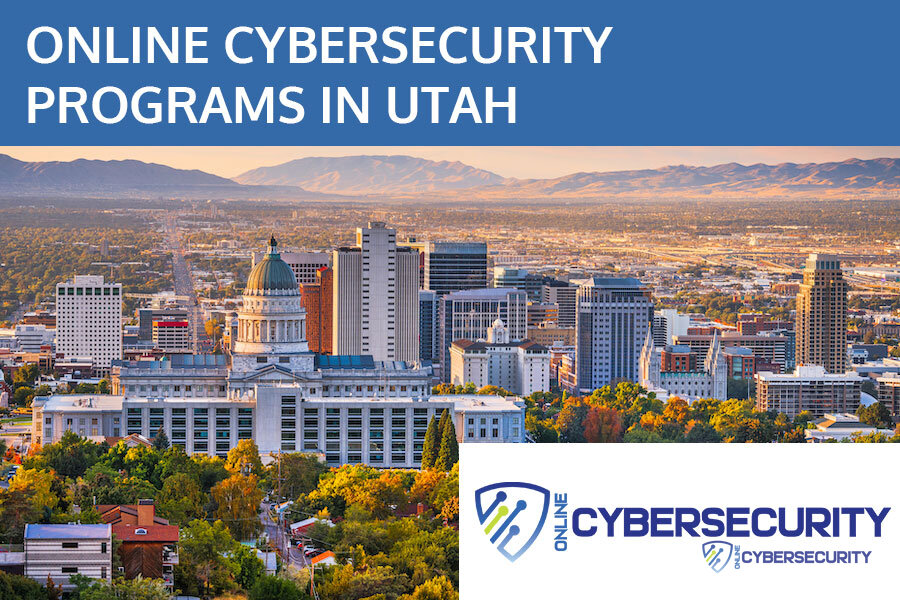
Utah had roughly 5,440 open cybersecurity positions as of April 2026, fueled by the NSA Utah Data Center in Bluffdale, Hill Air Force Base, and the expanding Silicon Slopes tech corridor. That demand creates real leverage for professionals who hold the right credentials, but choosing among the state's accredited cybersecurity programs online requires sorting through differences in degree level, cost, and certification alignment.
Utah's public universities offer online cybersecurity programs ranging from graduate certificates to master's degrees. In-state tuition can vary by thousands of dollars per credit, and not every program prepares you for the same industry certifications. For career changers, the gap between a well-matched program and a poor fit often shows up in time to employment and starting salary, not just on a transcript.
Best Online Cybersecurity Programs in Utah: 2026 Rankings
Utah's cybersecurity education landscape spans graduate certificates, master's degrees, and bachelor's programs, each tailored to different career stages. The rankings below reflect a composite of institutional quality, affordability, and program relevance for online learners. All three schools are public institutions, keeping costs manageable whether you live in Utah or are studying from out of state. Program-level earnings data is not yet available for these offerings, so we focus on institutional outcomes and program strengths instead.
- Academic quality and graduation rates
- Tuition affordability and net price
- Program depth and hands-on emphasis
- Online or hybrid delivery flexibility
- Regional employer alignment
- NCES-IPEDS federal institutional data — nces.ed.gov
- College Scorecard graduate earnings — collegescorecard.ed.gov
- Internal program database
- Independent program research
- #1
University of Utah
Salt Lake City, UT · $10,000 – $31,000/yr
Best for: Tech professionals seeking focused cyber upskilling
The University of Utah's Kahlert School of Computing offers a 15-credit Graduate Certificate in Secure Computing delivered fully online. Designed in partnership with the David Eccles School of Business, the program blends technical coursework in network and software security with business-oriented risk and compliance topics. Its location in Salt Lake City's Silicon Slopes corridor means coursework often draws on real scenarios from Utah's tech, healthcare, and government sectors, giving students regionally relevant, hands-on experience.
View program
- 15 credits at $901.43 per credit, fully online
- No separate nonresident surcharge for online students
- Covers network security, software security, and digital forensics
- Business aspects course revised for NIST CSF 2.0 alignment
- Red team/blue team capstone exercise using cloud labs
- Requires BS in Computer Science or equivalent experience
- Minimum 2.6 GPA for admission; 3.0 GPA to earn certificate
- Credits can stack toward the MS in Computing at the U
- #2
Southern Utah University
Cedar City, UT · $7,000 – $21,000/yr
Best for: Working professionals pursuing an accelerated master's
Southern Utah University delivers two distinct online master's pathways in cybersecurity, each completable in about a year. The MS in Cybersecurity with Information Assurance focuses on cyber operations, threat intelligence, and incident response, while the MBA with a Cybersecurity Emphasis prepares future managers to lead enterprise security strategy. Both programs charge a flat online tuition rate regardless of residency, and their 7-week course format is built for working professionals who need scheduling flexibility.
View 2 programs
- 30 credit hours, completable in as few as 11 months
- Total tuition approximately $15,120, flat rate for all students
- 100% online with asynchronous 7-week courses
- Covers threat intelligence, cloud security, and cyber law
- Capstone or internship option for hands-on experience
- No GRE required; bachelor's degree from accredited institution
- Aligned with NSA/DHS CAE requirements for government roles
- 33 credit hours, completable in as few as 12 months
- Total tuition approximately $16,632, same rate in or out of state
- AACSB-accredited business curriculum with cyber focus
- No GMAT required; minimum 2.5 GPA for admission
- Capstone strategy project often completed with Utah organizations
- Coursework covers cyber risk, data privacy regulations, and insurance
- Nine emphasis credits devoted to cybersecurity topics
- #3
Weber State University
Ogden, UT · ~$10,000/yr (est.)
Best for: Northern Utah residents balancing work and school
Weber State University offers cybersecurity education at both the bachelor's and graduate certificate levels through a hybrid delivery model. The ABET-accredited BS in Cybersecurity and Network Management is one of Utah's primary pipelines for network engineers and security analysts, while the MBA Certificate in Cybersecurity gives business professionals a focused 12-credit credential. Strong ties to Hill Air Force Base and northern Utah defense contractors make Weber a natural fit for students targeting government and aerospace security roles.
View 2 programs
- 12 credit hours, completable in as few as two semesters
- Hybrid format with evening sessions for working professionals
- No technical background required for enrollment
- Covers penetration testing, security policies, and IT management
- Can be taken standalone or as part of the full MBA
- Updated labs incorporate cloud and hybrid infrastructure scenarios
- Up to seven years allowed for completion
- ABET-accredited bachelor's degree, hybrid delivery
- Courses in cyber defense, cloud security, and wireless networking
- Seamless transfer pathway from Salt Lake Community College
- In-person labs held at the Davis campus in northern Utah
- Prepares for roles as information security analysts and network engineers
- Participates in Utah Cyber Challenge and regional competitions
- Concurrent enrollment option available for early-start students
How We Ranked Utah's Online Cybersecurity Schools
Transparency matters when you are comparing programs that could shape the next decade of your career. Rather than present a black-box list, we want to walk you through exactly how we arrived at our 2026 rankings so you can judge for yourself whether our priorities align with yours.
Online-Delivery Boost
Because this guide is specifically about online cybersecurity education, schools that offer robust online delivery receive an upward adjustment in our scoring. This ensures that programs designed from the ground up for remote learners, with asynchronous lectures, virtual labs, and remote proctoring, surface ahead of schools that merely list a handful of hybrid electives. We apply the same methodology across all of our state guides and our national list of best online cybersecurity programs.
Baseline Quality Composite
Every school starts with a composite quality score built from four pillars:
- Graduation rate: This metric reflects institution-wide completion, not a single program. It is one useful signal of how well a school supports students through to the finish line, though individual program completion may differ.
- Net price: We use a sector-conditional average that accounts for financial aid. In practice, this means you are seeing a more realistic out-of-pocket figure than the sticker price, adjusted for whether the school is public, private nonprofit, or for-profit.
- Earnings outcomes: Where program-level earnings data is available at one, two, and four years after completion, we use those figures rather than institution-wide medians. This gives a more targeted picture of what cybersecurity graduates specifically are earning, not an average diluted across every major on campus.
- Debt metrics: Lower median debt relative to post-graduation earnings signals a healthier return on investment, and our composite rewards programs that keep borrowing in check.
Why This Matters
Many ranking lists you will find online offer no explanation of how schools were ordered, leaving readers to wonder whether placements are driven by advertising dollars or editorial preference. By publishing our methodology here, we give you the context to weigh each factor according to your own situation. A career changer with GI Bill benefits, for example, may care less about net price and more about earnings trajectory, while a recent high school graduate might prioritize low debt above all else.
If a specific data point is not yet available for a program, we note that clearly rather than fill in a guess. Our goal is to give you an honest, data-grounded starting point, not a definitive verdict. Pair these rankings with your own research into faculty, curriculum, and career services, and you will be well positioned to choose a program that fits.
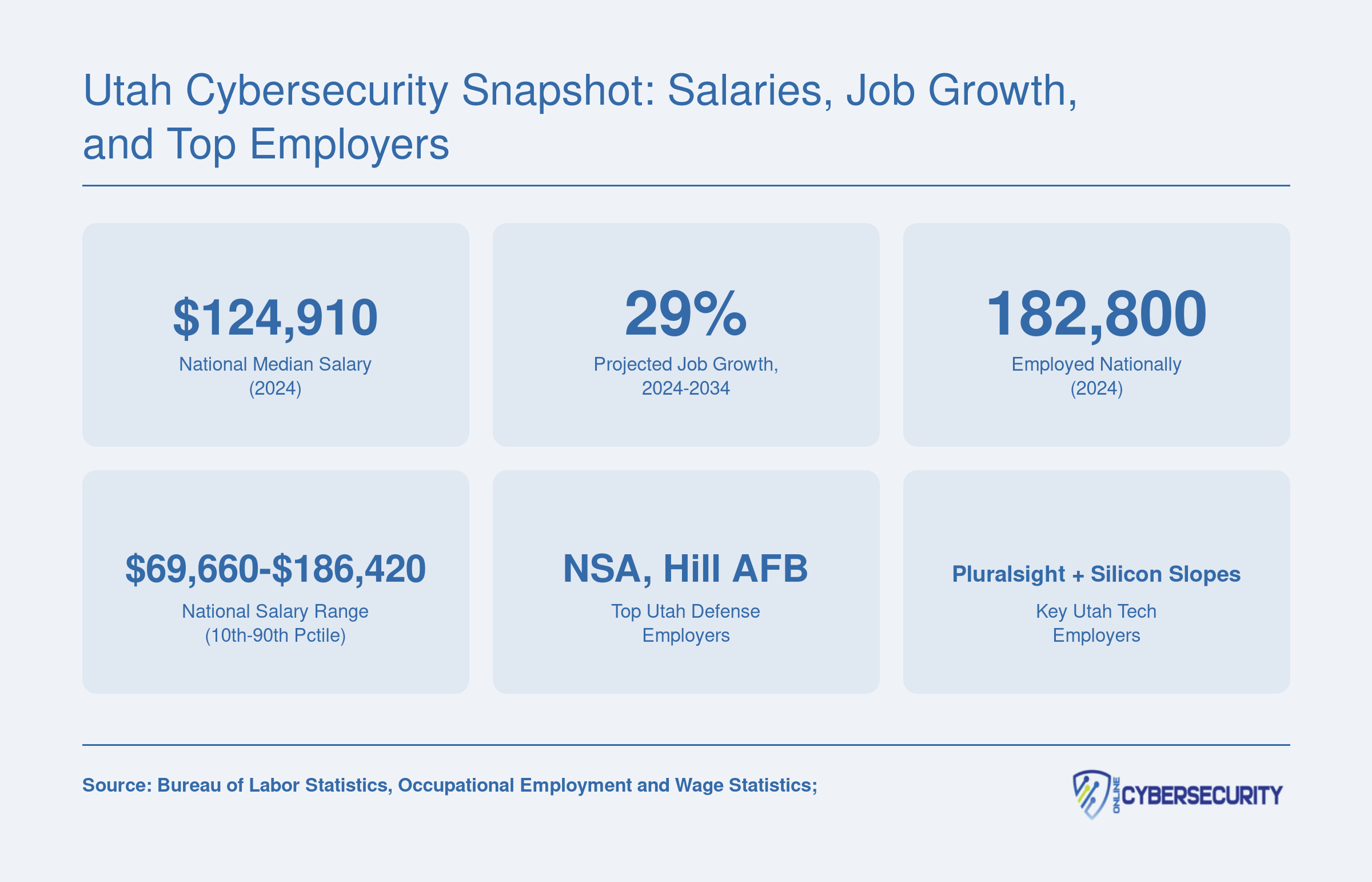
Utah Cybersecurity Snapshot: Salaries, Job Growth, and Top Employers
Utah's defense and tech corridor makes it one of the most active cybersecurity hiring markets in the country. The NSA Utah Data Center in Bluffdale, Hill Air Force Base, and a thriving Silicon Slopes startup scene all compete for qualified analysts, pushing demand well above average. Here is how the state's cybersecurity landscape stacks up at a glance.
Related Articles
Utah Online Cybersecurity Degrees by Level
Utah's online cybersecurity landscape in 2026 spans graduate certificates and master's degrees, making these programs especially well suited for working professionals and career changers who already hold a bachelor's degree. Graduate certificates offer a focused entry point, typically requiring 12 to 15 credits, while master's programs provide deeper expertise across topics like cyber operations, risk management, and penetration testing. No fully online associate or bachelor's cybersecurity programs from these ranked Utah schools appear in the current listings, so learners seeking undergraduate options may want to explore related computer science or IT degrees at these institutions.
| School | Degree Level | Concentration | Program Format | In-State Tuition (Annual) | Out-of-State Tuition (Annual) | Program Highlights |
|---|---|---|---|---|---|---|
| University of Utah | Graduate Certificate | Secure Computing | Online | $8,724 | $27,983 | 15 credits, $901.43 per credit; covers network security, software and systems security, digital forensics, and security operations |
| Southern Utah University | Master of Science | Cyber Operations | Online | $8,577 | $25,273 | 30 credits, completable in as few as 11 months; total tuition approximately $15,120; no GRE required; 7-week course format |
| Weber State University | MBA Certificate | Cybersecurity | Hybrid | $9,066 | $18,679 | 12 credits over two semesters; no technical background required; covers penetration testing, enterprise IT, and networking |
Cost Comparison: Tuition and Total Program Costs
Tuition for online cybersecurity programs in Utah spans a wide range depending on the degree level, institution type, and whether you qualify for in-state rates. Before you commit, it pays to map out every dollar, from per-credit charges and technology fees to textbook bundles and certification exam vouchers that some programs include.
Institutional Financial Aid and Cybersecurity Awards
Each of Utah's major cybersecurity schools maintains its own financial aid and scholarship office, and that should be your first stop. The University of Utah, Utah State University, Weber State University, and Western Governors University all publish dedicated pages listing merit-based and need-based awards. Look specifically for STEM or cybersecurity-focused scholarships; departments sometimes set aside funds that go unclaimed simply because fewer students apply for niche awards than for general ones.
The CyberCorps Scholarship for Service (SFS) program, administered by the U.S. Office of Personnel Management, covers tuition, fees, and a generous stipend in exchange for government service after graduation. As of 2026, participation by individual Utah institutions has not been publicly confirmed for the current cycle.1 Check each school's cybersecurity or computer science department page, and visit the OPM's SFS participating-institutions list directly for the latest updates.
State-Level STEM Grants and Workforce Funds
Utah invests in growing its tech workforce through several channels. The Utah System of Higher Education (USHE) oversees grant and scholarship programs across public institutions, some of which target STEM fields. The Governor's Office of Economic Development (GOED) also supports workforce development initiatives that occasionally include funding for cybersecurity training. Both agencies maintain websites where you can search current opportunities, eligibility windows, and application deadlines.
External Scholarships Worth Exploring
Professional associations offer scholarships that any qualifying student can pursue regardless of which school they attend:
- (ISC)² Scholarships: Open to undergraduate and graduate students pursuing information security studies.
- CompTIA Scholarships and Vouchers: Occasionally offered through partner programs and academic alliances.
- SANS Cyber Academies: Competitive programs that cover training and certification costs for participants who meet selection criteria.
These external awards can meaningfully reduce your out-of-pocket costs, especially when stacked with institutional aid. Students still weighing degree levels may also want to explore an online cybersecurity associate's degree as a lower-cost entry point before committing to a four-year program.
Putting It All Together
Exact tuition figures change from year to year, and individual aid packages vary based on residency, enrollment status, and academic record. Rather than relying on sticker prices alone, use each institution's net price calculator to estimate your real cost. Cross-reference that estimate with the scholarship sources listed above, and factor in any employer tuition-reimbursement benefits you may have access to. A few hours of research now can save you thousands over the life of your program.
Questions to Ask Yourself
Career Outcomes for Utah Cybersecurity Graduates
Understanding what happens after graduation is just as important as choosing the right program. Utah's cybersecurity job market has a distinct advantage: the state blends federal defense work, a thriving tech corridor, and growing state-level security needs, so graduates rarely have to relocate to launch a career.
What the Earnings Data Tells Us
Program-level earnings data (such as median salaries at one, two, and four years after completion) is not yet published for the cybersecurity programs at the University of Utah, Weber State University, or Southern Utah University. That is not unusual for newer or smaller credential tracks; federal reporting often lags behind program launches by several years. What we can look at instead is each institution's broader graduate earnings picture and the value those degrees deliver over time.
At the institution level, University of Utah graduates report a median income of roughly $67,170 ten years after enrollment, while Weber State graduates come in around $56,287 and Southern Utah University graduates sit near $50,296. These figures span all programs at each school, not just cybersecurity, but they offer a useful baseline. Cybersecurity-specific roles in Utah tend to command salaries well above these medians, which suggests that graduates who enter the field may outperform their institution's overall averages.
Value for Your Dollar
One practical way to gauge whether a program is worth the investment is to compare long-term earnings against typical graduate debt. Among the three ranked schools, Southern Utah University stands out with the strongest ratio, delivering roughly four dollars in ten-year earnings for every dollar of median graduate debt. Weber State follows closely at about 3.7 to 1, and the University of Utah rounds out the group at approximately 3.5 to 1. All three represent solid returns, especially when you consider that cybersecurity salaries in Utah frequently exceed these institution-wide benchmarks. If speed to market matters to you, it is also worth exploring the fastest online cybersecurity degree options that let you enter the workforce sooner.
Employment share and poverty-threshold outcomes at the program level are also not yet reported for these specific credentials. As these programs mature and more cohorts complete them, expect federal data to fill in the picture.
Where Utah Graduates Land
Utah's employer landscape is unusually well suited for cybersecurity professionals. Graduates from these programs feed into several high-demand sectors:
- Defense and intelligence: Hill Air Force Base and the NSA's Utah Data Center in Bluffdale are major employers with a constant need for cleared cybersecurity talent.
- State and local government: Utah's Division of Technology Services and county-level IT departments actively recruit cybersecurity analysts and incident responders.
- Silicon Slopes tech firms: Companies like Qualtrics, Domo, Pluralsight, and dozens of mid-size SaaS firms along the Wasatch Front maintain dedicated security teams.
- Healthcare and finance: Intermountain Health, Zions Bancorporation, and similar organizations invest heavily in information security staff to meet compliance requirements.
The practical takeaway is that even without granular program-level outcome data, Utah's cybersecurity graduates enter a market with strong demand, competitive salaries, and employers that actively partner with in-state universities. If you are weighing your options, pay attention to each program's career services office and whether it facilitates internships or capstone placements with these employers. Those direct pipelines often matter more than aggregate statistics.
Certifications, Labs, and Hands-On Learning
One of the smartest moves you can make while earning your online cybersecurity degree is stacking industry certifications alongside your coursework. Several Utah programs build certification preparation directly into their curricula, which means you graduate with both academic credentials and the vendor-recognized certifications employers actively look for. Here is how the landscape breaks down across the state's key programs.
Certification Prep Built into Utah Programs
Western Governors University stands out for embedding preparation for CompTIA Security+, CySA+, and Certified Ethical Hacker (CEH) directly into its cybersecurity degree path.1 Even better, WGU includes exam vouchers as part of tuition, so you are not paying out of pocket for each attempt. That is a meaningful cost savings, since a single Security+ voucher runs around $400 and CEH can exceed $1,200.
Utah Valley University aligns coursework with CompTIA Security+ objectives, giving students a strong foundation for that exam upon completion.1 Salt Lake Community College goes a step further at the associate level by aligning with CompTIA A+, Network+, and Security+, which creates a natural certification ladder for students building their skills from the ground up.1
Which Certifications at Which Level?
If you are pursuing a bachelor's degree, prioritize CompTIA Security+ first. It is widely regarded as the baseline certification for cybersecurity roles and satisfies DoD 8570 requirements for many government positions. CySA+ and CEH are solid next steps once you have some coursework or entry-level experience under your belt.
For master's students or professionals with five or more years of experience, the CISSP from ISC2 is the gold standard. It signals senior-level competence and is frequently listed as a requirement for management and architecture roles. If you are considering a leadership track, an online MBA in cybersecurity can pair well with CISSP to round out both business and technical credentials. If you are not yet at five years, you can pass the exam and hold an Associate of ISC2 status until you meet the experience threshold.
Virtual Labs and Cyber Range Access
Hands-on practice is non-negotiable in cybersecurity education. WGU provides virtual lab environments where students can practice network defense, penetration testing, and incident response in sandboxed settings.1 When evaluating any program, ask specifically whether they offer cloud-based lab platforms, simulated attack environments, or partnerships with providers that host cyber range exercises. Programs that lack this component leave graduates at a disadvantage in technical interviews.
The CAE Designation: A Quality Signal Worth Knowing
Brigham Young University holds the NSA/DHS Center of Academic Excellence in Cyber Defense (CAE-CD) designation, a recognition that its curriculum meets rigorous federal standards for cybersecurity education.2 This designation is awarded after a detailed review process and signals that a program's content aligns with the knowledge units the NSA considers essential. While not every strong program carries this label, it is a useful quality indicator, particularly if you plan to pursue federal employment or defense-sector roles where CAE graduates may receive preferential consideration.
As you compare programs, look for the combination of embedded certification prep, included exam vouchers, robust lab access, and recognized designations. These elements transform an online degree from a purely academic exercise into a launchpad for real-world cybersecurity work.
Admissions Requirements and Transfer Credit Policies
Getting into a Utah online cybersecurity program is more accessible than many career changers expect. None of the state's top programs require standardized test scores like the GRE, and most maintain moderate GPA thresholds that leave room for applicants whose academic history has a few rough spots. Here is what to expect as you prepare your application.
GPA and Prerequisite Expectations
Minimum GPA requirements vary by institution and degree level. The University of Utah recommends a 3.0 GPA for its graduate cybersecurity offerings, while Utah State University and Weber State University set the floor at 2.5 for undergraduate admissions (Weber State recommends a 2.7 to 3.0 for competitive applicants). Western Governors University does not enforce a hard GPA minimum, instead evaluating candidates on a combination of prior education, relevant certifications, and professional experience. Southern Utah University's master's program similarly waives the GRE and focuses on transcript review.
For online cyber security programs at the bachelor's level, expect foundational coursework in math, introductory IT, or computer science to appear as prerequisites. Master's programs typically require a completed bachelor's degree, and some, like the University of Utah's cybersecurity management track, prefer candidates with relevant work experience.3
Standardized Testing Policies
Across the board, Utah's online cybersecurity programs have moved away from requiring the GRE or other entrance exams. The University of Utah, Utah State, Weber State, Southern Utah University, and WGU all offer test-free admissions pathways. This is welcome news for working professionals who may have been out of school for years and do not want a standardized test standing between them and a degree.
Transfer Credits and Prior Learning
Transfer credit policies are especially important if you are pivoting from a community college or bringing military training to the table. Most Utah programs accept transfer credits earned with a grade of C or better. The University of Utah allows between 60 and 70 transfer credits, making it feasible to complete the first two years at a community college and finish online.4 Utah State University also accepts C-or-better coursework and evaluates Joint Services Transcripts (JST) for military-affiliated students.
WGU stands apart with its competency-based model. Instead of mapping course-to-course equivalencies alone, WGU evaluates industry certifications (such as CompTIA A+, Security+, or Network+) and documented professional experience as potential credit. If you already hold relevant credentials, you could significantly shorten your time to graduation, a path worth exploring if you are interested in a fastest competency based cybersecurity degree.
Military-Friendly Admissions
All four of the leading Utah programs accept GI Bill benefits, and several go further. The University of Utah participates in the Yellow Ribbon Program, which can reduce out-of-pocket costs for veterans.4 Utah State and Weber State both evaluate JST and Community College of the Air Force (CCAF) transcripts for transfer credit, and WGU accepts Tuition Assistance in addition to GI Bill funding. If you are transitioning from military service, these policies can translate your training into meaningful academic progress.
Selectivity at a Glance
The University of Utah has an admissions rate of roughly 86 percent, and Southern Utah University sits near 82 percent. Weber State operates with open admissions for many of its undergraduate programs. In practical terms, Utah's online cybersecurity landscape is not gatekept by ultra-competitive acceptance rates. The real determining factors are meeting GPA floors, submitting complete transcripts, and demonstrating genuine interest in the field.
Before you apply, contact each school's admissions office to confirm current policies. Requirements can shift between catalog years, and an advisor can help you map out exactly which credits will transfer and which prerequisites you still need.
As of April 2026, Utah had roughly 5,440 open cybersecurity positions, reflecting the state's surging demand for skilled professionals. Much of this demand is fueled by the concentration of federal facilities, defense contractors, and a fast-growing tech sector along the Wasatch Front.
Frequently Asked Questions About Utah Cybersecurity Programs
Choosing the right cybersecurity program in Utah means weighing cost, format, duration, and career alignment. Below are answers to the questions prospective students ask most often, drawn from current program data and admissions details.