

What you’ll learn in this article…
- BLS projects about 33 percent job growth for information security analysts through 2033, far outpacing the national average.
- Top-paying metros in California and the D.C. corridor offer mean salaries above $130,000 for cybersecurity professionals.
- Certifications like CompTIA Security Plus, CISSP, and CySA Plus can fast-track career changers past experience requirements.
- Finance, healthcare, defense, and tech are among the sectors hiring the most cybersecurity talent in 2026.
The United States has roughly 500,000 unfilled cybersecurity positions as of early 2026, according to CyberSeek data. That gap has hovered near the half-million mark for several years, even as employer demand continues to climb. For people considering a move into the field, the practical challenge is not whether jobs exist. It is figuring out which role fits your background, what credentials actually matter to hiring managers, and how to build a realistic timeline from where you are now to a funded offer letter.
The field rewards specificity. A security analyst protecting hospital networks faces different tooling, compliance frameworks, and on-call expectations than a penetration tester working for a consulting firm. Career changers coming from IT, networking, or adjacent disciplines often have more transferable skills than they realize, but translating that experience into a competitive application still requires deliberate planning. Whether you need a cybersecurity bootcamp online to build foundational skills or a targeted certification to round out years of adjacent experience, the sections ahead break down every step.
Cybersecurity Job Outlook: Demand, Workforce Gap, and Growth Projections
If you are weighing a career move into cybersecurity, the numbers tell a compelling story. Few professional fields combine this level of demand, this wide a talent shortage, and this strong a long-term growth trajectory. Here is what the data actually looks like heading into 2026.
Projected Growth Rate
The Bureau of Labor Statistics projects that employment for information security analysts will grow 29 percent from 2024 to 2034, a pace that dwarfs the roughly 4 percent average projected across all occupations.1 That translates to an estimated 16,000 to 17,300 new openings each year over the decade, driven by both expansion and turnover. As of the most recent national employment data, roughly 179,000 people held the information security analyst title in the United States, giving you a sense of the baseline headcount that is set to climb.
The Workforce Gap
Growth projections only capture part of the picture. The real urgency shows up in the gap between how many cybersecurity professionals the world needs and how many it actually has. According to the most recent global workforce study, the cybersecurity workforce reached about 5.5 million in 2025, yet the total number of professionals needed stood at roughly 10.2 million.2 That leaves a gap of nearly 4.8 million, meaning the field is operating at only about 54 percent capacity. The shortage grew 19 percent year over year, a trend that shows no sign of reversing.
In the United States specifically, more than 514,000 cybersecurity positions were open as of 2025.2 That figure spans every sector, from federal agencies and defense contractors to healthcare systems and financial institutions.
Why Demand Keeps Outpacing Supply
Several forces are compounding faster than training pipelines can respond:
- Expanding attack surfaces: Cloud migration, IoT adoption, and remote work architectures have multiplied the number of endpoints organizations must defend.
- Regulatory requirements: Frameworks like CMMC, updated SEC disclosure rules, and sector-specific mandates (HIPAA, PCI DSS) require dedicated security staff to maintain compliance. Roles like compliance analyst exist specifically because of this growing burden.
- AI-driven threats: Adversaries are leveraging generative AI for phishing, deepfakes, and automated vulnerability scanning, which forces defenders to upskill continuously.
- Talent pipeline lag: Degree programs, bootcamps, and certification tracks are growing, but they cannot yet produce graduates at the pace employers need them. Online cybersecurity programs are helping close the gap, though supply still trails demand.
The takeaway is straightforward. Cybersecurity is not a field where you will struggle to find opportunity. The challenge for most career changers is not whether jobs exist; it is choosing the right entry point and building skills efficiently, topics we cover in the sections ahead.
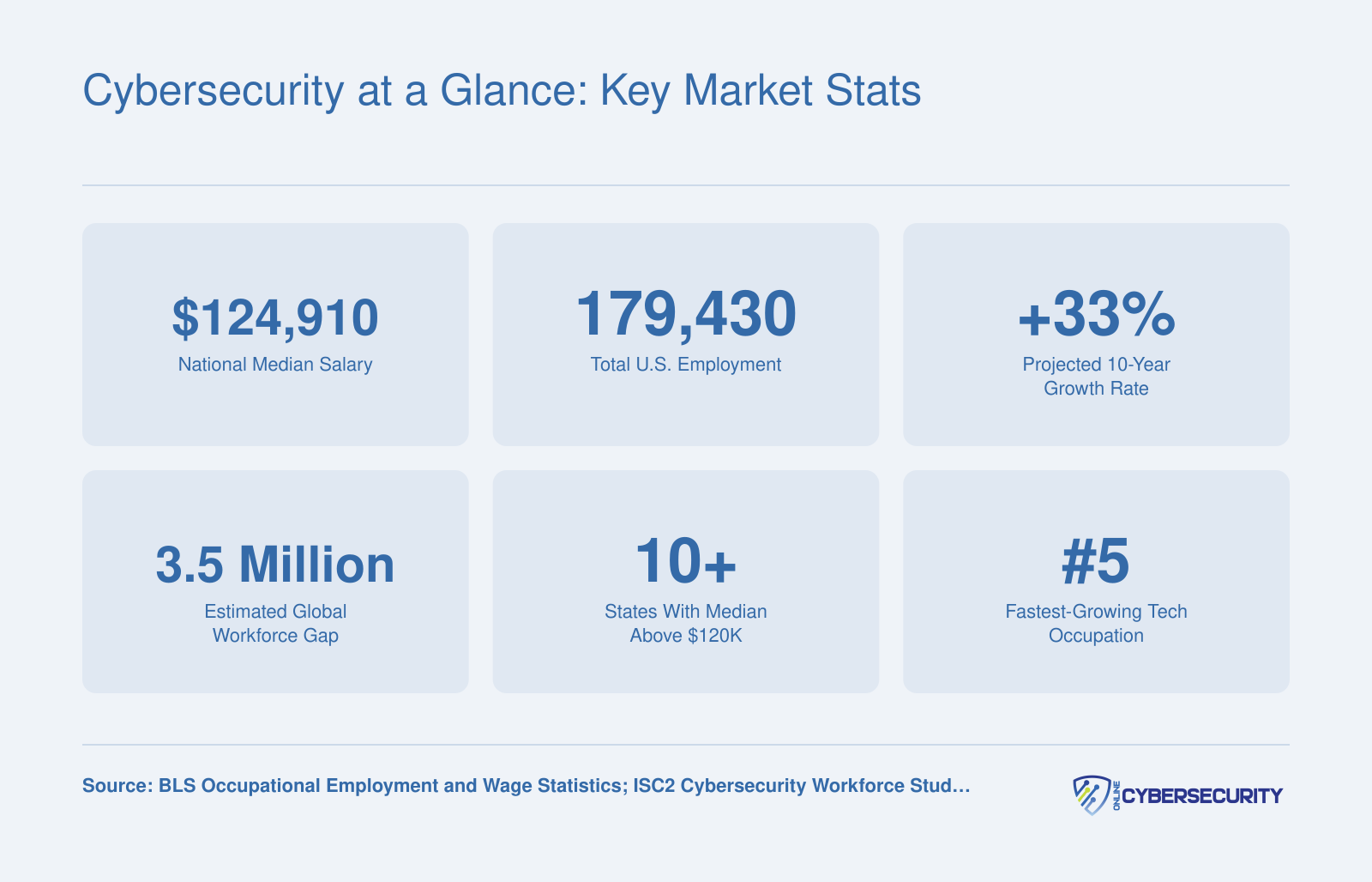
Cybersecurity at a Glance: Key Market Stats
The cybersecurity labor market continues to outpace nearly every other technology sector. These headline figures capture the scale of demand, the compensation potential, and the persistent talent shortage shaping the field in 2026.
Top Cybersecurity Roles and Responsibilities
Cybersecurity spans a wide range of specializations, each with its own tools, focus areas, and career trajectory. The table below breaks down some of the most in-demand roles in 2026, along with core responsibilities, the tools professionals commonly use, and the experience levels typically expected. Whether you are pivoting from IT support or exploring your first tech career, understanding these roles can help you map a realistic path forward.
| Role | Primary Responsibilities | Common Tools | Typical Entry Point | Experience Level |
|---|---|---|---|---|
| Security Analyst | Monitor networks for threats, investigate alerts, analyze logs, and escalate incidents | SIEM platforms (Splunk, Microsoft Sentinel), IDS/IPS, Wireshark | Help desk or IT support technician | Entry to mid level (1 to 3 years) |
| Penetration Tester | Simulate cyberattacks to identify vulnerabilities in systems, applications, and networks | Burp Suite, Metasploit, Nmap, Kali Linux | Junior security analyst or IT auditor | Mid level (2 to 4 years) |
| Security Engineer | Design, build, and maintain security architectures including firewalls, VPNs, and endpoint protection | Palo Alto, Cisco ASA, Terraform, AWS Security Hub | Systems or network administrator | Mid level (3 to 5 years) |
| Incident Responder | Lead containment and remediation during active security breaches, perform forensic analysis | Volatility, EnCase, CrowdStrike Falcon, TheHive | Security analyst or SOC analyst | Mid level (2 to 4 years) |
| Cloud Security Specialist | Secure cloud infrastructure, enforce identity and access policies, audit cloud configurations | AWS IAM, Azure Security Center, Prisma Cloud, Terraform | Cloud administrator or DevOps engineer | Mid level (3 to 5 years) |
| Governance, Risk, and Compliance (GRC) Analyst | Assess organizational risk, ensure regulatory compliance (HIPAA, PCI DSS, NIST), manage audit processes | RSA Archer, ServiceNow GRC, OneTrust | IT auditor or business analyst | Entry to mid level (1 to 3 years) |
| Threat Intelligence Analyst | Collect and analyze threat data, produce intelligence reports, advise teams on emerging attack patterns | MISP, Recorded Future, VirusTotal, MITRE ATT&CK framework | Security analyst or military intelligence role | Mid level (2 to 4 years) |
| Security Operations Center (SOC) Manager | Oversee SOC team operations, define detection and response playbooks, report metrics to leadership | SOAR platforms, SIEM dashboards, ticketing systems | Senior SOC analyst or incident response lead | Senior level (5 to 8 years) |
| Chief Information Security Officer (CISO) | Set enterprise security strategy, manage budgets, communicate risk to the executive team and board | GRC platforms, executive dashboards, risk modeling tools | Director of security or VP of information security | Executive level (10 plus years) |
| Application Security Engineer | Integrate security into the software development lifecycle, review code, manage vulnerability scanning | Checkmarx, Snyk, OWASP ZAP, GitHub Advanced Security | Software developer or DevOps engineer | Mid level (3 to 5 years) |
Related Articles
Cybersecurity Salaries by Role, State, and Metro Area
Cybersecurity salaries vary significantly depending on where you work. States with large federal, defense, or tech sectors tend to offer the highest pay, while lower cost-of-living states still provide strong six-figure earning potential. The table below shows median and mean annual wages for Information Security Analysts across all 50 states and territories, sorted from highest to lowest median salary.
| State | Total Employed | Median Salary | Mean Salary | 25th Percentile | 75th Percentile |
|---|---|---|---|---|---|
| Washington | 6,830 | $142,920 | $144,140 | $117,040 | $169,350 |
| California | 15,800 | $140,660 | $152,640 | $105,150 | $178,090 |
| Maryland | 8,770 | $140,480 | $145,450 | $105,230 | $175,390 |
| New Jersey | 4,730 | $135,390 | $141,130 | $108,320 | $168,240 |
| Delaware | 630 | $134,050 | $130,860 | $105,310 | $154,060 |
| New Mexico | 1,760 | $133,780 | $131,220 | $101,940 | $166,300 |
| Virginia | 18,670 | $132,460 | $136,680 | $101,610 | $166,510 |
| New York | 8,860 | $131,100 | $139,540 | $98,320 | $170,220 |
| Colorado | 5,840 | $130,570 | $135,980 | $102,350 | $164,010 |
| Connecticut | 1,160 | $130,500 | $127,740 | $95,260 | $152,410 |
| New Hampshire | 730 | $129,690 | $128,040 | $98,540 | $158,360 |
| Minnesota | 2,550 | $128,830 | $126,150 | $99,300 | $145,860 |
| District of Columbia | 2,010 | $127,760 | $132,790 | $109,680 | $150,920 |
| Massachusetts | 5,780 | $127,610 | $129,350 | $101,730 | $161,940 |
| Hawaii | 580 | $125,790 | $128,310 | $99,730 | $154,340 |
| Arizona | 4,170 | $125,320 | $123,780 | $88,520 | $161,250 |
| Texas | 14,730 | $124,970 | $126,800 | $96,020 | $149,780 |
| Georgia | 6,480 | $124,270 | $126,380 | $92,620 | $156,390 |
| Idaho | 870 | $121,970 | $145,880 | $87,980 | $157,060 |
| North Carolina | 6,850 | $121,070 | $122,310 | $88,560 | $147,030 |
| Oregon | 1,370 | $119,000 | $132,430 | $93,650 | $152,880 |
| Illinois | 4,560 | $114,300 | $119,540 | $83,960 | $138,130 |
| Iowa | 1,180 | $112,950 | $116,710 | $82,990 | $133,830 |
| North Dakota | 340 | $112,330 | $101,200 | $89,520 | $112,330 |
| Alabama | 3,290 | $111,110 | $112,800 | $79,870 | $138,270 |
| Pennsylvania | 4,420 | $110,230 | $114,870 | $79,670 | $137,900 |
| Rhode Island | 880 | $109,410 | $117,010 | $85,790 | $141,690 |
| West Virginia | 270 | $107,820 | $103,770 | $79,870 | $123,770 |
| Ohio | 5,070 | $107,570 | $115,600 | $83,480 | $137,430 |
| Nevada | 1,570 | $106,530 | $111,340 | $80,380 | $136,710 |
| Florida | 13,770 | $105,990 | $117,500 | $86,250 | $139,150 |
| Michigan | 3,120 | $104,540 | $107,630 | $79,920 | $129,150 |
| South Dakota | 430 | $103,310 | $104,120 | $86,360 | $115,300 |
| Missouri | 2,560 | $102,440 | $107,250 | $78,210 | $130,810 |
| Alaska | 210 | $102,170 | $111,900 | $96,320 | $121,060 |
| Kansas | 1,380 | $99,420 | $100,850 | $71,960 | $129,080 |
| Wisconsin | 1,760 | $99,210 | $106,260 | $79,640 | $128,770 |
| Kentucky | 1,790 | $98,210 | $102,820 | $67,650 | $128,910 |
| Utah | 1,720 | $97,180 | $101,430 | $72,800 | $127,980 |
| Nebraska | 1,120 | $95,470 | $103,310 | $85,120 | $122,360 |
| Maine | 270 | $93,710 | $99,420 | $73,890 | $129,560 |
| Arkansas | 1,010 | $93,560 | $96,080 | $66,800 | $125,550 |
| Louisiana | 580 | $88,200 | $101,280 | $73,830 | $107,250 |
| Montana | N/A | $87,100 | $99,560 | $87,100 | $102,650 |
| Vermont | 80 | $86,810 | $95,800 | $67,080 | $108,940 |
| Oklahoma | 1,270 | $86,500 | $92,390 | $57,490 | $117,500 |
| Mississippi | 560 | $84,640 | $89,910 | $60,240 | $105,830 |
| Indiana | 2,540 | $78,290 | $91,740 | $64,500 | $115,650 |
| Puerto Rico | 470 | $59,520 | $62,190 | $44,780 | $81,330 |
Highest-Paying Metro Areas for Cybersecurity Professionals
Location plays a major role in cybersecurity compensation. The table below ranks the top metro areas by mean annual salary for information security analysts, based on federal labor statistics. Tech-heavy metros in California and the greater D.C. corridor consistently lead, but several metros outside traditional tech hubs also offer six-figure averages. If you are open to relocation or remote roles tied to these labor markets, you could significantly boost your earning potential.
| Metro Area | Total Employment | Mean Annual Salary | Median Annual Salary | 25th Percentile | 75th Percentile |
|---|---|---|---|---|---|
| San Jose, Sunnyvale, Santa Clara, CA | 2,500 | $204,340 | $175,520 | $132,810 | $220,100 |
| San Francisco, Oakland, Fremont, CA | 4,010 | $166,090 | $168,160 | $129,350 | $188,060 |
| Seattle, Tacoma, Bellevue, WA | 4,490 | $156,000 | $152,660 | $121,370 | $174,530 |
| New York, Newark, Jersey City, NY/NJ | 10,160 | $146,810 | $138,360 | $106,760 | $172,050 |
| Washington, Arlington, Alexandria, DC/VA/MD/WV | 15,870 | $146,720 | $138,410 | $111,130 | $172,670 |
| Baltimore, Columbia, Towson, MD | 4,370 | $144,460 | $136,050 | $103,780 | $175,420 |
| Denver, Aurora, Centennial, CO | 3,620 | $137,180 | $131,670 | $103,780 | $165,430 |
| San Diego, Chula Vista, Carlsbad, CA | 1,240 | $134,740 | $130,900 | $94,260 | $168,070 |
| Los Angeles, Long Beach, Anaheim, CA | 4,420 | $133,230 | $131,280 | $97,800 | $164,130 |
| Boston, Cambridge, Newton, MA/NH | 4,870 | $132,120 | $132,170 | $101,760 | $164,370 |
| Phoenix, Mesa, Chandler, AZ | 3,160 | $130,430 | $130,390 | $99,400 | $170,400 |
| Dallas, Fort Worth, Arlington, TX | 6,570 | $128,470 | $131,280 | $101,550 | $154,150 |
| Austin, Round Rock, San Marcos, TX | 1,870 | $128,460 | $121,880 | $93,450 | $151,540 |
| Minneapolis, St. Paul, Bloomington, MN/WI | 2,090 | $127,600 | $129,380 | $100,860 | $147,390 |
| Atlanta, Sandy Springs, Roswell, GA | 4,940 | $127,490 | $126,880 | $96,970 | $160,670 |
| Houston, Pasadena, The Woodlands, TX | 2,040 | $127,360 | $120,170 | $94,770 | $150,390 |
| Charlotte, Concord, Gastonia, NC/SC | 2,130 | $127,280 | $127,840 | $96,960 | $161,250 |
| Philadelphia, Camden, Wilmington, PA/NJ/DE/MD | 2,440 | $126,220 | $124,270 | $95,060 | $152,350 |
| Orlando, Kissimmee, Sanford, FL | 2,070 | $124,570 | $124,870 | $97,190 | $151,380 |
| Richmond, VA | 1,550 | $123,680 | $122,530 | $91,310 | $151,920 |
Questions to Ask Yourself
Cybersecurity Career Paths: Entry-Level to Leadership
One of the most encouraging things about cybersecurity is that there is no single "right" way to build a career. Plenty of today's security architects started out resetting passwords on a help desk, and many incident responders came from networking or DevOps backgrounds rather than a dedicated cybersecurity degree program. The field rewards curiosity, hands-on skills, and continuous learning, which means career changers are genuinely welcome. If you are still exploring your options, our overview of the cybersecurity career path is a good starting point.
Below is a realistic three-tier map of how careers typically unfold, along with the salary progression you can expect at each stage.
Tier 1: Entry-Level (0 to 2 Years)
Common starting roles include SOC (Security Operations Center) analyst, junior penetration tester, IT support with a security focus, and vulnerability assessment technician. These positions emphasize monitoring, triage, and learning the rhythm of an organization's security posture.
Compensation in this band generally falls between $55,000 and $85,000, though specific roles can skew higher.1 Entry-level cybersecurity analysts report median earnings around $89,000, while junior penetration testers typically start closer to $76,000. If you hold a government security clearance, expect a premium of roughly $10,000 to $20,000 on top of those figures, pushing the range to $65,000 to $100,000 even in the first two years.3
Tier 2: Mid-Level (3 to 7 Years)
With a few years of real-world incidents under your belt, you can move into security engineer career path roles, incident responder positions, threat intelligence analyst work, or governance, risk, and compliance (GRC) analyst functions. This is where specialization matters. You will choose whether to go deep on offensive security, defensive engineering, cloud security, or policy and compliance.
Salaries climb meaningfully at this stage. Early-career cybersecurity engineers report median pay near $106,000, rising to roughly $116,000 at the mid-career mark. Penetration testers in this band see medians between $89,000 and $103,000. Cleared professionals with two to five years of experience can land packages in the $90,000 to $140,000 range, and those approaching the five-to-ten-year window often see $120,000 to $185,000.3
Tier 3: Senior and Leadership (8-Plus Years)
At the top of the ladder sit security architects, directors of security, and Chief Information Security Officers (CISOs). These roles blend deep technical knowledge with business strategy, risk management, and team leadership. Experienced cybersecurity engineers earn median salaries around $127,000, experienced penetration testers reach roughly $118,000, and information security managers report medians near $156,000. CISOs at large organizations regularly command total compensation well above $200,000, especially when bonuses and equity are factored in. If leadership appeals to you, learn more about how to become chief information security officer.
The Career-Changer Pathway
If you are coming from IT support, software development, networking, or even a non-tech field, you are not starting from zero. Skills in troubleshooting, scripting, system administration, and analytical thinking all transfer directly. Here is a realistic transition playbook:
- From IT support or networking: You already understand infrastructure. Earn a CompTIA Security+ or CySA+ certification, build a home lab where you practice log analysis or basic intrusion detection, and apply for SOC analyst roles. Many people make this move within six to twelve months.
- From software development: Your coding skills are a significant advantage. Focus on application security or DevSecOps. A certification like the Certified Ethical Hacker (CEH) or Offensive Security Certified Professional (OSCP) signals your intent to hiring managers.
- From a non-tech background: Start with foundational IT knowledge (CompTIA A+ or Network+), then layer on Security+. Pair those credentials with hands-on practice through platforms like TryHackMe or Hack The Box, and you can realistically be interview-ready for entry-level security roles within 12 to 18 months.
Lateral Moves Are the Norm, Not the Exception
Do not assume you need to climb a single vertical ladder. It is extremely common for professionals to shift laterally. A network engineer might pivot into cloud security engineering. A GRC analyst might move into security architecture after earning a CISSP. A DevOps engineer might transition into threat modeling. These lateral shifts often come with salary bumps and broader career options, so think of your cybersecurity career less as a straight staircase and more as a climbing wall with multiple handholds.
The salary figures referenced here reflect 2026 industry data from multiple compensation surveys and should be treated as useful benchmarks rather than guarantees. Geography, employer size, industry sector, and clearance status all influence what you will actually earn. Still, the overall trajectory is clear: cybersecurity rewards experience generously, and the gap between entry-level and senior compensation is wide enough to keep you motivated for years.
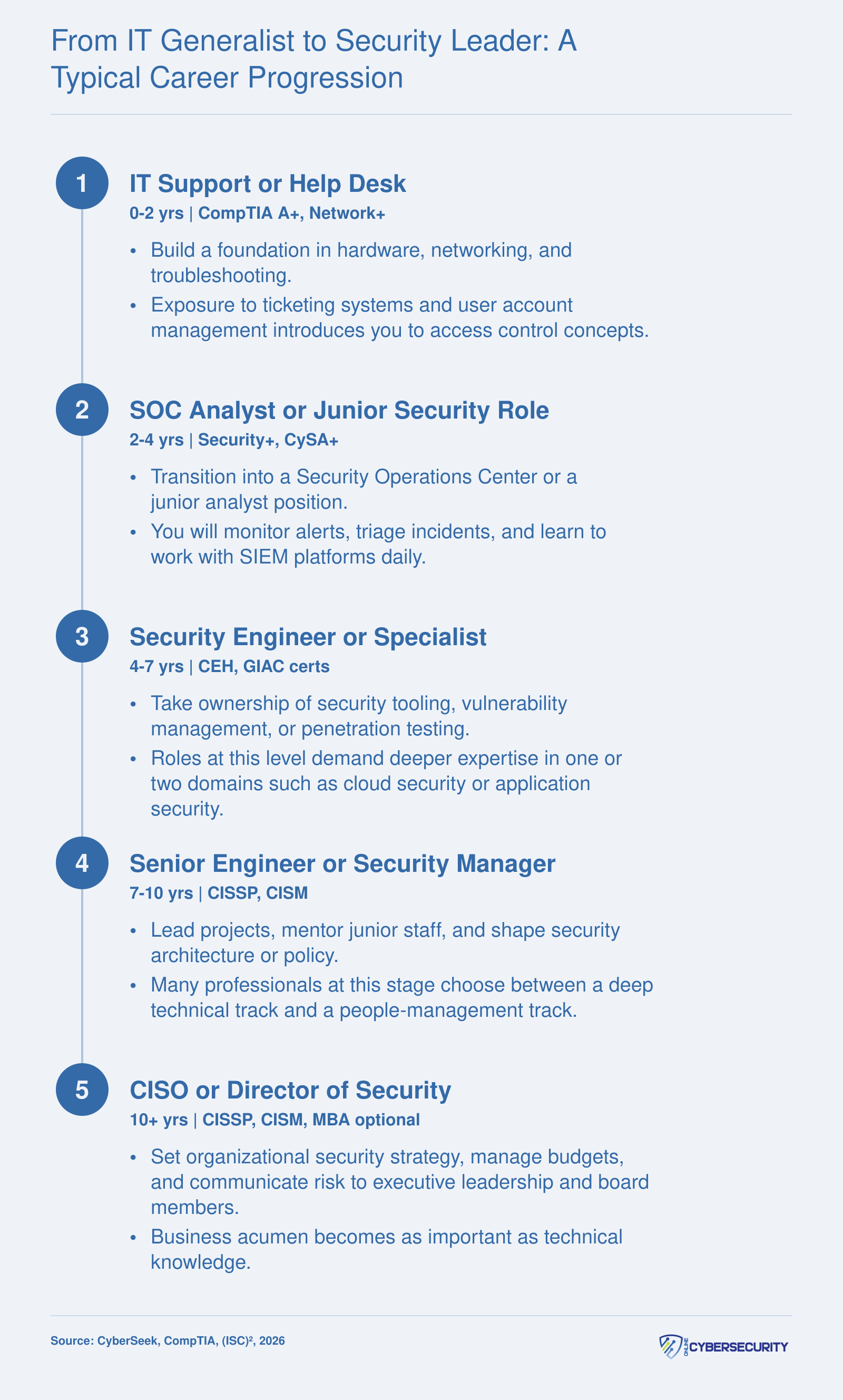
From IT Generalist to Security Leader: A Typical Career Progression
Cybersecurity careers rarely start in cybersecurity. Most professionals climb a well-worn ladder that begins in general IT and advances through increasingly specialized security roles. Here is what a typical five-stage progression looks like, along with the experience benchmarks and certifications that mark each rung.
Best Certifications for Cybersecurity Jobs
Certifications are the currency of the cybersecurity job market. They signal to hiring managers that you have validated, hands-on knowledge, and for career changers they can fast-track your way past the "experience required" barrier. The challenge is choosing the right ones. Rather than guessing, you can use free, publicly available tools to see exactly which credentials employers are asking for right now.
Which Certifications Show Up Most in Job Postings?
Based on employer demand data from workforce analytics platforms and annual industry reports published through early 2026, these certifications consistently appear at the top of real job listings:
- CompTIA Security+: The most frequently requested certification across entry-level and mid-level cybersecurity postings. It covers foundational threat analysis, risk management, and network security concepts, making it a near-universal starting point.
- CISSP (Certified Information Systems Security Professional): The gold standard for mid-career and senior roles. Employers in government, finance, and consulting list it more than almost any other advanced credential.
- CEH (Certified Ethical Hacker): Popular in penetration testing and vulnerability assessment job listings, particularly in defense contracting and managed security service providers.
- CySA+ (CompTIA Cybersecurity Analyst): Growing in demand for SOC analyst and threat intelligence positions. It bridges the gap between Security+ and more specialized credentials.
- CISM (Certified Information Security Manager): Frequently requested for security management and governance roles, especially in larger enterprises.
- CCSP (Certified Cloud Security Professional): Rising fast as organizations migrate workloads to cloud environments.
- OSCP (Offensive Security Certified Professional): Highly valued in red team and advanced penetration testing roles. Its hands-on exam format carries significant weight with technical hiring managers.
- GSEC (GIAC Security Essentials): Common in government and defense sector listings, often appearing alongside DoD 8570/8140 compliance requirements.
How to Verify Demand for Yourself
Do not take any list at face value, including this one. The job market shifts, and your target role or region may have different priorities. Here is how to check:
Visit CyberSeek.org, which pulls from Lightcast labor analytics, and explore the interactive career pathway map. It shows which certifications are tied to specific roles and how often they appear in current postings. You can filter by geography to see what matters in your metro area.
Search major job boards like LinkedIn, Indeed, and Dice using certification acronyms as keywords. For example, search "CISSP" or "Security+" alongside your target job title. The number of results gives you a rough but useful frequency count.
Review the annual workforce studies published by (ISC)², CompTIA, and Fortinet. These reports survey thousands of hiring managers and practitioners worldwide, and they track year-over-year shifts in which credentials employers prioritize. The 2025 and 2026 editions are especially relevant as cloud security and AI-related skills reshape demand.
Finally, check the Bureau of Labor Statistics Occupational Outlook Handbook entry for information security analysts. It lists recommended credentials and provides updated growth projections, giving you a government-sourced baseline to complement the industry data.
A Practical Certification Strategy
If you are entering the field, start with Security+ to establish credibility and qualify for a broad range of entry-level cybersecurity jobs. Once you have a year or two of experience, layer on a role-specific certification: CySA+ if you are heading toward a cyber threat intelligence analyst career, CEH or OSCP if penetration testing appeals to you, or CCSP if you are drawn to cloud security specialist work. For those aiming at leadership, CISM and CISSP are the credentials that open doors to director and CISO-track positions.
The key takeaway is to let real employer demand, not marketing hype, guide your certification investments. The tools mentioned above are free and take minutes to use. A quick check before committing time and money to a certification can save you months of effort and thousands of dollars.
According to the ISC2 Cybersecurity Workforce Study, roughly 65 percent of cybersecurity professionals say that earning certifications is one of the best ways to advance in the field. For career changers, that is encouraging news: a well chosen certification can carry serious weight with hiring managers, even without years of direct experience.
How to Get a Job in Cybersecurity: A Step-By-Step Playbook
Landing your first cybersecurity role can feel like a chicken-and-egg puzzle: job postings labeled "entry-level" routinely ask for two or three years of experience. The good news is that hiring managers increasingly recognize non-traditional experience, including home labs, capture-the-flag (CTF) competitions, and volunteer security audits, as legitimate proof of skill. Below is a concrete, seven-step plan you can start today, whether you are pivoting from another IT role or coming from an entirely different career.
Step 1: Build Foundational IT Skills
Before you specialize in security, you need a working knowledge of networking, operating systems, and basic scripting. Set up a free Linux virtual machine, learn TCP/IP fundamentals, and get comfortable navigating the command line. If you already hold a role in help desk, systems administration, or cloud operations, you are closer than you think.
Step 2: Earn an Entry-Level Certification
CompTIA Security+ remains the most widely requested credential in entry-level job postings. It covers threat analysis, risk management, and network security in enough depth to prove you speak the language. Other solid starting points include the ISC2 Certified in Cybersecurity (CC) credential, which is free to take, and the CompTIA CySA+ for anyone leaning toward analyst work.
Step 3: Build a Home Lab and Document Everything
A home lab is your answer to the "experience gap" paradox. Spin up a small Security Operations Center environment using free or open-source tools like Security Onion, Splunk Free, or Elastic SIEM. Practice triaging alerts, writing detection rules, and investigating simulated incidents. Host your configurations, scripts, and write-ups on GitHub so hiring managers can see exactly what you have built. Participating in CTF competitions on platforms like TryHackMe or Hack The Box adds another layer of demonstrable skill.
Step 4: Tailor Your Resume With Security-Specific Language
Generic resumes get filtered out before a human ever reads them. Mirror the exact terminology in the job description: phrases like "incident response," "SIEM monitoring," "vulnerability assessment," and "NIST framework" help your resume pass applicant tracking systems. Quantify accomplishments wherever possible. Instead of "monitored network traffic," write "analyzed 500+ daily SIEM alerts and reduced mean time to triage by 30% in lab environment."
Step 5: Network Through Professional Communities
Join a local ISSA or OWASP chapter, attend BSides conferences, and stay active on LinkedIn. Many cybersecurity jobs are filled through referrals rather than public postings. Engaging in community Slack channels and Discord servers also gives you exposure to hiring managers and mentors who can vouch for your skills.
Step 6: Apply Strategically
Treat the "requirements" section of a job posting as a wish list, not a hard gate. If you meet roughly 60 to 70 percent of what is listed, apply anyway. Focus on roles like SOC analyst (learn more about how to become a security analyst), penetration tester career path, GRC analyst, and security support positions. Prioritize companies that mention training programs or rotational assignments, because these employers are investing in growth rather than expecting a finished product on day one.
Step 7: Prepare for Technical Interviews
SOC analyst interviews commonly present scenario-based questions: "Walk me through how you would investigate a phishing alert" or "Explain what you would do if you saw lateral movement in your SIEM logs." Practice articulating your thought process out loud. Interviewers care less about a perfect answer and more about structured reasoning, so use a framework like "identify, contain, eradicate, recover" to organize your response.
A Note on Remote, Hybrid, and On-Site Trends
Work-location flexibility varies significantly by role. GRC, cloud security, and threat intelligence positions are among the most likely to offer remote or hybrid arrangements. SOC analyst roles, especially those supporting classified environments or government contracts, tend to remain on-site. Across professional occupations broadly, roughly 77% of postings are on-site, with hybrid (19%) and fully remote (4%) opportunities making up the remainder.1 Compensation can differ by work arrangement as well: recent workforce data suggests on-site cybersecurity professionals may earn modestly higher median salaries than their remote counterparts (around $178,500 versus $164,000), though that gap narrows in high-demand specializations where employers compete for talent regardless of location.2 If maximizing flexibility matters to you, targeting cloud security specialist roadmap or compliance analyst skills is a practical strategy.
The path into cybersecurity is rarely a straight line, but it is more accessible than most people assume. Focus on building demonstrable skills, documenting your work, and connecting with the community. That combination consistently outweighs a traditional resume in this field.
How to Find and Land a Cybersecurity Internship
Cybersecurity internships in major metropolitan areas such as New York City typically offer salary ranges between $44,000 and $53,000 annually for roles in security operations and governance, risk, and compliance1, making them financially viable for students and career changers alike. Beyond the paycheck, internships serve as the most direct pathway into a competitive field, often converting to full-time offers and providing hands-on experience that classroom learning cannot replicate.
Types of Cybersecurity Internships and Responsibilities
Internship openings span four primary specializations.2 Security Operations Center (SOC) interns handle alert triage, enrichment, incident handling, and detection tuning, learning to distinguish real threats from noise in live production environments. Governance, risk, and compliance (GRC) interns maintain policy documentation, collect evidence for audits, conduct risk assessments, and complete vendor security questionnaires. This track suits candidates with business, compliance, or process backgrounds and emphasizes writing, organization, attention to detail, and framework literacy. Vulnerability management and application security interns run vulnerability scans, help track remediation efforts, and prepare patching summaries, making the role ideal for those with coding experience or familiarity with development tools and software workflows. Candidates drawn to that track may want to explore the application security engineer career path for a sense of where those skills can lead. Penetration testing interns assist with reconnaissance, run basic vulnerability scans, develop exploitation scripts, and help write engagement reports, a track best suited to individuals who enjoy problem-solving puzzles, capture-the-flag competitions, hacking labs, and detailed technical work.
Where to Search for Internship Opportunities
Start with company career pages at firms known for robust security teams, including financial institutions, healthcare providers, cloud platforms, and defense contractors. Niche job boards dedicated to cybersecurity postings often surface internships not listed on general platforms. University partnerships and career fairs provide direct access to recruiters, especially for students still enrolled in degree programs. Many organizations reserve internship slots exclusively for candidates met through campus recruiting channels.
How to Stand Out in the Application Process
Home lab projects demonstrate initiative and practical skill. Building a virtual environment to simulate attacks, deploying a SIEM, or reverse-engineering malware samples signal readiness beyond coursework. Participation in capture-the-flag competitions showcases problem-solving ability and familiarity with tools used in production security work. Entry-level certifications such as Security+ validate foundational knowledge and differentiate candidates in early-stage resume reviews. For a broader look at credentials worth pursuing, the cybersecurity salary guide outlines how certifications affect earning potential over a career. Together, these efforts communicate commitment and competence to hiring managers evaluating dozens of applications.
Industries and Sectors Hiring Cybersecurity Professionals
Cybersecurity talent is in demand across virtually every industry, but certain sectors stand out for the volume of open roles and the unique challenges they present. Understanding what each sector values can help you target your job search and tailor your skill set accordingly.
Financial Services
Banks, insurance companies, investment firms, and fintech startups handle enormous volumes of sensitive financial data every day. Regulatory frameworks like PCI-DSS and SOX drive heavy investment in security teams, making governance, risk, and compliance (GRC) skills especially valuable here. If you enjoy working at the intersection of policy and technology, financial services is a natural fit.
Healthcare
Hospitals, health systems, insurers, and health-tech companies face relentless pressure to protect patient data under HIPAA and related state regulations. The stakes are uniquely high: a breach can compromise patient safety, not just financial records. Professionals with compliance expertise and experience securing medical devices or electronic health record systems are in particularly short supply.
Government and Defense
Federal agencies, the Department of Defense, intelligence organizations, and their contractors represent one of the largest cybersecurity hiring pools in the country. Many of these roles require security clearances, which can command significant salary premiums but often limit remote work flexibility and restrict where you can live. If you are willing to navigate that process, government work offers stable employment and access to some of the most advanced threat landscapes in the world.
Technology
Software companies, cloud providers, and SaaS platforms expect security professionals to operate at a fast pace and wear multiple hats. You might move from threat modeling a new product feature to responding to an incident in the same week. These firms tend to offer some of the highest base salaries in the field, but they also expect broader skill sets and comfort with rapid change.
Energy and Utilities
Power grids, water treatment facilities, oil and gas operations, and renewable energy companies rely on operational technology (OT) that was never designed with internet connectivity in mind. Securing these environments requires specialized knowledge of industrial control systems and SCADA networks, and the consequences of failure can extend well beyond data loss.
Retail and E-Commerce
Major retailers and online marketplaces process millions of payment transactions daily and store vast customer databases. The holiday shopping season alone can double the attack surface. Security teams here focus on fraud prevention, payment security, and protecting supply chain data.
Education
Universities, K-12 school districts, and edtech platforms manage sensitive student records and research data on relatively lean budgets. Ransomware attacks targeting schools have surged in recent years, creating urgent demand for security professionals who can do more with less.
Consulting and Managed Security Services
Consulting firms and managed security service providers (MSSPs) hire broadly because they serve clients across all of the sectors above. If you are curious about this path, explore how to become a cybersecurity consultant for a closer look at the day-to-day work. Expect competitive compensation alongside the broadest skill requirements. You will likely rotate across industries, which makes this path ideal for building a diverse resume early in your career.
Choosing Your Sector
The right sector depends on your interests, risk tolerance, and career goals. A few factors to weigh:
- Regulatory intensity: Healthcare and financial services reward GRC expertise and deep compliance knowledge.
- Clearance requirements: Government and defense roles pay well but come with lifestyle trade-offs around location and remote work.
- Pace and breadth: Tech and consulting demand rapid learning across many domains, while energy and utilities reward deep specialization.
- Mission alignment: If protecting patients, students, or critical infrastructure motivates you more than maximizing salary, let that guide your search.
No matter which sector you choose, the core technical foundations of cybersecurity transfer across industries. Starting in one sector does not lock you in; many professionals move between industries throughout their careers as their interests evolve.
Cybersecurity Careers for Veterans and Military Personnel
Military service builds exactly the skill set the cybersecurity industry needs most, and employers know it. Discipline under pressure, operational security awareness, teamwork in high-stakes environments, and (often) an active security clearance translate directly into cyber roles that are notoriously hard to fill with civilian candidates alone.
Translating Military Experience Into Cyber Roles
If you served in communications, intelligence, signals, or IT operations, you already speak much of the language hiring managers use. Even combat arms and logistics veterans bring structured problem-solving and mission-critical thinking that SOC teams and incident-response units prize. An existing security clearance is a significant advantage for government contracting positions, where cleared analysts can command higher salaries and face less competition.1
Common entry points for veterans in 2026 include SOC analyst positions, network defense roles, and government contracting work supporting federal agencies or defense contractors.
Funding Your Transition With the GI Bill and SkillBridge
Two programs can dramatically lower the cost of breaking into cybersecurity:
- GI Bill: Covers approved degree programs, bootcamps, and certification-oriented training. If a program is VA-approved, your tuition, fees, and often a housing allowance are covered.1
- DoD SkillBridge: Lets transitioning service members spend up to 180 days gaining civilian work experience with an industry partner while still receiving active-duty pay and benefits. Several major tech and defense firms participate.1
Veteran-Friendly Employers and Programs
A growing list of companies run formal military transition and training initiatives:
- Fortinet Veterans Program: Free, self-paced online training with exam vouchers included.2
- Cisco Military and Veterans Program: SkillBridge-eligible, with placements lasting three to six months.3
- Palo Alto Networks: Offers SkillBridge internships focused on network security.4
- Peraton: Runs a 180-day SkillBridge internship pipeline feeding directly into defense contracting roles.5
- Amazon AWS Military Apprenticeship: Paid training that can lead to cloud security positions.6
- Microsoft Software and Systems Academy (MSSA): Targets transitioning service members, Guard, Reserves, and veterans with hands-on technical training.6
- IBM Veterans Employment Initiative: Provides training and certification support.6
- Google Veterans Network: Offers apprenticeship tracks.6
- Salesforce Trailhead Military: Free training and certification prep.6
- HPE: Assigns a dedicated veteran recruiter to guide candidates through the hiring process.6
Additional nonprofit resources like CyberVetsUSA (free training), NPower's SkillBridge Cybersecurity Program, and VetSuccess Academy (scholarship support) round out the ecosystem.1
Making Yourself Competitive
Beyond leveraging these programs, veterans can stand out by earning an entry-level certification such as CompTIA Security+, building a home lab to practice detection and response, and participating in Capture the Flag competitions. For a broader look at how federal programs can offset the cost of this training, federal programs covering cybersecurity tuition are worth exploring. Pair that hands-on portfolio with your military background, and you bring a combination most civilian applicants simply cannot match.
If you are switching into cybersecurity from IT, software development, networking, the military, law, or finance, you already have an edge. Employers increasingly prize the domain expertise, communication skills, and project management instincts that career changers bring to the table. These transferable strengths can set you apart from candidates with a purely technical background.
Frequently Asked Questions About Cybersecurity Careers
Whether you are just starting to explore cybersecurity or actively planning a career switch, these are the questions we hear most often. Each answer is designed to give you a concrete next step or data point you can act on right away.