

What you’ll learn in this article…
- BLS projects information security analyst employment to grow roughly 33 percent from 2024 to 2034.
- SAST, DAST, and SCA are the three core application security engineer tools you must master early.
- Building a portfolio with real vulnerability findings and secure pipeline projects sets candidates apart.
- Top-paying metro areas and certifications like CSSLP or GWEB can push total compensation well above six figures.
Organizations pushed over 200 million container images to production registries in 2025 alone, and every deployment widens the attack surface that application security engineers are hired to defend. The Bureau of Labor Statistics projects 33 percent growth for information security analyst roles through 2034, and median salaries for AppSec specialists regularly clear six figures even at mid-career.
The real tension for career changers is sequencing: knowing which combination of education, tooling fluency, certifications, and portfolio projects actually moves you from interested outsider to hired engineer. Employers weigh hands-on proof of secure coding and vulnerability analysis far more heavily than credential count, so the order in which you build those skills matters. This guide walks you through each step, from building your educational foundation and mastering key tools to earning the right certifications, assembling a standout portfolio, and navigating the job market with confidence.
What Does an Application Security Engineer Do?
Application security engineers are the people who make sure software is secure before it reaches users, not after something goes wrong. If you have ever wondered what does an application security engineer do on a typical day, the answer is surprisingly varied. Unlike a security analyst who monitors alerts from a security operations center, or a penetration tester who simulates attacks on finished systems, an AppSec engineer is embedded directly in the development process, working alongside the teams that write and ship code.
A Day in the Life: Typical Workflow
No two days look identical, but a realistic daily workflow usually blends several core activities:
- Threat modeling: Early in a sprint or feature design, you sit with developers and architects to map out how data flows through a new feature and identify where attackers could exploit weaknesses.
- Code reviews: You review pull requests with a security lens, looking for issues like injection flaws, broken authentication logic, or insecure deserialization.
- SAST/DAST triage: You manage the findings from static and dynamic analysis tools, filtering out false positives, prioritizing real risks, and writing clear guidance so developers can fix issues quickly.
- Developer coaching: A meaningful part of the role is educational. You run lunch-and-learn sessions, create secure coding guidelines, and pair-program with engineers to help them internalize security practices.
- Incident response support: When a vulnerability is discovered in production, you help coordinate the fix, assess the blast radius, and update defenses to prevent recurrence.
This blend of technical depth and cross-team collaboration is what sets the role apart from purely offensive or purely defensive security positions.
Where AppSec Fits in the SDLC
Application security engineers are champions of the shift-left philosophy. Rather than bolting security checks onto the end of the development lifecycle, they embed security into every stage: design, build, testing, and CI/CD pipelines. When a team adopts shift-left practices, vulnerabilities get caught during code commits or staging environments instead of after deployment. This approach dramatically reduces remediation costs and keeps release timelines on track.
Specializations Within AppSec
The field is broad enough to support several focused career tracks:
- Web application security: Protecting browser-facing apps from threats like cross-site scripting, SQL injection, and session hijacking.
- Mobile security: Securing iOS and Android applications against reverse engineering, insecure data storage, and improper platform API usage.
- API security: Hardening the endpoints that connect modern microservices, third-party integrations, and mobile backends.
- Cloud-native security: Safeguarding containerized workloads, serverless functions, and infrastructure-as-code templates across platforms like AWS, Azure, and GCP.
As you progress deeper into architecture-level decisions, the AppSec role can naturally evolve toward a security architect career path.
Is Application Security Engineering a Good Career?
In short, yes. Demand for AppSec talent continues to outpace supply in 2026, and compensation reflects that imbalance. You will find detailed salary benchmarks and growth projections later in this article that illustrate just how strong the outlook is for professionals on this path.
Step 1: Build Your Educational Foundation
Your educational background matters in application security engineering, though the path you take is more flexible than many newcomers expect. The key is ensuring you come out the other side with demonstrable coding ability, a solid grasp of secure software design, and enough networking and systems knowledge to reason about threats across an entire stack.
Traditional Degree Paths
Three degree disciplines show up most often in AppSec job descriptions: computer science, cybersecurity, and information technology. Of these, a computer science degree tends to carry the most weight with hiring managers because it builds deep programming fluency, covers data structures and algorithms, and typically includes coursework in operating systems and software engineering. Those foundations translate directly into the code-review and threat-modeling work that fills an AppSec engineer's day.
A cybersecurity degree program can absolutely get you hired, especially when paired with strong programming electives or personal projects that prove you can read and write production-quality code. The same goes for an IT degree. If you are choosing a program today, look for one that combines security coursework with at least two semesters of software development.
Alternatives for Career Changers
If you already hold a degree in another field, or if a four-year program does not fit your timeline, several accelerated routes can close the gap:
- Bootcamps and intensive programs: SANS cyber-focused courses and Springboard's cybersecurity career track both compress critical material into months rather than years and often include mentorship and career support.
- Self-taught curricula: The OWASP Foundation publishes free guides, labs, and the WebGoat practice application that let you learn vulnerability classes hands-on. MIT OpenCourseWare offers full computer science lecture series at no cost, covering everything from introductory programming to network security.
- Framing a non-CS degree: A background in mathematics, physics, or even finance can be an asset. Employers value analytical rigor, so position your prior education as proof of structured problem-solving ability and pair it with a portfolio of security projects (covered in Step 4).
Can You Become an AppSec Engineer Without a Degree?
Yes, though you should go in with realistic expectations. Without a degree, employers will look for concrete proof-of-skill substitutes: recognized certifications, contributions to open-source security tools, published vulnerability disclosures, and a portfolio that shows you can identify and remediate real flaws. For a broader look at navigating this challenge, our guide on how to become a cybersecurity analyst without a degree covers strategies that apply across many security roles. Plan on building that evidence base deliberately.
Realistic Timeline Estimates
Timelines vary by starting point:
- Starting from scratch with a degree path: Expect roughly two to four years, combining coursework with internships or part-time security projects.
- Transitioning from an adjacent role (software developer, sysadmin, QA engineer): One to two years is a realistic window if you dedicate consistent time to security-specific study, earn at least one relevant certification, and actively seek AppSec-adjacent tasks in your current position.
Regardless of the route you choose, the goal is the same: arrive at your first AppSec interview able to walk through how you would review a codebase for common vulnerability classes, explain the OWASP Top 10, and discuss secure development lifecycle practices with confidence. If you are still exploring the broader cybersecurity career path, building this educational foundation will serve you well no matter which specialization you ultimately pursue.
Questions to Ask Yourself
Step 2: Develop Essential Technical Skills and Learn Key Tools
Employers hiring application security engineers do not expect you to ship production features. They expect you to read, audit, and reason about code written by others, then integrate security tooling into the development lifecycle. That distinction matters as you plan your skill development. Focus on building fluency across three pillars: programming languages, security frameworks, and the tooling ecosystem.
Programming Languages: Read and Audit, Not Build
You need enough depth in a language to spot insecure patterns, trace data flows, and write automation scripts. In 2026, the languages that appear most consistently in job postings are:
- Python: The default for scripting, automation, and writing custom security checks. Almost every AppSec team uses it daily.
- Java: Still the backbone of enterprise web applications. Expect to review Spring Boot services, deserialization logic, and authentication flows.
- JavaScript (and TypeScript): Front-end and Node.js back-end code dominate modern web stacks, so you will encounter these constantly during code reviews.
- Go: Increasingly common in cloud-native tooling, container orchestration, and microservices. Familiarity here signals that you can operate in modern infrastructure environments.
You do not need to master all four at once. Start with Python and one of the application languages (Java or JavaScript), then expand.
Security Frameworks and Standards You Must Know
These frameworks give you a shared vocabulary with developers and a structured approach to threat identification:
- OWASP Top 10: The universal shorthand for the most critical web application risks. Every stakeholder in your organization will reference it.
- OWASP ASVS (Application Security Verification Standard): A more granular checklist for verifying security controls at different assurance levels.
- NIST SSDF (Secure Software Development Framework): Defines practices across the entire software lifecycle and is increasingly cited in federal and regulated-industry contracts.
- CWE/SANS Top 25: Maps the most dangerous software weaknesses to concrete code-level patterns, making it especially useful during code review and triage.
Think of these as reference libraries, not one-time reads. You will return to them throughout your career.
The In-Demand Tool Stack by Category
Application security tooling falls into distinct categories, and hiring managers expect you to have hands-on experience with at least one tool in each. Here is the landscape as of 2026:123
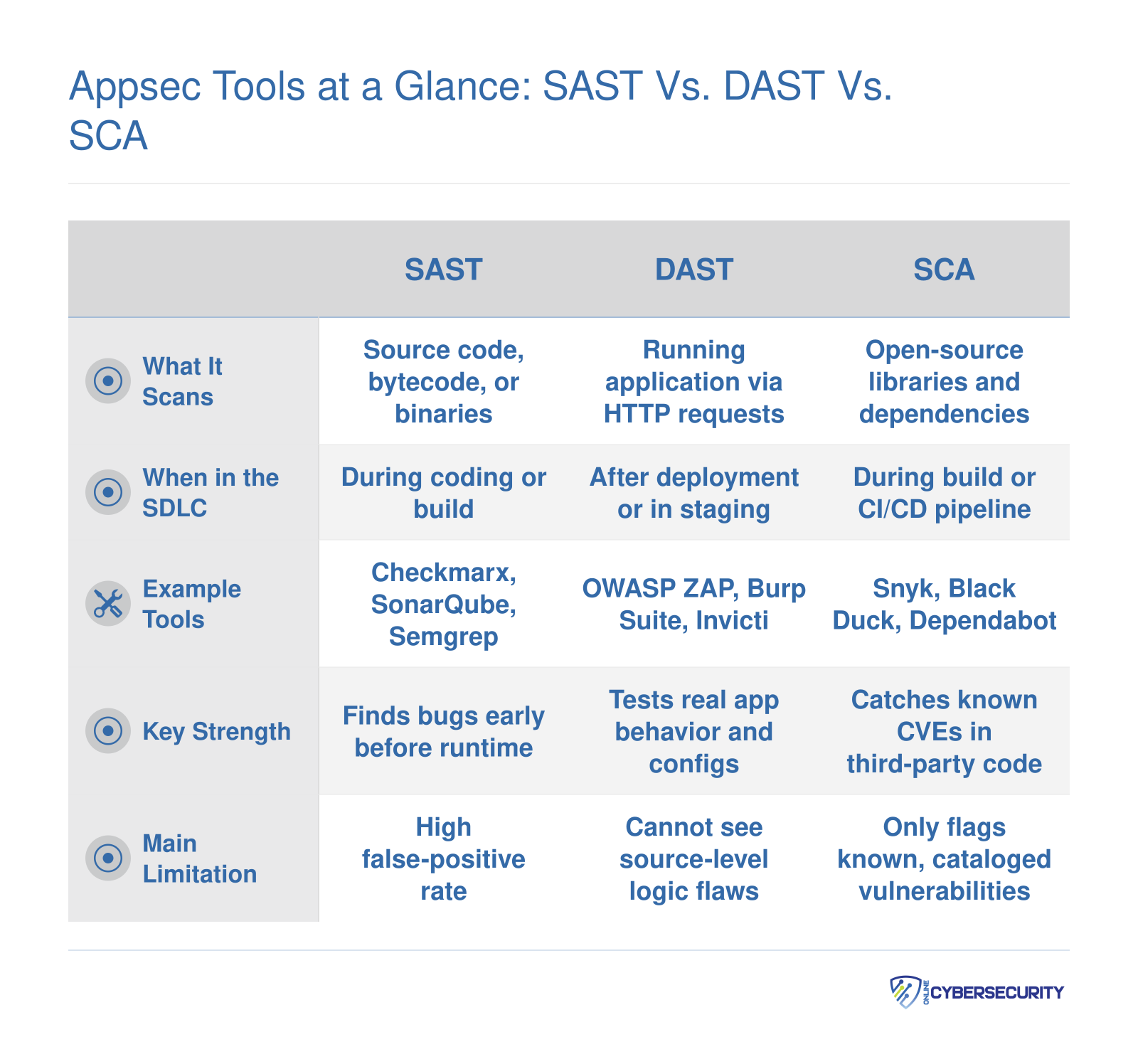
- SAST (Static Application Security Testing): Checkmarx remains a top-tier choice in enterprise environments. Semgrep and SonarQube are popular open-source and commercial options, especially in teams that want lightweight, customizable rule sets.
- DAST (Dynamic Application Security Testing): Burp Suite is the industry standard for interactive testing and is referenced in the majority of job listings. OWASP ZAP provides a strong free alternative, and Nuclei has gained traction for template-based scanning at scale.
- SCA (Software Composition Analysis): Snyk Open Source is the most commonly requested SCA tool, followed by Black Duck for enterprises that need deep license compliance. Dependabot is standard in GitHub-native workflows. Expect to produce or consume Software Bill of Materials outputs in CycloneDX or SPDX formats.
- IAST/RASP (Interactive and Runtime Protection): Contrast Assess leads this category in job postings, with Synopsys Seeker also appearing in larger organizations.
- CI/CD Security Integrations: GitHub Actions is the most commonly requested pipeline platform, and GitHub Advanced Security and GitLab SAST bring scanning directly into pull request workflows. Knowing how to configure these pipelines, set quality gates, and tune findings is a day-one expectation.
- ASPM (Application Security Posture Management): Platforms like Apiiro are gaining market share as organizations look for centralized visibility across all the tools listed above.
IDE Plugins: Meet Developers Where They Work
One area many candidates overlook, and where you can stand out, is developer-facing security tooling inside the editor. The Snyk IDE plugin surfaces vulnerability alerts while a developer is still writing code, not after a build fails. The Semgrep VS Code extension runs custom rules locally so issues are caught before they ever reach a pull request. Familiarity with these plugins signals that you understand shift-left security in practice, not just in theory.
Many of these same skills transfer directly into the broader security engineer career path, so the time you invest here compounds across roles. As you explore these tools, set up a home lab or use free-tier accounts to run scans against intentionally vulnerable projects (OWASP Juice Shop and WebGoat are ideal). Hands-on repetition is what transforms tool awareness into interview-ready competence.
Related Articles
Appsec Tools at a Glance: SAST Vs. DAST Vs. SCA
Application security engineers rely on three core tool categories to find vulnerabilities at different stages of the software development lifecycle. Understanding when and how each type works will help you choose the right approach for every phase of a project.
Step 3: Earn Industry Certifications That Hiring Managers Value
Certifications alone will not make you an application security engineer, but the right ones signal to hiring managers that you understand secure development at a professional level. The challenge is choosing wisely: there are dozens of security certifications, and only a handful carry real weight in AppSec hiring. Here is an honest, side-by-side look at six credentials worth your attention in 2026.
Quick Comparison of AppSec-Relevant Certifications
- CompTIA Security+: Roughly $404. Multiple choice plus performance-based questions, 90 minutes. This is the baseline credential that clears automated HR filters at most organizations. It is broad rather than deep, covering foundational security concepts rather than application-specific skills. Think of it as table stakes, not a differentiator.
- CSSLP (ISC2): Roughly $599 to $749. Multiple choice, 125 questions over 3 hours. Focused squarely on the secure software development lifecycle, this is the certification most directly mapped to what an AppSec engineer does day to day. Hiring managers in product-driven companies tend to recognize it quickly.
- CASE (EC-Council): Roughly $450 to $600. Multiple choice, 50 to 100 questions over 2 to 3 hours. Geared toward secure coding practices and appeals most to developer-turned-AppSec candidates. Less widely recognized than the CSSLP, but affordable and relevant if you are building secure code rather than reviewing it.
- OSWE (OffSec): Roughly $1,600 to $2,500. Entirely hands-on: you receive 47 to 72 hours of lab access and must submit a detailed report. This is the hardest credential on this list by a wide margin, and it shows. Hiring managers with offensive security backgrounds treat OSWE as proof you can actually find and exploit application-level vulnerabilities, not just answer questions about them.
- GWAPT (GIAC): Roughly $979 to $1,299. Open-book multiple choice, 75 to 82 questions over 2 to 3 hours. A strong pick for web application penetration testing roles that overlap with AppSec. GIAC certifications are well respected in enterprise and government environments.
- CEH (EC-Council): Roughly $1,199. Multiple choice, 125 questions over 4 hours. Widely recognized by name, but most experienced AppSec hiring managers view it as a general ethical hacking credential rather than an AppSec-specific differentiator. It can help clear government or contractor HR screens.
Difficulty and Format: What Actually Matters
If you are debating between a multiple-choice exam and a hands-on one, lean toward hands-on when you can. The OSWE stands apart because it requires you to discover real vulnerabilities in a controlled environment and write a professional report, mirroring the actual work of an offensive AppSec engineer. That said, not every role is offensive in nature. If your career is headed toward secure design reviews and SDLC governance, the CSSLP maps more directly to your daily responsibilities.
My Recommended Path
Start with CompTIA Security+, one of the best cybersecurity certifications for beginners, to establish a baseline and pass initial screening. It is affordable and achievable within a few months of focused study. From there, choose your next certification based on the direction you want to grow:
- If you lean toward secure development processes and architecture review, the CSSLP is your best next step. It signals that you understand how to embed security across the entire software lifecycle.
- If you lean toward offensive testing and vulnerability research, invest the time and money in the OSWE. Nothing else on this list proves hands-on skill as convincingly.
Either path gives you a credential that genuinely differentiates you from candidates who stopped at a generalist certification. As highlighted by Cybersecurity Ventures, credentials tied to specialized, demonstrable skills continue to correlate with stronger salary outcomes heading into 2026.1 Choose the path that aligns with the type of AppSec work you actually want to do, and treat the certification as a milestone on a longer learning journey rather than a finish line.
Step 4: Build a Portfolio and Gain Hands-On Experience
Certifications and coursework prove you understand concepts, but a strong portfolio proves you can apply them. Hiring managers in application security want to see evidence that you can find real vulnerabilities, build secure pipelines, and communicate technical findings clearly. This step is where you move from studying to doing.
Portfolio Project Ideas That Stand Out
Aim for four or five projects that span different areas of the appsec discipline. Here are concrete ideas worth pursuing:
- Write a custom SAST rule in Semgrep: Pick a vulnerability class (such as insecure deserialization in Python or SQL injection in Java) and author a detection rule. Document the pattern you are targeting, walk through true positives and false positives, and publish the rule in a public repository.
- Perform a full threat model of an open-source application: Choose a well-known project, apply STRIDE or PASTA methodology, diagram data flows, and catalog the threats you identify along with suggested mitigations. This demonstrates architectural thinking, not just code-level skills.
- Document a bug bounty finding (responsibly): After a vulnerability has been resolved and publicly disclosed, write a detailed case study covering your reconnaissance, the root cause, your proof-of-concept, and the remediation. Always follow the program's disclosure policy before publishing.
- Build a CI/CD pipeline with integrated security gates: Use GitHub Actions or GitLab CI to create a pipeline that runs SAST, dependency scanning, and container image scanning. Show how the pipeline blocks a merge when a critical finding surfaces.
- Contribute a fix to an OWASP project: Submit a pull request that patches a real security issue or improves documentation in a project like OWASP ZAP, ModSecurity Core Rule Set, or the OWASP Cheat Sheet Series. Open-source contributions carry weight because reviewers can verify your code quality.
Practice Environments and a Suggested Learning Sequence
Deliberate practice in safe lab environments accelerates your learning faster than passive study. Start with OWASP WebGoat, which walks you through vulnerabilities with guided lessons. Move to Damn Vulnerable Web Application (DVWA) for a slightly less guided experience where you control the difficulty. Then tackle OWASP Juice Shop, a modern single-page application packed with challenges that mirror real-world appsec scenarios.
Once you are comfortable exploiting common vulnerability classes, graduate to platform-based labs. TryHackMe offers structured AppSec learning paths that progress from beginner to advanced, while HackTheBox provides more open-ended challenges that reward creative problem-solving. Working through these environments in this order builds a natural progression from foundational to advanced skills.
Showcasing Your Work
The way you present your portfolio matters almost as much as the work itself. A well-organized GitHub repository with clear README files, annotated code, and detailed write-ups is the most accessible format. Supplement that with a personal blog where you document your vulnerability research process, lessons learned, and tool evaluations. If you prefer a more polished presentation, build a simple portfolio site with sanitized case studies that walk readers through findings without exposing sensitive details from live programs.
Structure each write-up with a consistent format: the objective, the tools and methodology you used, your findings, and the outcome. This mirrors how you would communicate with engineering teams on the job and signals professionalism to anyone reviewing your work.
Bug Bounties and CTFs as Resume Builders
Bug bounty platforms like HackerOne, Bugcrowd, and Intigriti give you the chance to test real applications with explicit permission. Even a handful of validated findings demonstrates that you can discover and report vulnerabilities in production software, which is exactly what appsec engineers do daily. List your profile rank or resolved report count on your resume. Many of the same offensive skills overlap with those needed to become a penetration tester, so bounty work can open doors in multiple directions.
Capture-the-flag competitions are another strong proof point. Events like the OWASP CTF and NahamCon CTF specifically test web application security skills. Placing well, or even just participating consistently, shows initiative and a competitive drive to sharpen your craft. Keep a log of competitions you enter and any write-ups you publish afterward.
Taken together, a portfolio of real projects, structured lab practice, public write-ups, and participation in bounty programs and CTFs creates a body of evidence that is far more persuasive than a bullet point on a resume claiming you "understand secure coding." Build the proof, and the interviews will follow.
The Bureau of Labor Statistics projects that employment for Information Security Analysts will grow 28.5 percent from 2024 to 2034, a pace roughly seven times faster than the average for all occupations. For aspiring application security engineers, that kind of demand translates into strong hiring prospects and negotiating power well into the next decade.
Application Security Engineer Salary by State and Metro Area
Application security engineer salaries vary significantly depending on where you work. The figures below reflect compensation data for information security analysts, the broader occupational category that includes AppSec roles. States with large technology sectors and federal contracting hubs tend to offer the highest pay, while lower cost of living areas may still provide strong purchasing power at more modest salary levels.
| State | Total Employment | 25th Percentile | Median Salary | 75th Percentile | Mean Salary |
|---|---|---|---|---|---|
| California | 15,800 | $105,150 | $140,660 | $178,090 | $152,640 |
| Washington | 6,830 | $117,040 | $142,920 | $169,350 | $144,140 |
| Maryland | 8,770 | $105,230 | $140,480 | $175,390 | $145,450 |
| New Jersey | 4,730 | $108,320 | $135,390 | $168,240 | $141,130 |
| Delaware | 630 | $105,310 | $134,050 | $154,060 | $130,860 |
| New Mexico | 1,760 | $101,940 | $133,780 | $166,300 | $131,220 |
| Virginia | 18,670 | $101,610 | $132,460 | $166,510 | $136,680 |
| New York | 8,860 | $98,320 | $131,100 | $170,220 | $139,540 |
| Colorado | 5,840 | $102,350 | $130,570 | $164,010 | $135,980 |
| Connecticut | 1,160 | $95,260 | $130,500 | $152,410 | $127,740 |
| New Hampshire | 730 | $98,540 | $129,690 | $158,360 | $128,040 |
| Minnesota | 2,550 | $99,300 | $128,830 | $145,860 | $126,150 |
| District of Columbia | 2,010 | $109,680 | $127,760 | $150,920 | $132,790 |
| Massachusetts | 5,780 | $101,730 | $127,610 | $161,940 | $129,350 |
| Hawaii | 580 | $99,730 | $125,790 | $154,340 | $128,310 |
| Arizona | 4,170 | $88,520 | $125,320 | $161,250 | $123,780 |
| Texas | 14,730 | $96,020 | $124,970 | $149,780 | $126,800 |
| Georgia | 6,480 | $92,620 | $124,270 | $156,390 | $126,380 |
| Idaho | 870 | $87,980 | $121,970 | $157,060 | $145,880 |
| North Carolina | 6,850 | $88,560 | $121,070 | $147,030 | $122,310 |
| Oregon | 1,370 | $93,650 | $119,000 | $152,880 | $132,430 |
| Illinois | 4,560 | $83,960 | $114,300 | $138,130 | $119,540 |
| Iowa | 1,180 | $82,990 | $112,950 | $133,830 | $116,710 |
| Alabama | 3,290 | $79,870 | $111,110 | $138,270 | $112,800 |
| Pennsylvania | 4,420 | $79,670 | $110,230 | $137,900 | $114,870 |
| Rhode Island | 880 | $85,790 | $109,410 | $141,690 | $117,010 |
| West Virginia | 270 | $79,870 | $107,820 | $123,770 | $103,770 |
| Ohio | 5,070 | $83,480 | $107,570 | $137,430 | $115,600 |
| Nevada | 1,570 | $80,380 | $106,530 | $136,710 | $111,340 |
| Florida | 13,770 | $86,250 | $105,990 | $139,150 | $117,500 |
| Michigan | 3,120 | $79,920 | $104,540 | $129,150 | $107,630 |
| South Dakota | 430 | $86,360 | $103,310 | $115,300 | $104,120 |
| Missouri | 2,560 | $78,210 | $102,440 | $130,810 | $107,250 |
| Alaska | 210 | $96,320 | $102,170 | $121,060 | $111,900 |
| Kansas | 1,380 | $71,960 | $99,420 | $129,080 | $100,850 |
| Wisconsin | 1,760 | $79,640 | $99,210 | $128,770 | $106,260 |
| Kentucky | 1,790 | $67,650 | $98,210 | $128,910 | $102,820 |
| Utah | 1,720 | $72,800 | $97,180 | $127,980 | $101,430 |
| Nebraska | 1,120 | $85,120 | $95,470 | $122,360 | $103,310 |
| Maine | 270 | $73,890 | $93,710 | $129,560 | $99,420 |
| Arkansas | 1,010 | $66,800 | $93,560 | $125,550 | $96,080 |
| Louisiana | 580 | $73,830 | $88,200 | $107,250 | $101,280 |
| Vermont | 80 | $67,080 | $86,810 | $108,940 | $95,800 |
| Oklahoma | 1,270 | $57,490 | $86,500 | $117,500 | $92,390 |
| Mississippi | 560 | $60,240 | $84,640 | $105,830 | $89,910 |
| Indiana | 2,540 | $64,500 | $78,290 | $115,650 | $91,740 |
| Puerto Rico | 470 | $44,780 | $59,520 | $81,330 | $62,190 |
Highest-Paying Metro Areas for Application Security Engineers
Application security engineers tend to earn the most in metro areas with dense tech ecosystems and high concentrations of software companies. The table below ranks the top 10 highest-paying metro areas by median annual salary for information security analysts, the closest federal occupational category that includes AppSec roles. Keep in mind that actual application security engineer compensation, especially at companies offering equity and bonuses, often exceeds these base figures.
| Metro Area | Total Employment | Median Salary | 25th Percentile | 75th Percentile | Mean Salary |
|---|---|---|---|---|---|
| San Jose, Sunnyvale, Santa Clara, CA | 2,500 | $175,520 | $132,810 | $220,100 | $204,340 |
| San Francisco, Oakland, Fremont, CA | 4,010 | $168,160 | $129,350 | $188,060 | $166,090 |
| Seattle, Tacoma, Bellevue, WA | 4,490 | $152,660 | $121,370 | $174,530 | $156,000 |
| Washington, Arlington, Alexandria, DC/VA/MD/WV | 15,870 | $138,410 | $111,130 | $172,670 | $146,720 |
| New York, Newark, Jersey City, NY/NJ | 10,160 | $138,360 | $106,760 | $172,050 | $146,810 |
| Baltimore, Columbia, Towson, MD | 4,370 | $136,050 | $103,780 | $175,420 | $144,460 |
| Boston, Cambridge, Newton, MA/NH | 4,870 | $132,170 | $101,760 | $164,370 | $132,120 |
| Denver, Aurora, Centennial, CO | 3,620 | $131,670 | $103,780 | $165,430 | $137,180 |
| Dallas, Fort Worth, Arlington, TX | 6,570 | $131,280 | $101,550 | $154,150 | $128,470 |
| Los Angeles, Long Beach, Anaheim, CA | 4,420 | $131,280 | $97,800 | $164,130 | $133,230 |
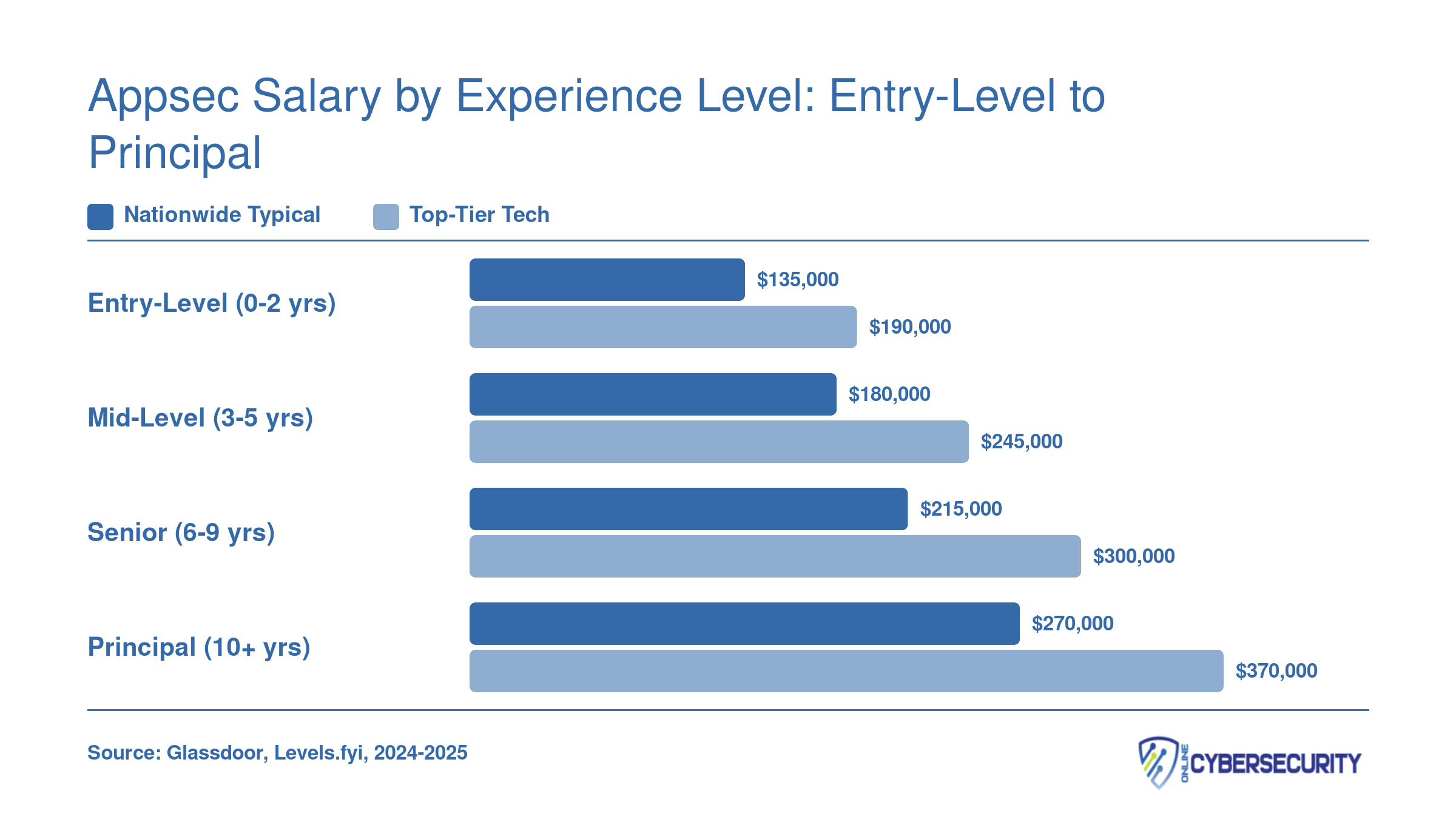
Appsec Salary by Experience Level: Entry-Level to Principal
Application security engineer salaries scale rapidly with experience, and adding certifications or moving to a top-tier tech employer can push total compensation significantly higher. The chart below compares typical nationwide total compensation across four seniority tiers, from entry-level to principal. At the highest levels, total comp can nearly triple what a junior engineer earns.
Career Path and Progression: From Entry-Level to Senior Appsec
Understanding the typical career ladder in application security helps you set realistic timelines and plan your next move with confidence. Whether you are entering the field fresh or pivoting from an adjacent role, knowing what each rung looks like makes the climb far less mysterious.
The Core Career Ladder
Most application security engineers move through four broad levels, each with a typical tenure before the next promotion.
- Junior / Associate AppSec Engineer (1 to 3 years): You triage vulnerability scan results, assist with code reviews, and learn the secure development lifecycle under the guidance of senior teammates. Expect a heavy learning curve and lots of mentorship.
- Mid-Level AppSec Engineer (2 to 4 years): You own threat models for individual products, lead penetration tests, and begin mentoring juniors. At this stage you are expected to recommend architectural changes, not just flag bugs.
- Senior AppSec Engineer (3 to 5 years): You drive security strategy across multiple product lines, define policies, and influence engineering culture. Cross-team collaboration and stakeholder communication become as important as technical depth.
- Principal Engineer / Security Architect / AppSec Manager (5 plus years): You set the organizational security roadmap, evaluate emerging threats at scale, and may manage a team of engineers. Some professionals choose the individual-contributor principal track while others move into people management.
Lateral Entry Points and Skill Gaps
Many successful AppSec engineers did not start in security. Here are common pivot paths and the gaps each role typically needs to close.
- Software Developer: Already comfortable with code and SDLC workflows. Needs to build expertise in threat modeling and vulnerability classification frameworks such as OWASP Top 10.
- DevOps / SRE: Brings strong CI/CD pipeline and infrastructure-as-code skills. Needs deeper knowledge of secure coding practices and application-layer attack patterns.
- SOC Analyst: Has experience with incident detection and log analysis. Professionals on this path may also want to explore how to become a security analyst for additional context. Needs to develop proficiency in reading source code and integrating security tooling into development pipelines.
- System Administrator: Understands OS hardening and network segmentation. Needs hands-on experience with web application frameworks and modern API architectures.
- QA Engineer: Skilled in testing methodologies and automation. Needs to shift from functional testing to adversarial thinking, learning how to craft exploit scenarios rather than only verifying expected behavior.
Specialization Forks at Mid-Career
Once you reach the mid-level stage, you will notice the field branching into distinct specializations. Choosing a fork does not lock you in permanently, but it does shape your day-to-day work and the tools you master.
- Web and API Security Specialist: Focuses on server-side and client-side vulnerabilities, OAuth flows, and API gateway hardening. Ideal if you enjoy deep-diving into HTTP traffic and authentication protocols.
- Mobile AppSec: Concentrates on iOS and Android platform security, reverse engineering mobile binaries, and securing data at rest on devices. This path suits engineers who like working close to hardware constraints.
- Cloud Security Engineer: Centers on securing workloads across AWS, GCP, or Azure, including container security, serverless function hardening, and identity and access management policies. Engineers drawn to this fork should consider the cloud security specialist roadmap for a deeper look at the required skills.
- Product Security Engineer: Operates as an embedded security partner within a product team, owning the full lifecycle from design review through post-release monitoring. This role demands strong communication skills alongside technical chops.
Regardless of the fork you choose, the fundamentals you built in the early years (threat modeling, secure code review, and toolchain fluency) remain the foundation. Career progression in AppSec rewards depth and breadth in roughly equal measure, so stay curious, keep building, and do not hesitate to move laterally before moving up.
Job Outlook and How to Land Your First Appsec Role
The demand for application security engineers is not slowing down. According to Bureau of Labor Statistics projections for 2024 to 2034, employment for Information Security Analysts is expected to grow by 33 percent, roughly ten to eleven times faster than the average across all occupations (which sits at about 3.1 percent).1 That translates to approximately 17,300 new openings each year over the decade.2 Within that broader category, AppSec is one of the fastest-growing sub-specialties, driven by the shift-left movement and the reality that most breaches originate in the application layer. Globally, the cybersecurity workforce gap remains severe: as of 2024, an estimated 4.8 million positions were unfilled against a total demand of about 10.2 million, leaving a gap of roughly 47 percent. Even though security job postings dipped about 36 percent from their pandemic-era peak, unfilled positions still grew 19 percent year over year, signaling that employer need continues to outpace available talent. If you are earlier in your career and considering related roles, the how to become a security analyst guide is a solid starting point before specializing in AppSec.
What to Expect in the AppSec Interview Process
AppSec hiring pipelines tend to follow a consistent structure, and knowing what is coming helps you prepare deliberately rather than scrambling.
- Resume screen: Hiring managers scan for relevant tools, languages, and quantifiable security outcomes. Generic resumes get filtered out quickly.
- Recruiter call: A 20 to 30 minute conversation focused on your background, salary expectations, and interest in the company's product or security posture.
- Technical screen: This is where AppSec interviews diverge from general software engineering. Expect a secure code review exercise where you identify vulnerabilities in a snippet of Java, Python, or JavaScript, or a capture-the-flag style challenge that tests exploitation and remediation skills.
- System design and threat modeling round: You will be asked to diagram a feature or microservice and walk through how you would threat-model it, covering trust boundaries, data flows, and mitigations.
- Behavioral and culture fit: Teams want to know you can communicate risk to developers without creating friction. Be ready to describe situations where you balanced security rigor with delivery speed.
Resume Tips That Actually Move the Needle
Your resume is your first security audit, so treat it with the same precision you would bring to a code review.
- Quantify your impact whenever possible. Instead of writing "performed code reviews," say something like "identified and drove remediation of 120-plus vulnerabilities across three product lines, reducing critical findings by 40 percent within two release cycles."
- Name the tools you have used by category: SAST (for example, Semgrep, Checkmarx), DAST (Burp Suite, OWASP ZAP), SCA (Snyk, Dependabot), and secrets scanning (TruffleHog, GitLeaks). Hiring managers often keyword-search resumes before reading them.
- If you have published CVEs, contributed to bug bounty programs, or authored vulnerability disclosures, list them. These are concrete proof of skill that most candidates cannot match.
- Tailor each resume to the job description's emphasis within the SDLC. If the posting highlights CI/CD pipeline integration, foreground your experience with pipeline security gates and automated scanning. If the role leans toward threat modeling and architecture review, lead with design-level work.
Remote Work Viability in AppSec
One of the practical advantages of an AppSec career is location flexibility. Because the day-to-day work centers on reviewing code, configuring scanning tools, and collaborating with development teams through pull requests and ticketing systems, most AppSec roles are remote-friendly. Many companies that adopted distributed engineering teams continue to hire AppSec engineers regardless of geography.
That said, some environments are exceptions. Organizations handling classified government data, companies in heavily regulated industries like defense contracting, and certain financial institutions may require on-site presence for compliance or clearance reasons. If you are targeting leadership growth over time, exploring how to become a CISO can help you map the long-term trajectory from hands-on AppSec into executive security roles. If location independence is a priority, filter job listings for remote-eligible positions early in your search and confirm the arrangement during the recruiter call to avoid surprises later in the process.
The bottom line: the market strongly favors candidates who combine hands-on technical skills with clear communication and a well-crafted resume. Prepare for each interview stage deliberately, and you will stand out in a field that still has far more open roles than qualified applicants to fill them.
Frequently Asked Questions About Application Security Engineering
Breaking into application security engineering raises a lot of practical questions, especially if you are coming from another tech role or a non-traditional background. Below are concise, actionable answers to the most common questions career changers and students ask about the field in 2026.