

What you’ll learn in this article…
- The DoW Cyber Apprenticeship is a 12-month paid program with no degree required.
- Applications close July 17, 2026, after 70,000 early inquiries.
- Graduates earn certifications and fill roles like Cyber Defense Analyst.
A four-year cybersecurity degree can cost $40,000 and delay earnings until graduation. The Department of War's new Cyber Apprenticeship Program eliminates both barriers: it pays you to learn and places you in a government cyber role in 12 months. After previewing the program in April 2026, the DoW saw over 70,000 inquiries.1 The application window opened July 6 and closes July 17, 2026, on USAJOBS.
The Technical Specialist pathway requires no college degree and no prior professional cyber experience, marking a decisive shift toward skills-based hiring in federal cyber defense. Career changers who demonstrate aptitude can bypass the traditional degree pipeline entirely, which is where how to become a cybersecurity professional resources become a useful complement to this kind of program.
With an 11-day application window and unprecedented applicant interest, securing a spot demands both speed and preparation. For career changers, this apprenticeship represents a tangible on-ramp into national security work that sidesteps years of classroom training.
What Is the Dow Cyber Apprenticeship Program (Cyber RAP)?
What exactly is the Department of War's Cyber Apprenticeship Program, and how does it work? Officially unveiled in 2026, the DoW Cyber Apprenticeship Program, often called Cyber RAP, is a 12-month paid apprenticeship designed to train entry-level cybersecurity professionals for mission-critical roles inside the Department of War. Run by the Office of the Chief Information Officer, the program is a direct response to the growing demand for cyber talent in the federal workforce. It's not a temporary internship; it's a structured pathway into permanent federal employment that aligns with the department's long-term workforce strategy.
A Purpose-Built Pipeline
Cyber RAP was created to bridge the gap between raw aptitude and job-ready skills. According to the official announcement on war.gov, the program attracted over 70,000 inquiries within its first preview period, signaling huge interest from career changers and aspiring cyber professionals.1 DoW Chief Information Officer Kirsten Davies emphasized that the program "removes barriers" by not requiring a college degree for the Technical Specialist pathway, instead focusing on what candidates can do. The goal is to build a diverse talent pool that reflects the nation's capabilities, bringing fresh perspectives into national security roles.
Training That Mirrors Real-World Demands
The apprenticeship uses a three-pillar approach: online coursework, hands-on labs, and on-the-job training. Apprentices learn cybersecurity fundamentals through a blend of self-paced digital learning and instructor-led sessions, then apply those skills in simulated environments and real agency systems. This competency-based model culminates in industry-recognized certifications that carry weight in both government and private-sector hiring. The curriculum is regularly updated to align with emerging threats, ensuring apprentices graduate with skills that are immediately applicable.
From Apprentice to Federal Cyber Professional
Successful completers fill defined roles such as Cyber Defense Analyst and incident responder career path, positions that are critical to protecting DoW networks and data. Because the program is a true apprenticeship, graduates transition directly into full-time federal jobs, making Cyber RAP one of the most direct routes into a cybersecurity career without needing prior professional experience. The department's investment in this program underscores its commitment to growing the next generation of cybersecurity leaders from within.
Eligibility Requirements and Who Should Apply
The application window is open only until July 17, 2026,1 so determining whether you qualify is the first step. Fortunately, the Cyber RAP removes many traditional barriers to entry, making it accessible to a wide range of applicants. Below we break down what the program requires, and who is most likely to succeed.
The Official Requirements
To apply, you must be a U.S. citizen, at least 18 years old, and able to obtain a Secret security clearance.2 The program is physically based in the Washington, DC area, so relocation or local residency is necessary. No prior professional cybersecurity experience is expected , this is a learn-on-the-job apprenticeship. A background check is part of the clearance process, so a clean record helps.
No College Degree? No Problem
The Technical Specialist pathway specifically waives any education requirement.2 You do not need an associate, bachelor's, or master's degree. This is a major shift toward skills-based hiring and opens the door for career changers, self-taught learners, cybersecurity bootcamp online graduates, and IT support specialists who want to pivot into cybersecurity without returning to school. If you have built foundational knowledge through platforms like TryHackMe, Hack The Box, or free online courses, you are exactly the kind of applicant the program seeks.
Who Makes an Ideal Candidate?
The Cyber RAP is designed for people with raw aptitude and a hunger to learn. Ideal applicants include cybersecurity careers for military veterans transitioning to civilian tech roles, help-desk or desktop support technicians, and anyone who has demonstrated problem-solving and analytical thinking, even in non-IT roles. According to the USAJOBS listing,2 evaluators look for "work ethic, eagerness to learn, analytical ability, and commitment" rather than a resume packed with certifications. If you can show you are dedicated and trainable, you fit the profile.
Facing the Competition
After an early preview generated over 70,000 inquiries, competition is expected to be fierce.3 The DoW has not disclosed the cohort size for this pilot year. Selection relies heavily on a resume and online questionnaire that assesses the competencies above. To stand out, tailor your resume to highlight projects, self-study, team collaboration, and any technical troubleshooting you have done, even if unpaid or volunteer. Meeting the minimum requirements is easy, but convincing the hiring team you are ready to grow is what will set you apart.
Technical Specialist Vs. DMDC Pathway: Key Differences
The Technical Specialist pathway is the first DoW cyber track to drop the college-degree requirement, opening doors for career changers and self-taught talent. The DMDC pathway still requires a degree, making it a distinct option for those with formal education.1 Both streams feed into the same 12-month paid apprenticeship, but your choice shapes where you train and where you'll ultimately serve.
Educational Requirements
The biggest differentiator is the degree gate. The Technical Specialist pathway requires no degree at all: applicants need only U.S. citizenship, be at least 18 years old, and be able to obtain a Secret clearance.1 The DMDC pathway, by contrast, requires a college degree. This makes the Technical Specialist track ideal for entry-level candidates, veterans transitioning to cybersecurity careers, or anyone who has built cyber skills through bootcamps, certifications, or self-study.
Training Focus and Role Placement
- Technical Specialist: Training covers generalized DoW cyber operations, and upon graduation you can be placed across various DoW components at multiple duty stations.2
- DMDC Pathway: Training zeroes in on DMDC-specific missions and systems, and your post-program placement stays within DMDC facilities.2
Both pathways prepare you for the same high-demand roles: Cyber Defense Analyst, Cyber Defense Infrastructure Support Specialist, and Cyber Defense Incident Responder.3 The difference is breadth versus depth: DoW-wide exposure versus deep immersion inside one defense agency.
Pay, Duty Stations, and Career Outcomes
All apprentices earn an annual stipend of $22,584 (GG-7 to GG-9 range) with no promotion potential during the program.3 Positions are on-site only (no telework) at either DoW cyber duty stations or DMDC facilities, depending on your pathway.3 After 12 months, successful graduates walk away with industry-recognized certifications and direct eligibility for these cyber defense roles, with no further application hurdles.
Related Articles
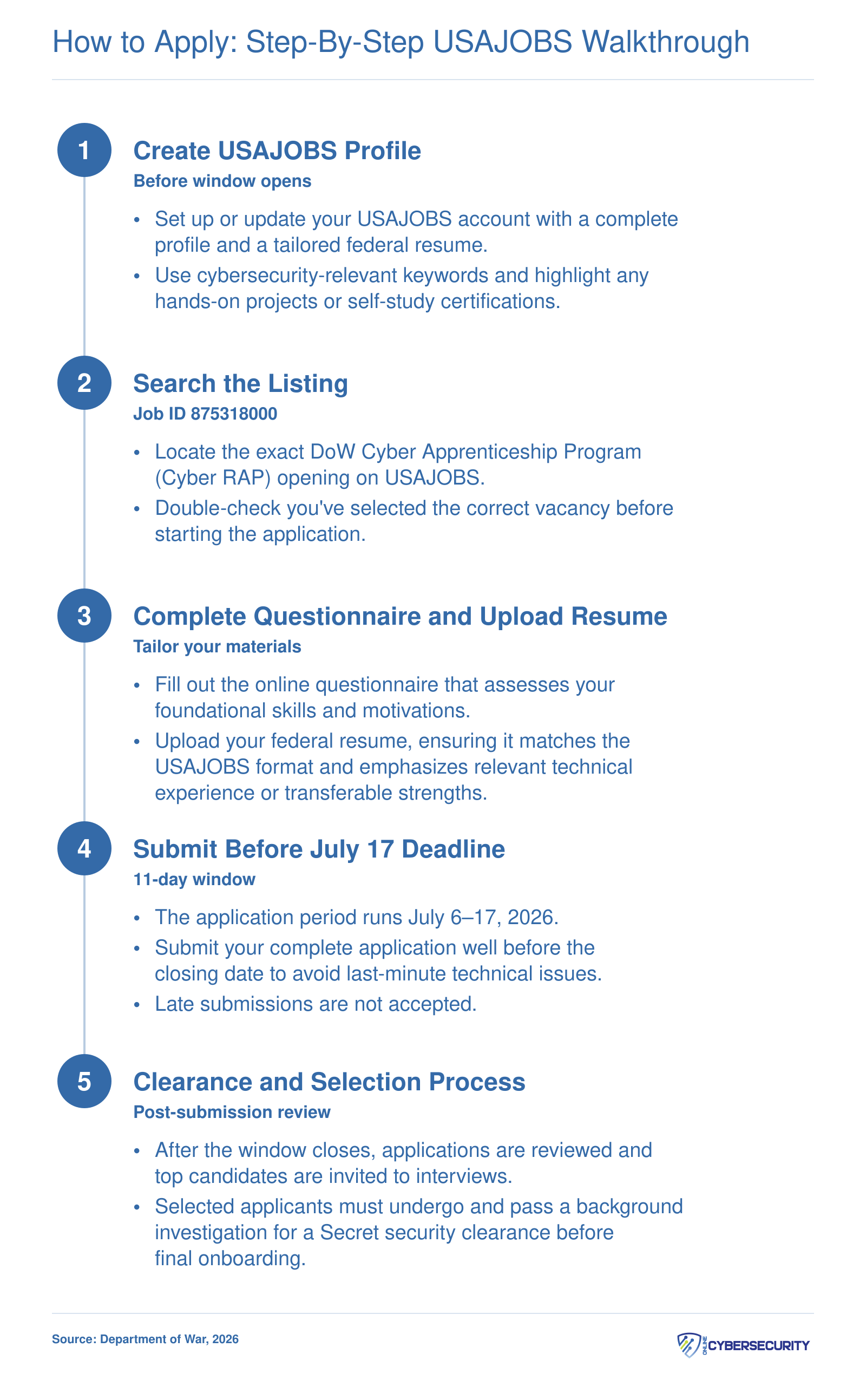
How to Apply: Step-By-Step USAJOBS Walkthrough
The application process for the DoW Cyber Apprenticeship is entirely through USAJOBS, the federal government’s official job site. With an 11-day window (July 6–17, 2026), preparation is key. Follow these steps to ensure your application is complete and competitive.
Training, Certifications, and What a Typical Week Looks Like
During the 12-month Cyber Registered Apprenticeship Program (Cyber RAP), participants earn industry-recognized certifications that open doors to DoD 8140 cyber roles.1 The curriculum blends three learning methods to build real-world proficiency fast.
A Blended Learning Model
The apprenticeship integrates asynchronous online learning, immersive hands-on labs, and structured on-the-job training. Each component reinforces the others, so you are not just studying concepts but applying them immediately. Online modules cover security operations, network defense, ethical hacking, and AI-driven threat analysis.2 Labs simulate live attack scenarios where you practice defensive and offensive techniques in a sandbox environment. On-the-job training pairs you with experienced cybersecurity professionals inside a DoW agency, letting you work on actual systems under supervision.
Certifications with Real Market Value
While the official announcement does not list specific certification names,1 similar federal cyber apprenticeships typically guide participants toward CompTIA Security+, CySA+, and GIAC certifications. These credentials are widely respected: Security+ is often a baseline requirement for government jobs, CySA+ validates advanced threat detection skills, and GIAC certifications prove deep technical expertise. Even without a college degree, earning two or three of these can demonstrate job-ready competence to employers across the public and private sectors. If you want a broader view of how accelerated cybersecurity certification programs fit into a career plan, the comparison is instructive.
A Typical Week: Asynchronous and Immersive
A full-time week weaves together self-paced online study, scheduled lab sessions, and recurring on-the-job tasks.3 Expect roughly 15 to 20 hours of online coursework, 10 to 15 hours in labs, and the remainder in hands-on agency work. The mix shifts as you progress: early weeks emphasize foundational knowledge and lab drills, while later months tilt toward real-time incident response and defense operations. The schedule is demanding but designed for newcomers, with no prior professional cyber experience required.
Location and Logistics
Official documents do not detail a remote work policy,4 but the heavy lab and on-the-job components suggest at least partial on-site presence at a duty station determined by the hiring agency.5 USAJOBS posting details will confirm the specific location. Trainees can expect a structured, mentorship-driven environment rather than a fully virtual setup. Toward the end of the 12 months, apprentices often rotate through specialized teams to broaden their exposure before graduating.
From Training to DoD 8140 Compliance
The program's certifications, combined with documented on-the-job training hours, qualify graduates for entry-level roles such as security analyst certifications or Incident Responder under DoD 8140 guidelines.5 This means you can step directly into a government cyber position without first earning a degree, proving that skills-based learning is not just a theory but a working pipeline into national security careers.
Pay, Benefits, and Security Clearance Details
GG-7 to GG-9 Pay Progression: Base Salary and Locality
The DoW Cyber Apprenticeship places participants on the DCIPS STEM/Cyber pay scale, which includes a Targeted Local Market Supplement (TLMS) that significantly boosts base pay to match regional costs.1 Apprentices enter at the GG-7 level, with total compensation in the Washington, DC area ranging from $81,901 to $111,935 for 2026, depending on step placement.1 As you demonstrate skills and complete training milestones, you move through GG-8 (roughly $88,315 to $120,692) and then to GG-9 (about $94,909 to $129,717).1 The exact totals depend on your assigned duty station. TLMS percentages vary nationwide, so an apprenticeship in a lower-cost region would see a smaller supplement, but the base scale remains competitive.
Federal Benefits: More Than a Paycheck
Beyond your salary, federal benefits add roughly 30-40% to your total compensation.2 Apprentices are eligible for the Federal Employees Health Benefits (FEHB) program, with dozens of plan options. You automatically participate in the Federal Employees Retirement System (FERS), a three-part package that includes a basic pension, Social Security, and the Thrift Savings Plan (TSP), a 401(k)-like account with government matching up to 5%. Paid leave accrues from day one: 13 days of annual leave per year for the first three years, plus 13 days of sick leave, and all 11 federal holidays. Additional perks like flexible spending accounts and life insurance are also available.
Security Clearance: Process and Common Hurdles
All participants must obtain a Secret security clearance, but you do not need one to apply.2 The investigation runs concurrently with your early training. Many apprentices start working with an interim clearance after an initial background check, while the full review proceeds in the background. Expect the process to take three to six months. The most common disqualifiers include serious financial delinquencies (unpaid debts in collections, bankruptcy), recent illegal drug use, or foreign contacts that raise security concerns. Full disclosure on your SF-86 form is critical: minor past issues can often be mitigated, but omitting them is itself a red flag. Check your credit report and be ready to discuss any anomalies.
How Apprentice Pay Stacks Up Against Private Sector Entry-Level Cyber Roles
Entry-level cybersecurity career paths in the private sector typically start at median base salaries of $70,000 to $85,000, often with fewer benefits and less job security. When you factor in the FEHB, FERS pension, and TSP match, the total value of the apprenticeship compensation is highly competitive, especially for a role that requires no prior experience. Additionally, the program provides a direct path to permanent federal cyber roles like Cyber Defense Analyst and Incident Responder, which command even higher salaries with experience. For career changers, this apprenticeship offers a rare chance to earn while you learn in one of the most stable and mission-driven sectors of the economy.
Career Outcomes: Post-Program Roles and National Salary Outlook
With the Bureau of Labor Statistics projecting 28.5% job growth for Information Security Analysts through 2034, graduates of the Cyber RAP enter a field with expanding opportunities and strong earning potential. While salaries vary by location and agency, the median salary nationally reflects a profession that consistently pays above the U.S. average. The table below shows the five highest-paying states for this role, highlighting how federal cyber hubs like Maryland, Virginia, and Washington, D.C., offer some of the most competitive compensation.
| State | Median Annual Salary |
|---|---|
| Washington | $142,920 |
| California | $140,660 |
| Maryland | $140,480 |
| New Jersey | $135,390 |
| Delaware | $134,050 |
Cyber Apprenticeship Vs. Online Cybersecurity Degrees: How They Compare
For career changers weighing a fast track against a traditional degree, the DoW Cyber Apprenticeship and online cybersecurity programs represent two distinct paths. The paid apprenticeship offers immediate income and a security clearance, while a degree provides broader academic credentials and flexibility across industries. Understanding their trade-offs can help you choose the right starting point.
Pros
- Cyber RAP pays you from day one with no tuition costs, so you earn while you learn instead of taking on student debt.
- You receive hands-on training alongside federal mentors and earn industry-recognized certifications at no personal expense.
- The program provides direct placement into high-demand government cyber roles and grants a Secret security clearance, a major career accelerator.
- No degree is required for the Technical Specialist pathway, making it accessible to career changers without a four-year credential.
Cons
- Admission is extremely competitive with limited cohort spots and a narrow annual application window, making it unpredictable.
- Training and career outcomes are heavily centered on federal roles, which may not translate directly to certain private-sector opportunities.
- You will not earn transferable college credits, so if you decide to pursue a degree later, the apprenticeship will not count toward your course requirements.
- The program's focus on specific government systems may limit exposure to the wider range of tools and environments common in industry.
Frequently Asked Questions About the Dow Cyber Apprenticeship
Still have questions about the Department of War Cyber Apprenticeship Program? Browse these frequently asked questions to learn more about eligibility, the application process, and what to expect after acceptance. If you don't see your question answered, check the official program page for the latest details.