
What you’ll learn in this article…
- Roughly 500,000 cybersecurity jobs remain unfilled across the United States.
- Indiana’s Cyber Network pays apprentices $20 hourly and placed 35 students.
- CAE-CD programs align with 52 NICE Framework cybersecurity work roles.
Half a million U.S. cybersecurity jobs sat empty last year, even as employers raised starting salaries and slashed experience requirements. The friction isn't a lack of candidates; it's a mismatch between what traditional degree programs deliver and what security operations centers actually need. Universities are now closing that gap by embedding certifications into curricula, running paid apprenticeship cohorts, and building direct feeder pipelines with state governments and private-sector employers. Indiana's model is a compelling example: the Indiana Cyber Network has built a middle-school-to-career pathway that funnels students into $20-per-hour cybersecurity apprenticeships, many of which convert to full-time roles. For anyone exploring entry-level cybersecurity jobs, this kind of integrated approach shifts the credential conversation from 'how long it takes' to 'how soon you can start protecting systems.'
The Scale of the Cybersecurity Workforce Gap in 2025-2026
How many cybersecurity positions remain unfilled across the U.S., and is the talent shortage actually improving? The numbers from 2025 and early 2026 paint a stark picture: the gap is vast, persistent, and expanding faster than the education system can fill it.
A Global Shortage of 4.8 Million Professionals
The ISC2 2025 Cybersecurity Workforce Study reveals an estimated 4.8 million unfilled cybersecurity positions worldwide.2 The study breaks down the state of the workforce using four categories:
- Right staffing: Only 34% of organizations have the cybersecurity staff they need.1
- Slight shortage: 44% report a slight shortage.1
- Significant shortage: 19% face a significant shortage.1
- Any skills need: A staggering 95% of organizations say their team has at least one skills gap, and 59% rate those gaps as critical.1
This global deficit means that even well-funded organizations struggle to find qualified candidates, and the competition for talent drives up salaries and lengthens hiring timelines. Our cybersecurity salary resource breaks down what those competitive wages look like by role and region.
Information Security Analysts: A National Snapshot
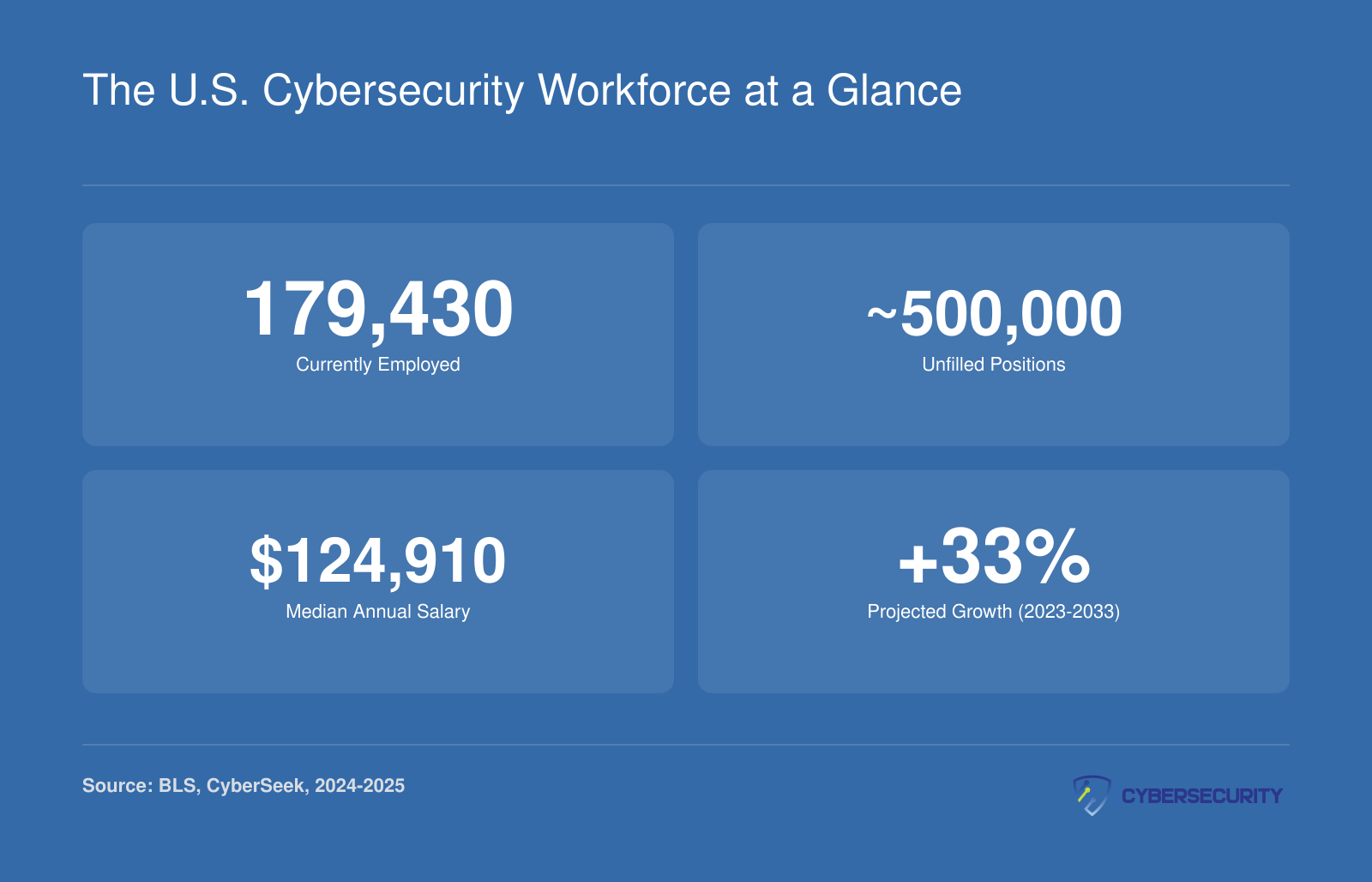
The U.S. Bureau of Labor Statistics counted approximately 179,000 information security analysts employed nationwide in its latest occupational data. This single role, central to most cybersecurity teams, commands a median annual wage of about $124,910, with top earners exceeding $159,600. Yet these 179,000 positions represent only a fraction of the total cybersecurity demand. Roles such as security engineers, incident responders, and penetration testers sit alongside analysts in an ecosystem that requires tens of thousands more workers.
The Gap Is Widening
BLS projections for the 2024-2034 period underscore that this is not a temporary spike. Employment of information security analysts is expected to grow roughly 33 percent, a rate much faster than the average for all occupations. As digital infrastructure expands, cloud adoption accelerates, and threat surfaces multiply, the demand for cybersecurity professionals will continue to outstrip the supply unless more people enter the talent pipeline through education and training.
State-Level Impact: Indiana as a Case Study
In Indiana, a mid-size state with a diverse economy, CyberSeek data from 2025 identified 5,368 unfilled cybersecurity positions. This mirrors the experience of dozens of states where hospitals, manufacturers, school districts, and local government agencies all compete for a limited pool of trained professionals. Indiana's figure, while smaller than the totals in larger coastal states, demonstrates that the shortage is not confined to tech hubs. To explore programs in the state, see the cybersecurity Indiana school listings.
What Is the Cybersecurity Talent Pipeline?
The "cybersecurity talent pipeline" refers to the coordinated pathway from early education and foundational IT skills through higher education, industry certifications, and work-based learning that prepares individuals to fill these roles. Understanding what cybersecurity is and why it is important provides useful context for anyone mapping that journey. Universities, community colleges, and K-12 partners are increasingly building structured pipelines that move students from awareness to employment, often with stackable credentials and paid apprenticeships along the way.
The U.S. Cybersecurity Workforce at a Glance
The cybersecurity workforce is facing a critical shortage. Current employment figures reveal a significant gap between available talent and open positions, with strong salary and growth projections underscoring the field's demand.
Five University Partnership Models Closing the Gap
Roughly 500,000 cybersecurity positions remain unfilled across the United States, driving universities and employers to experiment with a range of pipeline-building collaborations. No single model fits every region or learner profile, but five distinct approaches have emerged that collectively address gaps in hands-on experience, credentialing, and talent sourcing.
Student-Led Security Operations Centers (SOC)
In this model, universities operate an on-campus or virtual SOC where students deliver real-time threat monitoring and response services under faculty supervision. Marshall University partnered with Intuit to create a student-led SOC, giving learners direct exposure to threat detection, incident response, log analysis, adversary emulation, SIEM/EDR tooling, and executive incident reporting.1 The arrangement mirrors enterprise security roles, making graduates immediately deployable in government, defense, financial services, or critical infrastructure settings.
Apprenticeship-Degree Hybrids
Some schools embed paid work experience directly into degree completion. Fontbonne University and CyberUp combine academic coursework with registered apprenticeship hours, allowing students to earn a wage while gaining on-the-job competencies. This blend reduces the financial burden of education and addresses the classic entry-level catch-22 of needing experience to get a job. Employers co-design the curriculum and commit to hiring completers. If you are weighing your options, a deeper look at a cybersecurity degree vs. certifications comparison can help clarify which path fits your goals.
Research Consortia
The Northrop Grumman Cybersecurity Research Consortium links multiple universities with a defense-sector anchor to solve applied security challenges. Faculty and students collaborate on cutting-edge research that feeds directly into product development and threat intelligence. The model prioritizes innovation and advanced technical skills, often leading to specialized roles in national security or aerospace.
Hub-and-Spoke Networks
Regional coalitions like the Carolina Cyber Network connect a central coordinating body with a web of community colleges, universities, and employers. The hub standardizes curriculum, facilitates credit transfer, and aggregates employer needs, while spokes deliver localized training and wrap-around support. This structure scales quickly and aligns closely with state workforce priorities.
Reskilling Partnerships
For career-switchers, programs such as the Purdue University and ThriveDX collaboration offer intensive bootcamps or certificate programs that map to industry credentials. These short-term, high-touch experiences focus on practical skills and rapid job placement, often serving adults who already hold online cybersecurity degrees in other fields. The model emphasizes speed-to-employment and accelerated cybersecurity certification programs that keep pace with evolving threats.
Inside Indiana's Cyber Network: A Blueprint for Pipeline Programs
The cybersecurity talent pipeline is shifting away from degree-only requirements toward integrated work-and-learn models that deliver both credentials and experience. Nowhere is this shift more concrete than in Indiana, where a public-private consortium is proving that paid apprenticeships, early education pathways, and industry partnerships can close the workforce gap faster than traditional hiring alone.
The ICN Model at Anderson University
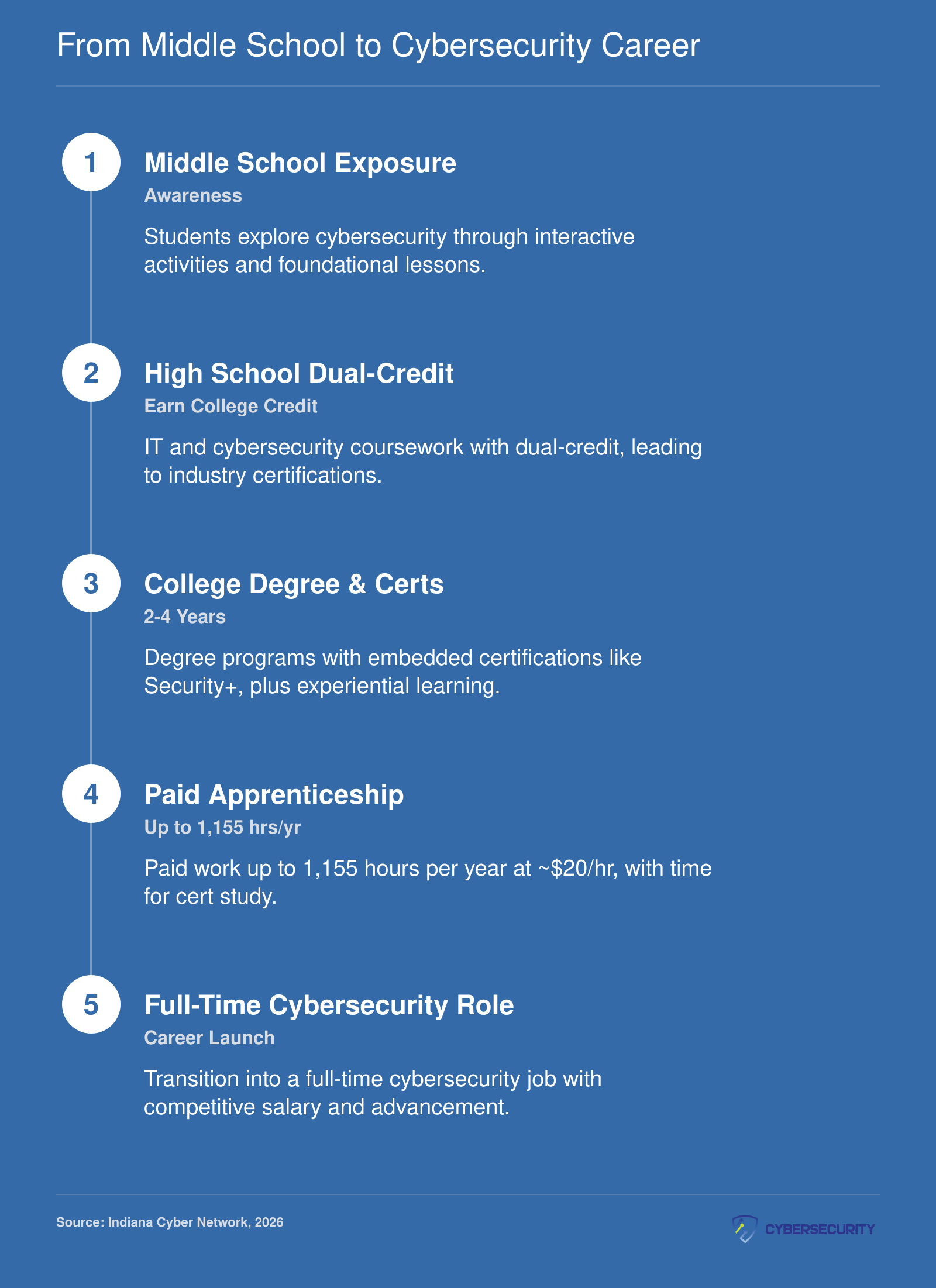
The Indiana Cyber Network (ICN), co-founded by David Dungan and housed at Anderson University's Center for Security Studies and Cyber Defense, connects students directly with employer needs. According to a 2026 GovTech report, ICN apprentices earn an average of $20 per hour while working up to 1,155 hours per year, with dedicated time built into their schedules for studying toward cybersecurity certifications.1 This paid-while-learning structure directly tackles the experience dilemma that blocks countless entry-level hopefuls. Employers often demand two years of hands-on work for roles labeled entry-level; ICN removes that barrier by embedding real cybersecurity tasks into the program.
Proven Outcomes and Regional Retention
Since 2023, roughly 35 students have completed the ICN program, and almost all have remained in Indiana to launch their careers.1 The only exceptions are two graduates who were originally from Ohio. That kind of retention rate is exactly what state workforce boards dream of seeing, turning public investment into immediate local talent. With Indiana facing about 5,368 unfilled cyber positions in 2025 according to CyberSeek, every graduate who stays represents a measurable step toward closing a critical skills gap.
Building a K-12-to-Career Pipeline
ICN's long-term vision extends further upstream. Its proposed pathway introduces cybersecurity concepts in middle school, scales into IT and cybersecurity degree program coursework with dual-credit opportunities during high school, and culminates in college-level classes and experiential learning. In May 2026, the Indiana Department of Education and the College Board reinforced this momentum by announcing a statewide push to bring cybersecurity education to 200 high schools and reach 4,000 students within three years.1 That alignment between ICN's design and state policy creates a seamless on-ramp from curiosity in a middle school classroom to a paid apprenticeship and, ultimately, a full-time cyber role.
Blending AI, Education, and Real-World Defense
ICN does not stop at classroom simulations. The network integrates AI-enabled cybersecurity education alongside workforce development and actual, client-facing cyber defense services. For students, this means learning to use threat detection tools that harness machine learning while also contributing to live security operations. That dual exposure, academic and operational, makes graduates immediately useful to employers who are themselves racing to adopt AI-augmented defenses. For career changers wondering whether a program will truly prepare them for the job, a model that marries certification prep, online cybersecurity associate's degree coursework, hands-on apprenticeship hours, and live-service work offers a compelling answer.
From Middle School to Cybersecurity Career
How Universities Integrate Certifications Into Degree Programs
NSA-designated Centers of Academic Excellence in Cyber Defense (CAE-CD) now map curricula to 52 specific NICE Framework work roles,1 directly connecting academic study to federal workforce needs. This alignment means that when you graduate from a CAE-CD program, you aren't just earning a degree; you're stepping into a role that government agencies and contractors actively recruit for.
The Stackable Credential Model
Leading universities now embed industry certification preparation into their degree coursework so that students graduate with both a diploma and recognized credentials. For example, Western Governors University and Purdue University include CompTIA Security+ and Certified Ethical Hacker (CEH) prep within their cybersecurity tracks.2 Coastline College aligns its entire curriculum with CompTIA Security+ objectives, ensuring students are exam-ready upon graduation.3 Excelsior University prepares learners for advanced credentials like CISSP and the EC-Council Security Certified Practitioner (ESCP).2 Even exam vouchers are often bundled into tuition at CAE-designated schools, and certifications can serve as graded milestones, reducing the financial and scheduling burden on students.4 If you're weighing which credentials to pursue first, the CompTIA Cybersecurity Career Pathway offers a practical sequence to follow.
NICE Framework Alignment and Employer Recognition
The NICE Cybersecurity Workforce Framework isn't just government shorthand; it is a detailed blueprint of knowledge, skills, and abilities for cyber roles. CAE-CD programs are required to map their courses to NICE Knowledge Units, which means every class you take correlates directly to the competencies that employers in the public and private sectors value.1 Drexel University's NSA-designated BS in Computing and Security Technology, for instance, aligns its learning outcomes to these work roles, giving graduates a clear advantage for federal positions.5 This mapping also signals to hiring managers that you have been trained against a nationally validated standard, not just a generic IT curriculum.
Cloud Certifications as the Next Layer
With organizations migrating infrastructure to the cloud, universities are now adding cloud security certifications on top of foundational ones. AWS Security Specialty and Azure Security Engineer Associate credentials are appearing in degree maps as advanced elective or integrated preparation tracks. While still emerging, this layered approach reflects the reality that modern cyber defense spans on-premises and cloud environments. Exploring accredited online cybersecurity programs can help you identify which schools have already built this layered model into their degree maps.
What This Means for Your Career
Walking into an interview with a degree plus CompTIA Security+ or CISSP on your resume dramatically shortens the hiring cycle. Employers know you can hit the ground running. Many federal contractors and agencies give hiring preference to CAE graduates,1 and the combination of a degree and certifications often boosts starting salaries by thousands of dollars compared to degree-only candidates. Choosing a program that builds in these credentials isn't just a checklist item; it's a direct investment in your marketability from day one. For a deeper look at how certification stacking compares to other training routes, see Cybersecurity Certifications vs. Bootcamps: Which Path Is Right for You?.
Statewide and Regional Workforce Initiatives Worth Watching
A Coordinated Effort: Why Statewide Initiatives Matter
The most effective cybersecurity workforce pipelines no longer rely on a single university program. States are now launching coordinated multi-institutional efforts that connect K-12 districts, community colleges, universities, and employers into seamless talent streams. These initiatives share a common recognition: closing the cyber workforce gap demands alignment across the entire education-to-employment spectrum.
- Virginia Cyber Innovation Center (CCI): Launched in 2019 with $25 million in state funding, CCI links over 40 higher education institutions, government agencies, and private companies through a hub-and-spoke model. It combines research, experiential learning, and workforce development, with regional nodes ensuring local relevance.
- Carolina Cyber Network: Established in 2020, this hub-and-spoke collaboration connects multiple community colleges, universities, and industry partners across best cybersecurity programs in North Carolina. Backed by state and National Science Foundation funding, it offers stackable credentials, apprenticeships, and curriculum alignment, making cybersecurity education accessible statewide.
- Maryland Cyber Workforce Accelerator: Launched in 2024, this program is a partnership of 16 community colleges offering a free, 48-hour accelerated training pathway.1 Funded by the state and federal Cyber Defense Services, it blends online asynchronous coursework with live instructor-led cyber range exercises.2 Participants, who must hold an associate degree or two of A+, Network+, or Security+, train for the SOC Operations Analyst I certification. The program targets 1,100 enrolled learners, and by March 2026, 394 individuals had completed training, with rolling enrollment and 40+ employer partners ready to hire.2 Learners interested in online cybersecurity programs in Maryland can use this initiative as a direct on-ramp into the state's employer network.
- Indiana High School Expansion: Announced in May 2026 by the Indiana Department of Education and the College Board, this initiative aims to bring cybersecurity education to 200 schools and 4,000 students within three years. It introduces dual-credit IT and cybersecurity coursework, preparing students for college-level study and certifications before graduation.
These programs illustrate how states are architecting talent pipelines that start as early as high school and extend into paid work experience, with multiple on-ramps and employer engagement at every stage. Stackable credentials tied to entry-level roles, like the top cybersecurity certifications that pay six figures, show why employers and state agencies are doubling down on credential-based hiring.
Related Articles
Cybersecurity Salaries and Career Outcomes From Pipeline Programs
The following table highlights state-level salary and employment data for information security analysts, drawn from the U.S. Bureau of Labor Statistics (2024). Keep in mind that these figures represent the entire profession, and pipeline program graduates entering the field will typically start at the lower end of these ranges, progressing upward with experience. Cybersecurity roles consistently earn a premium over many other IT positions, making them a strong long-term career bet.
| State | Employment | Mean Annual Wage | Median Annual Wage | 25th Percentile | 75th Percentile |
|---|---|---|---|---|---|
| Washington | 6,830 | $144,140 | $142,920 | $117,040 | $169,350 |
| California | 15,800 | $152,640 | $140,660 | $105,150 | $178,090 |
| Maryland | 8,770 | $145,450 | $140,480 | $105,230 | $175,390 |
| New Jersey | 4,730 | $141,130 | $135,390 | $108,320 | $168,240 |
| Virginia | 18,670 | $136,680 | $132,460 | $101,610 | $166,510 |
| New York | 8,860 | $139,540 | $131,100 | $98,320 | $170,220 |
| Colorado | 5,840 | $135,980 | $130,570 | $102,350 | $164,010 |
| Massachusetts | 5,780 | $129,350 | $127,610 | $101,730 | $161,940 |
| Georgia | 6,480 | $126,380 | $124,270 | $92,620 | $156,390 |
| Texas | 14,730 | $126,800 | $124,970 | $96,020 | $149,780 |
| Florida | 13,770 | $117,500 | $105,990 | $86,250 | $139,150 |
| Indiana | 2,540 | $91,740 | $78,290 | $64,500 | $115,650 |
How to Choose a Pipeline-Aligned Cybersecurity Program
Choosing a cybersecurity program with a true talent pipeline means weighing time to employment against the depth of a traditional degree. A well-structured pipeline should get you hands-on experience and industry credentials faster, while a conventional program might offer broader theory but slower entry into the workforce. Here is how to tell them apart and pick what fits your goals.
Key Features to Look For
A strong pipeline program will openly name its employer partners. Vague claims about "industry connections" are not enough; look for specific companies that actively recruit graduates, serve on advisory boards, or host apprentices. Embedded industry certifications are equally critical. The program should map CompTIA Security+, CySA+, or CISSP preparation directly into the curriculum, not merely offer optional exam vouchers. Check that you can earn these credentials as part of your coursework, not on the side.
Hands-on environments are non-negotiable. The curriculum should include access to live security operations centers, cyber ranges, or simulated attack scenarios, not just textbook labs. Ask about published placement rates and, just as important, how those rates are calculated. A program aligned to the NICE Framework will structure courses around recognized workforce roles, giving you a clear path to jobs like SOC analyst or penetration tester. Browsing best online cybersecurity programs can help you compare how schools stack these features side by side.
Special Considerations for Career Changers
If you are switching fields, switching to cybersecurity from other IT careers offers a step-by-step breakdown of reskilling options worth reviewing alongside your program search. Some universities, like Purdue with its ThriveDX partnership, offer accelerated bootcamps or bridge courses that assume no prior tech experience. Flexible scheduling, including evening and online options, is vital if you are balancing a current job. Also look for prior-learning credit options that can shorten your timeline by recognizing previous degrees or military training.
Red Flags That Signal a Weak Program
Beware of any program that lists certifications as "available" but does not weave prep into the core classes. If you must self-study and pay extra for each attempt, the value diminishes. The Center of Academic Excellence in Cybersecurity designation is a baseline signal of quality; if a program lacks it, ask why. Finally, if a school cannot name specific employer partners that hire its graduates, the pipeline may be more marketing than reality.
The Apprenticeship Advantage
The most powerful pipeline programs include paid, work-based learning. The Indiana Cyber Network model shows how apprenticeships pay students roughly $20 per hour while they earn credentials and build professional networks. This approach not only offsets tuition but also solves the classic catch-22 of needing experience to get a job. Traditional internships rarely offer comparable income or long-term commitment, so prioritize programs that embed apprenticeships directly into the degree plan. A computer science cybersecurity concentration can pair particularly well with this model, giving you the theoretical foundation to back up hands-on apprenticeship work.
Common Questions About Cybersecurity Pipeline Programs
Cybersecurity pipeline programs are reshaping how the next generation of professionals enters the field. Below, we answer the most common questions about university-led workforce initiatives, certifications, and career pathways.