

What you’ll learn in this article…
- Expect a three to five year timeline from scratch, or 12 to 18 months if you already hold an IT role.
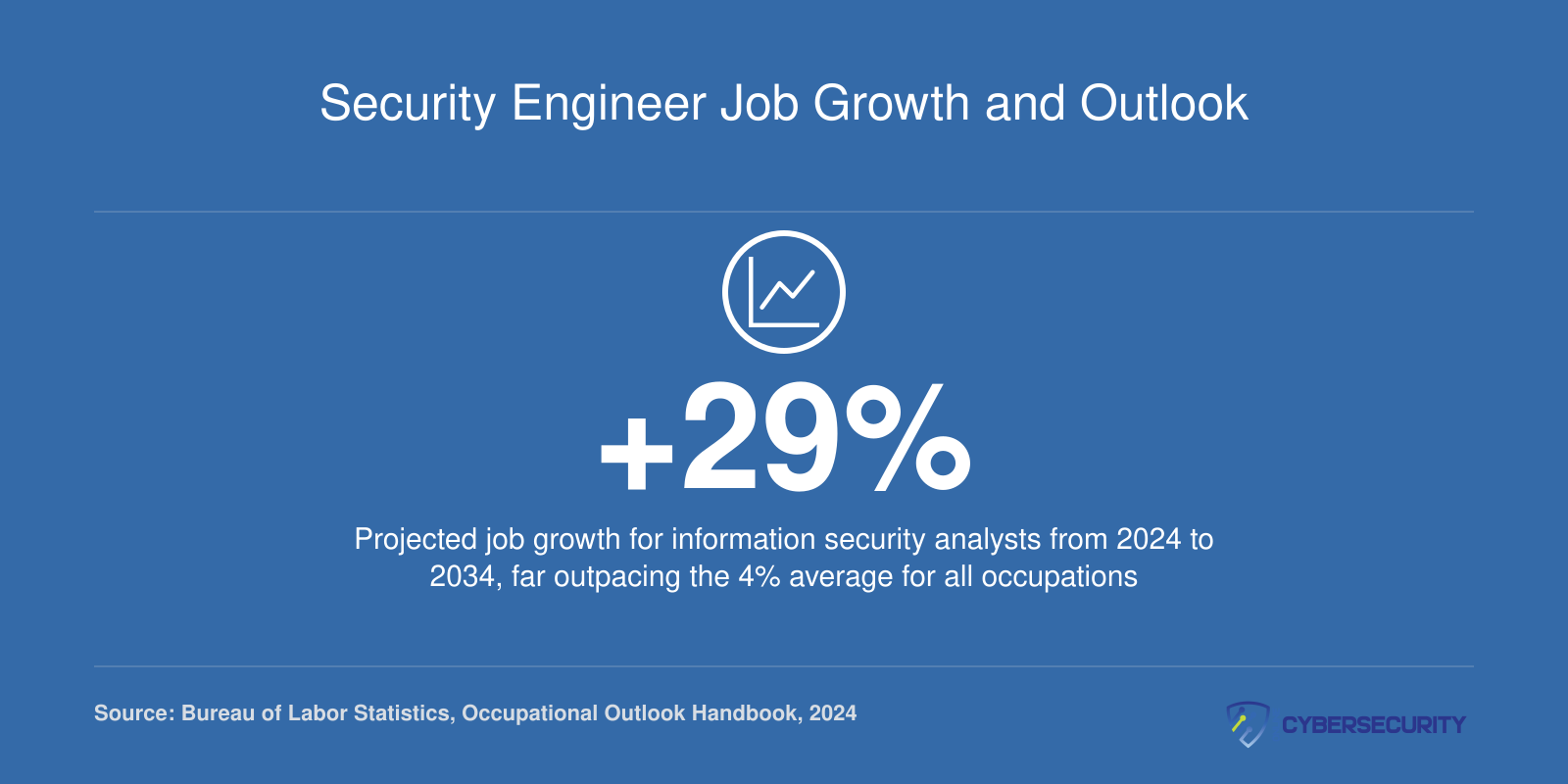
- BLS projects information security analyst demand will grow roughly seven times faster than the average for all occupations through 2034.
- California, Virginia, and Maryland consistently offer the highest median salaries and the most open security engineer positions.
- Building a portfolio of home lab projects and automation scripts can outweigh a missing degree during the hiring process.
Security engineers rank among the fastest-growing roles in tech, with the Bureau of Labor Statistics projecting demand growth roughly seven times the national average through 2034. Median pay already sits well above six figures in most major metros, and employers routinely struggle to fill open positions. That supply gap is real, but so is the confusion around how to actually break in.
If you are working a help desk, sysadmin, or network engineering role today, you are closer than you think. If you are starting from zero, the timeline is longer but still concrete: three to five years with deliberate planning. The harder question is not whether opportunities exist but which sequence of skills, credentials, and job moves will get you there without wasted effort. This guide walks through the cybersecurity career path from foundational skills and certifications to specialization tracks and salary benchmarks, so you can build a plan that fits your starting point. Employer expectations vary sharply by sector, and the wrong certification stack can cost you a year of momentum.
What Does a Security Engineer Do?
A security engineer is the person who designs, builds, and maintains the systems that keep an organization's digital assets safe. While other cybersecurity roles focus on monitoring alerts, advising leadership, or probing for weaknesses, the security engineer is squarely in the construction zone: writing firewall rules, automating detection pipelines, hardening cloud environments, and making sure every new piece of infrastructure ships with security baked in rather than bolted on.
Day-to-Day Responsibilities
The daily work of a security engineer spans a range of hands-on technical tasks. While priorities shift depending on the employer, most roles involve some combination of the following:
- Configuring firewalls and intrusion detection systems: Deploying, tuning, and maintaining network security controls to filter malicious traffic and flag anomalous behavior before it reaches production systems.
- Hardening cloud infrastructure: Reviewing and locking down configurations in platforms like AWS, Azure, or GCP, including identity and access management policies, storage bucket permissions, and network segmentation.
- Automating security controls: Building scripts, playbooks, and CI/CD pipeline integrations that enforce security policies without manual intervention, reducing human error and speeding up response times.
- Incident response tooling: Creating and maintaining the tools, dashboards, and runbooks that incident responders rely on when a breach occurs, so the team can move from detection to containment quickly.
- Vulnerability management: Running scans, triaging findings, and working with development or infrastructure teams to remediate weaknesses on a risk-prioritized schedule.
How the Role Differs from Related Positions
Security engineering sits at the intersection of several cybersecurity disciplines, and it helps to draw clear lines. A SOC analyst is primarily reactive, monitoring dashboards and triaging alerts as they come in. A security architect career path operates at a higher level of abstraction, defining strategy, reference architectures, and long-term security roadmaps without necessarily writing the code or configurations. A penetration tester works on the offensive side, simulating attacks to find gaps. The security engineer, by contrast, is the one who takes an architect's blueprint, turns it into working infrastructure, and keeps that infrastructure running day after day. Think of it this way: the architect draws the vault, the engineer builds it, and the pen tester tries to crack it.
A Note on Job Titles
One thing that trips up job seekers is the sheer variety of titles attached to this work. Depending on the company, you might see the same core responsibilities listed under "infrastructure security engineer," "platform security engineer," "DevSecOps engineer," or simply "security engineer." Some titles overlap with specialized niches; for example, teams that embed security into the software development lifecycle may post roles that closely resemble application security engineer tools in practice. Smaller organizations sometimes bundle the role with broader site reliability or cloud engineering duties, while larger enterprises tend to carve out more specialized positions. When you are searching for openings, focus less on the exact title and more on whether the job description emphasizes building and maintaining security systems. That engineering emphasis is the defining trait of the role, regardless of what the posting is called.
Security Engineer Skills: What You Need to Learn (And in What Order)
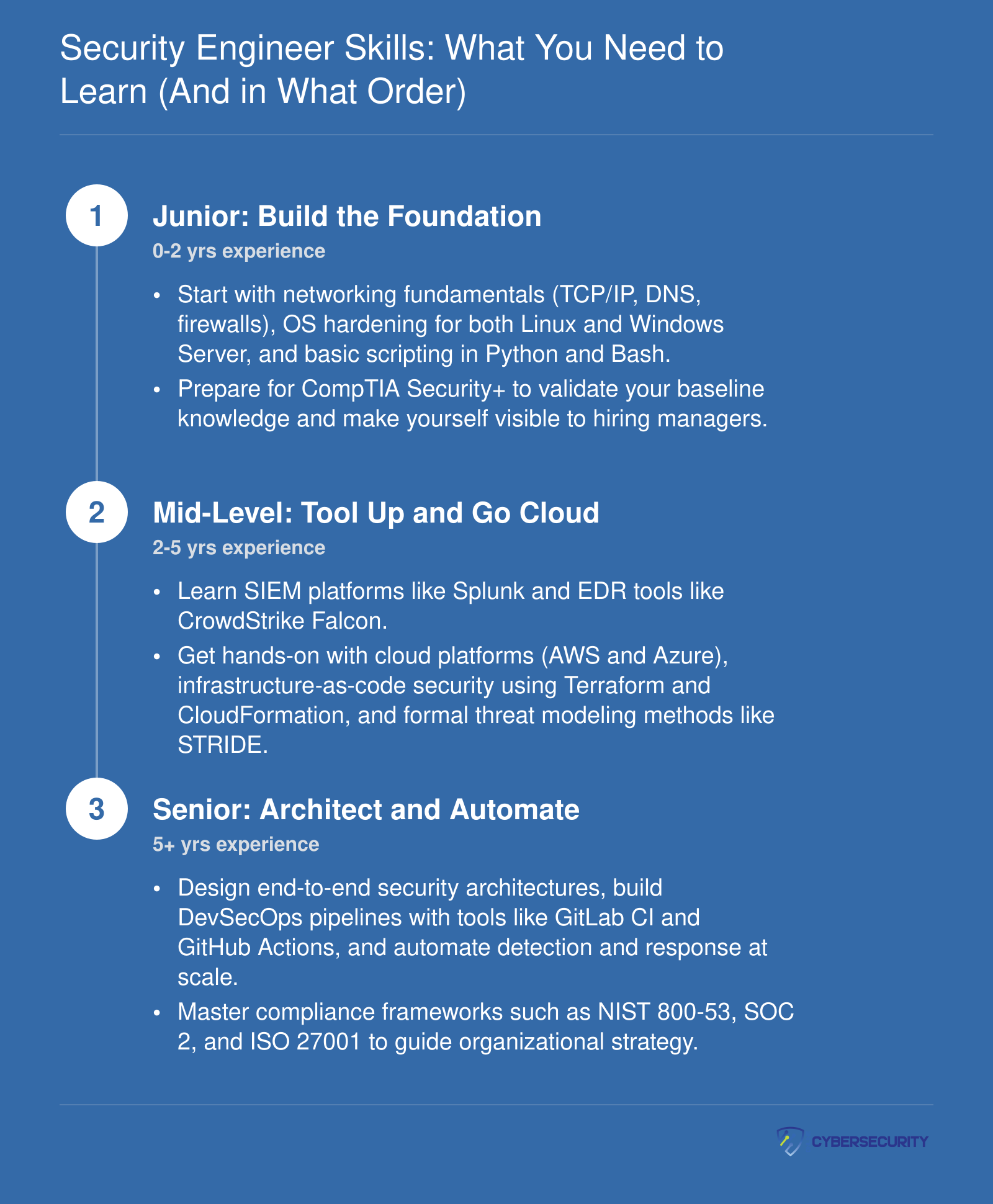
The biggest mistake career switchers make is jumping straight to security tools before mastering foundational IT skills. Networking, Linux, and Windows Server administration are the bedrock everything else sits on. Build these first, then layer security-specific skills on top in a deliberate order.
Step-By-Step Path to Becoming a Security Engineer
Most people want a straight answer to the timeline question, so here it is: if you are starting from scratch with no IT background, plan on three to five years to land a security engineer title. If you are already working in an adjacent IT role (sysadmin, network engineer, cloud operations), you can compress that timeline to one to two years. Either way, the path breaks into five phases that overlap more than they stack neatly.
Phase 1: Build Foundational IT Knowledge (6 to 12 Months)
Security engineering sits on top of a broad IT foundation. Before you can protect systems, you need to understand how they work. Spend the first six to twelve months getting comfortable with networking (TCP/IP, DNS, firewalls, routing), operating systems (Linux command line and Windows Server administration), and basic scripting (Python or Bash). You do not need a degree to start this phase. Free and low-cost resources, community college courses, and structured self-study can all get you there. For those considering a more formal route, a cybersecurity degree program can accelerate this foundational phase considerably. The goal is fluency, not perfection: you need to troubleshoot confidently and read logs without guessing.
Phase 2: Land an Entry-Level IT Role (1 to 2 Years)
Hands-on experience matters more than any other single factor. Look for help desk, junior sysadmin, or NOC analyst positions. These roles teach you how production environments actually behave, how incidents unfold in real time, and how teams communicate under pressure. Expect to spend one to two years building that operational muscle memory. Every ticket you resolve and every outage you help triage adds context that will serve you later.
Phase 3: Earn Foundational Certifications and Start Security-Adjacent Work (Concurrent with Phase 2)
While you are working in that entry-level role, begin layering in security knowledge. Cybersecurity certifications like CompTIA Security+, the AWS Cloud Practitioner credential, or a vendor-specific firewall cert signal baseline competence to hiring managers. More importantly, volunteer for security-adjacent tasks at work: assist with patch management, shadow the security team during an audit, or take ownership of access reviews. This is how you build credibility inside your organization and start steering your career toward security.
Phase 4: Build a Portfolio of Security Projects (Ongoing)
This phase never really ends, and it matters as much as certifications. Hiring managers for security engineer roles want evidence that you can think through problems and build solutions, not just pass exams. A strong portfolio sets you apart from a stack of resumes that all list the same certs.
Three concrete project ideas to consider:
- SIEM lab in AWS: Deploy an open-source SIEM (like Wazuh or Elastic Security) on AWS, ingest logs from multiple sources, and write custom detection rules. Document your architecture decisions and share the write-up.
- Automated vulnerability scanning with Python: Write a Python tool that wraps an open-source scanner (such as OpenVAS or Nmap), parses results, and pushes alerts to Slack or a ticketing system. This demonstrates both scripting skill and an understanding of vulnerability management workflows.
- Hardened Kubernetes cluster: Deploy a Kubernetes cluster, apply CIS benchmarks, implement network policies, and run a penetration test against your own setup. Write up what you found and how you remediated it.
Capture-the-flag competitions on platforms like HackTheBox and TryHackMe are another excellent way to sharpen skills and generate public write-ups that showcase your analytical thinking.
Phase 5: Apply for Junior Security Engineer Roles (Years 3 to 5 Total)
The job search itself requires strategy. Security engineer postings vary wildly from company to company. One organization's "security engineer" is another's "detection engineer" or "infrastructure security analyst." Read job descriptions carefully and target roles that align with the specialization you have been building through your projects and work experience. Tailor your resume to each posting, highlighting relevant projects and measurable outcomes ("reduced mean time to detect by 40% after deploying custom SIEM rules"). Do not spray applications at every listing with "security" in the title.
The path is not perfectly linear, and your timeline will depend on how aggressively you pursue projects and certifications alongside your day job. The key insight is that no single phase is sufficient on its own. Certifications without experience get filtered out. Experience without a portfolio blends in. A portfolio without foundational knowledge crumbles in interviews. Stack all five phases deliberately, and you put yourself in a strong position.
Questions to Ask Yourself
Education Requirements: Degrees, Bootcamps, and Self-Study
There is no single "right" way to qualify for a security engineer role. A four-year degree, an intensive bootcamp, and a self-directed study plan can all get you there, but each path comes with distinct trade-offs in time, cost, and how employers perceive your credentials. Here is an honest side-by-side look at all three.
Bachelor's Degree in Computer Science or Cybersecurity
- Timeline: 4 years (full-time); 2 years if you already hold an associate degree or transfer credits.
- Cost range: Roughly $40,000 to $160,000 depending on whether you attend a public in-state university or a private institution.
- Employer perception: A bachelor's degree remains the gold standard at large enterprises, government agencies, and defense contractors. Many of these organizations filter resumes by degree before a human ever sees them. A CS or cybersecurity bachelor's also builds foundational knowledge in operating systems, networking, and software development that pays dividends throughout your career.
- Best fit: Students entering the workforce for the first time, or professionals who want access to the broadest possible range of employers, including those with strict degree requirements.
Be aware that a degree alone is rarely enough. Hiring managers still expect hands-on skills and, increasingly, at least one industry certification.
Cybersecurity or Coding Bootcamp
- Timeline: Around 3 to 4 months for a full-time cohort, with some part-time formats stretching to 6 months.
- Cost range: Approximately $14,000 on average, though programs vary from about $8,000 to $22,000.1
- Employer perception: According to Course Report's 2026 data, 86 percent of employers express confidence in hiring bootcamp graduates.2 The typical bootcamp graduate sees a median salary increase of about $25,000 over their pre-bootcamp earnings, and 79 percent land in technical roles within six months.1 That said, some larger organizations still view a bootcamp as supplemental rather than a replacement for a degree.
- Best fit: Career changers with existing professional experience (the average bootcamp student already has 6 to 7 years of work history) who need a fast, structured on-ramp into security.1
If you are leaning toward an accelerated program, compare options across online cybersecurity bootcamp providers to find the right fit for your schedule and budget.
Self-Study with Certifications
- Timeline: Highly variable, from 6 months to 2-plus years depending on your pace and starting knowledge.
- Cost range: Certification exam fees typically run $350 to $750 each, plus study materials. Total investment can stay under $3,000 if you leverage free labs and open-source resources.
- Employer perception: Roughly 15 to 25 percent of working security professionals describe themselves as primarily self-taught. Mid-market companies and startups that prioritize practical skill over pedigree are the most receptive. However, without a degree or bootcamp credential, your portfolio, lab work, and certifications carry extra weight during screening.
- Best fit: Disciplined, self-motivated learners who already work in IT and can apply new skills on the job as they learn them.
The Bottom Line on Degree Requirements
A degree is not required for most security engineer positions. Job postings frequently list a bachelor's as "preferred" rather than "required," and many hiring managers will substitute equivalent certifications plus demonstrated experience. That said, skipping the degree means you need to compensate with a strong certification stack, a public portfolio of projects, and ideally a track record in adjacent IT roles. For those who do want to pursue formal education, browsing best online cybersecurity programs can help you weigh accredited options side by side. The next sections cover the certifications and transition strategies that make a non-degree path viable.
Best Certifications for Security Engineers at Every Career Stage
Certifications signal competence to employers and help you build structured knowledge, but chasing every credential in sight is a trap. A smarter approach is to pick one or two certifications per career stage, earn them, and then apply what you learned on real projects before moving on. Depth beats breadth every time.
Below is a stage-by-stage map, informed by 2025 and 2026 job-posting analysis showing how frequently employers list each credential in security engineer requisitions.
Entry-Level Certifications
At this stage your goal is proving you understand networking fundamentals and core security concepts.
- CompTIA Network+ (N10-009): Covers network architecture, troubleshooting, and protocols. Exam fee is approximately $369. Valid for three years; renewed through continuing education credits or retesting.
- CompTIA Security+ (SY0-701): The single most recognized entry-level security cert. It appears in roughly 25 to 35 percent of security engineer job postings. Covers threat analysis, cryptography, identity management, and risk assessment. Exam fee is about $404 with a three-year renewal cycle.
- AWS Cloud Practitioner: A foundational cloud literacy credential that costs $100 and introduces you to AWS services, billing, and shared-responsibility models. Renews every three years. Even at the entry level, cloud fluency sets you apart.
Mid-Level Certifications
Once you have a couple of years of hands-on work, these certifications validate deeper, specialized skill sets.
- CompTIA CySA+ (CS0-003): Focused on defensive operations and SOC workflows, including behavioral analytics and incident response. Exam fee is around $404, with a three-year renewal. CySA+ appears in 10 to 20 percent of security engineer postings.
- AWS Certified Security, Specialty: A highly sought-after credential that shows up in 25 to 40 percent of postings, reflecting how aggressively organizations are migrating workloads to AWS. Exam fee is $300 with a three-year validity period.
- Microsoft Azure Security Engineer Associate (AZ-500): Covers identity protection, platform security, and data and application safeguards within Azure. Listed in 20 to 35 percent of job postings. Exam fee is $165, and renewal requires passing a free online assessment annually.
- GIAC GSEC: A vendor-neutral certification from SANS that validates broad security knowledge. It is more expensive (roughly $2,500 when bundled with SANS training) but highly respected. Renews every four years through continuing professional education credits.
Senior-Level Certifications
Senior credentials demonstrate strategic thinking, architecture-level expertise, or advanced offensive skills.
- CISSP (ISC2): The dominant senior security credential, appearing in 30 to 40 percent of all security engineer postings. It covers eight domains ranging from asset security to software development security. Exam fee is $749, requires five years of experience, and renews every three years through continuing professional education.
- CCSP (ISC2): A cloud-focused companion to CISSP, ideal if your trajectory is cloud security architecture. Exam fee is $599, with the same three-year renewal cycle.
- GIAC GPEN or GXPN: Penetration-testing certifications for security engineers who want offensive expertise. GPEN covers network and web application pen testing, while GXPN targets advanced exploit development. Each costs approximately $2,500 with training and renews every four years.
Choosing Wisely
Rather than stacking four or five certifications at once, focus on one that aligns with your current role and one that stretches you toward your next position. For example, a help-desk technician moving into security might pair Security+ with AWS Cloud Practitioner, then wait until they are in a security role before pursuing CySA+ or the AWS Security Specialty. If you are still mapping out the broader journey, our guide on how to become a cybersecurity professional lays out each step from education through job placement. This approach keeps your study time productive and your skills directly applicable to the work you are actually doing.
Transition Paths: How to Move Into Security Engineering From Other IT Roles
You do not need to start your career in security to end up there. Most working security engineers followed a winding path through other IT disciplines before landing the role. Below are the two most common transition pipelines, along with a third path that often flies under the radar.
Pathway 1: Help Desk or IT Support to Security Engineer (3 to 5 Years)
This is the question we hear most often: can you go from help desk to security engineer? The honest answer is yes, but not in one leap. Jumping directly from tier-1 support to a security engineering title is rare because hiring managers want candidates who have already built and maintained the systems they will be asked to protect. The bridge role is a sysadmin or network admin position, where you gain hands-on experience configuring firewalls, managing servers, and troubleshooting infrastructure at scale. That operational foundation is what makes you credible as a security hire.
Three actions to start right now:
- Upskill in systems and networking fundamentals: Pursue structured study in areas like TCP/IP, Active Directory, Linux administration, and cloud infrastructure (AWS or Azure).
- Earn a bridging certification: CompTIA Security+ is the standard entry point, but pairing it with a Network+ or a vendor-specific cert (such as an AWS Solutions Architect Associate) accelerates the move into an admin role.
- Volunteer for security-adjacent tasks at your current job: Offer to help with patch management, access reviews, or incident triage. Even small contributions build resume-worthy experience and signal initiative.
Pathway 2: Software Developer to Security Engineer (1 to 3 Years)
Developers have a major head start. You already understand code, version control, and CI/CD pipelines. The pivot typically runs through DevSecOps or application security, where your coding skills translate directly into writing secure code, building automated security tests, and reviewing pull requests for vulnerabilities. If this path appeals to you, our guide on how to become an application security engineer breaks down the role in detail.
Three actions to start right now:
- Learn secure coding frameworks and common vulnerability classes: Study the OWASP Top 10 and practice identifying flaws in intentionally vulnerable apps like Juice Shop or WebGoat.
- Pursue an application security certification: The Certified Secure Software Lifecycle Professional (CSSLP) or GIAC Web Application Penetration Tester (GWAPT) are well-regarded options.
- Integrate security tooling into your team's pipeline: Introduce a static analysis scanner (like Semgrep or SonarQube) into your CI workflow. Championing a tool like this at work demonstrates initiative and gives you a concrete project to discuss in interviews.
Pathway 3: Military and Government IT
A third pipeline worth mentioning is military or government IT service. Personnel who have worked under frameworks like the DoD 8570 directive (now updated to DoD 8140) often arrive with structured security training, active clearances, and hands-on experience with compliance-heavy environments. If compliance work resonates with you, you may also want to explore how to become a compliance analyst, since the skill sets overlap significantly. These qualifications are highly valued in the private sector, particularly at defense contractors and regulated industries like finance and healthcare. If you are currently serving or recently separated, your experience likely maps more closely to a security engineering role than you might realize.
Choosing Your Path
Regardless of which pipeline fits your background, the underlying principle is the same: security engineering rewards people who have already operated or built the things they are now defending. Pick the transition route that matches your current skill set, commit to the concrete actions above, and treat the intermediate role not as a detour but as essential preparation.
Security Engineer Salary: National, State, and Metro Breakdown
The Bureau of Labor Statistics (BLS) groups security engineers under the broader Information Security Analysts category (SOC 15-1212), which also includes lower-paying analyst roles. Because of that mix, actual security engineer salaries often run higher than the BLS median. The national figures below reflect approximate 2024 BLS data covering roughly 179,430 employed professionals. Following the national snapshot, experience-based salary estimates from industry sources show how compensation climbs as you advance. Figures from multiple salary platforms vary because each uses different methodologies, so treat ranges as approximate guides rather than guarantees.
| Category | Metric | Annual Salary |
|---|---|---|
| BLS National (Information Security Analysts) | 25th Percentile | $92,160 |
| BLS National (Information Security Analysts) | Median | $124,910 |
| BLS National (Information Security Analysts) | Mean | $127,730 |
| BLS National (Information Security Analysts) | 75th Percentile | $159,600 |
| Security Engineer by Experience (PayScale, less than 1 year) | Average Total Compensation | $76,332 |
| Security Engineer by Experience (PayScale, 1 to 4 years) | Average Total Compensation | $97,214 |
| Security Engineer by Experience (PayScale, Mid-Career) | Mean Annual Wage | $103,349 |
| Security Engineer by Experience (Glassdoor, 0 to 1 year) | Median Total Pay | $132,000 |
| Security Engineer by Experience (Glassdoor, 1 to 3 years) | Median Total Pay | $151,000 |
| Security Engineer by Experience (Glassdoor, 4 to 6 years) | Median Total Pay | $172,000 |
| Security Engineer by Experience (Glassdoor, 7 to 9 years) | Median Total Pay | $181,000 |
| New York City, Entry-Level Security Engineer | Mean Annual Wage | $104,000 |
| New York City, Senior Security Engineer (Built In) | Mean Annual Wage | $175,875 |
| New York City, Senior Security Engineer (Glassdoor) | Mean Annual Wage | $214,745 |
Highest-Paying States for Security Engineers
The states offering the highest median salaries for security professionals tend to cluster around major tech hubs and defense corridors. California, Virginia, and Maryland lead both in pay and in sheer volume of open positions, reflecting the concentration of Silicon Valley firms, federal agencies, and defense contractors. However, keep in mind that cost of living varies dramatically. A remote role paying $120,000 in a lower cost state like Colorado or North Carolina may stretch further than $140,000 in the Bay Area or the D.C. metro.
| State | Median Salary | Mean Salary | Total Employment | 25th Percentile | 75th Percentile |
|---|---|---|---|---|---|
| Washington | $142,920 | $144,140 | 6,830 | $117,040 | $169,350 |
| California | $140,660 | $152,640 | 15,800 | $105,150 | $178,090 |
| Maryland | $140,480 | $145,450 | 8,770 | $105,230 | $175,390 |
| New Jersey | $135,390 | $141,130 | 4,730 | $108,320 | $168,240 |
| Delaware | $134,050 | $130,860 | 630 | $105,310 | $154,060 |
| New Mexico | $133,780 | $131,220 | 1,760 | $101,940 | $166,300 |
| Virginia | $132,460 | $136,680 | 18,670 | $101,610 | $166,510 |
| New York | $131,100 | $139,540 | 8,860 | $98,320 | $170,220 |
| Colorado | $130,570 | $135,980 | 5,840 | $102,350 | $164,010 |
| Connecticut | $130,500 | $127,740 | 1,160 | $95,260 | $152,410 |
Security Engineer Job Growth and Outlook
The Bureau of Labor Statistics projects that demand for information security analysts will grow roughly seven times faster than the average for all occupations between 2024 and 2034. Cloud migration, AI-driven threats, and expanding regulatory requirements are the primary forces fueling this surge, creating an estimated 16,000 openings per year across the decade.
Specialization Tracks: Cloud, Application, and Automation Security Engineering
Once you have a solid foundation in security engineering, choosing a specialization track lets you deepen your expertise and position yourself for roles that command premium compensation. Three tracks dominate the market in 2026: cloud security engineering, application security engineering, and automation-focused security engineering. Each calls for a distinct skill set, but all three share the same core imperative: protecting systems at scale.
Cloud Security Engineering
Cloud platform experience has become a near-default requirement in security engineer job postings. To get a clear picture of how fast this shift is happening, check authoritative labor market sources. The Bureau of Labor Statistics Occupational Outlook Handbook provides broad demand data for information security roles, while CyberSeek's cybersecurity supply/demand heat map shows real-time regional listings that filter by cloud-related skills. LinkedIn's emerging jobs reports and its advanced search filters are also valuable for tracking how often AWS, Azure, and GCP appear in security engineer descriptions over the last 12 to 18 months.
Industry surveys reinforce the trend. Reports from ISACA's State of Cybersecurity, the (ISC)² Cybersecurity Workforce Study, and the Cloud Security Alliance each publish annual data on cloud platform prevalence in security roles. These sources consistently show that multi-cloud fluency, not just familiarity with a single provider, is increasingly expected.
If you choose this track, prioritize hands-on lab work in at least two major cloud environments. Our cloud security specialist roadmap walks through the certifications and skills you need in detail. Credentials like AWS Certified Security Specialty, Microsoft Certified: Azure Security Engineer Associate, and Google Professional Cloud Security Engineer signal readiness to employers. Keep an eye on curriculum updates from training organizations such as SANS, CompTIA, and AWS re:Start, because their course catalogs tend to reflect shifting employer demands within a few months.
Application Security Engineering
Application security (AppSec) engineers embed security into the software development lifecycle rather than bolting it on after deployment. This track suits you if you enjoy reading code, conducting threat modeling, and working closely with development teams. Core skills include:
- Secure coding review: Ability to identify vulnerabilities in languages like Python, Java, Go, and JavaScript.
- SAST and DAST tooling: Hands-on experience with static and dynamic analysis tools integrated into CI/CD pipelines.
- Threat modeling frameworks: Familiarity with STRIDE, PASTA, or similar methodologies for proactive risk identification.
- API security: Understanding of OWASP API Security Top 10 and common authentication/authorization flaws.
AppSec roles often overlap with DevSecOps, so comfort with container security (Docker, Kubernetes) and infrastructure-as-code scanning adds real value to your profile.
Automation Security Engineering
Automation-focused security engineers build the tooling and orchestration layers that let security operations scale without proportional headcount growth. If you gravitate toward scripting, pipeline design, and reducing manual toil, this is your lane. Key areas include:
- SOAR platforms: Designing and maintaining playbooks in tools like Splunk SOAR, Palo Alto XSOAR, or open-source alternatives.
- Infrastructure as code security: Writing and auditing Terraform, CloudFormation, or Pulumi templates with security guardrails baked in.
- Custom detection engineering: Building detection rules, log parsers, and automated response workflows using Python or Go.
- CI/CD pipeline hardening: Integrating security gates that block vulnerable artifacts before they reach production.
This track rewards engineers who think in systems and workflows. A strong portfolio of automation projects, even personal ones, can differentiate you from candidates who only list tool names on a resume.
Choosing Your Track
You do not have to lock in a specialization on day one. Many security engineers start with cloud security because it aligns with the broadest set of current job postings, then layer on AppSec or automation skills as their career matures. For a broader look at where these specializations fit, consult our Cybersecurity Jobs Guide. The important thing is to stay current: subscribe to workforce studies, review job posting trends quarterly, and update your lab projects to reflect the platforms and tools employers are actually asking for.
Frequently Asked Questions About Becoming a Security Engineer
Below are the questions career changers and students ask most often when exploring the security engineer career path. Each answer is kept concise so you can scan for what matters to you, then dig deeper in the sections above.